From Surf Wiki (app.surf) — the open knowledge base
Alpes-Maritimes
Department in Provence-Alpes-Côte d'Azur, France

Department in Provence-Alpes-Côte d'Azur, France
| Field | Value | |
|---|---|---|
| <!-- See Template:Infobox settlement for additional fields and descriptions --> | name | Alpes-Maritimes |
| native_name | oc | |
| native_name_lang | fr | |
| type | Department of France | |
| image_skyline | {{Photomontage | position=center |
| photo1a | Roquebrune.jpg | |
| photo3b | Palais des rois de Sardaigne 02.jpg | |
| photo3a | Saint-Dalmas.jpg | |
| photo2a | Panoramique Île Saint-Honorat (2014).JPG | |
| photo4a | Valberg panorama.jpg | |
| size | 270 | |
| spacing | 2 | |
| color | #FFFFFF | |
| border | 0 | |
| foot_montage | }} | |
| image_caption | Clockwise from top: a view on the Mediterranean from Roquebrune-Cap-Martin; Lérins Abbey on Île Saint-Honorat; Saint-Dalmas-le-Selvage; prefecture building in Nice; and Mercantour National Park | |
| image_flag | Comte de Nice flag.svg | |
| image_shield | Arms of Nice.svg | |
| image_map | Alpes-Maritimes-Position.svg | |
| map_caption | Location of Alpes-Maritimes in France | |
| coordinates | ||
| subdivision_type | Country | |
| subdivision_name | France | |
| subdivision_type1 | Region | |
| subdivision_name1 | Provence-Alpes-Côte d'Azur | |
| seat_type | Prefecture | |
| seat | Nice | |
| parts_type | Subprefecture | |
| parts_style | para | |
| p1 | Grasse | |
| leader_party | LR | |
| leader_title | President of the Departmental Council | |
| leader_name | Charles Ange Ginésy | |
| unit_pref | Metric | |
| area_footnotes | ||
| area_total_km2 | 4299 | |
| population_total | ||
| population_as_of | ||
| population_footnotes | ||
| population_rank | 20th | |
| population_density_km2 | auto | |
| blank_name_sec1 | Department number | |
| blank_info_sec1 | 06 | |
| blank_name_sec2 | Arrondissements | |
| blank_info_sec2 | 2 | |
| blank1_name_sec2 | Cantons | |
| blank1_info_sec2 | 27 | |
| blank2_name_sec2 | Communes | |
| blank2_info_sec2 | 163 | |
| timezone1 | CET | |
| utc_offset1 | +1 | |
| timezone1_DST | CEST | |
| utc_offset1_DST | +2 | |
| footnotes | French Land Register data, which exclude estuaries and lakes, ponds and glaciers larger than 1 km2 |
Alpes-Maritimes (; ; ; ) is a department of France located in the country's southeast corner, on the Italian border and Mediterranean coast. Part of the Provence-Alpes-Côte d'Azur region, it encompasses the French Riviera alongside neighbouring Var. Alpes-Maritimes had a population of 1,094,283 in 2019. Its prefecture (and largest city) is Nice, with Grasse as the sole subprefecture.
Alpes-Maritimes has become one of the world's most attractive tourist destinations in recent decades, featuring renowned cities and towns such as Nice, Grasse, Cannes, Antibes, Menton, Èze, Roquebrune-Cap-Martin and Sainte-Agnès, as well as numerous alpine ski resorts. It also entirely surrounds the Principality of Monaco. The department's inhabitants are called Maralpins (masculine) or Maralpines (feminine) but are more commonly referred to as "Azuréens"; its flag and arms are those of the City of Nice. In terms of politics, Alpes-Maritimes is one of France's most right-wing departments, as the majority led by The Republicans in the departmental council holds all but two of the 54 seats following the 2021 election.
Geography
Overview
The Alpes-Maritimes department is surrounded by the departments of Var in the southwest, Alpes-de-Haute-Provence in the northwest; Italy to the north and east; and the Mediterranean Sea to the south. It surrounds the Principality of Monaco on the west, north and east.
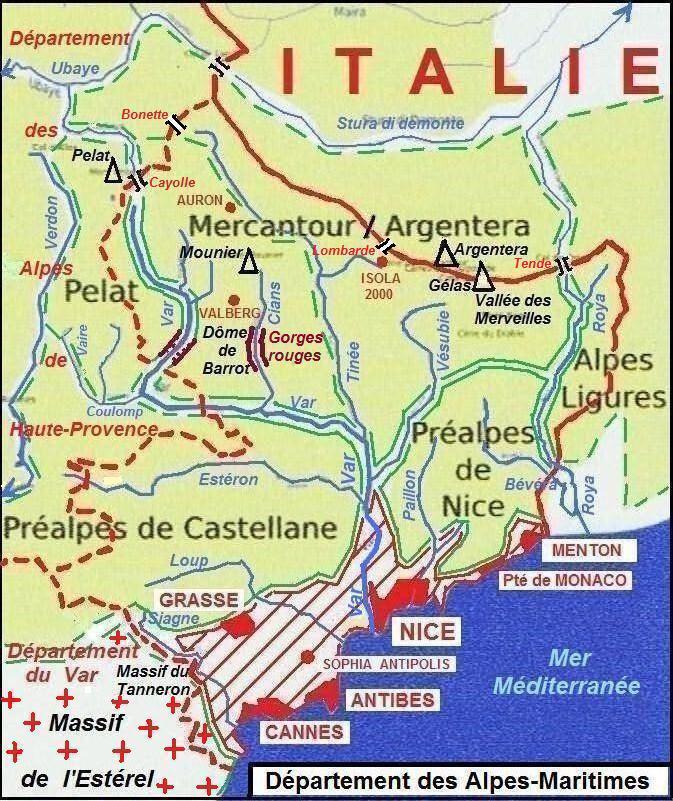
Its topography is very mixed. As its name suggests, most of the department is a constituent part of the overall topographic Alps – including the Maritime Alps – but it also has the distinction of being a coastal district with its Mediterranean coast. The coastal area, urbanized and densely populated (shaded in red on the map), includes all the cities in an almost continuous conurbation from Cannes to Menton, while the larger but sparsely populated mountainous area (light green) is fully rural with the exception of the three large resorts of Valberg (created in 1936), Auron (created in 1937) and Isola 2000 (created in 1971).
Summits and passes
The highest point of the department is the Cime du Gélas (3143 m) on the Franco-Italian border which dominates the Vallée des Merveilles further east. The summit of Monte Argentera is higher at 3297 m above sea level, but it is located in Italy. There is also Mount Mounier (2817 m), which dominates the south of the vast Dôme de Barrot, formed of a mass more than 900 m thick of red mudstones deeply indented by the gorges of Daluis and Cians. Except in winter, four passes allow passage to the north of the Mercantour-Argentera massif whose imposing 62 km barrier is covered in winter snow which is visible from the coast. From the west, the Route des Grandes Alpes enters the Cayolle Pass (2326 m) first on the way to the Alps and the sources of the Var in the commune of Entraunes. Then the route follows the Col de la Bonette – the highest pass in Europe at 2715 m – to connect to the valley of the Tinée then the Ubaye. Further east, the Col de la Lombarde (2350 m) above Isola 2000 allows access to the shrine of Saint-Anne de Vinadio in Italy. Finally, at its eastern end, the Col de Tende (1871 m) links with Cuneo in Italy.
Landscape and forest vegetation
The only region of the Alps close to Nice has an afforestation rate of 60.9%, slightly higher than the average of the department and well above the average of 39.4% for the Provence-Alpes-Côte d'Azur region.
The rivers in alphabetical order are:
- Aigue Blanche
- Barlatte
- Bassera
- Bendola
- Bévéra
- Borrigo
- Bourdous
- Bouyon
- Brague
- Braisse
- Braus
- Cagne
- Caramagne
- Carei
- Castérine
- Chalvagne
- Cians
- Cianavelle
- Clans
- Coulomb
- Estéron
- Faye
- Fontanalba
- Gorbio
- Gordolasque
- Guercha
- Lévensa or Levenza
- Loup
- Lubiane
- Maglia
- Magnan
- Malvan
- Mayola
- Minière
- Nieya
- Oglione
- Paillon (les Paillons)
- Raton
- Réfréi
- Riou
- Rioulan
- Roudoule
- Roya
- Siagne
- Tinée
- Tuébi
- Valmasque
- Var
- Vésubie
- Vionène
Climate
It is the climate that made the Côte d'Azur famous. The current department of Alpes-Maritimes, however, does not have only one climate, the complex terrain and high mountains divide the department between those who are well exposed (the south-facing side) and those which are less (the north-facing side) and even with the mild Mediterranean climate there can be violent storms and prolonged droughts.
The coastal area has a Mediterranean climate (rainfall in autumn November and spring February especially, summer drought, mild winter and dry summer). The interior, especially in the north, has a mountain climate (winter quite bright, summer storms). Around Cannes is a particularly warm micro-climate due to the high hills warming the air which descends on the city.
One of the attractions of the department is its level of sunshine: over 300 days per year. Despite this the department is also the most stormy of France with an average of 70 to 90 thunderstorm days per year, arising from the differences in temperature due to a warm sea in autumn.
As soon as one moves away from the coast, towards the west of the department, the interior plains (in particular near Grasse) the climate is a little less temperate but just as sunny. In summer, the temperature very easily exceeds 30 C, while the average is only 27 C along the Nice coast during July and August. Occasional frost is possible in the interior during winter, unlike in Nice and rest of the coast, where frost is very rare.
In the east of the department, unlike the west, there are no plains. In the Menton region, the altitude increases very rapidly inland, so the sea tempers the atmosphere much more: the maximum in summer is on average 25 C and the winters are milder than in the interior and frost is very rare.
Snow is also rare along the coast, however, it happens that rare snowfall surprises the Côte d'Azur residents (on average every 5–7 years), as was the case in the winter of 2004–2005 when the city of Nice woke up with a few centimetres of snow, often creating traffic problems. More recently, in February 2010, more than 10 cm of snow was measured in Cannes and nearly 30 cm in the Grasse region.
In the north of the department the climate in the Alps is mountainous, and there is decent snow cover from end of November until late April.
Subdivisions

Alpes-Maritimes is divided into two arrondissements: Grasse and Nice, twenty-seven cantons and 163 communes.
As of 1 January 2014, there were seven intercommunalities:
- Four agglomeration communities:
- Communauté d'agglomération de Sophia Antipolis
- Communauté d'agglomération Cannes Pays de Lérins
- Communauté d'agglomération du Pays de Grasse
- Communauté d'agglomération de la Riviera Française
- One metropolis:
- Métropole Nice Côte d'Azur.
Two communautés de communes:
Principal communes
The most populous commune is the prefecture Nice. As of 2019, there are 10 communes with more than 20,000 inhabitants:
| Commune | Population (2019) |
|---|---|
| Nice | 342,669 |
| Cannes | 74,545 |
| Antibes | 73,438 |
| Cagnes-sur-Mer | 52,178 |
| Grasse | 48,870 |
| Le Cannet | 41,887 |
| Menton | 30,525 |
| Saint-Laurent-du-Var | 29,169 |
| Vallauris | 27,364 |
| Mandelieu-la-Napoule | 21,998 |
History
The Roman military district of Alpes Maritimae was created by Augustus in 14 BC. It became a full Roman province in the middle of the 1st century AD, with its capital first at Cemenelum (today Cimiez, a suburb north of Nice) and subsequently at Embrun. At its greatest extent in AD 297, the province reached north to Digne and Briançon.
Conquered by the French First Republic during the French Revolutionary Wars, a department of Alpes-Maritimes was first set up in 1793 with different boundaries from those of the modern department. In 1793, Alpes-Maritimes included Monaco (Port Hercules), but not Grasse, which was then part of the department of Var as a historical part of France. In 1805, San Remo (San Rème) was included after the disbandment of the Ligurian Republic. In 1812, the department had three arrondissements with the following cantons:
- Nice, cantons: Nice (2 cantons), Aspremont, La Brigue, Menton, Monaco, Roquebillière, Saint-Sauveur-sur-Tinée, Saorge, L'Escarène, Sospel, Utelle and Villefranche-sur-Mer.
- Sanremo, cantons: Sanremo, Bordighera, Dolceacqua, Pigna, Taggia, Triora and Ventimiglia.
- Puget-Théniers, cantons: Puget-Théniers, Beuil, Gilette, Guillaumes, Roquestéron, Saint-Étienne-de-Tinée and Villars-sur-Var. The population of the department in 1812 was 131,266, and its area was 3226.74 km2, covering both present-day Arrondissement of Nice, Principality of Monaco and Province of Imperia.
In 1814, at the close of the Napoleonic Wars, the territory was restored to the Crown of Savoy by the Congress of Vienna.
In 1860 Camillo Benso, Count of Cavour, one of the architects of Italian unity with the Kingdom of Piedmont-Sardinia, negotiated support for Napoleon III in exchange for Savoy and the County of Nice as set forth in the Treaty of Turin. The annexation was confirmed on 15 and 16 April 1860 by 30,712 male electors enrolled in the 89 communes of the County of Nice who, for the first time, had universal male suffrage by plebiscite. The "Yes" vote for reunification with France was 83.8% of registered voters and 99.2% of votes.
The new department of Alpes-Maritimes consisted of the former County of Nice, divided into an Arrondissement of Nice and an Arrondissement of Puget-Théniers (both arrondissements existed in the former Department (1793–1814)), and a portion of the Var department, which formed the Arrondissement of Grasse. However, the County of Nice did not include Tende and La Brigue, which were still part of Piedmont-Sardinia.
For economic reasons, the Arrondissement of Puget-Théniers was merged into the Arrondissement of Nice in 1926. Since that time, the department has had two arrondissements.
In 1947, in accordance with the Treaty of Paris and as a referendum result favourable to their attachment to France, the communes of Tende and La Brigue (also parts of communes in the high valleys of Vésubie and Tinée: part the commune of Isola) which had not been ceded to France in 1860, were attached to the department.
Heraldry
Blazon:
Argent, an eagle crowned of gules displayed with wings inverted, on a mountain of three hillocks sable issuant from the pointed waves of a sea azure waved in argent.
Administration
Politics

Since the end of World War II, Alpes-Maritimes has generally voted to the right. It has nine constituencies for the National Assembly. Following the 2017 legislative election, six constituencies are represented by members of The Republicans (LR) right-wing party and three by members of the La République En Marche! (REM) centrist party. Of the five members of the Senate who represent the department in the upper house of Parliament, four are right-wing (LR) and one is left-wing (Socialist Party, PS). Of the 54 departmental councillors, 52 are aligned with the right-wing coalition and two are in the left-wing opposition.
In the 2022 French presidential election, Marine Le Pen of the National Rally won a plurality in Alpes-Maritimes in the first round; incumbent Emmanuel Macron of La République En Marche! won a majority in the second round.
In the 1980s and 1990s, Alpes-Maritimes experienced corruption problems with its politicians, which led to several criminal convictions, including those of Nice Mayor Jacques Médecin and Cannes Mayor Michel Mouillot, as well as that of Antibes Mayor Pierre Merli, criminally indicted in 1995 for a real estate scam and convicted four years later.
Departmental Council of Alpes-Maritimes
The President of the Departmental Council has been Charles-Ange Ginésy since 2017, who took office upon succeeding Éric Ciotti. Ciotti remained a councillor and became majority leader. Ginésy, who has been a councillor for the canton of Vence since 2015, has held a seat in the council since 2003. He also was Mayor of Péone (2001–2017) and the MP for Alpes-Maritimes's 2nd constituency (2005–2007; 2007–2008; 2009–2010; 2012–2017). Both are members of The Republicans (LR).
The coalition majority in the departmental council is one of the largest majorities in any such institution in France. Out of the 54 seats, only two are held by left-wing councillors, both elected in the canton of Grasse-2. In neighbouring Var, the right-wing coalition also holds all but two seats in the departmental council, although it is made up of fewer seats and the two councillors in opposition are members of the far-right National Rally (RN). Following the 2021 departmental election, the seats were allocated as follows in Alpes-Maritimes:
| Party | Seats | Union for a Popular Movement}}" | • | Miscellaneous Right}}" | • | Union of Democrats and Independents}}" | • | La République En Marche!}}" | • | Europe Ecology – The Greens}}" | Socialist Party (France)}}" | |||
|---|---|---|---|---|---|---|---|---|---|---|---|---|---|---|
| The Republicans | 45 | |||||||||||||
| Miscellaneous right | 5 | |||||||||||||
| Union of Democrats and Independents | 1 | |||||||||||||
| La République En Marche! | 1 | |||||||||||||
| Europe Ecology – The Greens | 1 | |||||||||||||
| Socialist Party | 1 |
Representation in Parliament
Members of the National Assembly
Alpes-Maritimes elected the following MPs to the National Assembly in the 2024 legislative election:
| Constituency | Member | Affiliation | |
|---|---|---|---|
| The Republicans (France)}}" | Alpes-Maritimes's 1st constituency | Éric Ciotti | |
| The Republicans (France)}}" | Alpes-Maritimes's 2nd constituency | Lionel Tivoli | |
| Horizons (political party)}};" | Alpes-Maritimes's 3rd constituency | Bernard Chaix | |
| National Rally}}" | Alpes-Maritimes's 4th constituency | Alexandra Masson | |
| The Republicans (France)}}" | Alpes-Maritimes's 5th constituency | Christelle d'Intorni | |
| National Rally}}" | Alpes-Maritimes's 6th constituency | Bryan Masson | |
| The Republicans (France)}}" | Alpes-Maritimes's 7th constituency | Éric Pauget | |
| The Republicans (France)}}" | Alpes-Maritimes's 8th constituency | Alexandra Martin | |
| The Republicans (France)}}" | Alpes-Maritimes's 9th constituency | Michèle Tabarot |
Senators
As of 2025, the department's five senators are Alexandra Borchio-Fontimp (LR, since 2020), Jean-Marc Delia (LR, since 2025), Patricia Demas (LR, since 2020), Dominique Estrosi Sassone (LR, since 2014) and Henri Leroy (LR, since 2017).
Budget
In 2011, the draft departmental budget amounted to €1.3 billion of which 498 million (38.3%) was devoted to social action and 346 million to operations (26.6%). Capital expenditures was just over 250 million euros (19.2%).
In 2010, the department was the third most indebted in France with €942 million of debt or 68.4% of the annual budget. This debt amounted to 2,460 euros per fiscal tax unit (household) and 859 euros per person. The trend of change in debt over the last decade has been a sharp increase: + 440% between 2001 and 2009 and 26% between 2009 and 2010. There was only €43 million in debt in 2003.
Projects
The Departmental Council of Alpes-Maritimes is currently sponsoring several large projects:
- construction of 10 residential facilities for the elderly
- building dykes in the Var plain
- creation of a STIC (science and information technology and communication) campus at Sophia Antipolis
- construction of 337 units of social housing
- establishment of facilities for the disabled
- road construction
- construction of schools and gyms (10)
- construction of a centre of sustainable development
- construction of the LGV Provence-Alpes-Côte d'Azur
- creation of the Eco Valley in the Plaine of the Var which will run from the Arenas Quarter (which will be converted) to the village of Baus-Roux
The Alpes-Maritimes Departmental Council has charged 1 euro per vehicle journey in the department, regardless of distance, since 1 January 2008.
Demographics
When Nice became part of France in 1860, it was still a small town; the department had fewer than 200,000 inhabitants. However, the population grew quickly from 300,000 at the beginning of the 20th century to over a million. The population is aging because of the number of retirees who move to the coast.
The population is now concentrated in the urban region that includes Antibes, Cannes, Grasse, Nice, and Menton, and which constitutes 90% of the total population.
The department had 1,083,310 inhabitants in 2017, making it the 20th most populated department in France. There are 163 communes including 107 under 2000 inhabitants (representing a total of 60,065 inhabitants), 38 from 2000 to 9999 inhabitants (total 171,935 inhabitants), 13 between 10,000 and 49,999 inhabitants (total 263,102 inhabitants), 4 between 50,000 and 199,999 inhabitants (Antibes, Cannes, Cagnes-sur-Mer and Grasse, total 248,191 inhabitants), and one with over 200,000 inhabitants (Nice, with 340,017 inhabitants). The population density was 252 inhabitants per square kilometre in 2017.
According to INSEE 39.5% of children born in 2011 in the department of Alpes-Maritimes have at least one parent born abroad (regardless of nationality), 15.4% have a father born in North Africa.
The area is also known for its extremely large population of people of Italian descent. About 40% of the population of the Alpes-Maritimes claim their ancestry as being solely Italian, and as many as 80% of the population can trace some degree of ancestry back to Italy before it was annexed by France in the 1860s.
Economy
The economy of the Alpes-Maritimes is characterized by the importance of the tertiary sector. The department has, in addition to tourism and traditional services, a relatively high level of corporate research and higher level of services. Agriculture is of little importance and industry plays a relatively small role although it has diversified into activities with high technological value. The construction and public works sector is quite important. The economy is very sensitive to changes in the national and international situation. The rate of unemployment is 9.1%.
According to the INSEE, in 2005 the GDP per capita of the Alpes-Maritimes was 27,723 euros which ranked it as the thirteenth highest department in France. GDP was 29.6 billion euros. According to Eurostat, GDP per capita at market prices in 2008, the department had a GDP per capita of 30,700 euros, which is also ranked it thirteenth in France.
Distribution of employment
| Services Sector | Industry | Construction & Public Works | Agriculture |
|---|---|---|---|
| Alpes-Maritimes | 76.2% | 12.5% | 9.2% |
| National Average | 71.5% | 18.3% | 6.1% |
Tourism is an essential industry for the entire coastal region (Côte d'Azur) and is highly developed. On the coast, thanks to the mild climate, towns are resort destinations all year round. In the mountains, there are winter sports stations that have received abundant snow in recent years, particularly Isola 2000.
There are also well-developed industries such as the perfume industry in Grasse, new technologies from Sophia-Antipolis, and the aerospace industry in Cannes-Mandelieu, where there is the first European satellite builders and the first industrial plant dedicated to spacecraft manufacturing.
Tourism
Seaside


The presence of the Mediterranean Sea and the French Alps under a mild sky has favoured one dominant activity: tourism, which accounts for 64,000 jobs directly in the Alpes-Maritimes. For only the city of Nice the tourism turnover represents a 12 to 13% share of the whole tourism market in France. The capital of the Côte d'Azur is the fifth most populous city in France. The city of Nice also has the second largest airport in France (Nice Côte d'Azur Airport), after Paris and its three airports at Roissy, Orly and Le Bourget. There are nearly 13.5 million passengers per year passing through Nice Airport.
The seaside where the majority of the population resides is one of the most popular parts of the world with many attractions:
- Seaside resorts (Théoule-sur-Mer, Mandelieu-la-Napoule, Cannes, Golfe-Juan, Juan-les-Pins, Antibes, Cagnes-sur-Mer, Nice, Villefranche-sur-Mer, Beaulieu-sur-Mer, Èze-sur-Mer, Cap d'Ail, Roquebrune-Cap-Martin and Menton)
- Convention cities that spread their business throughout the year are Cannes, with its Palais des Festivals, and Nice, with its Acropolis.
The area inland from the busy French Riviera is an excellent base for many outdoor sports: cycling, mountain biking, skiing, walking, rock climbing, canyoning, canoeing, rafting, fishing, horse riding, Adventure parks, caving and the area has the first ever underground via ferrata. The area has internationally renowned paragliding and hang gliding flying sites at Col-de-Bleyne, Gourdon, Gréolières and Lachens.
Mountainside

In the mountains, skiing and hiking bring life to Saint-Étienne-de-Tinée (Auron), Beuil, Péone (Valberg), Saint-Martin-Vésubie, Isola, Gréolières, Peïra-Cava, Col de Turini, and Turini-Camp d'argent in the Authion mountains.
Second homes
As of 2020, 25.3% of available housing in the department were second homes.
Education
Primary and secondary education
The department has 222 nursery schools, 357 primary schools and one special school. It also hosts 72 colleges, 14 vocational schools and 22 high schools, to which must be added 65 private schools.
Higher education
The University of Nice Sophia Antipolis, in Nice and neighbouring areas, was founded in 1965. In 2019 it was merged into the new Université Côte d'Azur.
Higher education is relatively underdeveloped in the department. The urban area of Nice has 35,000 students, while Rennes and Bordeaux each have 60,000.
A campus of the Paris Institute of Political Studies (Sciences Po) was established in Menton in October 2005. The Menton campus is dedicated to the relationship between the northern and southern shores of the Mediterranean and the relationship of Europe with the Middle East.
Several engineering schools are also located in Sophia Antipolis:
- Eurecom (School of Engineering and Research Center in communication systems)
- Mines ParisTech
- Polytech Nice Sophia
In addition, two major business schools are located in the region:
- EDHEC in Nice
- Skema Business School in Sophia Antipolis
There are the French Institute for Research in Computer Science and Automation (INRIA) and the French National Centre for Scientific Research (CNRS) in Sophia Antipolis.
References
Bibliography
- The Heritage of the Communes of Alpes-Maritimes in two volumes, Flohic Éditions, collective work, volume I, Cantons of Antibes to Levens, January 2000, Paris, 504 pages, , Jean-Luc Flohic .
- The Heritage of the Communes of Alpes-Maritimes in two volumes, Flohic Éditions, collective work, volume II, Cantons of Menton to Villefranche-sur-Mer, January 2000, Paris, 574 pages, , Jean-Luc Flohic, p. 505 to 1079 .
- Rural Architecture of Alpes-Maritimes, Édisud, Philippe de Beauchamp, 1992, Aix-en-Provence, 140 pages, , Photographer Loîc-Jahan .
- Religious Art in Alpes-Maritimes, Édisud, Philippe de Beauchamp, 4th Quarter 1993, Aix-en-Provence, 144 pages, , Photographer Loîc-Jahan .
References
- (4 May 2022). "Répertoire national des élus: les conseillers départementaux".
- [https://www.insee.fr/fr/statistiques/fichier/6011060/dep06.pdf Populations légales 2019: 06 Alpes-Maritimes], INSEE
- [https://www.france-montagnes.com/departement/alpes-maritimes France Montagne: Alpes-Maritimes] (in French).
- (2004). "Inventaire forestier départemental Alpes-Maritimes: IIIe inventaire 2002". [[Ministry of Agriculture (France).
- Huault, Christian. (16 April 2013). "L'intercommunalité en ordre de marche". [[Nice-Matin]].
- "Métropole NCA | Accueil".
- [http://gallica.bnf.fr/ark:/12148/bpt6k204214z/f364.image Almanach Impérial an bissextil MDCCCXII], p. 368, accessed in [[Gallica]] 24 July 2013 {{in lang. fr
- Table of Results pages 319 to 320 in ''La réunion de Nice à la France'' by Paul Gonnet, Les Éditions du Cabri, Breil-sur-Roya, 2003, 343 pages, {{ISBN. 9782914603102 {{in lang. fr
- (15 September 2017). "Charles-Ange Ginésy est le nouveau président du conseil départemental des Alpes-Maritimes".
- Nationale, Assemblée. "Assemblée nationale ~ Les députés, le vote de la loi, le Parlement français".
- [http://www.cg06.fr/fr/le-cg06/les-alpes-maritimes-institution/organisation-budgetaire/budget-2011/le-budget-2011/ Budget 2011], Official site of the General Council of Alpes-Maritimes. Consulted on 1 July 2011. {{in lang. fr
- [http://www.journaldunet.com/economie/magazine/dette-departement/dette-alpes-maritimes.shtml Alpes-Maritimes], Le Journal du Net. Consulted on 1 July 2011. {{in lang. fr
- ''Register of Competitivity'', 29 January 2009. {{in lang. fr
- "Historique des Alpes-Maritimes".
- "Évolution et structure de la population en 2016". INSEE.
- [https://www.insee.fr/fr/statistiques/fichier/4265429/ensemble.pdf Téléchargement du fichier d'ensemble des populations légales en 2017], [[Institut national de la statistique et des études économiques. INSEE]]
- fr
- The Alpes-Maritimes, much like the rest of the PACA region, is markedly more religious than the rest of France
- fr
- fr
- [http://www.journaldunet.com/economie/les-dix/entreprises-leaders/alcatel.shtml 10 French Companies who are World Champions: Alcatel Alenia Space], Le Journal du Net {{in lang. fr
- [http://www.apotheloz.com/articles-enquete/2002_03_alcatel-space.htm Christian Apothéloz, ''Alcatel space at Cannes, More than an entreprise, a legend''], in The New Economist, March 2002
- fr
- [http://www.agglo-nice.fr/chiffres-cles-atouts-territoire.htm Métropole Nice Côte d'Azur – A territory of international excellence] {{Webarchive. link. (24 February 2009 , Official site of the Urban Community of Nice-Côte d'Azur. Consulted on 26 September 2008. {{in lang). fr
This article was imported from Wikipedia and is available under the Creative Commons Attribution-ShareAlike 4.0 License. Content has been adapted to SurfDoc format. Original contributors can be found on the article history page.
Ask Mako anything about Alpes-Maritimes — get instant answers, deeper analysis, and related topics.
Research with MakoFree with your Surf account
Create a free account to save articles, ask Mako questions, and organize your research.
Sign up freeThis content may have been generated or modified by AI. CloudSurf Software LLC is not responsible for the accuracy, completeness, or reliability of AI-generated content. Always verify important information from primary sources.
Report