From Surf Wiki (app.surf) — the open knowledge base
Aloha shirt
Loose-fitting short-sleeve shirts of brightly colored fabric in tropical prints

Loose-fitting short-sleeve shirts of brightly colored fabric in tropical prints
The aloha shirt (),Via
also referred to as a Hawaiian shirt, is a style of dress shirt originating in Hawaii. They are collared and buttoned dress shirts, usually short-sleeved and made from printed fabric. They are traditionally worn untucked, but can be worn tucked into the waist of trousers. They are worn casually or as informal business attire in Hawaii.
"Aloha Friday", or Casual Friday, a now-common tradition of celebrating the end of the workweek by wearing more casual attire on Fridays, initially grew out of an effort to promote aloha shirts.
Design
Aloha dress shirts are printed, mostly short-sleeved, and collared. They almost always have buttons, sometimes for the entire length of the shirt or at least up to the chest. They usually have a left chest pocket sewn in, often with attention to ensure the printed pattern remains continuous. Aloha shirts may be worn by men or women. Women's aloha shirts usually have a lower-cut, v-neck style.
The lower hems are straight, and the shirts are often worn with the shirt-tails hanging out, rather than tucked in. Wearing an untucked shirt was possibly influenced by the local Filipinos who wore shirt-tail out, and called these tl meaning "friend". Wearing it untucked or tucked depends on personal taste; it carries the same connotations of tucking or untucking a polo shirt. In the 1950s, the shirt became allowed as business attire for aloha week, but only if worn tucked in.
Traditional men's aloha shirts are usually adorned with traditional Hawaiian quilt designs, tapa designs, and simple floral patterns in more muted colors. Contemporary aloha shirts may have prints that do not feature any traditional Hawaiian quilt or floral designs but instead may incorporate drinks, palm trees, surf boards or other island tropical elements in a similar form as the traditional aloha shirt.
It has been observed that locals (kamaʻāina) tended to shy away from the garishness of aloha shirts as "too wild" when they first appeared, whereas tourists embraced wearing designs of many bright colors. An example of the type of shirt the locals may prefer includes the "reverse print"; these shirts are often printed on the interior, resulting in the muted color on the exterior.
History

According to some sources, the origin of aloha shirts can be traced to the 1920s or the early 1930s, It has also been contended that the aloha shirt was devised in the early 1930s by Chinese merchant Ellery Chun of "King-Smith Clothiers and Dry Goods", a store in Waikiki. Although this claim has been described as a myth reinforced by repeated telling, Chun may have been the first to mass-produce or to maintain the ready-to-wear in stock to be sold off the shelf.
The name "aloha shirt" appeared later. By 1935 and 1936, the word aloha was being attached to various sorts of Hawaiian products, so calling the garments "aloha shirts" was hardly original. The term aloha shirt first appeared in print in an advertisement for Musa-Shiya in the June 28, 1935 issue of The Honolulu Advertiser newspaper. However, Ellery Chun is sometimes credited for coining the term, perhaps in 1933; Chun's store reportedly carried window signs that said "aloha shirts". The term "aloha sportswear" was registered as a trademark by Chun's company in 1936, followed by Chun trademarking "Aloha Shirt" in 1937 and owning the rights to this appellation for the next 20 years.
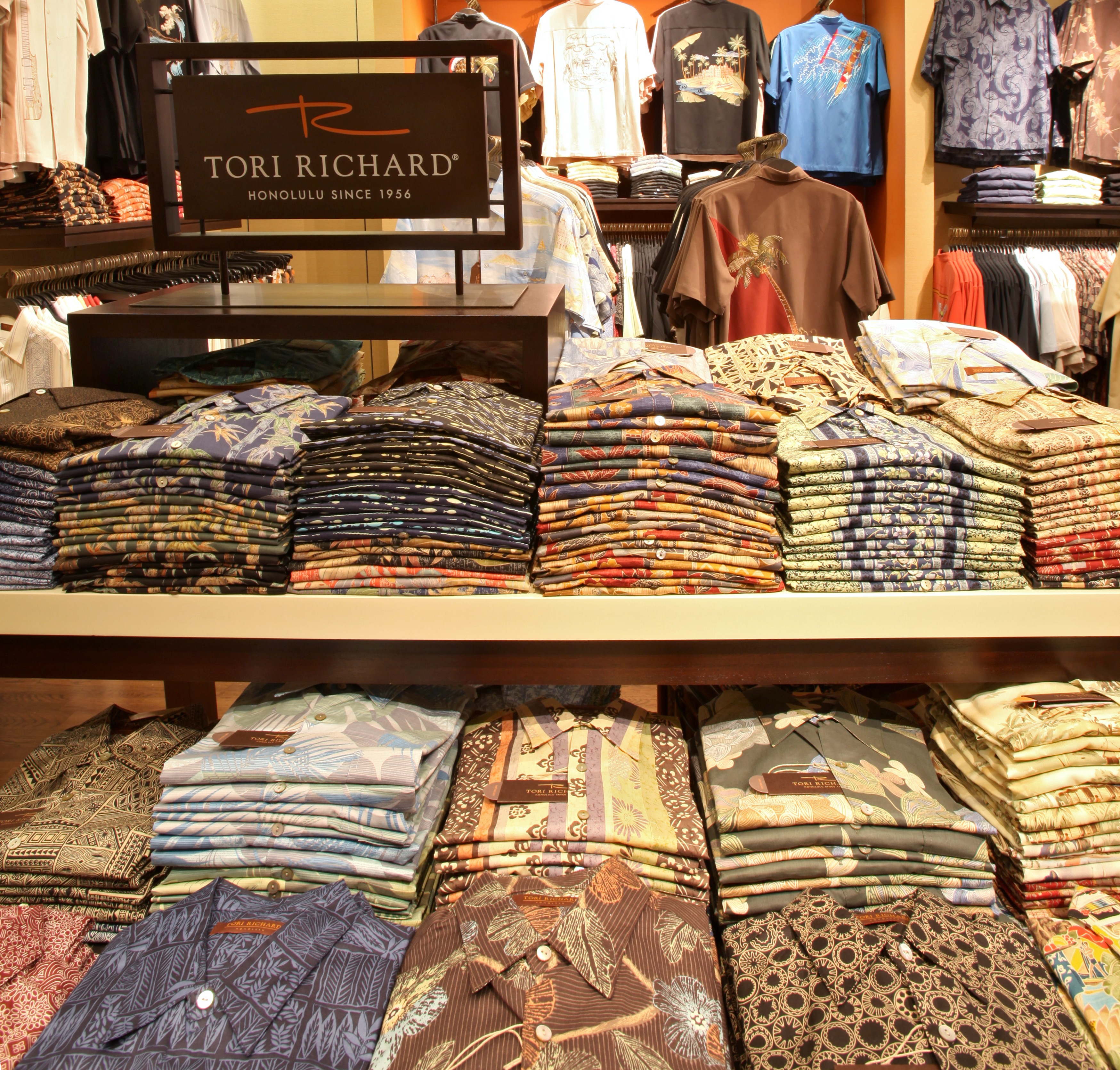
Within years, major designer labels sprang up all over Hawaii and began manufacturing and selling aloha shirts en masse. By the end of the 1930s, 450 people were employed in an industry worth $600,000 annually. Two notable manufacturers of this period are Kamehameha and Branfleet (later Kahala), both founded in 1936. Retail chains in Hawaii, including some based on the mainland, may mass-produce a single aloha shirt design for employee uniforms.
After World War II, many servicemen and servicewomen returned to the United States from Asia and the Pacific islands with aloha shirts made in Hawaii since the 1930s. Spooner's of Waikiki, precursor of Reyn Spooner, also established business in 1956.
Exports
Garments manufactured in Hawaii could bear "Made in Hawaii" labels before statehood (1959), and even afterwards, their sales to mainland United States continued to be referred to as "exports".
Aloha shirts tend to be referred to as "Hawaiian shirts" by the populace from the mainland United States, and are often brilliantly colored with floral patterns or generic Polynesian motifs.
The aloha shirt is currently the premier textile export of the Hawaii manufacturing industry.
Aloha dress codes
Aloha Week
.jpg)
In 1946, the Honolulu Chamber of Commerce funded a study of aloha shirts and designs for comfortable business clothing worn during the hot Hawaiian summers. The City and County of Honolulu passed a resolution allowing their employees to wear sport shirts from June–October. City employees were not allowed to wear aloha shirts for business until the creation of the Aloha Week festival in 1947. The Aloha Week festival was motivated by both cultural and economic concerns: First held at Ala Moana Park in October, the festival revived interest in ancient Hawaiian music, dancing, sports, and traditions. There was a holoku ball, a floral parade, and a makahiki festival attended by 8,000 people. Economically, the week-long event first attracted visitors during October – traditionally a slow month for tourism – which benefited the Hawaiian fashion industry as they supplied the muumuu and aloha shirts worn for the celebration. Aloha Week expanded in 1974 to six islands, and was lengthened to a month. In 1991, Aloha Week was renamed to Aloha Festivals.
In the end, Aloha Week had a direct influence on the resulting demand for alohawear, and was responsible for supporting local clothing manufacturing: locals needed the clothing for the festivals, and soon people in Hawaii began wearing the clothing in greater numbers on more of a daily basis. Hawaii's fashion industry was relieved, as they were initially worried that popular clothing from the mainland United States would eventually replace aloha attire.
Aloha Friday
In 1962, a professional manufacturing association known as the Hawaiian Fashion Guild began to promote aloha shirts and clothing for use in the workplace, particularly as business attire. In a campaign called "Operation Liberation", the Guild distributed two aloha shirts to every member of the Hawaii House of Representatives and the Hawaii Senate. Subsequently, a resolution passed in the Senate recommending aloha attire be worn throughout the summer, beginning on Lei Day. The wording of the resolution spoke of letting "the male populace return to 'aloha attire' during the summer months for the sake of comfort and in support of the 50th state's garment industry".
In 1965, Bill Foster Sr., president of the Hawaii Fashion Guild, led the organization in a campaign lobbying for "Aloha Friday", a day employers would allow men to wear aloha shirts on the last business day of the week a few months out of the year. Aloha Friday officially began in 1966, and young adults of the 1960s embraced the style, replacing the formal business wear favored by previous generations. By 1970, aloha wear had gained acceptance in Hawaii as business attire for any day of the week. Unlike the court dress required in most jurisdictions, attorneys in Hawaii may be allowed to wear aloha shirts in court, though this varies among individual courts.
Hawaii's custom of Aloha Friday slowly spread east to California, continuing around the globe until the 1990s, when it became known as Casual Friday. Today in Hawaii, alohawear is worn as business attire for any day of the week, the phrase was used by Kimo Kahoano and Paul Natto in their 1982 song, "It's Aloha Friday, No Work 'til Monday", heard every Friday on Hawaii radio stations across the state.
Aloha attire
The related concept of "aloha attire" stems from the aloha shirt. Semi-formal functions such as weddings, birthday parties, and dinners are often designated as "aloha attire", meaning that men wear aloha shirts and women wear muumuu or other tropical prints. Because Hawaii tends to be more casual, it is rarely appropriate to attend such functions in full evening wear like on the mainland; instead, aloha attire is seen as a happy medium between excessive formality and casual wear (i.e., business casual).
Notes
References
References
- (March 2007). "Aloha Friday".
- "Tapa_making".
- Japanese print]]s (especially [[kasuri]]).{{Refn. Musa-Shiya was established by [[Japanese in Hawaii. Japanese immigrant]] {{nihongo. Chōtarō Miyamoto. 宮本長太郎 in 1904. After Miyamoto's death in 1915, the shop was renamed "Musa-Shiya Shoten" (Japanese title: 武蔵屋呉服店 (Musashi-ya-gofukuten) by his son {{nihongo. Kōichirō Miyamoto. Furer. 1983. Hope. Tozian. 2000. Hughes. 2017
- Martin, Douglas. (8 June 2000). "Ellery Chun, 91, Popularizer of the Shirt That Won Hawaii". [[The New York Times]].
- (23 February 2018). "The Origins and Appropriations of the Aloha Shirt". [[Vox Media]].
- (1998). "Tori Richard".
- Miller-Davenport, Sarah. (2019). "Gateway State: Hawai{{okina}}i and the Cultural Transformation of American Empire". Princeton University Press.
- (2006). "A Cultural Showcase of Hawaii". Hawaii Tourism Authority.
- (8 June 2006). "'Wear Aloha' Exhibit Opens At Honolulu Hale".
- (January 19, 2011). "AHFI Insights : What Not to Wear — Hawai{{okina}}i Lawyers Edition". www.hawaiilitigation.com.
- Loomis, Susan Herrmann. (16 October 1988). "Shopper's World; Hawaii's Short-Sleeve Plumage". [[The New York Times]].
- Dale Hope: ''The Aloha Shirt'' with a different year of introduction.{{when. (August 2019)
- Fujii, Jocelyn K.. (2006). "Tori Richard: The First Fifty Years". TR Press.
- Brown, J. J.. (September 9, 2007). "Did you ever wonder?". [[The Gazette (Colorado Springs).
- (2004). "The Pacific Region". [[Greenwood Publishing]].
- Hendrickson, Robert. (2001). "The Art of the Aloha Shirt". [[John Wiley & Sons, Inc.]].
- (2002). "Distinguished Asian American Business Leaders". Island Heritage Publishing.
- Musa-Shiya Shoten, Ltd.. (28 June 1935). "'Aloha' Shirts ― well tailored, beautiful designs and radiant colors (advertisement)". Honolulu Advertiser.
- Ronck, Ronn. (2 April 1987). "Print that Aloha Shirt". Honolulu Advertiser.
- Hoover, Will. (11 July 2000). "Aloha Shirts Unplugged: Unraveling Some Rumors and Fabrication". Honolulu Advertiser.
- Gordon, Mike. (2 July 2006). "Aloha shirts". Honolulu Advertiser.
- (2012). "Aroha shatsu to nihonjin imin no rekishi". [[Japan International Cooperation Agency]].
- (23 July 2010). "Hawaiian Style: The Roots of the Aloha Shirt Interview with Linda Arthur". The Collectors Weekly.
- Noland, Claire. (2009-01-04). "Alfred Shaheen, garment industry pioneer, dies at 86". [[Los Angeles Times]].
- Padilla, Max. (2010-06-20). "Reyn Spooner's new wave of Hawaiian shirts". [[Los Angeles Times]].
- Schmitt, Robert C.. (1980). "Some Firsts in Island Business and Government". Hawaiian Historical Society.
- Smith, Ray A.. (June 7, 2012). "When Designers Meddle With Hawaiian Shirts". [[The Wall Street Journal]].
- Christian, Scott. (March 30, 2017). "The Men's Shirt That Will Get You Noticed". [[The Wall Street Journal]].
This article was imported from Wikipedia and is available under the Creative Commons Attribution-ShareAlike 4.0 License. Content has been adapted to SurfDoc format. Original contributors can be found on the article history page.
Ask Mako anything about Aloha shirt — get instant answers, deeper analysis, and related topics.
Research with MakoFree with your Surf account
Create a free account to save articles, ask Mako questions, and organize your research.
Sign up freeThis content may have been generated or modified by AI. CloudSurf Software LLC is not responsible for the accuracy, completeness, or reliability of AI-generated content. Always verify important information from primary sources.
Report