From Surf Wiki (app.surf) — the open knowledge base
Aloe vera
Species of plant
Species of plant
- Aloe barbadensis var. chinensis Haw.
- Aloe chinensis (Haw.) Baker
- Aloe elongata Murray
- Aloe flava Pers.
- Aloe indica Royle
- Aloe lanzae Tod.
- Aloe maculata Forssk. (illegitimate)
- Aloe perfoliata var. vera L.
- Aloe rubescens DC.
- Aloe variegata Forssk. (illegitimate)
- Aloe vera Mill. (illegitimate)
- Aloe vera var. chinensis (Haw.) A. Berger
- Aloe vera var. lanzae Baker
- Aloe vera var. littoralis J.Koenig ex Baker
- Aloe vulgaris Lam.
Aloe vera () is a succulent plant species of the genus Aloe. It is widely distributed, and is considered an invasive species in many world regions.
An evergreen perennial, it originates from the Arabian Peninsula, but also grows wild in tropical, semi-tropical, and arid climates around the world.
The leaves of Aloe vera contain significant amounts of the polysaccharide gel acemannan, which can be used for topical purposes. The leaves also contain aloin, which is a toxic compound. Aloe vera products are typically made from the gel.
Aloe vera acemannan may be used in skin lotions, cosmetics, ointments and gels for minor burns, skin abrasions, insect bites, and windburn.
Oral ingestion of aloe vera extracts may cause acute abdominal pain and cramps, and hepatitis if consumed chronically.
Etymology
The genus name Aloe is derived from the Arabic word alloeh, meaning "bitter and shiny substance" or from Hebrew אוהלים ahalim, plural of אוהל ahal. The specific epithet vera comes from verus meaning "true" in Latin.
Common names
Common names use aloe with a region of its distribution, such as Chinese aloe, Cape aloe or Barbados aloe.
Taxonomy
The species has several synonyms: Aloe barbadensis Mill., Aloe indica Royle, Aloe perfoliata L. var. vera and Aloe vulgaris Lam. Some literature identifies the white-spotted form of Aloe vera as Aloe vera var. chinensis; and the spotted form of Aloe vera may be conspecific with A. massawana. The species was first described by Carl Linnaeus in 1753 as Aloe perfoliata var. vera, and was described again in 1768 by Nicolaas Laurens Burman as Aloe vera in Flora Indica on 6 April and by Philip Miller as Aloe barbadensis some ten days after Burman in the Gardener's Dictionary.
Techniques based on DNA comparison suggest Aloe vera is relatively closely related to Aloe perryi, a species endemic to Yemen. Similar techniques, using chloroplast DNA sequence comparison and inter simple sequence repeat profiling have also suggested it is closely related to Aloe forbesii, Aloe inermis, Aloe scobinifolia, Aloe sinkatana, and Aloe striata. With the exception of the South African species A. striata, these Aloe species are native to Socotra (Yemen), Somalia, and Sudan. The lack of obvious natural populations of the species has led some authors to suggest Aloe vera may be of hybrid origin.
Description
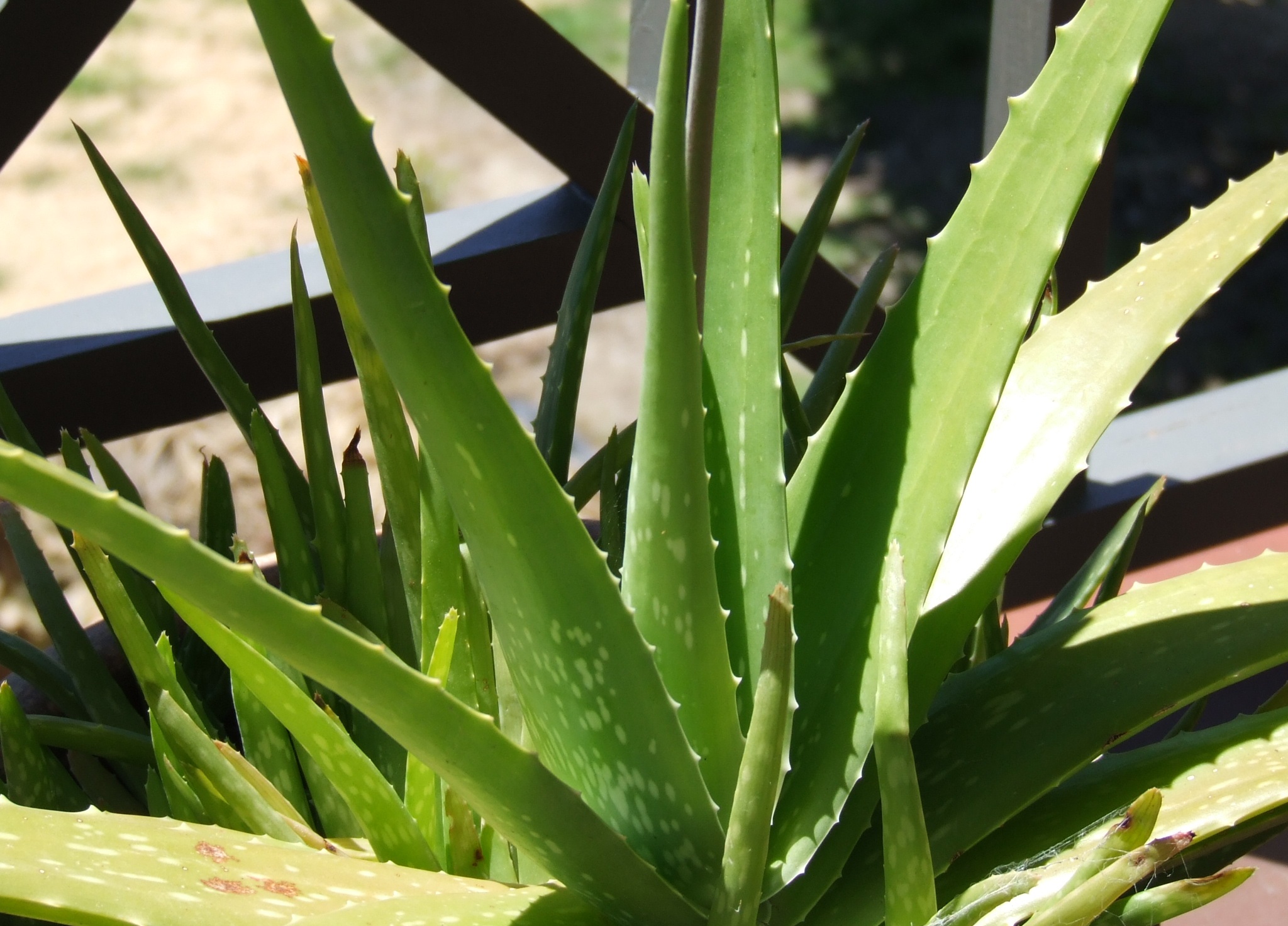

Aloe vera is a stemless or very short-stemmed plant growing to 60-100 cm tall, spreading by offsets.
Leaves
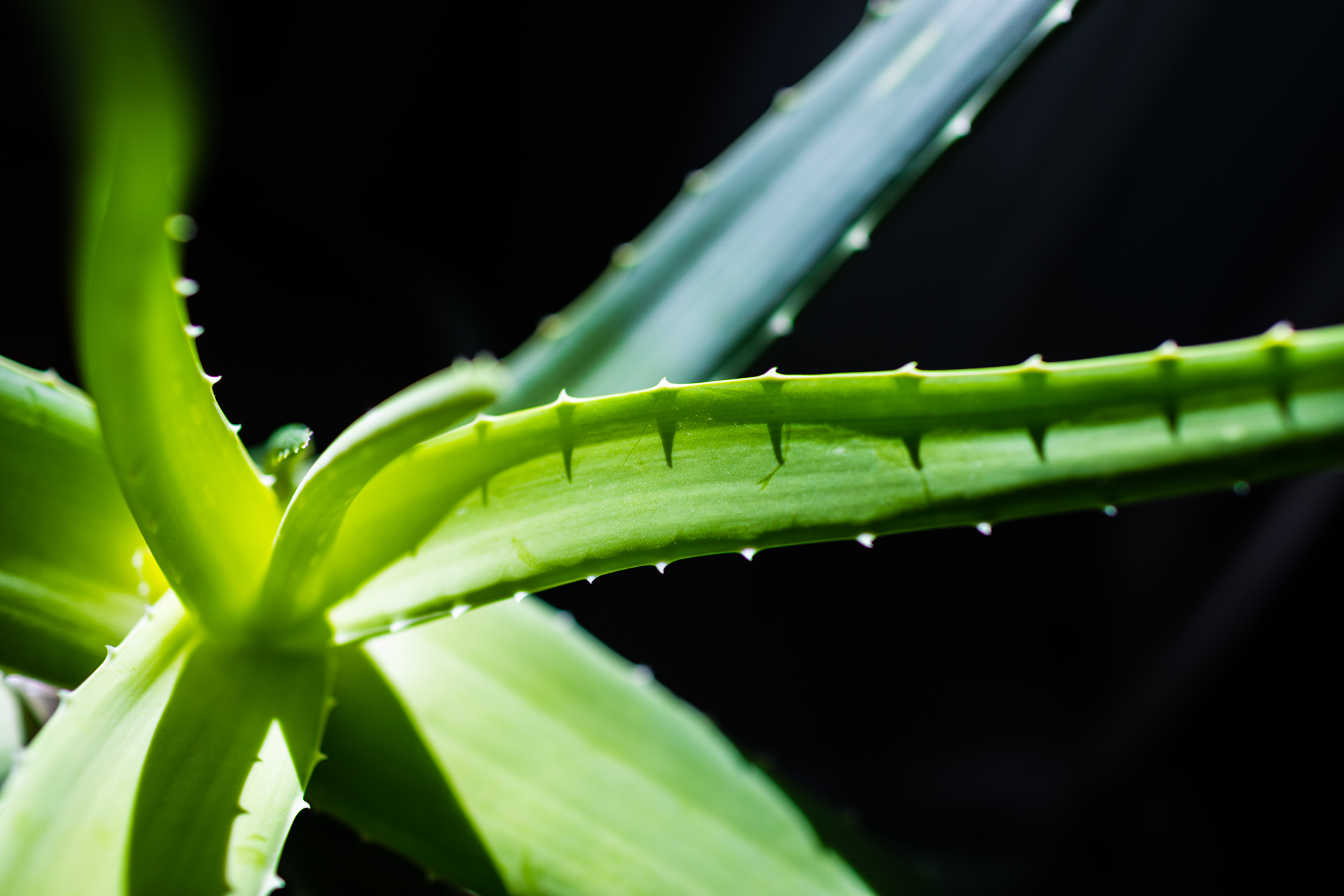
The leaves are thick and fleshy, green to grey-green, with some varieties showing white flecks on their upper and lower stem surfaces. The margin of the leaf is serrated and has small white teeth.
Aloe vera leaves contain phytochemicals under study for possible bioactivity, such as lignans, phytosterols, polyphenols, acetylated mannans, polymannans, anthraquinones C-glycosides, anthrones, and other anthraquinones, such as emodin and various lectins.
Flowers
The flowers are produced in summer on a spike up to 90 cm tall, each flower being pendulous, with a yellow tubular corolla 2-3 cm long.
Roots
Like other Aloe species, Aloe vera forms arbuscular mycorrhiza, a root symbiosis that allows the plant better access to mineral nutrients from the soil.
Distribution
Aloe vera is considered to be native to the south-east Arabian Peninsula in the Hajar Mountains in north-eastern Oman and eastern U.A.E. However, it has been widely cultivated around the world, and has become naturalized in North Africa, as well as Sudan and neighboring countries, along with the Canary Islands, Cape Verde, and Madeira Islands. It has also naturalized in the Algarve region of Portugal, and in wild areas across Spain, especially in the region of Murcia.
The species was introduced to China and various parts of southern Europe in the 17th century. It is widely naturalized elsewhere, occurring in arid, temperate, and tropical regions of temperate continents. The current distribution may be the result of cultivation.
Cultivation
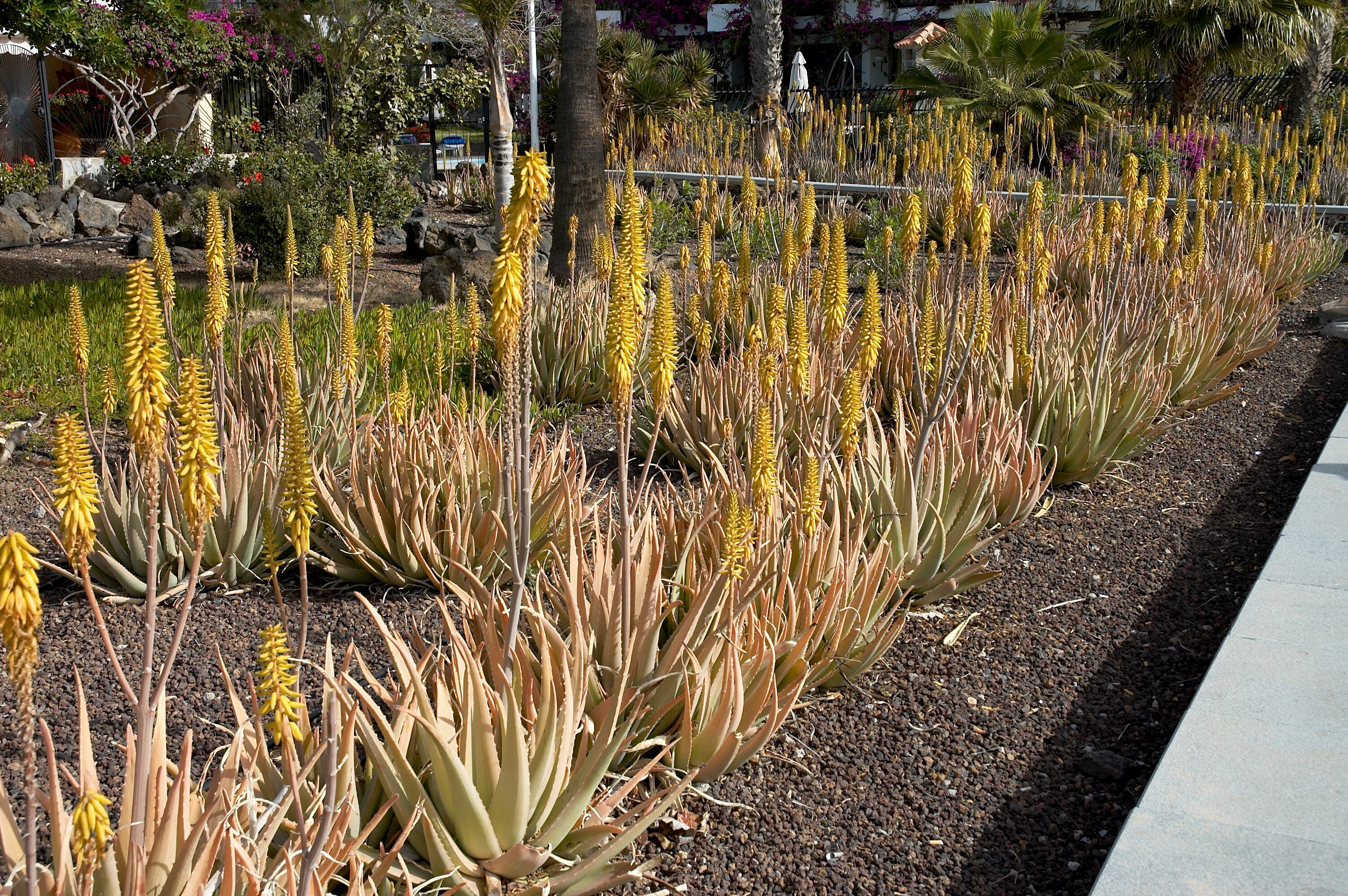

Aloe vera has been widely grown as an ornamental plant. The species is popular with modern gardeners as a topical medicinal plant The species is relatively resistant to most insect pests, though spider mites, mealy bugs, scale insects, and aphid species may cause a decline in plant health. This plant has gained the Royal Horticultural Society's Award of Garden Merit.
In pots, the species requires well-drained, sandy potting soil, and bright, sunny conditions. Aloe plants can turn red from sunburn under too much direct sun, though gradual acclimation may help. The use of a good-quality commercial propagation mix or packaged "cacti and succulent mix" is recommended, as they allow good drainage. Terra cotta pots are preferable as they are porous. Potted plants should be allowed to completely dry before rewatering. When potted, aloes can become crowded with "pups" growing from the sides of the "mother plant". Plants that have become crowded can be divided and repotted to allow room for further growth, or the pups can be left with the mother plant. During winter, Aloe vera may become dormant, during which little moisture is required. In areas that receive frost or snow, the species is best kept indoors or in heated glasshouses.
There is large-scale agricultural production of Aloe vera in Australia, Cuba, the Dominican Republic, China, Mexico, India, Jamaica, Kenya, Tanzania, South Africa, Spain, and the United States, with much of the output going toward the cosmetics industry.
Uses
Two substances from Aloe vera – a clear gel and its yellow latex – are used to manufacture commercial products.
There is conflicting evidence regarding whether Aloe vera is effective as a treatment for wounds or burns. There is some evidence that topical use of aloe products might relieve symptoms of certain skin disorders, such as psoriasis, acne, or rashes, but topical application may cause an allergic reaction in some people.
Aloe vera gel is used commercially as an ingredient in yogurts, beverages, and some desserts, but at high or prolonged doses, ingesting aloe latex or whole leaf extract can be toxic. Use of topical aloe vera in small amounts is likely to be safe.
Topical medication and potential side effects
Aloe vera may be prepared as a lotion, gel, soap or cosmetics product for use on skin as a topical medication. For people with allergies to Aloe vera, skin reactions may include contact dermatitis with mild redness and itching, difficulty with breathing, or swelling of the face, lips, tongue, or throat.
Dietary supplement

Aloin, a bitter-tasting compound found in the semi-liquid latex of some Aloe species, was a common ingredient in over-the-counter (OTC) laxative products in the United States until 2002 when the Food and Drug Administration banned it because manufacturers failed to provide the necessary safety data.
Aloe vera and its (alcohol) extracts have potential toxicity, with side effects occurring at some dose levels both when ingested and when applied topically. Chronic ingestion of aloe (dose of 1 gram per day) cause adverse effects, including hematuria, weight loss, and cardiac or kidney disorders.
Aloe vera juice is marketed to support the health of the digestive system, but there is neither scientific evidence nor regulatory approval for this claim. The extracts and quantities typically used for such purposes are associated with toxicity in a dose-dependent way.
Traditional medicine
Aloe vera is used in traditional medicine as a skin treatment. Early records of its use appear from the fourth millennium BCE.
Commodities
Aloe vera is used on facial tissues where it is promoted as a moisturizer and anti-irritant to reduce chafing of the nose. Cosmetic companies commonly add sap or other derivatives from Aloe vera to products such as makeup, tissues, moisturizers, soaps, sunscreens, incense, shaving cream, or shampoos. A review of academic literature notes that its inclusion in many hygiene products is due to its "moisturizing emollient effect". The cosmetic industry limits the anthraquinone content of aloe extracts to 50 ppm.
Toxicity
Orally ingested non-decolorized aloe vera leaf extract was listed by the California Office of Environmental Health Hazard Assessment among "chemicals known to the state to cause cancer or reproductive toxicity", possibly resulting from the anthraquinones.
Since 2016, aloe vera whole leaf extract is classified as a possible human carcinogen (group 2B) by the International Agency for Research on Cancer.
Use of aloe vera on the skin is generally not associated with significant side effects. Oral ingestion of aloe vera is potentially toxic, and may cause abdominal cramps and diarrhea which in turn can decrease the absorption of drugs.
Interactions with prescribed drugs
Ingested aloe products may have adverse interactions with prescription drugs, such as those used to treat blood clots, diabetes, heart disease and potassium-lowering agents (such as Digoxin), and diuretics, among others.
Gallery
File:Aloe vera leaf showing the gel (1).JPG|Leaf and inner gel File:Aloe vera gel.jpg|Gel used for desserts File:Es Lidah Buaya.JPG|Es lidah buaya, an Indonesian Aloe vera iced drink File:Gelaloevera.JPG|Juice File:Cut Aloe Vera Leaf.jpg|Cut leaf File:Aloe vera cut leaf drawing1.jpg|Diagram of leaf: 1 Cuticle, 2 Chloroplast parenchym, 3 Inner tissue, 4 Vascular bundles File:Aloe Vera Buds.jpg|Buds File:Aloe Vera flower.jpg|Flower buds File:Aloe vera flower 2.jpg|Flowers File:AloeBluhendD2.JPG|Plants of different sizes File:A potted aloe vera plant.jpg|A potted plant File:Aloe plant bud.jpg|Basal shoots (root sprouts)
References
References
- [http://www.tropicos.org/Name/18403421?tab=synonyms Aloe vera (L.) Burm. f.] Tropicos.org
- (2022). "''Aloe vera'' L. Burm.f. Fl. Indica : 83 (1768)". World flora Consortium.
- {{cite Dictionary.com. aloe vera
- (13 February 2019). "Aloe vera (true aloe)". [[Centre for Agriculture and Bioscience International]].
- Perkins, Cyndi. (13 March 2013). "Is Aloe a tropical plant?".
- (2019-04-19). "Extraction, Purification, Structural Characteristics, Biological Activities and Pharmacological Applications of Acemannan, a Polysaccharide from Aloe vera: A Review". Molecules.
- (2008). "Aloe vera: A short review". Indian Journal of Dermatology.
- (30 December 2020). "Aloe". Drugs.com.
- (1 October 2020). "Aloe vera". National Center for Complementary and Integrative Health, US National Institutes of Health.
- (2021). "Aloe". Online Etymology Dictionary.
- (2 April 2016). "Aloe vera: A review of toxicity and adverse clinical effects". J Environ Sci Health C Environ Carcinog Ecotoxicol Rev.
- (16 March 2008). "aloe".
- (1879). "vērus". Perseus Digital Library.
- "''Aloe vera'', African flowering plants database". Conservatoire et Jardin botaniques de la Ville de Genève.
- "Taxon: Aloe vera (L.) Burm. f.". Germplasm Resources Information Network, United States Department of Agriculture..
- (2004). "[Determination of aloin content in callus of Aloe vera var. chinensis]". Zhong Yao Cai.
- (1997). "[Peroxidase and soluble protein in the leaves of Aloe vera L. var. chinensis (Haw.)Berger]". Zhongguo Zhong Yao Za Zhi.
- Lyons G. "The Definitive ''Aloe vera'', vera?". Huntington Botanic Gardens.
- Linnaeus, C. (1753). ''Species plantarum, exhibentes plantas rite cognitas, ad genera relatas, cum differentiis specificis, nominibus trivialibus, synonymis selectis, locis natalibus, secundum systema sexuale digestas.'' Vol. 2 pp. [i], 561–1200, [1–30, index], [i, err.]. Holmiae [Stockholm]: Impensis Laurentii Salvii.
- (1979). "In defense of the name ''Aloe vera''". The Cactus and Succulent Journal of Great Britain.
- (2003). "Molecular assessment of germplasm diversity in ''Aloe'' spp. using RAPD and AFLP analysis". J. Med. Arom. Plant Sci..
- (2003). "Phylogenetic relationships in Asphodelaceae (Alooideae) inferred from chloroplast DNA sequences (rbcl, matK) and from genomic finger-printing (ISSR)". Taxon.
- Jones WD, Sacamano C. (2000) ''Landscape Plants for Dry Regions: More Than 600 Species from Around the World''. California Bill's Automotive Publishers. USA.
- Yates A. (2002) ''Yates Garden Guide''. Harper Collins Australia
- (2004). "Aloe vera: a valuable ingredient for the food, pharmaceutical and cosmetic industries—a review". Critical Reviews in Food Science and Nutrition.
- (2001). "Botanica's Pocket Gardening Encyclopedia for Australian Gardeners". Random House Publishers.
- (2002). "[Study on application of arbuscular-mycorrhizas in growing seedings of Aloe vera]". Zhong Yao Cai.
- "World Checklist of Selected Plant Families: Royal Botanic Gardens, Kew".
- "''Aloe vera''". [[Royal Botanic Gardens, Kew]].
- Domingues de Almeida, J & Freitas. (2006). "Exotic naturalized flora of continental Portugal – A reassessment". core.ac.uk.
- Gideon F Smith, Estrela Figueiredo. (2009). "Aloe arborescens Mill. and Aloe Vera spreading in Portugal". bioone.
- (9 April 2015). "Aloe Vera Cultivation in Murcia".
- Farooqi, A. A. and Sreeramu, B. S. (2001) ''Cultivation of Medicinal and Aromatic Crops''. Orient Longman, India. {{ISBN. 8173712514. p. 25.
- [http://www.efloras.org/florataxon.aspx?flora_id=1&taxon_id=200027555 "Aloe vera (Linnaeus) Burman f., Fl. Indica. 83. 1768."] in ''Flora of North America'' Vol. 26, p. 411
- "BBC Gardening, ''Aloe vera''". British Broadcasting Corporation.
- "Pest Alert: ''Aloe vera'' aphid ''Aloephagus myersi'' Essi.". [[Florida Department of Agriculture and Consumer Services]].
- "Kemper Center for Home Gardening: ''Aloe vera''". Missouri Botanic Gardens, USA.
- "RHS Plant Selector ''Aloe vera'' AGM / RHS Gardening". Apps.rhs.org.uk.
- (2017). "How Not to Kill Your Houseplant". DK Penguin Random House.
- Coleby-Williams, J. (21 June 2008). "Fact Sheet: ''Aloes''". Gardening Australia, Australian Broadcasting Corporation.
- (6 December 2005). "''Aloe vera'' producer signs $3m China deal". Australian Broadcasting Corporation.
- (7 July 2006). "Korea interested in Dominican 'aloe vera'". DominicanToday.com—The Dominican Republic News Source in English.
- Varma, Vaibhav. (11 December 2005). "India experiments with farming medicinal plants". channelnewsasia.com.
- "Harnessing the potential of our aloe". Jamaica Gleaner, jamaica-gleaner.com.
- Mburu, Solomon. (2 August 2007). "Kenya: Imported Gel Hurts Aloe Vera Market". allafrica.com.
- (23 August 2015). "Córdoba is the Spanish province with more aloe vera crops (translated from Spanish)". ABC-Córdoba.
- "US Farms, Inc. – A Different Kind of Natural Resource Company". resourceinvestor.com.
- (4 December 2015). "Chemicals Listed Effective December 4, 2015, as Known to the State of California to Cause Cancer: Aloe Vera, Non-Decolorized Whole Leaf Extract, and Goldenseal Root Powder". California Office of Environmental Health Hazard Assessment.
- "IARC Monographs on the Identification of Carcinogenic Hazards to Humans". World Health Organization.
This article was imported from Wikipedia and is available under the Creative Commons Attribution-ShareAlike 4.0 License. Content has been adapted to SurfDoc format. Original contributors can be found on the article history page.
Ask Mako anything about Aloe vera — get instant answers, deeper analysis, and related topics.
Research with MakoFree with your Surf account
Create a free account to save articles, ask Mako questions, and organize your research.
Sign up freeThis content may have been generated or modified by AI. CloudSurf Software LLC is not responsible for the accuracy, completeness, or reliability of AI-generated content. Always verify important information from primary sources.
Report