From Surf Wiki (app.surf) — the open knowledge base
Allotropes of plutonium
Six or seven different forms that pure plutonium metal can take
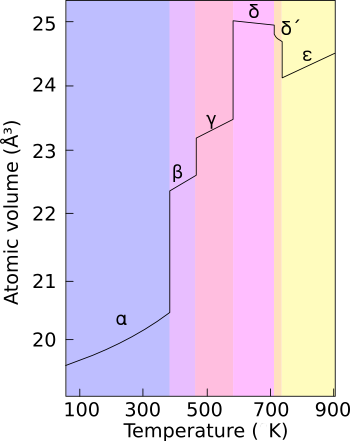
Six or seven different forms that pure plutonium metal can take
| Phase | Crystal structure | Density (g/cm3) | alpha (α) | beta (β) | gamma (γ) | delta (δ) | delta | |
|---|---|---|---|---|---|---|---|---|
| epsilon (ε) | ||||||||
| simple monoclinic | 19.86 | |||||||
| body-centered monoclinic | 17.70 | |||||||
| face-centered orthorhombic | 17.14 | |||||||
| face-centered cubic | 15.92 | |||||||
| body-centered tetragonal | 16.00 | |||||||
| body-centered cubic | 16.51 |
|editor-last=Wick |editor-first=O.J. |access-date=2025-01-24
Plutonium occurs in a variety of allotropes, even at ambient pressure. These allotropes differ widely in crystal structure and density; the α and δ allotropes differ in density by more than 25% at constant pressure.
Overview
Plutonium normally has six allotropes and forms a seventh (zeta, ζ) under high temperature and a limited pressure range. |access-date=2025-01-23 |url-access = registration
Machining plutonium
The presence of this many allotropes makes machining plutonium very difficult, as it changes state very readily. For example, the alpha (α) phase exists at room temperature in unalloyed plutonium. It has machining characteristics similar to cast iron but changes to the beta (β) phase at slightly higher temperatures.
The reasons for the complicated phase diagram are not entirely understood; recent research has focused on constructing accurate computer models of the phase transitions. The α phase has a low-symmetry monoclinic structure, hence its poor conductivity, brittleness, strength, and compressibility.
Stabilization
Plutonium in the delta (δ) phase normally exists in the 310 °C to 452 °C range but is metastable at room temperature when alloyed with a small percentage of gallium, aluminium, or cerium, enhancing workability and allowing it to be welded in weapons applications. The δ phase has a more typically metallic character and is roughly as strong and malleable as aluminium. In fission weapons, the explosive shock waves used to compress a plutonium core will also cause a transition from the usual δ phase plutonium to the denser α phase, significantly helping to achieve supercriticality. Plutonium–gallium alloy is the most common δ-stabilized alloy.
Gallium, aluminium, americium, scandium and cerium can stabilize the δ phase of plutonium for room temperature. Silicon, indium, zinc and zirconium allow formation of a metastable δ state when rapidly cooled. High amounts of hafnium, holmium and thallium also allows retaining some of the δ phase at room temperature. Neptunium is the only element that can stabilize the α phase at higher temperatures. Titanium, hafnium and zirconium stabilize the β phase at room temperature when rapidly cooled.
_150_kbar_region.png)
References
References
- S. Dabos-Seignon, J. P. Dancausse, R. Gering, S. Heathman, U. Benedict: ''Pressure induced phase transition in α-Pu.'' In: ''[[Journal of Alloys and Compounds]].'' 190, 1993, S. 237–242 ([[doi:10.1016/0925-8388(93)90404-B]]).
- visualisation of the crystal structure at [https://log-web.de/chemie/Start.htm?name=Pu_HP&lang=en log-web.de].
- "geometry of crystalline alpha plutonium".
- "geometry of crystalline delta plutonium".
- Hecker, Siegfried S. and Timofeeva, Lidia F. (2000) [https://permalink.lanl.gov/object/tr?what=info:lanl-repo/lareport/LA-UR-00-0415 A Tale of Two Diagrams]
- [http://www.globalsecurity.org/wmd/intro/pu-phase.htm Plutonium Crystal Phase Transitions]. Globalsecurity.org (27 April 2005). Retrieved 2010-02-08.
- David A. Young. (11 September 1975). "Phase Diagrams of the Elements". Lawrence Livermore Laboratory.
This article was imported from Wikipedia and is available under the Creative Commons Attribution-ShareAlike 4.0 License. Content has been adapted to SurfDoc format. Original contributors can be found on the article history page.
Ask Mako anything about Allotropes of plutonium — get instant answers, deeper analysis, and related topics.
Research with MakoFree with your Surf account
Create a free account to save articles, ask Mako questions, and organize your research.
Sign up freeThis content may have been generated or modified by AI. CloudSurf Software LLC is not responsible for the accuracy, completeness, or reliability of AI-generated content. Always verify important information from primary sources.
Report