From Surf Wiki (app.surf) — the open knowledge base
Alkali metal halide
Family of compounds consisting of an alkali metal bonded to a halogen

Family of compounds consisting of an alkali metal bonded to a halogen
Alkali metal halides, or alkali halides, are the family of inorganic compounds with the chemical formula MX, where M is an alkali metal and X is a halogen. These compounds are the often commercially significant sources of these metals and halides. The best known of these compounds is sodium chloride, table salt.
Structure
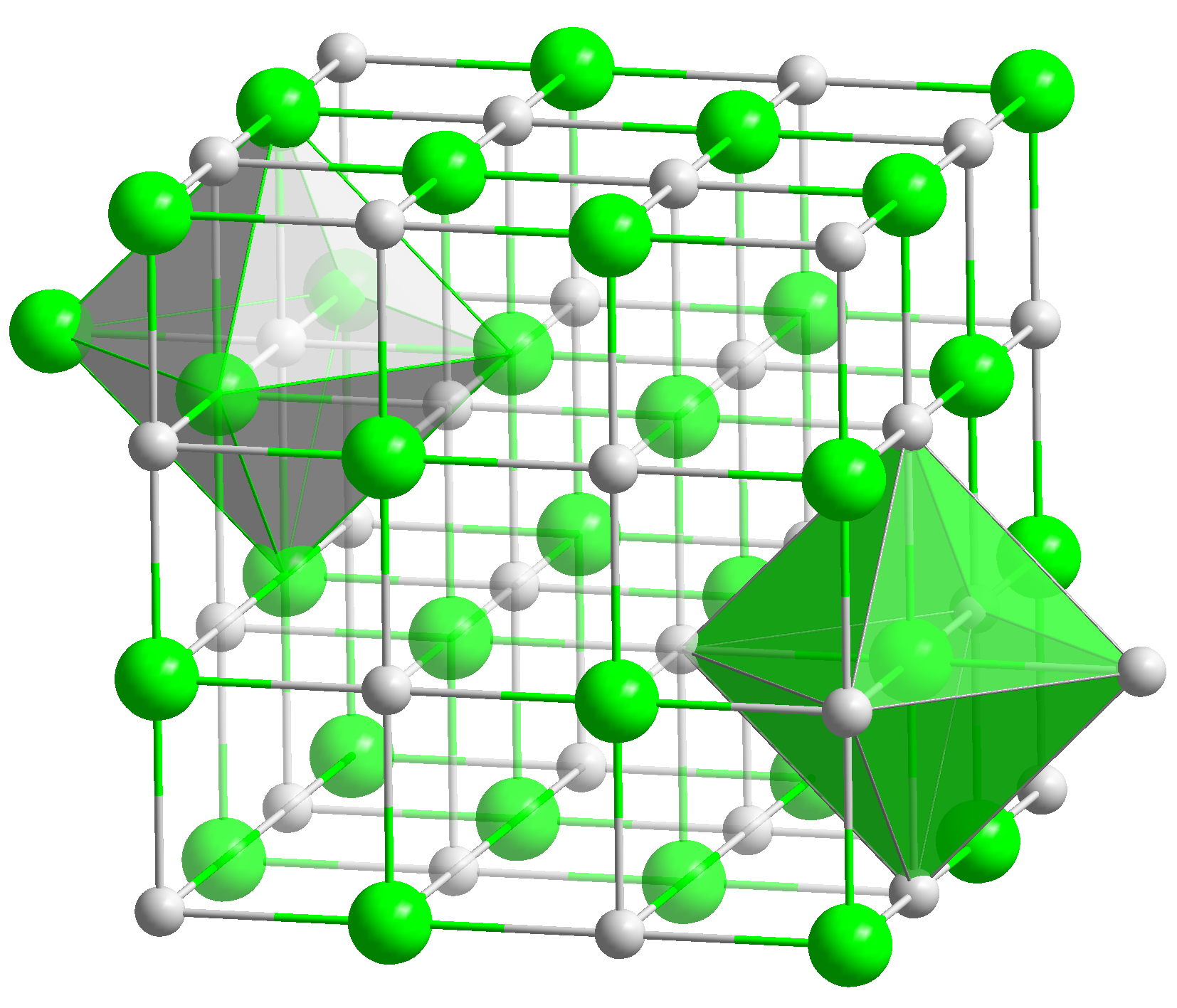
Most alkali metal halides crystallize with the face-centered cubic lattices. In this structure both the metals and halides feature octahedral coordination geometry, in which each ion has a coordination number of six. Caesium chloride, bromide, and iodide crystallize in a body-centered cubic lattice that accommodates coordination number of eight for the larger metal cation (and the anion also).

Properties
The alkali metal halides exist as colourless crystalline solids, although as finely ground powders appear white. They melt at high temperature, usually several hundred degrees to colorless liquids. Their high melting point reflects their high lattice energies. At still higher temperatures, these liquids evaporate to give gases composed of diatomic molecules.
These compounds dissolve in polar solvents to give ionic solutions that contain highly solvated anions and cations. Alkali halides dissolve large amounts of the corresponding alkali metal: caesium is completely miscible at all temperatures above the melting point.
The table below provides links to each of the individual articles for these compounds. The numbers beside the compounds show the electronegativity difference between the elements based on the Pauling scale. The higher the number is, the more ionic the solid is.
| Alkali metals | Lithium | Sodium | Potassium | Rubidium | Caesium | va=middle | Halogens}} | Fluorine | Chlorine | Bromine | Iodine |
|---|---|---|---|---|---|---|---|---|---|---|---|
| LiF (3.0) | NaF (3.1) | KF (3.2) | RbF (3.2) | CsF (3.3) | |||||||
| LiCl (2.0) | NaCl (2.1) | KCl (2.2) | RbCl (2.2) | CsCl (2.3) | |||||||
| LiBr (1.8) | NaBr (1.9) | KBr (2.0) | RbBr (2.0) | CsBr (2.1) | |||||||
| LiI (1.5) | NaI (1.6) | KI (1.7) | RbI (1.7) | CsI (1.8) |
References
References
- Greenwood, N. N.; & Earnshaw, A. (1997). Chemistry of the Elements (2nd Edn.), Oxford:Butterworth-Heinemann. {{ISBN. 0-7506-3365-4.
- Wells, A.F. (1984) Structural Inorganic Chemistry, Oxford: Clarendon Press. {{ISBN. 0-19-855370-6.
- (1993). "Inorganic chemistry : principles of structure and reactivity". Harper.
This article was imported from Wikipedia and is available under the Creative Commons Attribution-ShareAlike 4.0 License. Content has been adapted to SurfDoc format. Original contributors can be found on the article history page.
Ask Mako anything about Alkali metal halide — get instant answers, deeper analysis, and related topics.
Research with MakoFree with your Surf account
Create a free account to save articles, ask Mako questions, and organize your research.
Sign up freeThis content may have been generated or modified by AI. CloudSurf Software LLC is not responsible for the accuracy, completeness, or reliability of AI-generated content. Always verify important information from primary sources.
Report