From Surf Wiki (app.surf) — the open knowledge base
Algorism
Mathematical technique for arithmetic
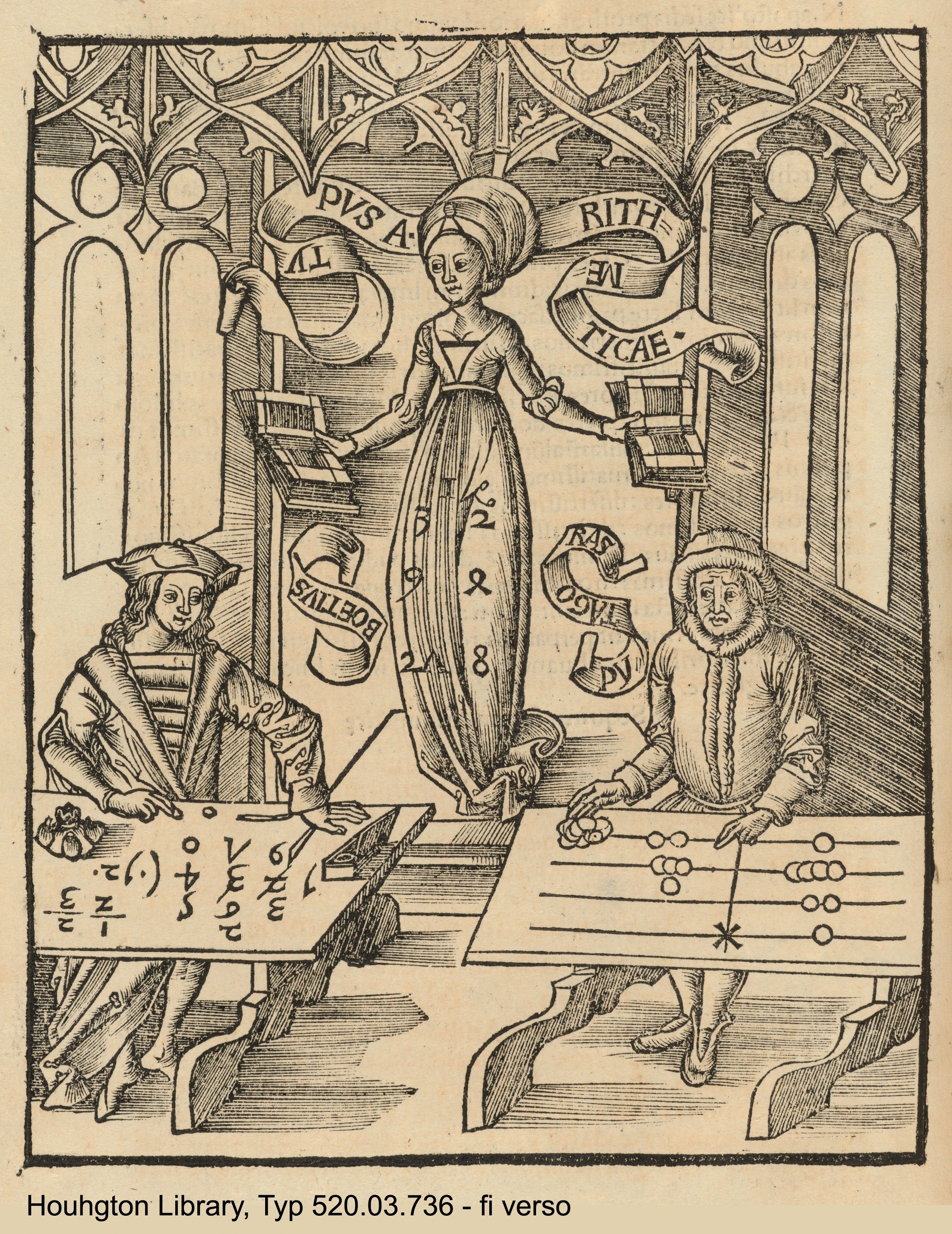
Mathematical technique for arithmetic
Algorism is the technique of performing basic arithmetic by writing numbers in place value form and applying a set of memorized rules and facts to the digits. One who practices algorism is known as an algorist. This positional notation system has largely superseded earlier calculation systems that used a different set of symbols for each numerical magnitude, such as Roman numerals, and in some cases required a device such as an abacus.
Etymology
The word algorism comes from the name Al-Khwārizmī (c. 780–850), a Persian mathematician, astronomer, geographer and scholar in the House of Wisdom in Baghdad, whose name means "the native of Khwarezm", which is now in modern-day Uzbekistan. He wrote a treatise in Arabic language in the 9th century, which was translated into Latin in the 12th century under the title Algoritmi de numero Indorum. This title means "Algoritmi on the numbers of the Indians", where "Algoritmi" was the translator's Latinization of Al-Khwarizmi's name. Al-Khwarizmi was the most widely read mathematician in Europe in the late Middle Ages, primarily through his other book, the Algebra. In late medieval Latin, algorismus, the corruption of his name, simply meant the "decimal number system" that is still the meaning of modern English algorism. During the 17th century, the French form for the word – but not its meaning – was changed to algorithm, following the model of the word logarithm, this form alluding to the ancient Greek . English adopted the French very soon afterwards, but it wasn't until the late 19th century that "algorithm" took on the meaning that it has in modern English. In English, it was first used about 1230 and then by Chaucer in 1391. Another early use of the word is from 1240, in a manual titled Carmen de Algorismo composed by Alexandre de Villedieu. It begins thus: which translates as:
The word algorithm also derives from algorism, a generalization of the meaning to any set of rules specifying a computational procedure. Occasionally algorism is also used in this generalized meaning, especially in older texts.
History
Starting with the integer arithmetic developed in India using base 10 notation, Al-Khwārizmī along with other mathematicians in medieval Islam, documented new arithmetic methods and made many other contributions to decimal arithmetic (see the articles linked below). These included the concept of the decimal fractions as an extension of the notation, which in turn led to the notion of the decimal point. This system was popularized in Europe by Leonardo of Pisa, now known as Fibonacci.
References
| author-link = Gerald Toomer
References
- (1991). "A History of Mathematics". John Wiley & Sons, Inc..
- Clifford A. Pickover (2009). The Math Book: From Pythagoras to the 57th Dimension, 250 Milestones in the History of Mathematics. Sterling Publishing Company, Inc. p. 84. ISBN 978-1-4027-5796-9.
- Corbin, Henry (1998). The Voyage and the Messenger: Iran and Philosophy. North Atlantic Books. p. 44. ISBN 978-1-55643-269-9.
- [https://books.google.com/books?id=3Sfrxde0CXIC Al-Khwarizmi: The Inventor of Algebra], by Corona Brezina (2006)
- [http://www-history.mcs.st-and.ac.uk/Extras/Boyer_Foremost_Text.html Foremost mathematical texts in history], according to [[Carl B. Boyer]].
- Etymology of algorithm at [http://dictionary.reference.com/browse/algorithm Dictionary.Reference.com]
- [[Oxford English Dictionary]] (first quote ''c'' 1230 CE, Chaucer ''c'' 1391, and later quotes showing continuing usage since then)
- "Leonardo Pisano {{!}} Italian mathematician".
- Hogendijk, Jan P.. (1998). "al-Khwarzimi". Pythagoras.
- Oaks, Jeffrey A.. "Was al-Khwarizmi an applied algebraist?". [[University of Indianapolis]].
This article was imported from Wikipedia and is available under the Creative Commons Attribution-ShareAlike 4.0 License. Content has been adapted to SurfDoc format. Original contributors can be found on the article history page.
Ask Mako anything about Algorism — get instant answers, deeper analysis, and related topics.
Research with MakoFree with your Surf account
Create a free account to save articles, ask Mako questions, and organize your research.
Sign up freeThis content may have been generated or modified by AI. CloudSurf Software LLC is not responsible for the accuracy, completeness, or reliability of AI-generated content. Always verify important information from primary sources.
Report