From Surf Wiki (app.surf) — the open knowledge base
Alfa Romeo Romeo
| Field | Value |
|---|---|
| image | Alfa Romeo Van.jpg |
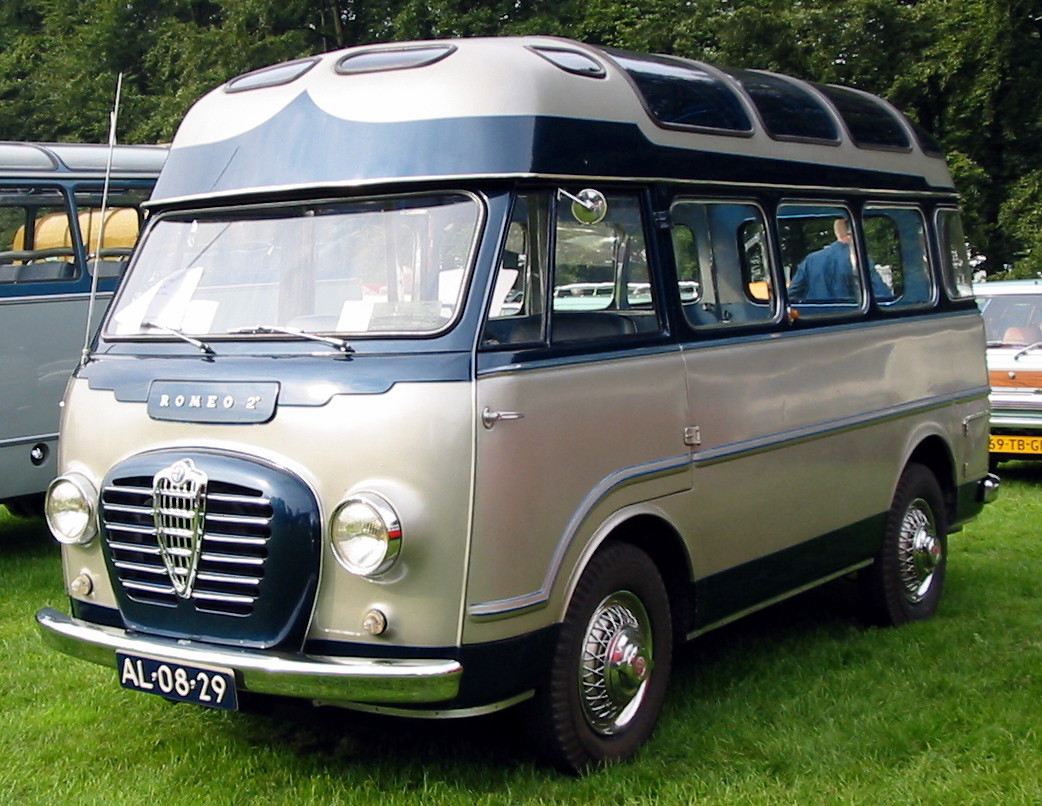
| caption | Alfa Romeo Romeo 2 Furgone |
| name | Alfa Romeo Romeo |
| manufacturer | Alfa Romeo |
| assembly | Italy |
| Spain (Romeo 2) | |
| related | Nissan Trade |
| production | 1954–1983 |
| predecessor | Alfa Romeo 900 |
| successor | Alfa Romeo AR6 |
| Nissan Trade (Spain) | |
| class | Light commercial vehicle (M) |
| body_style | Van |
| Pickup truck | |
| layout | FF layout |
Spain (Romeo 2) Nissan Trade (Spain) Pickup truck
The Alfa Romeo Romeo is a light commercial, cabover van and pickup truck that was introduced by the Italian automaker Alfa Romeo in 1954 as the Alfa Romeo Autotutto ("all purpose"). The line of vans continued to be built until 1983, when it was replaced by relabelled Fiat and Iveco commercials. In Spain, where this vehicle was also built, it was rebodied and kept in production into the early 2000s, first as an Ebro or Avia and finally as the Nissan Trade.
TOC
Romeo
Alfa Romeo Autotutto | petrol: | 1,290 cc I4 | diesel: | 1,158 cc supercharged 2-stroke I2
The first Alfa Romeo T10 "Autotutto" ("all purpose") was unveiled at the 1954 Turin Motor Show in panel and minibus versions. Later, more versions became available as Alfa Romeo introduced numerous body versions: van, high-roof van, "Promiscuo" (van with additional side windows and rear seating), minibus, school bus, ambulance, pickup, drop-side truck and double-cab truck. In addition, coachbuilding companies made their own versions.
The van used the 1,290 cc Alfa Romeo Twin Cam straight-four engine detuned to 37 hp-metric and had a top speed of 60 mph. This engine was later used on the Giulietta Berlina. The optional two-cylinder, supercharged two-stroke diesel engine had 30 hp-metric and managed a top speed of 75 km/h.
Romeo 2
| petrol: | 1,290 cc I4 | diesel: | 1,158 cc supercharged 2-stroke I2 | 1,760 cc Perkins 4.99 I4 (Spain)
The updated Romeo 2 version was introduced in 1957/ It was assembled in Italy and also built under license in Spain by FADISA (Fabricacion de Automoviles Diesel S.A.). The Spanish version had a 1.6-liter Perkins 4.99 diesel engine and a gearbox with synchronization on all forward gears.
Romeo 3
The final version, the Romeo 3, was introduced in 1966. The Romeo 3 had various improvements, including a hydraulic clutch and adjustable driver's seat. It had a short production run of around six months before being replaced by the Giulia 1300 engined F12 and A12 models. In all, some 23,000 Romeos were produced between 1954 and 1966.
F12/A12 and F11/A11
1973–1983 (diesel) 17,899 built 1,760 cc Perkins 4.108 diesel I4
In 1967, the Autotutto was replaced with the Giulia-engined Alfa Romeo F12 and A12 vans. The front of the vehicle was updated with a wider chrome and mesh grill, and the 1,290 cc Alfa Romeo twin cam engine was updated to 52 hp-metric. The front-engined van had a four-speed gearbox and front-wheel drive.
In 1973, an inline-four 1,760 cc Perkins diesel (4.108) with 50 hp-metric was released. This engine was also available in the Giulia sedan from 1976. The van had a top speed of around 115 km/h. The front brakes were discs and rear ones drums. Abandoning the use of a model name, "F" depicted a furgone, or van, "A" depicted an autocarro or light truck, and "12" indicated the carrying capacity of 12 quintali (1 quintale = 100 kg).
Between 1967 and 1971, the lighter A11 and F11 versions were also available. These has a lighter payload and a lower horsepower rating. All Alfa Romeo vans were facelifted in 1977 with a new black plastic radiator grill, and chrome badging was replaced with black adhesive stickers. Production stopped in 1983, by when the total production of A11, A12, F11, and F12 vans was around 17,300 units.
Alfa F12 Ambulance.jpg|1967-1977 Alfa Romeo F12 (pre-facelift with metal grille) Alfa Romeo F12 Classic-Gala 2025 DSC 1061.jpg|1977-1983 Alfa Romeo F12 (facelift version) FurgonetaEBRO.jpg|The facelifted Ebro F-108 (introduced in 1971)
In Spain
In 1967, Motor Ibérica took over FADISA, the company that made Ebro trucks and merged the companies products. The Alfa Romeo F12 was renamed the Ebro F-100 in Spain, receiving a facelift with a black plastic grille in 1971. It was completely rebodied in 1976, with the new model being sold as the Avia 1000/1250/2000 or the Ebro F-series, and was eventually renamed the Ebro Trade. In 1986 it was renamed Nissan; Nissan Motors took full control of Motor Ibérica and Ebro Trucks the following year. The Nissan Trade continued to be made until the beginning of the 2000s at the Ávila plant in Spain.
Replacement
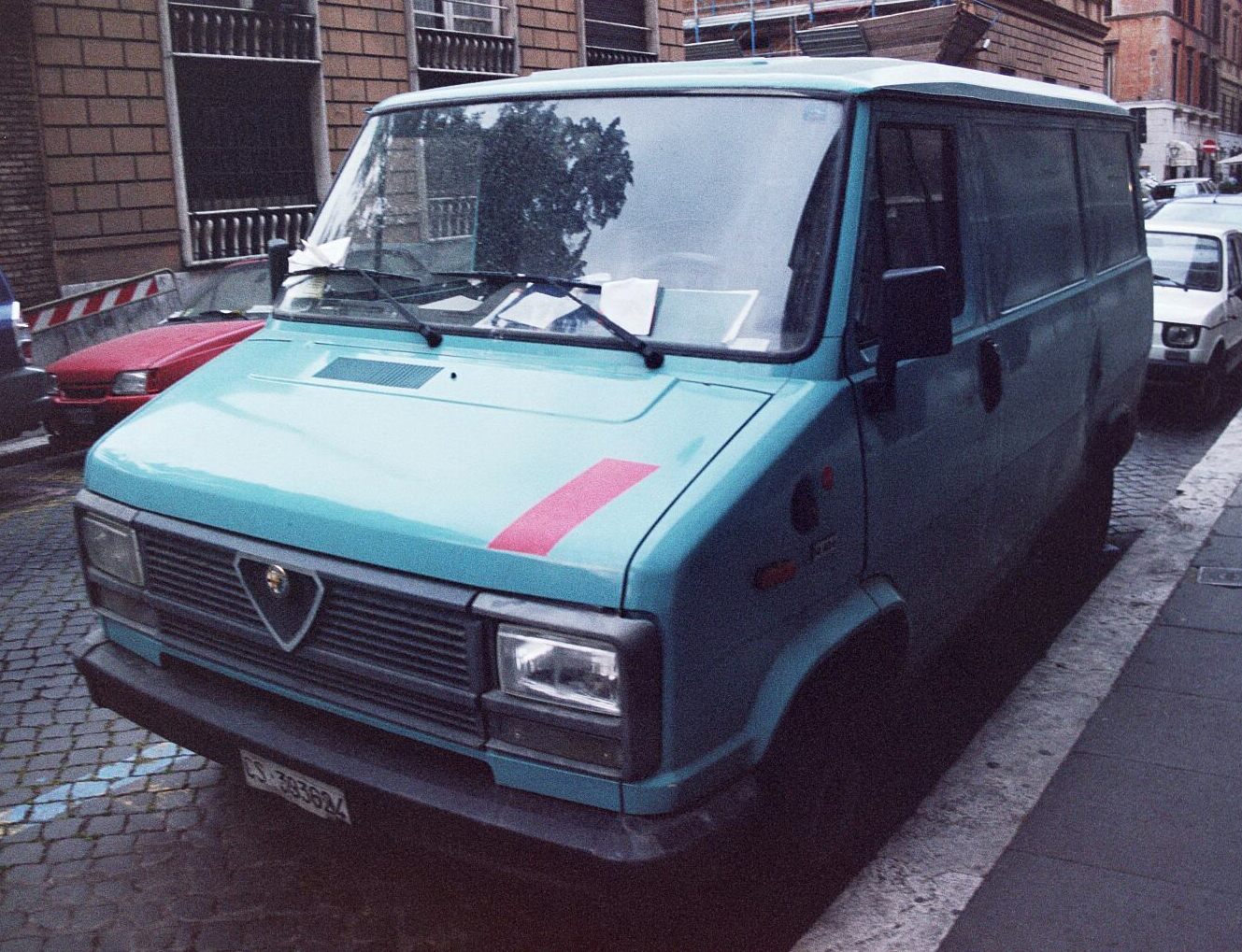

Some Fiat and Iveco models were also marketed as Alfa Romeos as replacements for Romeo Romeo vans. The AR8 was based on the first-generation Iveco Daily, and the AR6 was a rebadged first-generation Fiat Ducato. They both carried Alfa Romeo's traditional shield-shaped grille.
References
References
- Schifter-Holm, Erik. "ALFA ROMEO T10, A11/F11 og A12/F12". alfaklub.dk.
- "A Romeo? What's That?". Giulietta Register.
- "Alfa Romeo Romeo 2 Furgone". blackandwhitegarage.com.
This article was imported from Wikipedia and is available under the Creative Commons Attribution-ShareAlike 4.0 License. Content has been adapted to SurfDoc format. Original contributors can be found on the article history page.
Ask Mako anything about Alfa Romeo Romeo — get instant answers, deeper analysis, and related topics.
Research with MakoFree with your Surf account
Create a free account to save articles, ask Mako questions, and organize your research.
Sign up freeThis content may have been generated or modified by AI. CloudSurf Software LLC is not responsible for the accuracy, completeness, or reliability of AI-generated content. Always verify important information from primary sources.
Report