From Surf Wiki (app.surf) — the open knowledge base
Alfa Romeo 158/159 Alfetta
Racing automobile

Racing automobile
| Field | Value | ||
|---|---|---|---|
| Car_name | Alfa Romeo 158, 159, 159A, 159B, 159M | ||
| Image | [[Image:Alfa-Romeo-159-(1951).jpg | 250px | Alfa Romeo 159 Formula 1 car]] |
| 1951 Alfa Romeo 159 | |||
| Category | Voiturette (1938–1947) | ||
| Formula One (1946–1951) | |||
| Constructor | Alfa Romeo | ||
| Designer | Gioacchino Colombo | ||
| predecessor | Alfa Romeo Tipo 512 | ||
| Successor | Alfa Special | ||
| Team | Alfa Romeo SpA | ||
| Drivers | Jean-Pierre Wimille | ||
| Giuseppe Farina | |||
| Juan Manuel Fangio | |||
| Luigi Fagioli | |||
| Chassis | Single-seater, tubular frame | ||
| Front suspension | Trailing arm, transverse leaf springs, hydraulic dampers | ||
| Rear suspension | Swing axle*, transverse leaf spring, hydraulic dampers | ||
| Engine name | Alfa Romeo 158/159 | ||
| Configuration | straight-8, | ||
| Turbo/NA | Roots-type supercharger**, | ||
| Gearbox name | Alfa | ||
| Gears | 5-speed | ||
| Type | manual | ||
| Fuel | Shell (98.5% methanol, 1% Castor oil, 0.5% water) | ||
| Tyres | Pirelli | ||
| Debut | 1938 Coppa Ciano Junior (158) | ||
| 1951 BRDC International Trophy (159) | |||
| Races | 41 (GP) | ||
| 13 (F1) | |||
| Wins | 37 (GP) | ||
| 10 (F1) | |||
| Cons_champ | Not applicable before | ||
| Drivers_champ | 2 ( – Giuseppe Farina | ||
| – Juan Manuel Fangio) | |||
| Poles | 10 (F1) | ||
| Fastest_laps | 13 (F1) | ||
| length | 4280 mm | ||
| width | 1473 mm | ||
| height | 1164 mm | ||
| wheelbase | 2502 mm | ||
| track | 1250 mm (Both Front and Rear) |
1951 Alfa Romeo 159 Formula One (1946–1951) Giuseppe Farina Juan Manuel Fangio Luigi Fagioli
De-Dion-axle was one of the last modifications 1951. | Turbo/NA = Roots-type supercharger*, 1951 BRDC International Trophy (159) 13 (F1) 10 (F1) – Juan Manuel Fangio)
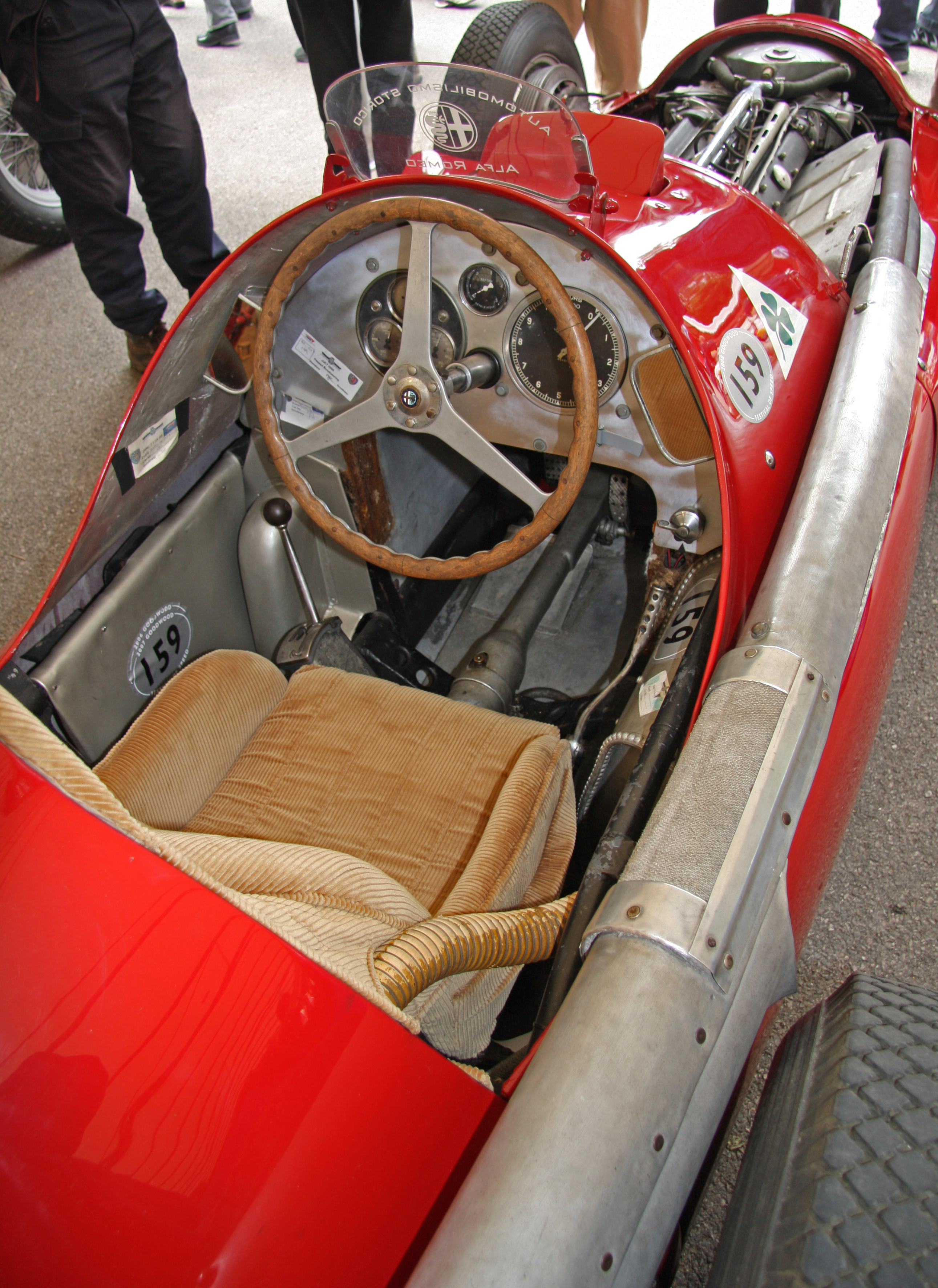

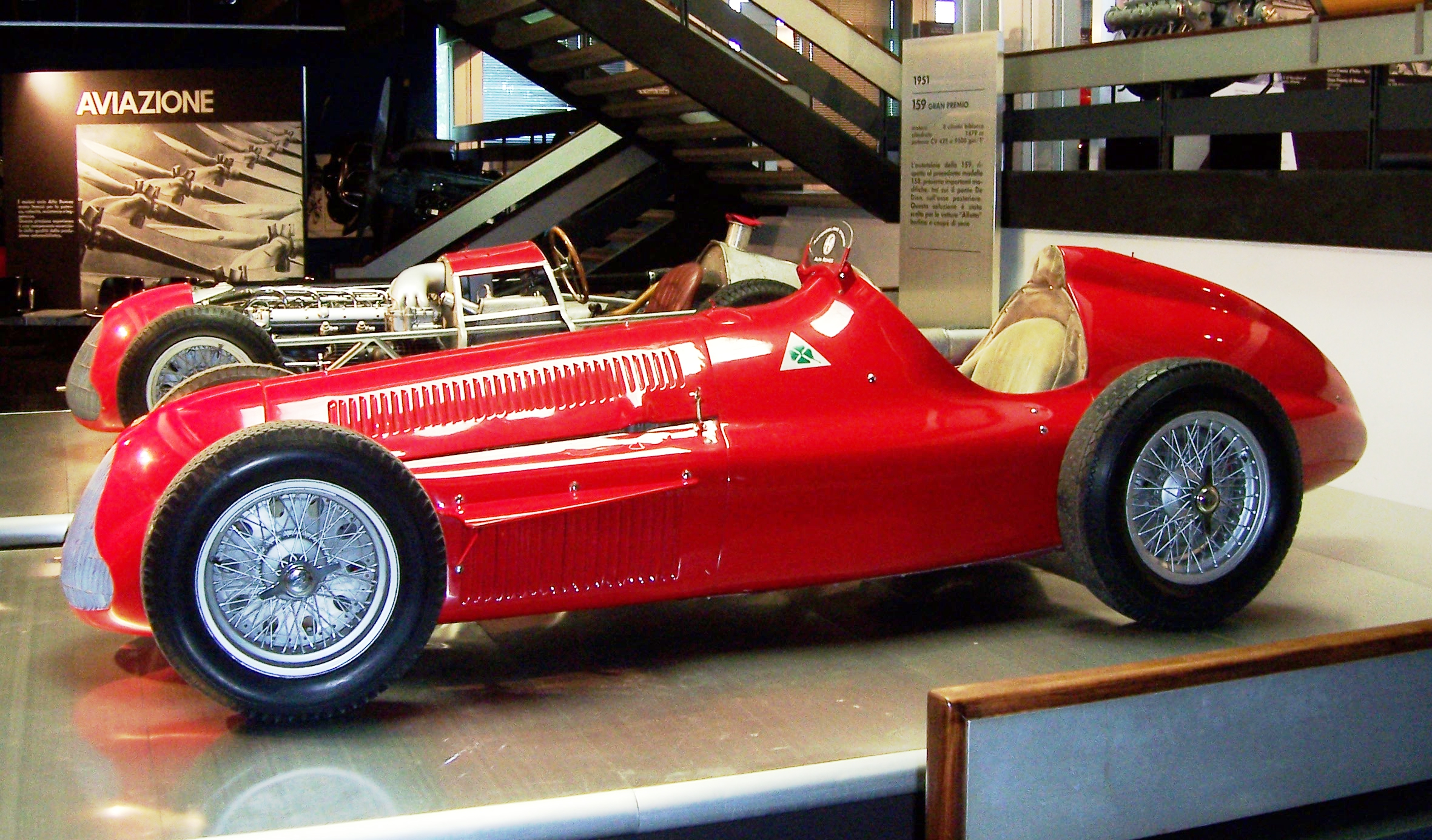
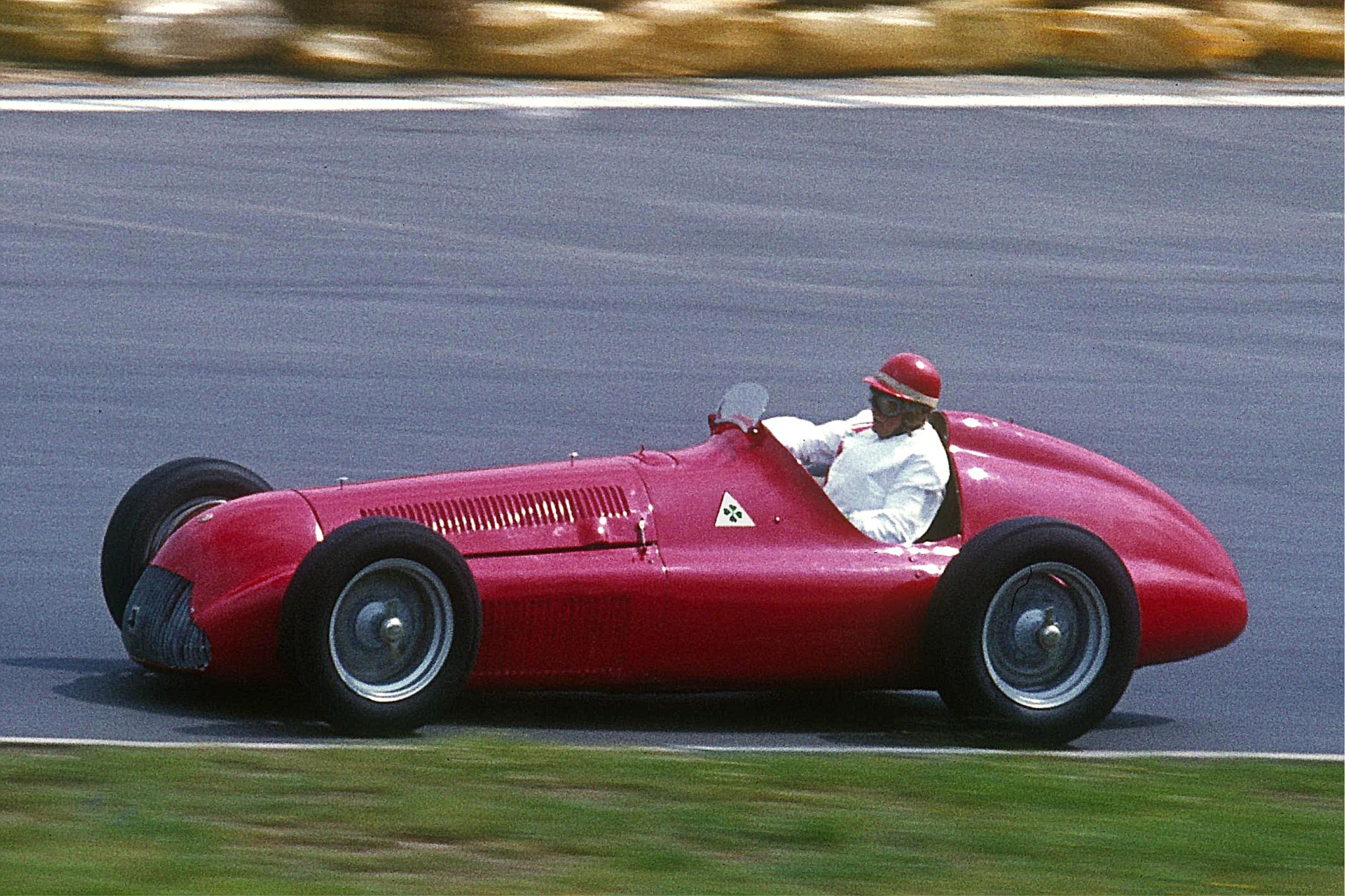
The Alfa Romeo 158/159, also known as the Alfetta (Little Alfa in Italian), is a Grand Prix racing car produced by Italian manufacturer Alfa Romeo. It is one of the most successful racing cars ever; the 158 and its derivative, the 159, took 47 wins from 54 Grands Prix entered. It was originally developed for the pre-World War II voiturette formula (1937) and has a 1.5-litre straight-8 supercharged engine. Following World War II, the car was eligible for the new Formula One introduced in 1947. In the hands of drivers such as Nino Farina, Juan Manuel Fangio and Luigi Fagioli, it dominated the first two seasons of the World Championship of Drivers.
Overview
The first version of this successful racing car, the 158, was made during 1937/1938. The main responsibility for engineering was given to Gioacchino Colombo.
The car's name refers to its 1.5-litre engine and eight cylinders. The voiturette class was for racing cars with 1.5-litre engines, standing in the same relation to the top 'Grand Prix' formula (usually for 3-litre engines) as the Formula Two does to Formula One today. Alfa's 3-litre racing cars in 1938 and 1939 were the Tipo 308, 312 and 316.

The 158 debuted with the works Alfa Corse team at the Coppa Ciano Junior in August 1938 at Livorno, Italy, where Emilio Villoresi took the car's first victory. At that time the 1479.56 cc (58.0 x 70.0 mm) engine produced around 200 bhp at 7000 rpm. with the help of a single-stage Roots blower. More success came at the Coppa Acerbo, Coppa Ciano and Tripoli Grand Prix in May 1940. Soon World War II stopped development of the car for six years. After the war the engine was developed further to push out 254 bhp in 1946.
In 1947, the Alfetta was put back into service. The new rules allowed 1500 cc supercharged and 4500 cc naturally aspirated engines. The 158 was modified again, this time to produce over 300 bhp and was denoted as Tipo 158/47. The car made a tragic debut in the 1948 Swiss Grand Prix where Achille Varzi lost control of his car and was killed. Another loss for the team came in practice for the 1949 Buenos Aires Grand Prix, where Jean-Pierre Wimille was killed in an accident (driving with Simca-Gordini).
In 1950, the 158 was eligible for the new World Championship of Drivers. The car won every race in which it competed during that first season of Formula One; it was incredible that a car which had originated in 1938 was so victorious, most likely because all the other constructors (as few as there were) had less money to build and develop their cars and the Alfa had so much development time. The Alfa Romeo team included talented drivers such as Giuseppe "Nino" Farina and Juan Manuel Fangio, the latter of whom later won the World Drivers' Championship five times.
At the end of the 1950 season, a further updated version known as the 159 was produced, which was used for the 1951 season. This version had reworked rear suspension, the old swing axle was replaced with a De-Dion axle and the engine produced around 420 bhp at 9600 rpm. The 159 had top speed of 305 km/h and it weighed 710 kg. In order to achieve this power however, the simplistically designed engine was fitted with larger superchargers over time. This fact, combined with the rich mixture required to burn methanol in the engine resulted in extremely poor fuel economy - the 159 achieved 1.5 mpgimp, compared to the Talbot-Lagos of the time, which delivered 9 mpgimp. The 1951 British Grand Prix at Silverstone was the first Formula One Grand Prix not won by an Alfa primarily because Fangio and Farina both had to stop twice simply to re-fuel their cars – and the Ferrari of José Froilán González did better on fuel and would go on to win the race, with Fangio second. Still, the Alfa had the edge on performance and with wins in Switzerland, France and Spain, Fangio won his first of five championships that year. For their second-to-last World Championship race (until 1979), the Italian Grand Prix at Monza, Alfa Romeo introduced a new evolution version known as the 159M, the "M" standing for Maggiorata ("enlarged").
After an unsuccessful bid by Alfa Romeo to obtain government assistance to meet development costs, the team announced their retirement from Grand Prix racing at the end of 1951 (leaving the development of the 2.5-litre Alfa Romeo 160). This, combined with problems for other Formula One teams lead to a decree by the FIA that all Grand Prix races counting towards the World Championship of Drivers in 1952 and 1953 would be for cars complying with Formula Two rather than Formula One.
Technical data
| Technical data | 158/39 | 158/50 | 159 |
|---|---|---|---|
| Engine: | Front mounted 8-cylinder in-line engine | ||
| Displacement: | 1479 cc | ||
| Bore x stroke: | 58x70 mm | ||
| Max power at rpm: | 225 bhp at 7 500 rpm | 350 bhp at 8 500 rpm | 429 bhp at 9 300 rpm |
| Max Torque at rpm: | 229 N.m at 7 000 rpm | 390 N.m at 4 500 rpm | 620 N.m at 5 300 rpm |
| Valve control: | 2 overhead Camshaft, 2 valves per cylinder | ||
| Induction: | Roots compressor | 2 Roots compressors | |
| Gearbox: | 4-speed manual, transaxle | ||
| suspension front: | Double longitudinal links, transverse leaf springs, hydraulic shock absorbers | ||
| suspension rear: | Pendulum axle | De Dion axle | |
| Rear suspension: | Transverse leaf springs, hydraulic shock absorbers | ||
| Brakes: | Hydraulic drum brakes | ||
| Wheelbase: | 2502 mm | ||
| Dry weight: | 630 kg | 700 kg | 710 kg |
Race victories
| Date | Type | Race | Location | Class | Driver |
|---|---|---|---|---|---|
| August 7, 1938 | 158 | Coppa Ciano | Livorno | Voiturette | Emilio Villoresi |
| September 11, 1938 | 158 | Milan Grand Prix | Monza | Voiturette | Emilio Villoresi |
| July 30, 1939 | 158 | Coppa Ciano | Livorno | Voiturette | Giuseppe Farina |
| August 13, 1939 | 158 | Coppa Acerbo | Pescara | Voiturette | Clemente Biondetti |
| August 20, 1939 | 158 | Swiss Grand Prix | Bremgarten | Voiturette | Giuseppe Farina |
| May 12, 1940 | 158 | Tripoli Grand Prix | Libya | Voiturette | Giuseppe Farina |
| July 21, 1946 | 158 | Grand Prix of Nations | Geneva | - | Giuseppe Farina |
| September 1, 1946 | 158 | Valentino Grand Prix | Turin, Valentino Park | non-Champ. F1 | Achille Varzi |
| September 30, 1946 | 158 | Milan Grand Prix | Milan, Sempione Park | - | Carlo Felice Trossi |
| June 8, 1947 | 158 | Swiss Grand Prix | Bremgarten | - | Jean-Pierre Wimille |
| June 29, 1947 | 158 | European Grand Prix | Spa | - | Jean-Pierre Wimille |
| July 13, 1947 | 158 | Bari Grand Prix | Bari | - | Achille Varzi |
| September 7, 1947 | 158 | Italian Grand Prix | Milan, Sempione Park | - | Carlo Felice Trossi |
| July 4, 1948 | 158 | Swiss Grand Prix | Bremgarten | - | Carlo Felice Trossi |
| July 18, 1948 | 158 | French Grand Prix | Reims | - | Jean-Pierre Wimille |
| September 5, 1948 | 158 | Italian Grand Prix | Turin, Valentino Park | - | Jean-Pierre Wimille |
| October 17, 1948 | 158 | Autodrome Grand Prix | Monza | - | Jean-Pierre Wimille |
| April 16, 1950 | 158 | San Remo Grand Prix | Ospedaletti | - | Juan Manuel Fangio |
| May 13, 1950 | 158 | European Grand Prix | Silverstone | Formula One | Giuseppe Farina |
| May 21, 1950 | 158 | Monaco Grand Prix | Monaco | Formula One | Juan Manuel Fangio |
| June 4, 1950 | 158 | Swiss Grand Prix | Bremgarten | Formula One | Giuseppe Farina |
| June 18, 1950 | 158 | Belgian Grand Prix | Spa | Formula One | Juan Manuel Fangio |
| July 2, 1950 | 158 | French Grand Prix | Reims | Formula One | Juan Manuel Fangio |
| July 9, 1950 | 158 | Bari Grand Prix | Bari | - | Giuseppe Farina |
| July 30, 1950 | 158 | Grand Prix of Nations | Geneva | - | Juan Manuel Fangio |
| August 15, 1950 | 158 | Coppa Acerbo | Pescara | - | Juan Manuel Fangio |
| August 26, 1950 | 158 | International Trophy | Silverstone | non-Champ. F1 | Giuseppe Farina |
| September 3, 1950 | 158 | Italian Grand Prix | Monza | Formula One | Giuseppe Farina |
| May 27, 1951 | 159 | Swiss Grand Prix | Bremgarten | Formula One | Juan Manuel Fangio |
| June 2, 1951 | 159 | Ulster Trophy | Dundrod | - | Giuseppe Farina |
| June 17, 1951 | 159 | Belgian Grand Prix | Spa | Formula One | Giuseppe Farina |
| July 1, 1951 | 159 | French Grand Prix | Reims | Formula One | Luigi Fagioli/Juan Manuel Fangio |
| October 28, 1951 | 159 | Spanish Grand Prix | Pedralbes | Formula One | Juan Manuel Fangio |
| September 2, 1951 | 159 | Bari Grand Prix | Bari | - | Juan Manuel Fangio |
Complete Formula One World Championship results
(key) (results in bold indicate pole position, results in italics indicate fastest lap)
| Year | Chassis | Engine | Tyres | Drivers | 1 | 2 | 3 | 4 | 5 | 6 | 7 | 8 | Points | WCC |
|---|---|---|---|---|---|---|---|---|---|---|---|---|---|---|
| 158 | Alfa Romeo 158 1.5 L8 | GBR | MON | 500 | SUI | BEL | FRA | ITA | 88 | -* | ||||
| Giuseppe Farina | *1* | Ret | 1 | *4* | 7 | 1 | ||||||||
| Juan Manuel Fangio | Ret | *1* | Ret | 1 | *1* | *Ret* | ||||||||
| Luigi Fagioli | 2 | Ret | 2 | 2 | 2 | 3 | ||||||||
| Reg Parnell | 3 | |||||||||||||
| Gianbattista Guidotti | DNS | |||||||||||||
| Consalvo Sanesi | Ret | |||||||||||||
| Piero Taruffi | Ret | |||||||||||||
| 159 | Alfa Romeo 158 1.5 L8 | SUI | 500 | BEL | FRA | GBR | GER | ITA | ESP | 75 | -* | |||
| Giuseppe Farina | 3 | 1 | 5 | Ret | Ret | 3 | 3 | |||||||
| Juan Manuel Fangio | *1* | *9* | *1* | 2 | 2 | Ret | 1 | |||||||
| Toulo de Graffenried | 5 | Ret | 6 | |||||||||||
| Consalvo Sanesi | 4 | Ret | 10 | 6 | ||||||||||
| Gianbattista Guidotti | DNS | |||||||||||||
| Luigi Fagioli | 1 | |||||||||||||
| Felice Bonetto | 4 | Ret | 3 | 5 | ||||||||||
| Paul Pietsch | Ret |
- The Constructors' Championship was not awarded until 1958.
Legacy
The 158/159 Alfetta remains one of the most successful cars in the history of Formula One, having won every race it entered in 1950, and winning 4 out of 7 races (with a podium in all of the other 3) in 1951.
Notes
References
- "THE ORIGINS OF THE ALFA ROMEO 158/159". enzociliberto.it.
- Sparrow, David. (1996). "Alfa Romeo Legends".
- "The Golden Era Of Grand Prix Racing". kolumbus.fi/leif.snellman.
- Borgeson, Griffith. (1990). "The Alfa Romeo Tradition".
- "Grand Prix Cars – Alfa Romeo 158". ddavid.com/formula1.
- "1938 Alfa Romeo 158 Alfetta". supercars.net.
- "Jean-Pierre Wimille: The man who would have been champion...". grandprix.com.
- Fiat Chrysler Automobiles EMEA Press: [http://www.alfaromeopress.com/press/article/alfa-romeo-gp-tipo-159-alfetta-al-gp-di-f1-in-gran-bretagna-1 Alfa Romeo GP Tipo 159 Alfetta at F1 British GP - Press Releases - Fiat Chrysler Automobiles EMEA Press] {{Webarchive. link. (2019-07-11 , accessdate: 11. July 2019)
- "Alfa Romeo 158 Alfetta".
- McKelvie, Steve. (November 11, 2011). "Talbot Lago T26-C Grand Prix Car".
- "The Alfetta's last call". forix.com.
- Mike Lang, ''Grand Prix'', Volume 1, 1950 to 1965, Haynes Publishing Group, 1981, page 39
This article was imported from Wikipedia and is available under the Creative Commons Attribution-ShareAlike 4.0 License. Content has been adapted to SurfDoc format. Original contributors can be found on the article history page.
Ask Mako anything about Alfa Romeo 158/159 Alfetta — get instant answers, deeper analysis, and related topics.
Research with MakoFree with your Surf account
Create a free account to save articles, ask Mako questions, and organize your research.
Sign up freeThis content may have been generated or modified by AI. CloudSurf Software LLC is not responsible for the accuracy, completeness, or reliability of AI-generated content. Always verify important information from primary sources.
Report