From Surf Wiki (app.surf) — the open knowledge base
Alexander Jackson Davis
American architect (1803–1892)

American architect (1803–1892)
| Field | Value |
|---|---|
| name | Alexander Jackson Davis |
| image | Alexander Jackson Davis.jpg |
| caption | Detail of Davis portrait ca. 1855 |
| birth_date | |
| birth_place | New York City, U.S. |
| death_date | |
| death_place | Llewellyn Park, West Orange, New Jersey, U.S. |
| practice | 1828–1884 |
| significant_buildings | North Carolina State Capitol |
| U.S. Customs House | |
| Dutch Reformed Church | |
| Lyndhurst | |
| Wadsworth Atheneum | |
| Loudoun | |
| Grace Hill | |
| Hurst-Pierrepont | |
| significant_projects | Montgomery Place |
| Oliver Bronson House | |
| Virginia Military Institute | |
| Llewellyn Park | |
| Lather's Woods |
U.S. Customs House Dutch Reformed Church Lyndhurst Wadsworth Atheneum Loudoun Grace Hill Hurst-Pierrepont Oliver Bronson House Virginia Military Institute Llewellyn Park Lather's Woods
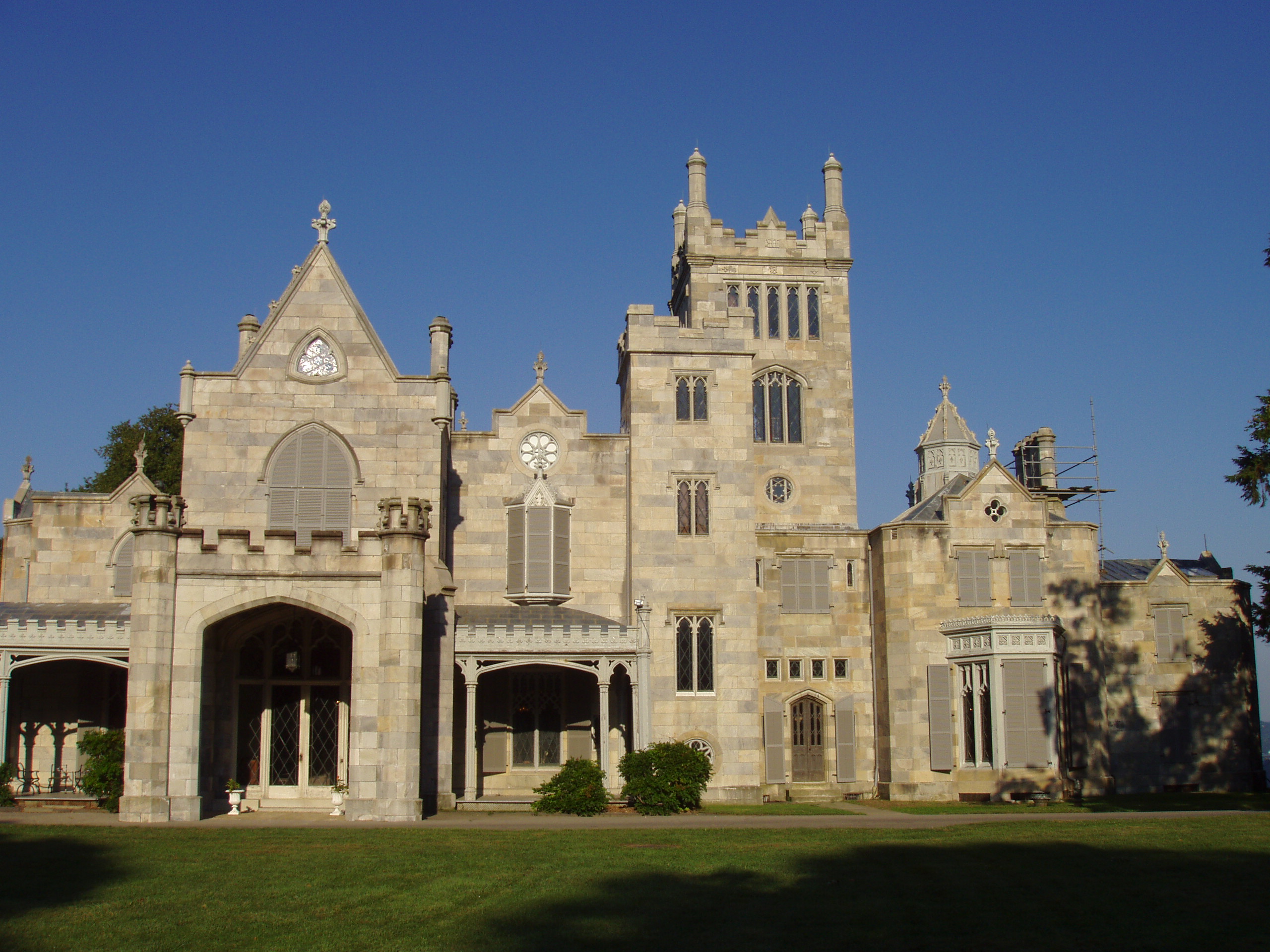


Alexander Jackson Davis (July 24, 1803 – January 14, 1892) was an American architect known particularly for his association with the Gothic Revival style.
Education
Davis was born in New York City and studied at the American Academy of Fine Arts, the New-York Drawing Association, and from the antique casts of the National Academy of Design. Dropping out of school, he became a lithographer and from 1826 he worked as a draftsman for Josiah R. Brady, a New York architect who was an early exponent of the Gothic Revival style. Brady's Gothic 1824 St. Luke's Episcopal Church is the oldest surviving structure in Rochester, New York.
Career
Partnership with Ithiel Town
Davis made a first independent career as an architectural illustrator in the 1820s,
From 1829, in partnership with Town, Davis formed the first recognizably modern architectural office and designed many late Classical buildings, including some of public prominence. In Washington, Davis designed the Executive Department offices and with Robert Mills the first Patent Office building (1834–1836). He also designed the Custom House of New York City (1833–1842). Bridgeport City Hall, constructed in 1853 and 1854, is a later government building Davis designed in the Classical style.
A series of consultations over state capitols followed, none apparently built entirely as Davis planned: the Indiana State House, has a stark Greek Doric order colonnade across a recessed entrance, flanked by recessed window bays that continue the rhythm of the central portico, all under a unique drum capped by a low saucer dome. With Town's partner James Dakin, he designed the noble colossal Corinthian order of the Greek Revival "Colonnade Row" on New York's Lafayette Street, the very first apartments designed for the prosperous American middle class (1833, half still standing). Two years after its completion, Davis was hired to design the Dutch Reformed Church upriver in Newburgh, inspired by the Temple of Poseidon, both positioned for the viewing of maritime travelers. He continued in partnership with Town until shortly before Town's death in 1844.
In 1831, he was elected an associate member of the National Academy. From 1835, Davis began work on his only publication, Rural Residences, the first pattern book for picturesque residences in a domesticated Gothic Revival style, which could be executed in carpentry, and also containing the first of the Italianate style "Tuscan" villas, flat-roofed with wide overhanging eaves and picturesque corner towers. Unfortunately, the Panic of 1837 cut short his plans for a series of like volumes, but Davis soon formed a partnership with Andrew Jackson Downing, illustrating his widely read books.
Additions to Vesper Cliff were built in 1834.
Country residences (1840 - 1860)
The 1840s and 1850s were Davis's two most fruitful decades as a designer of country houses. His villa "Lyndhurst" at Tarrytown, New York, is his most famous house. Many of his villas were built in the scenic Hudson River Valley—where his style informed the vernacular Hudson River Bracketed that gave Edith Wharton a title for a novel—but Davis sent plans and specifications to clients as far afield as Indiana. Around 1850, he designed Sharswood Plantation for the Virginian planter Nathaniel Crenshaw Miller. He designed Blandwood, the 1846 home of Governor John Motley Morehead that stands as America's earliest Italianate Tuscan Villa. Innovative interior features, including his designs for mantels and sideboards, were also widely imitated in the trade. Other influential interior details include pocket shutters at windows, bay windows, and mirrored surfaces to reflect natural light. The Greek Revival style William Walsh House was built at Albany, New York, and Gothic Revival style Belmead was built near Powhatan, Virginia, in 1845.
Two smaller but well known structures designed by Davis include one built for John Cox Stevens in 1845; Stevens was the first Commodore of the New York Yacht Club and the small Carpenter Gothic building on his property near Hoboken was given to NYYC to be used as its first clubhouse. This building, fondly called "Station 10", still exists and can be found in Newport. Davis built a similar pavilion for his colleague and fellow NYYC founder, John Clarkson Jay, on Jay's Long Island Sound waterfront property in Rye, New York, in 1849. Although this building was taken down in the 1950s, the original setting and garden where it was once located is part of a National Historic Landmark site and open to the public.
Inspired in part by friend Andrew Jackson Downing, Davis constructed several Gothic Revival cottage-style homes in Central New York, including the 1852-completed Reuel E. Smith House, which is included in the National Register of Historic Places.
In 1851, Davis completed Winyah Park, one of approximately eighteen or more Italianate houses he designed in the 1850s. Winyah was built for Richard Lathers, who had studied architecture with Davis in New York in the 1830s. It was situated on Lathers's estate in the town of New Rochelle in Westchester County, New York. For this design Davis won the first architectural prize at the New York World's Fair of 1853–1854. He used its most striking feature, two adjacent yet contrasting towers, in a much larger house named Grace Hill, built in Brooklyn between 1853 and 1854. In both Winyah and Grace Hill, broad octagonal towers serve as visual anchors for the taller square towers. Lathers later employed Davis to design four additional "investment houses" on his property which became known as "Lathers's Hill". The homes included two Gothic cottages and "Tudor Villa" constructed in 1858, and "Pointed Villa" constructed in 1859. In 1890, the artist Frederic Remington purchased one of these cottages from which he created his estate "Endion", which served as the studio for most of his artistic career.
The success of "Winyah Park" and "Lathers's Hill" generated other important commissions for Davis in New Rochelle, including two cottage-villas, Wildcliff and Sans Souci, which he designed for members of a prominent Davenport family. Both homes feature Davis's signature central gable. Another extant Gothic Revival commission is Whitby Castle, designed in 1852 for Davis' lifelong friend William Chapman. The building is part of the Boston Post Road Historic District (Rye, New York) and retains many original features. Today it is used as the clubhouse for the Rye Golf Club.
Davis was invited to become a member of the American Institute of Architects shortly after its founding in 1857. In the late 1850s, Davis worked with the entrepreneur Llewellyn S. Haskell to create Llewellyn Park in West Orange, New Jersey, a garden suburb that was one of the first planned residential communities in the United States.{{cite book |url-access=registration
Davis designed buildings for the University of Michigan in 1838, and in the 1840s he designed buildings for the University of North Carolina at Chapel Hill. At the Virginia Military Institute, Jackson's designs from 1848 through the 1850s created the first entirely Gothic Revival college campus, built in brick and stuccoed to imitate stone. Davis's plan for the Barracks quadrangle was interrupted by the Civil War; it was sympathetically completed to designs of Bertram Goodhue in the early 20th century.
Davis is credited with coining the term "Collegiate Gothic", documented in a handwritten description of his own "English Collegiate Gothic Mansion" of 1853 for the Harrals of Bridgeport, Connecticut.
He married Margaret Beale in 1853 and had two children.
Declining patronage and retirement (1860–1892)
With the onset of Civil War in 1861, patronage in house building dried up, and after the war, new styles unsympathetic to Davis's nature were in vogue. In 1867, he designed the Hurst-Pierrepont Estate. In 1878, Davis closed his office. He built little in the last thirty years of his life, but spent his easy retirement in West Orange drawing plans for grandiose schemes that he never expected to build, and selecting and ordering his designs and papers, by which he was determined to be remembered. They are shared by four New York institutions: the Avery Architectural and Fine Arts Library at Columbia University, the New York Public Library, the New-York Historical Society, and the Metropolitan Museum of Art. A further collection of Davis material has been assembled at the Winterthur Museum, Garden and Library. Davis is interred in Bloomfield Cemetery in Bloomfield, New Jersey.
Selected works
- Belmead, Powhatan, Virginia (1845)
- Blandwood, Greensboro, North Carolina (1846)
- Bridgeport City Hall, Bridgeport, Connecticut (1853–1854)
- Davenport House, New Rochelle, New York (1859)
- [[File:House for William J. Rotch, New Bedford, Massachusetts (front elevation) MET DT239695.jpg|thumb|House for William J. Rotch, New Bedford, Massachusetts (front elevation) 1845. The Reuel E. Smith house (1852) is similar to this plan.]]Litchfield Villa, Brooklyn, New York (1857)
- Lyndhurst, Tarrytown, New York (1838)
- Reuel E. Smith House, Skaneateles, New York (1852)
- Wadsworth Atheneum, Hartford, Connecticut (1842)
- Wildcliff, New Rochelle, New York (1852)
- Winyah Park, New Rochelle, New York (1851)
References
References
- "United States Capitol, Washington, D.C.: East Front Elevation, Rendering". [[World Digital Library]].
- "Monroe County (NY) Library System - Pathfinders - Architecture - Every Building Tells a Story".
- (2020-06-08). "Wooded Path".
- Historic American Buildings Survey, creator. (1933-01-01). "Sachem's Wood, Hillhouse Avenue, New Haven, New Haven County, CT".
- William E. Krattinger. (n.d.). "National Register of Historic Places Registration: Vesper Cliff". [[New York State Office of Parks, Recreation and Historic Preservation]].
- "Archived item".
- {{NRISref. 2009a
- Society, South Carolina Historical. (28 March 2018). "This discursive biographical sketch of Colonel Richard Lathers, 1841-1902: was compiled as required for honorary membership in Post 509, Grand Army of the Republic ...". J.B. Lippincott.
- Edwards, Lee M.. (1986). "Domestic Bliss: Family Life in American Painting, 1840-1910". Hudson River Museum.
- (1909). "Architectural Record". McGraw-Hill.
- "History of The American Institute of Architects". American Institute of Architects.
- "Clayton Hall, Virginia Military Institute Barracks, by Alexander Jackson Davis".
- "Barracks History Timeline - VMI Archives - Virginia Military Institute".
- (31 December 2002). "Aspirations for Excellence: Alexander Jackson Davis and the First Campus Plan for the University of Michigan, 1838". University of Michigan Press.
- "Bridgeport's Gothic Ornament The Harral-Wheeler House". Smithsonian Institution Press.
- Elise M. Barry. (April 1982). "National Register of Historic Places Registration: Hurst-Pierrepont Estate". [[New York State Office of Parks, Recreation and Historic Preservation]].
- "NJ Historical Trust".
This article was imported from Wikipedia and is available under the Creative Commons Attribution-ShareAlike 4.0 License. Content has been adapted to SurfDoc format. Original contributors can be found on the article history page.
Ask Mako anything about Alexander Jackson Davis — get instant answers, deeper analysis, and related topics.
Research with MakoFree with your Surf account
Create a free account to save articles, ask Mako questions, and organize your research.
Sign up freeThis content may have been generated or modified by AI. CloudSurf Software LLC is not responsible for the accuracy, completeness, or reliability of AI-generated content. Always verify important information from primary sources.
Report