From Surf Wiki (app.surf) — the open knowledge base
Alembic
Alchemical still
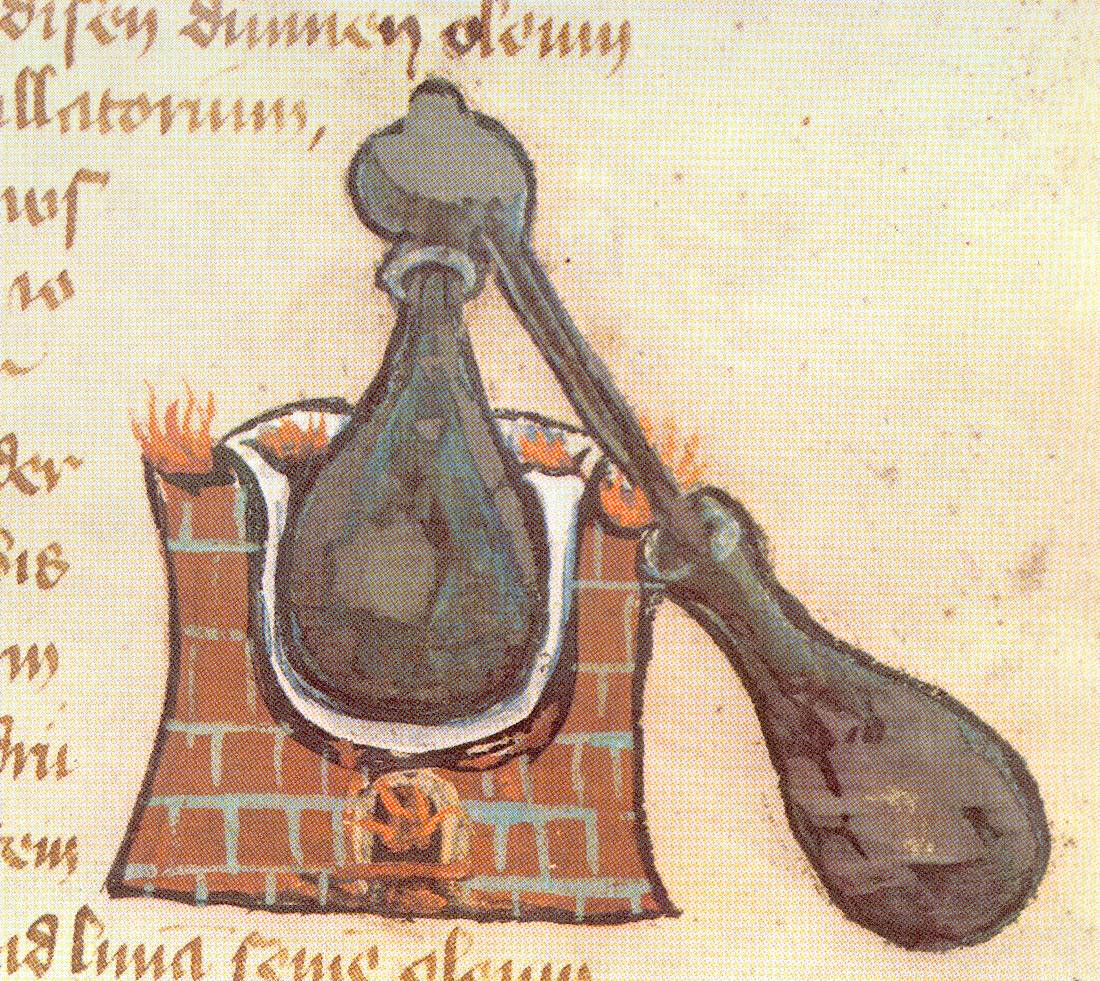
Alchemical still
alchemical stills
An alembic (from , originating from , 'cup, beaker') is an alchemical still consisting of two vessels connected by a tube, used for distillation of liquids.
Description
The complete distilling apparatus consists of three parts:
- the "cucurbit" (Arabic: ḳarʿa; Greek: βῖκος, bîkos), the still pot containing the liquid to be distilled, which is heated by a flame
- the "head" or "cap" (إِنْبِيق{{lrm}}, ʾinbīq; Greek ἄμβιξ, ambix) which fits over the mouth of the cucurbit to receive the vapors, with an attached downward-sloping "tube" (σωλήν, sōlēn)
- the "receiver" (قَابِلَة, qābila; ἄγγος, angos or φιάλη, phialē) container
In the case of another distilling vessel, the retort, the "cap" and the "cucurbit" have been combined to form a single vessel. The anbik The complete distilling apparatus consists of three parts: the "cucurbit" (ḳarʿa), the "head" or "cap" (anbīḳ) and the "receiver" (ḳābila). is also called the raʾs (the Arabic word raʾs means "head") of the cucurbit. The liquid in the cucurbit is heated or boiled; the vapour rises into the anbik, where it cools by contact with the walls and condenses, running down the spout into the receiver. A modern descendant of the alembic is the pot still, used to produce distilled beverages.
History

Dioscorides's ambix, described in his De materia medica (c. 50 C.E.), is a helmet-shaped lid for gathering condensed mercury. For Athenaeus (c. 225 C.E.) it is a bottle or flask. For later chemists it denoted various parts of crude distillation devices.
Alembic drawings appear in works of Cleopatra the Alchemist (3rd century C.E.), Zosimos of Panopolis (c. 300 C.E.), and Synesius (c. 373 – c. 414 C.E.). There were alembics with two (dibikos) and three (tribikos) receivers. According to Zosimos of Panopolis, the alembic was invented by Mary the Jewess.
The anbik is described by Ibn al-Awwam in his Kitab al-Filaha (Book of Agriculture), where he explains how rose-water is distilled. Amongst others, it is mentioned in the Mafatih al-Ulum (Key of Sciences) of Khwarizmi and the Kitab al-Asrar (Book of Secrets) of al-Razi. Some illustrations occur in the Latin translations of works which are attributed to Geber. File:Man Paris, Grec 2327 fol 83v.jpg|Alembic of Zosimos of Panopolis File:Alembic (PSF).jpg|Modern alembic File:AlambicCharentaisChalvignacPrulhoDistillation.jpg|Large "charentais" type alembic for distilling spirits File:Alambique 056.jpg|Copper retort File:Alembic.jpg|Glass alembic File:Chemical Faculty of TUG, staircase.jpg|Alembic metalwork in the staircase at the Chemical Faculty of Gdańsk University of Technology, 1904
Unicode
The Unicode character set specifies three symbols for alembics: the pictogram ⚗ (), its emoji variation ⚗️ (), and the ancient alchemical symbol 🝪 ().
References
References
- M. Ullmann. (1986). "[[The Encyclopaedia of Islam]]". Brill.
- (1986). "[[The Encyclopaedia of Islam]]". Brill.
- (1897). "[[A Greek–English Lexicon]]". Harper & Brothers.
- Marcellin Berthelot. (1889). "Introduction à l'étude de la chimie des anciens et du moyen âge". Steinheil.
- Edmund Lippmann. (1919). "Entstehung und Ausbreitung der Alchemie". Springer.
This article was imported from Wikipedia and is available under the Creative Commons Attribution-ShareAlike 4.0 License. Content has been adapted to SurfDoc format. Original contributors can be found on the article history page.
Ask Mako anything about Alembic — get instant answers, deeper analysis, and related topics.
Research with MakoFree with your Surf account
Create a free account to save articles, ask Mako questions, and organize your research.
Sign up freeThis content may have been generated or modified by AI. CloudSurf Software LLC is not responsible for the accuracy, completeness, or reliability of AI-generated content. Always verify important information from primary sources.
Report