From Surf Wiki (app.surf) — the open knowledge base
Albert Pike Memorial
Statue in Washington, D.C., U.S.
Statue in Washington, D.C., U.S.
| Field | Value |
|---|---|
| monument_name | Albert Pike Memorial |
| image | Albert Pike memorial.jpg |
| caption | Albert Pike Memorial in 2008 |
| location | 3rd and D Streets NW, Washington, D.C., U.S. |
| designer | Gaetano Trentanove |
| material | bronze (sculpture) |
| granite (base) | |
| height | 28 ft (sculpture and base) |
| open | October 23, 1901 |
| dedicated_to | Albert Pike |
| coordinates | |
| embed | yes |
| nrhp_type | cp |
| nocat | yes |
| partof | Civil War Monuments in Washington, D.C. |
| added | September 20, 1978 |
| refnum | 78000257 |
granite (base) The Albert Pike Memorial is a public artwork in Washington, D.C. It honors Albert Pike (1809–1891), a senior officer of the Confederate States Army as well as a poet, lawyer, and influential figure in the Scottish Rite of freemasonry. The memorial sits near the corner of 3rd and D Streets NW in the Judiciary Square neighborhood. The memorial's two bronze figures were sculpted by Gaetano Trentanove, the Italian-American sculptor of another Washington, D.C., sculptural landmark, the Daniel Webster Memorial. The dedication ceremony in 1901 was attended by thousands of Masons who marched in a celebratory parade.
The memorial is one of 18 Civil War monuments in Washington, D.C., which were collectively listed on the National Register of Historic Places in 1978. The memorial is owned and maintained by the National Park Service (NPS), a federal agency of the Interior Department. The Pike statue is the only outdoor sculpture in Washington, D.C., honoring a Confederate general. Though Pike is depicted as a Mason, not a soldier, concerns and protests over the memorial have occurred for decades. It was partially demolished in 2020 by protestors responding to the murder of George Floyd. In 2025, the NPS refurbished and reinstalled the statue.
History
Background
Albert Pike (1809–1891) was a Massachusetts native who became a schoolteacher and frontiersman before settling in Arkansas. There he began teaching again and continued to write poetry, a lifelong passion. His letters to local newspapers led to a job offer as an editor for the Arkansas Advocate, a newspaper in Little Rock affiliated with the Whig Party. Pike later became a successful lawyer specializing in Native American claims against the U.S. government. He served as a captain in the Mexican–American War and resumed his legal practice following the war. In the 1850s, Pike switched his allegiance to the Know Nothing Party due to the Whig Party's reluctance to embrace slavery and sided with the Confederacy when Southern states seceded from the United States in 1861.
During the Civil War, Pike's knowledge of Native Americans led to him being commissioned a brigadier general in the Confederate Army. Pike assembled an Indian cavalry loyal to the Confederacy and led them in battle at Pea Ridge, where his poor leadership and inability to keep the cavalry engaged with the enemy was a contributing factor to the Confederates' loss. Alleged atrocities committed by his troops include the scalping of captured enemy combatants. A few months after the battle, Pike resigned from the army and resumed practicing law. Following the war, Pike settled in Memphis, Tennessee, where it was rumored he became involved with the Ku Klux Klan (KKK), although "this is not certain."
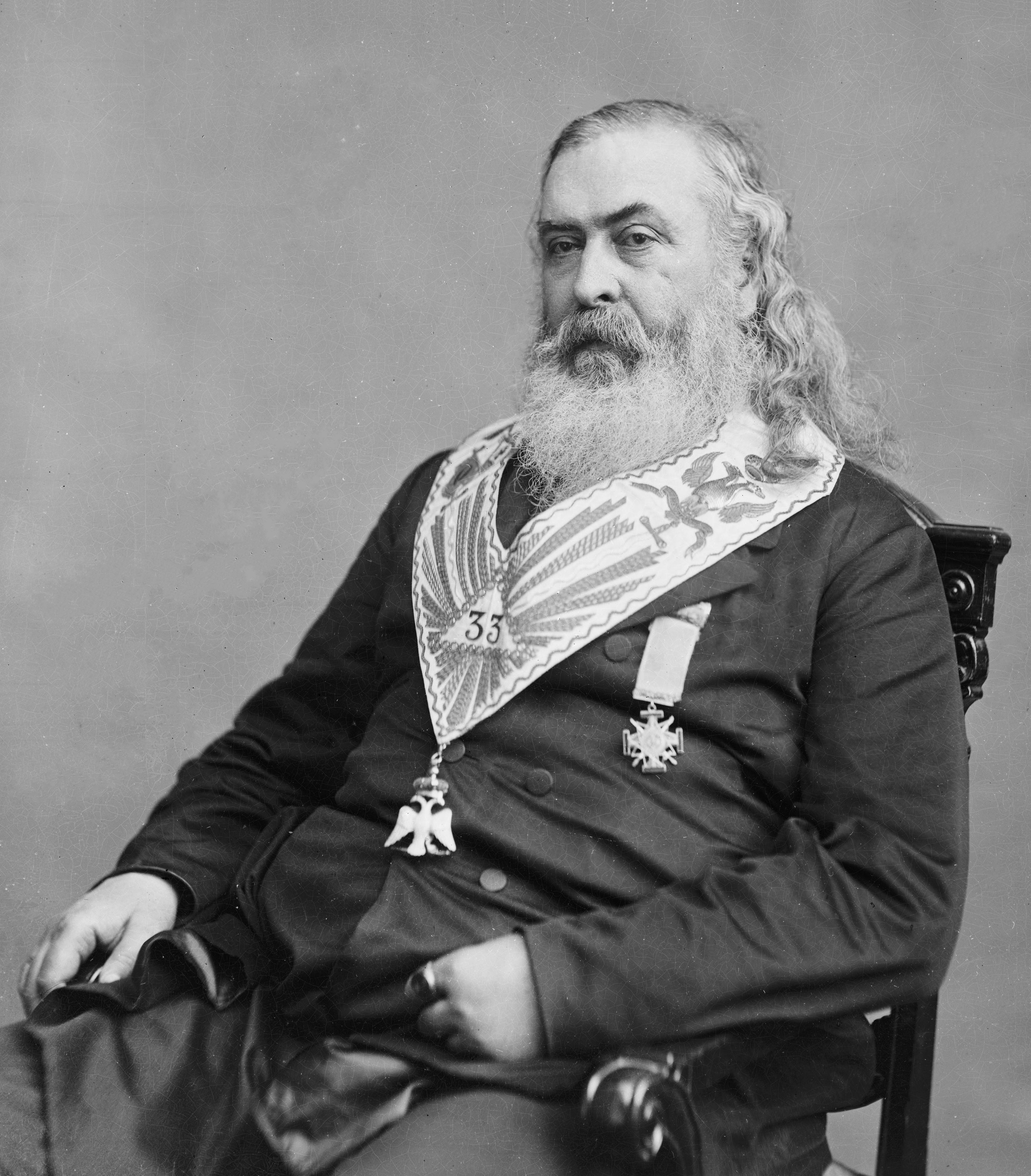
Around 1870, Pike moved to Washington, D.C. to practice law and continue serving as Sovereign Grand Commander (SGC) of the Washington-based Supreme Council, Southern Jurisdiction (SC-SJ), one of two jurisdictions in the Scottish Rite. Pike had become a Mason in 1850 and quickly rose through its ranks, becoming the SGC in 1859. He rewrote and interpreted Masonic rituals and compiled the Southern Jurisdiction's first philosophical document, Morals and Dogma of the Ancient and Accepted Scottish Rite of Freemasonry, an influential book in the organization. Pike continued serving as SGC until he died in 1891.
Pike once stated, "When I am dead, I wish my monument to be builded only in the hearts and memories of my brethren of the Ancient and Accepted Rite". A few years after his death, Masons began plans for a monument in the nation's capital. The SC-SJ chose Italian-American artist Gaetano Trentanove to sculpt the memorial. Trentanove was an acquaintance of Pike and had recently received praise for his sculpture of Jacques Marquette housed in the National Statuary Hall Collection. While Trentanove was working on the commission, Masons lobbied members of Congress for public land in Washington, D.C., where the monument could be placed.
When members of the Grand Army of the Republic (GAR), a fraternal organization of Union veterans, became aware of plans for a public memorial to be erected in Washington, D.C. in honor of a Confederate general, they contacted congressmen and told them it would be a disgrace to the memories of all Union soldiers. On April 9, 1898, members of Congress approved the memorial after Masons assured them it would depict Pike as a civilian, not a soldier.
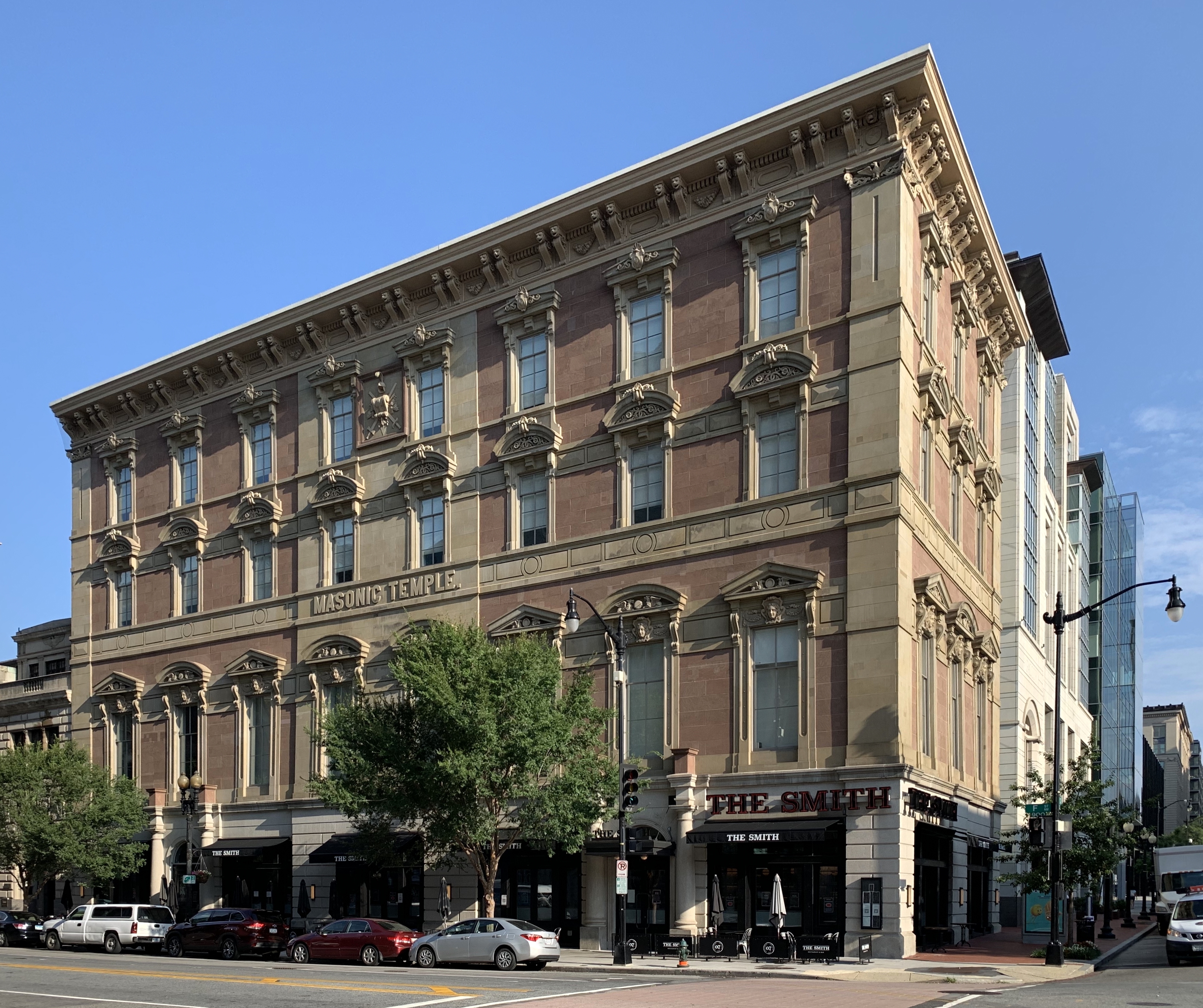
Excavation for the memorial site took place in the summer of 1899 and on July 4, 1900, the cornerstone was laid. Prior to the cornerstone ceremony, several members of the SC-SJ, including Third Assistant Secretary of State Thomas W. Cridler, gathered at the House of the Temple at 433 3rd Street NW (current site of the Tax Court Building), where Pike had lived, to reminisce. The men signed a parchment noting the date and who was in attendance. At the ceremony, the parchment was enclosed in a bottle and placed in an opening of the memorial's foundation. Fabrication was carried out by the Washington Granite Monumental Company and the sculptures founded by Fonderia Galli.
Dedication
The dedication ceremony on October 23, 1901, was planned to coincide with the centennial anniversary of the SC-SJ. The parade ended at the memorial site, on a triangular lot bordered by 3rd Street, D Street, and Indiana Avenue NW. A large temporary stand for invited guests and ceremony participants was built at the base of the memorial.
Following a musical performance by Haley's Washington Band, grand commanders of the SC-SJ, the Scottish Rite's Northern Masonic Jurisdiction, and Royal Order of Scotland all released the halyard holding the U.S. flag that covered the memorial. This was followed by loud cheers from the crowd and a prayer given by Masonic chaplain Charles Alvin Smith. Frederick Webber, secretary general of the SC-SJ, then gave a speech and formally presented the memorial to the American people: President of the District Commission H. B. F. McFarland accepted the memorial on behalf of the American people: After the band performed additional music, a benediction was given, and the ceremony concluded. Throughout the ceremony, Pike was portrayed as a kind poet. There were a few references to his service as a Confederate general.
Later history
For many years, members of the United Daughters of the Confederacy would hold ceremonies at the site on Pike's birthday and Masons would decorate the memorial, though the latter still happens on occasion. The memorial is one of 18 Civil War monuments in Washington, D.C., which were collectively listed on the National Register of Historic Places on September 20, 1978, and the District of Columbia Inventory of Historic Sites on March 3, 1979. The memorial is also designated a contributing property to the Pennsylvania Avenue National Historic Site, established on September 30, 1965. In 1993, the memorial was surveyed by the Smithsonian Institution as part of its Save Outdoor Sculpture! program, and it was deemed "well maintained". The memorial is owned and maintained by the National Park Service (NPS), an operating unit of the United States Department of the Interior.

Starting in the 1990s, there was renewed interest in removing the statue. In late 1992, members of the LaRouche movement, including civil rights activist and Lyndon LaRouche's vice-presidential candidate James Bevel, began a series of protests demanding the memorial be removed, citing Pike's alleged links with the KKK. During one such event, LaRouche supporters draped Pike's statue with a KKK pointed hat and gown. Bevel stated: "One way or the other, this statue is coming down. Either the statue will be taken down gracefully, or it will be torn down." The protesters sought a congressional resolution to have the statue removed and replaced with a monument inscribed with the Declaration of Independence. Historian and LaRouche activist Anton Chaitkin called the statue a "monument to terrorism" and members of the Council of the District of Columbia petitioned to have the statue removed.
Michael Farquhar, a former writer and editor at The Washington Post, called Pike a "blustering blowhard, a feeble poet, a laughable hypocrite, a shameless jingoist, a notoriously insubordinate military officer, and yes, a bigot with genocidal inclinations". Boettjer stated: "[Pike] received a full pardon from the federal government for his service in the Civil War as a Confederate general. There is not a jot of reliable proof that Albert Pike was ever a member, much less an officer, of the Klan." He also claimed a LaRouche video promised the Middle East conflict would be solved and World War III averted if the statue was removed. The weekly protests by LaRouche supporters continued into 1993. That year Bevel and Chaitkin were convicted of "unlawful statue climbing" and sentenced to one week in jail.
There was continued criticism of the memorial in the 1990s and 21st century. John F. Doyle, a retired judge of the Superior Court of the District of Columbia, said Pike was responsible for Native American casualties during the Civil War and their subsequent loss of land. C. Fred Kleinknecht, then chief executive officer of the Scottish Rite, defended Pike and said the statue was not in honor of his role as a Confederate general but as an "advocate for Native Americans and his role as a champion of educational and social reform and for his literary accomplishments and scholarship." Scottish Rite Journal managing editor S. Brent Morris has also defended the memorial and Pike's role as a Confederate officer: "We're not embarrassed in the least that he was a Confederate general...Even in 1901, I don't think the United States Congress would have approved honoring a Confederate general, so he was honored for all his other accomplishments."
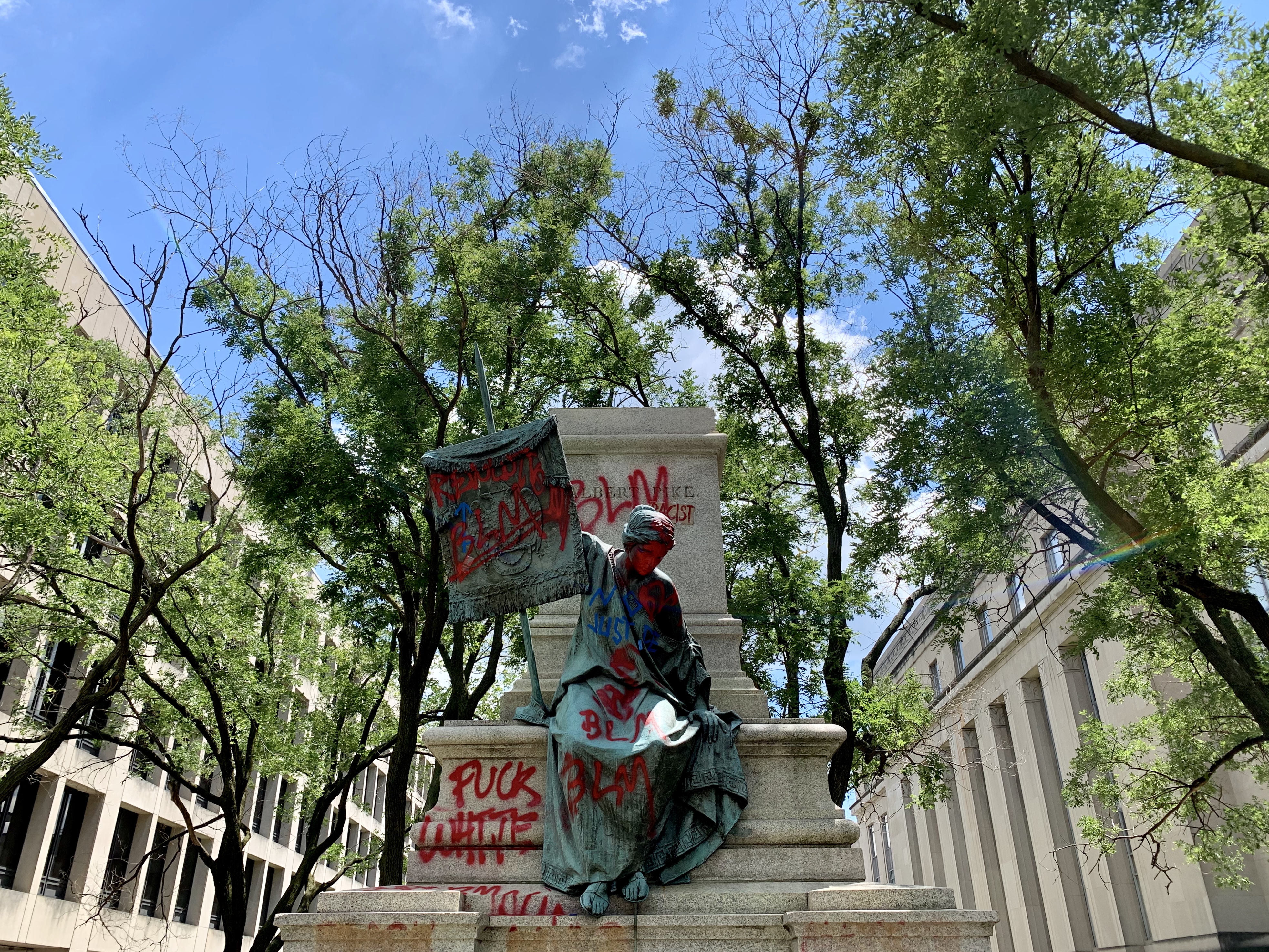
Following the 2017 Unite the Right rally, there was renewed interest in many cities and states to remove Confederate statues and memorials from public land. The day after the rally, protesters gathered at the Pike memorial and chanted "tear it down", and during another protest, it was vandalized when someone threw red paint on it. Local government officials, including some members of the council, Attorney General for the District of Columbia Karl Racine, and Delegate Eleanor Holmes Norton, asked the NPS to remove the memorial. In July 2019 Norton introduced House bill H.R. 4135 directing that the statue be removed.
Damage and subsequent actions
On June 19, 2020, after weeks of protests in response to the murder of George Floyd in Minneapolis, protesters using rope and chains toppled the Pike statue, doused it with a flammable liquid and ignited it. After several minutes, local police intervened, extinguished the flames, and left the scene. The following day the National Park Service removed the statue. The pedestal was covered in graffiti that but later cleaned.
Although Norton had been a strong proponent of removing the statue, after its toppling, she clarified: "I would like these statues to be placed in museums, and the history of the statue told so that we don't lose this moment in history. We don't want to obliterate our history. The way to keep that history alive so we can never repeat this kind of history again."
On July 2, 2020, the United States Department of Justice (DOJ) announced the arrest and charging of a man who had helped destroy the Pike statue by pulling it from its base and setting it on fire. The DOJ's complaint alleged that the man had been captured on video dousing the statue with a flammable liquid, igniting it as it lay on the ground, and using the fire to light a cigarette. The DOJ also charged the man with being among a crowd of rioters that on June 22 had unsuccessfully attempted to topple Clark Mills' 1852 bronze equestrian statue of Andrew Jackson in Lafayette Square in President's Park, directly north of the White House. The DOJ alleged that the man was seen on video climbing up onto the federally-owned Jackson statue and affixing a rope that was then used to try to pull the statue down. In 2025, the NPS reinstalled the refurbished Pike statue in keeping with historic preservation and executive orders by Trump.
Design and location

The Pike memorial includes the only outdoor sculpture in Washington, D.C. honoring a Confederate general, although he is dressed as a civilian, not a soldier. The memorial is located in Reservation 188 at the southwest corner of 3rd and D Street NW in the Judiciary Square neighborhood. It is sited between the U.S. Department of Labor's Frances Perkins Building and Metropolitan Police Department headquarters.
The bronze sculpture of Pike measures 11 ft high. It depicts him as a Masonic leader, not a Confederate officer. He is wearing a double-breasted vest and a long coat. His right arm is extended, and with the left hand, he holds a book, thought to be his work Morals and Dogma of the Ancient and Accepted Scottish Rite of Freemasonry. The sculpture surmounts a granite, Beaux-Arts base that is 17.2 ft tall and 17.1 ft wide. On the front of the memorial (north side), a bronze sculpture representing the Goddess of Masonry rests halfway down the base. With her right hand, she holds the banner of the Scottish Rite on a staff. She is wearing a long Greek robe and facing downward, her ankles crossed and feet dangling.
Inscriptions on the memorial include the following:
- G. TRENTANOVE / FLLI GALLI FUSERO (base of Pike's sculpture)
- 33 / DEUS MEUMQUE JUS (on a banner held by Goddess figure)
- ALBERT PIKE (front of upper base)
- Born , 1809. / Died , 1891. (rear of base)
- AUTHOR – VIXIT / LABORUM EJUS SUPERSTITES SUNT FRUCTUS – POET (front of lower base)
- SCHOLAR – SOLDIER (left side of lower base)
- ORATOR – JURIST (right side of lower base)
- PHILANTHROPIST – ERECTED 1901 BY THE SUPREME COUNCIL OF / THE AASR OF FREEMASONRY / FOR THE S J U.S.A. – PHILOSOPHER (rear of lower base)
References
References
- (September 30, 2009). "District of Columbia Inventory of Historic Sites". District of Columbia Office of Planning – Historic Preservation Office.
- {{NRISref
- Jacob, Kathryn Allamong. (1998). "Testament to Union: Civil War Monuments in Washington, D.C.". JHU Press.
- Moneyhon, Carl H.. "Albert Pike (1809–1891)". Central Arkansas Library System.
- Loewen, James W.. (July 1, 2015). "Why do people believe myths about the Confederacy? Because our textbooks and monuments are wrong.". The Washington Post.
- (May 26, 1898). "The Veterans Are Up In Arms". The Evening Press.
- (July 11, 1899). "Statue of Albert Pike". Alexandria Gazette.
- (July 4, 1900). "Corner Stone in Place". Evening Star.
- Doyle, John F.. (March 7, 1998). "General's Role Brings Indian Bloodshed, Land Loss". The Washington Times.
- (October 10, 1901). "The Scottish Rite". Evening Star.
- (October 17, 1901). "Centennial Celebration". Evening Star.
- (October 23, 1901). "A Centennial Day". Evening Star.
- (October 8, 1992). "Protesters Want Statue Removed". The Washington Post.
- (November 30, 1992). "Confederate Statue Target Of Protesters". TimesDaily.
- Chaitkin, Anton. (April 4, 1993). "It's a Monument to Terrorism". The Washington Post.
- Farquhar, Michael. (March 14, 1993). "Pike's Pique: Why This Statue Is a Bust". The Washington Post.
- Boettjer, John W.. (March 24, 1993). "No Proof Of Klan Membership". The Washington Post.
- (December 18, 1992). "Removal of Washington statue of Klan organizer supported". Austin American Statesman.
- (April 20, 1993). "Judge Convicts Two Protesters Of Pike Statue". The Washington Post.
- Zimmerman, Richard G.. (April 30, 2000). "Poor Choice For a Pedestal". The Washington Post.
- Kleinknecht, C. Fred. (May 7, 2000). "This Man Deserves to Be on a Pedestal". The Washington Post.
- Hart, Benjamin. (August 14, 2017). "Local Officials Call for Removal of Confederate Memorials After Charlottesville Violence". New York.
- (August 18, 2017). "Red Paint Thrown on DC Statue of Confederate General". WRC-TV.
- Iacone, Amanda. (August 16, 2017). "DC officials seek to remove statue of Confederate general". WTOP.
- "H.R. 4135: To direct the Secretary of the Interior to remove the statue to the memory and in honor of Albert Pike erected near Judiciary Square in the District of Columbia, and for other purposes".
- Stein, Perry. (June 20, 2020). "Protesters topple only Confederate statue in the nation's capital". The Washington Post.
- Schultz, Kyley. (June 20, 2020). "Who was Confederate General Albert Pike, and why was his statue in DC in the first place?". WUSA.
- "Public Lands in DC". Government of the District of Columbis.
- (July 2, 2020). "Man Charged in Federal Court for Attempting to Tear Down Statue of Andrew Jackson in Lafayette Square Amid Protests: Man also Charged with Destruction of Albert Pike Statue". United States Department of Justice: United States Attorney for the District of Columbia.
- Gibson, Jake. (July 2, 2020). "Feds arrest 'ringleader' in attack on Andrew Jackson statue by White House". Fox News.
- Weil, Martin. (July 7, 2020). "D.C. man set Confederate statue on fire, prosectors allege". The Washington Post.
- (August 4, 2025). "Statue of Confederate general toppled in 2020 to be reinstalled in D.C.". NBC Washington.
- (August 4, 2025). "National Park Service to restore and reinstall Albert Pike statue". National Mall and Memorial Parks {{!}} U.S. National Park Service.
- Tsioulcas, Anastasia. (October 27, 2025). "A Confederate statue toppled in Washington, D.C., in 2020 has been reinstalled". NPR.
- Montgomery, David. (April 12, 2011). "Hunting for the Confederacy in D.C.". The Washington Post.
- Loewen, James W.. (2013). "Lies Across America: What Our Historic Sites Get Wrong". The New Press.
- Goode, James M.. (1974). "The Outdoor Sculpture of Washington, D.C.". Smithsonian Institution Press.
This article was imported from Wikipedia and is available under the Creative Commons Attribution-ShareAlike 4.0 License. Content has been adapted to SurfDoc format. Original contributors can be found on the article history page.
Ask Mako anything about Albert Pike Memorial — get instant answers, deeper analysis, and related topics.
Research with MakoFree with your Surf account
Create a free account to save articles, ask Mako questions, and organize your research.
Sign up freeThis content may have been generated or modified by AI. CloudSurf Software LLC is not responsible for the accuracy, completeness, or reliability of AI-generated content. Always verify important information from primary sources.
Report