From Surf Wiki (app.surf) — the open knowledge base
Al-Jahiz
Arabic writer (776–869)
Arabic writer (776–869)
| Field | Value | |
|---|---|---|
| name | al-Jahiz | |
| region | Islamic Philosophy | |
| era | Islamic Golden Age/Medieval era | |
| image | Al-Jahiz stamp, 1968, Syria.jpg | |
| caption | Syrian stamp of al-Jahiz from 1968 | |
| birth_name | Abū ʿUthman ʿAmr ibn Baḥr al-Kinānī al-Baṣrī | |
| birth_date | 776 | |
| birth_place | Basra, Abbasid Caliphate | |
| death_date | December 868/January 869 (aged 92-93) | |
| death_place | Basra, Abbasid Caliphate | |
| school_tradition | Aristotelianism | |
| main_interests | Arabic literature, Biology, Trivium, Islamic studies, Islamic theology | |
| module | {{Infobox religious biography | embed = yes |
| religion | Islam | |
| denomination | Mu'tazila}} |
Abu Uthman Amr ibn Bahr al-Kinani al-Basri (; ), commonly known as al-Jahiz (, ), was an Arab Muslim theologian, intellectual, and litterateur known for his individual Arabic prose. A polymath who lived during the Abbasid Caliphate, he was the author of works of literature (including theory and criticism), theology, zoology, philosophy, grammar, dialectics, rhetoric, philology, linguistics, and politico-religious polemics. His extensive zoological work has been credited with describing principles related to natural selection, ethology, and the functions of an ecosystem.
From about 815 CE, he rose to become one of the literary figures around the Abbasid caliph al-Ma'mun (r. 813–833 CE). Although he held no official posts, he received funding from several Abbasid prime ministers, while also working as a scribe and a teacher. Al-Jahiz was part of the rationalist Mu'tazilite school of theology supported by al-Ma'mun and his two successors, Al-Mu'tasim (r. 833-842 CE) and Al-Wathiq (r. 842-847 CE).
Ibn al-Nadim lists nearly 140 titles attributed to al-Jahiz, of which 75 are extant. The best known are Kitāb al-Ḥayawān (The Book of Animals), a seven-part compendium on an array of subjects with animals as their point of departure; Kitāb al-Bayān wa-l-tabyīn (The Book of Eloquence and Exposition), a wide-ranging work on human communication; and Kitāb al-Bukhalāʾ (The Book of Misers), a collection of anecdotes on stinginess. Known for his significant engagement with religious and scholarly texts, Al-Jahiz was one of the earliest Muslims to make use of biblical material in Arabic translation. Tradition claims that he was smothered to death when a vast amount of books fell over him.
Life
The actual name of al-Jahiz was Abū ʿUthman ʿAmr ibn Bahr ibn Maḥbūb. His grandfather, Maḥbūb, was a protégé or mawali of ‘Amr ibn Qal‘ al-Kinānī, who was from Arab Banu Kinanah tribe. Not much is known about al-Jāḥiẓ's early life, but his family was very poor. Born in Basra early in 160/February 776, he asserted in a book he wrote that he was a member of the Banu Kinanah. However, the grandfather of al-Jāḥiẓ was reportedly a Black jammāl (cameleer) or ḥammāl (porter); the manuscripts differof ‘Amr ibn Qal‘ named Maḥbūb, nicknamed Fazārah, or Fazārah was his maternal grandfather, and Maḥbūb his paternal. The names may however have been confused. His nephew also reported that al-Jāḥiẓ's grandfather was a black cameleer. In the early Islamic Arabia, the designation of Black ( Arabic: السودان "as-swadan") was used to describe people like Zuṭṭ and Zanj, and based on this, several scholars have stated that al-Jahiz descended from one of these black communities, with some even suggesting that he was possibly of African descent.
He sold fish along one of the canals in Basra to help his family. Financial difficulties, however, did not stop al-Jāḥiẓ from continuously seeking knowledge. He used to gather with a group of other youths at Basra's main mosque, where they would discuss different scientific subjects. During the cultural and intellectual revolution under the Abbasid Caliphate books became readily available, and learning accessible. Al-Jāḥiẓ studied philology, lexicography and poetry from among the most learned scholars at the School of Basra, where he attended the lectures of Abū Ubaydah, al-Aṣma’ī, Sa'īd ibn Aws al-Anṣārī and studied ilm an-naḥw (علم النحو, i.e., syntax) with Akhfash al-Awsaṭ (al-Akhfash Abī al-Ḥasan). Over a twenty-five-year span studying, al-Jāḥiẓ acquired a considerable knowledge of Arabic poetry, Arabic philology, pre-Islamic Arab history, the Qur'an and the Hadiths. He read translated books on Greek sciences and Hellenistic philosophy, especially that of the Greek philosopher Aristotle. Al-Jahiz was also critical of those who followed the Hadiths of Abu Hurayra, referring to his Hadithist opponents as al-nabita ("the contemptible").
Al-Jāḥiẓ died 250 [A.D. 869], during the caliphate of al-Mu‘tazz. Al-Nadīm reports that al-Jāḥiẓ said he was about the same age as Abū Nuwās and older than al-Jammāz.
Career
While still in Basra, al-Jāḥiẓ wrote an article about the institution of the Caliphate. This is said to have been the beginning of his career as a writer, which would become his sole source of living. It is said that his mother once offered him a tray full of notebooks and told him he would earn his living from writing. He went on to write two hundred books in his lifetime on a variety of subjects, including on the Quran, Arabic grammar, zoology, poetry, lexicography, and rhetoric. Al-Jāḥiẓ was also one of the first Arabic writers to suggest a complete overhaul of the language's grammatical system, though this would not be undertaken until his fellow linguist Ibn Maḍāʾ took up the matter two hundred years later.
Al-Nadīm cited this passage from a book of al-Jāḥiẓ:When I was writing these two books, about the creation of the Qur’ān, which was the tenet given importance and honour by the Commander of the Faithful, and another about superiority in connection with the Banū Hāshim, the ‘Abd Shams, and Makhzūm. What was my due but to sit above the Simakān, Spica and Arcturus, or on top of the ‘Ayyūq, or to deal with red sulphur, or to conduct the ‘Anqā by her leading string to the Greatest King.
Al-Jāḥiẓ moved to Baghdad, then the capital of the Abbasid Caliphate, in 816 AD, because the caliphs encouraged scientists and scholars and had just founded the library of the Bayt al-Ḥikmah. But al-Nadim suspected al-Jāḥiẓ's claim that the caliph al-Ma’mūn had praised his books on the imamate and the caliphate, for his eloquent phraseology, and use of market-place speech, and that of the elite and of the kings, was exaggerated self-glorification and doubted that al-Ma’mūn could have spoken these words. Al-Jāḥiẓ was said to have admired the eloquent literary style of the director of the library, Sahl ibn Hārūn (d. 859/860) and quoted his works. Because of the caliphs' patronage and his eagerness to establish himself and reach a wider audience, al-Jāḥiẓ stayed in Baghdad.
Al-Nadīm gives two versions of an anecdote which differ in their source: his first source is Abū Hiffān and his second is the grammarian al-Mubarrad, and retells the story of al-Jāḥiẓ's reputation for being one of the three great bibliophiles and scholarsthe two others being al-Fatḥ ibn Khāqān and judge Ismā’īl ibn Isḥāq such that “whenever a book came into the hand of al-Jāḥiẓ he read through it, wherever he happened to be. He even used to rent the shops of al-warrāqūn for study.”
Al-Jāḥiẓ replaced Ibrāhīm ibn al-‘Abbās al-Ṣūlī in the government secretariat of al-Ma’mūn but left after just three days. Later at Samarra he wrote a huge number of his books. The caliph al-Ma'mun wanted al-Jāḥiẓ to teach his children, but then changed his mind when his children were frightened by al-Jāḥiẓ's boggle-eyes (جاحظ العينين). This is said to be the origin of his nickname. He enjoyed the patronage of al-Fath ibn Khaqan, the bibliophile boon companion of Caliph al-Mutawakkil, but after his murder in December 861 he left Samarra for his native Basra, where he lived on his estate with his “concubine, her maid, a manservant, and a donkey.”
Selected books
Main article: al-Jahiz bibliography
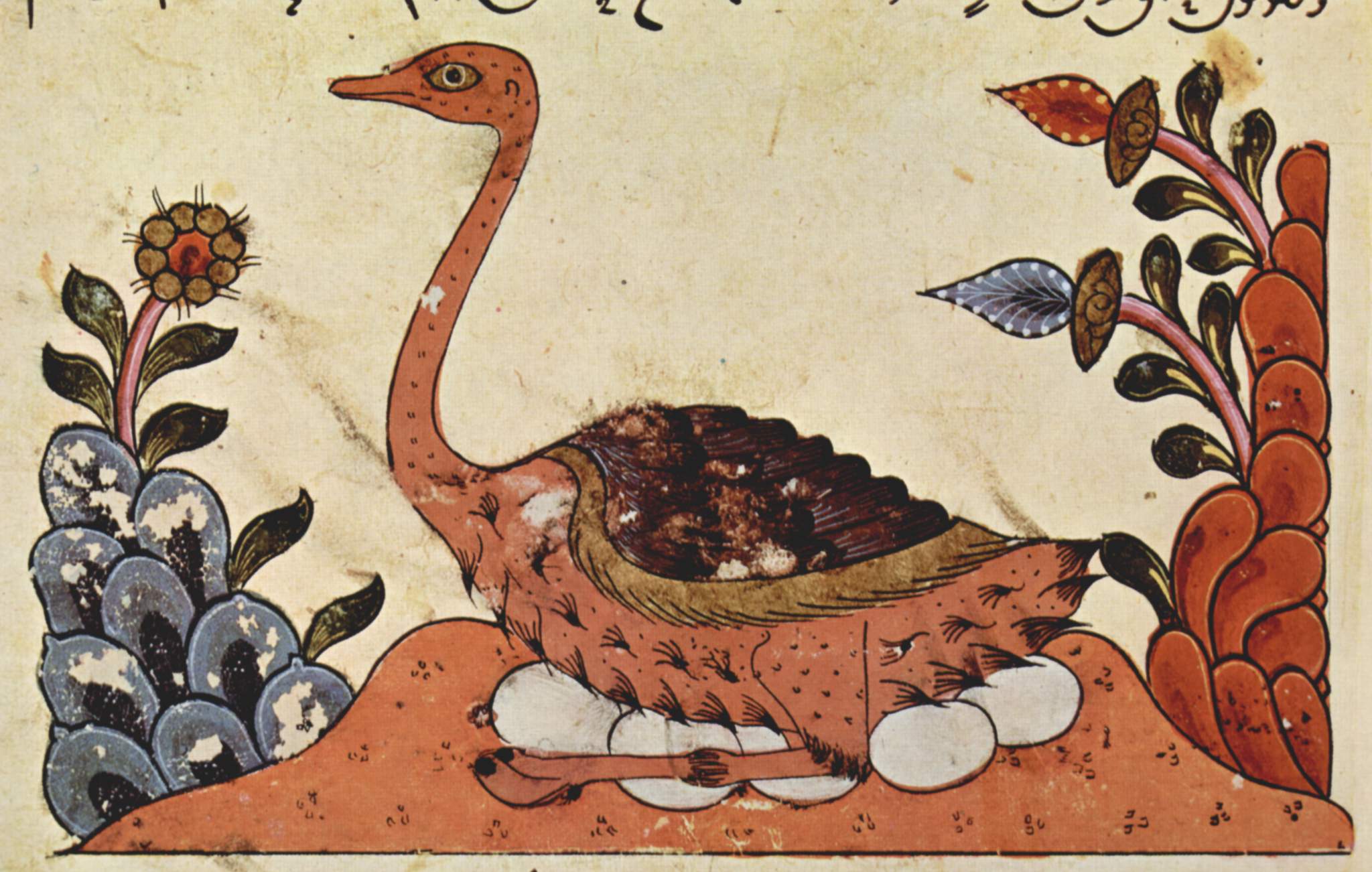
Kitāb al-Ḥayawān ({{lang|ar|كتاب الحيوان}}) 'book of the animal'
Conway Zirkle, writing about the history of natural selection science in 1941, said that an excerpt from this work was the only relevant passage he had found from an Arabian scholar. He provided a quotation describing the struggle for existence, citing a Spanish translation of this work:
The rat goes out for its food, and is clever in getting it, for it eats all animals inferior to it in strength", and in turn, it "has to avoid snakes and birds and serpents of prey, who look for it in order to devour it" and are stronger than the rat. Mosquitos "know instinctively that blood is the thing which makes them live" and when they see an animal, "they know that the skin has been fashioned to serve them as food". In turn, flies hunt the mosquito "which is the food that they like best", and predators eat the flies. "All animals, in short, can not exist without food, neither can the hunting animal escape being hunted in his turn. Every weak animal devours those weaker than itself. Strong animals cannot escape being devoured by other animals stronger than they. And in this respect, men do not differ from animals, some with respect to others, although they do not arrive at the same extremes. In short, God has disposed some human beings as a cause of life for others, and likewise, he has disposed the latter as a cause of the death of the former."
According to Frank Edgerton (2002), the claim made by some authors that al-Jahiz was an early evolutionist is "unconvincing", but the narrower claim that Jahiz "recognized the effect of environmental factors on animal life" seems valid. Rebecca Stott (2013) writes of al-Jahiz's work:
Jahiz was not concerned with argument or theorizing. He was concerned with witnessing; he promoted the pleasures and fascinations of close looking and told his readers that there was nothing more important than this. ... Here and there amid the close looking there are visions, glimpses of brilliant insight and perception about natural laws, but the overt purpose of Living beings was to persuade the reader to fulfil his moral obligation to God, an obligation enjoined by the Qu'ran: to look closely and search for understanding. ... If certain historians have claimed that Jahiz wrote about evolution a thousand years before Darwin and that he discovered natural selection, they have misunderstood. Jahiz was not trying to work out how the world began or how species had come to be. He believed that God had done the making and that he had done it brilliantly. He took divine creation and intelligent design for granted. … There was, for him, no other possible explanation. ... What is striking, however, about Jahiz’s portrait of nature in Living Beings is his vision of interconnectedness, his repeated images of nets and webs. He certainly saw ecosystems, as we would call them now, in the natural world. He also understood what we might call the survival of the fittest.
Like Aristotle, al-Jahiz believed in spontaneous generation. He frequently used metaphors of webs and nets to express the interconnectedness of the natural world.
Kitāb al-Bukhalā’ ({{lang|ar|البُخلاء}}) 'the book of misers' (a.k.a. 'avarice and the avaricious')
A collection of stories about the greedy. Humorous and satirical, it is the best example of al-Jāḥiẓ' prose style. Al-Jāḥiẓ ridicules schoolmasters, beggars, singers and scribes for their greedy behavior. Many of the stories continue to be reprinted in magazines throughout the Arabic-speaking world. The book is considered one of the best works of al-Jāḥiẓ. The book has two English translations: One by Robert Bertram Serjeant titled The Book of Misers, and another by Jim Colville titled Avarice and the Avaricious. Editions: Arabic (al-Ḥājirī, Cairo, 1958); Arabic text, French preface. Le Livre des avares. (Pellat. Paris, 1951)
Kitāb al-Bayān wa-al-Tabyīn 'The Book of eloquence and demonstration'
al-Bayan wa al-Tabyin was one of al-Jāḥiẓ's later works, in which he wrote on epiphanies, rhetorical speeches, sectarian leaders, and princes. The book is considered to have started Arabic literary theory in a formal, systemic fashion. Al-Jāḥiẓ's defining of eloquence as the ability of the speaker to deliver an effective message while maintaining it as brief or elaborate at will was widely accepted by later Arabic literary critics.
Al-Radd ʿalā al-Naṣārā
Al-Jahiz was one of the earliest Muslims to make use of biblical material in Arabic translation. In his book titled "Al-Radd ʿalā al-Naṣārā", he asserted that the text of the extant Hebrew Bible was trustworthy and a more reliable source than the Christian Gospels. He also discredited Jewish translations of the Old Testament as a source for Christian arguments that Jesus was the literal Son of God, and asserted that the anthropomorphizing content of existing Jewish versions resulted from poor translation.
Fakhr al-Sūdān ala al-Bīḍān ({{lang|ar|فَخْر السُودان على البيضان}}) 'pride of blacks over whites'
This book is composed as a debate between black people and white people as to which group is superior. Al-Jāḥiẓ mentions that Blacks have an oratory and eloquence of their own culture and language.
Editions and translations
- al-Jahiz, Fakhr El Soudan Ala Al Bidhan (Beirut: Dar al-Guiel, 1991).
- al-Jāḥiẓ, “The Boasts of the Blacks Over the Whites,” trans. Tarif Khalidi, Islamic Quarterly, 25, no. 1 (1981): 3–51.
On the Zanj ("Swahili coast")
Concerning the Zanj, he wrote:
Mu‘tazilī theological debate
Al-Jāḥiẓ intervened in a theological dispute between two Mu’tazilītes, and defended Abū al-Hudhayl al-'Allaf against the criticism of Bishr ibn al-Mu‘tamir. Another Mu‘tazilite theologian, Ja‘far ibn Mubashshir, wrote a “refutation of al-Jāḥiẓ”.
According to the Encyclopædia Britannica, he was "part of the rationalist Mu’tazilite school of theology supported by the caliph al-Maʾmūn and his successor. When Muʿtazilism was abandoned by the caliph al-Mutawakkil, al-Jāḥiẓ remained in favour by writing essays such as Manāqib at-turk (Eng. trans., “Exploits of the Turks”).
Death
Al-Jāḥiẓ returned to Basra with hemiplegia after spending more than fifty years in Baghdad. He died in Basra in the Arabic month of Muharram in AH 255/December 868 – January 869 AD. His exact cause of death is not clear, but a popular assumption is that al-Jāḥiẓ died in his private library after one of many large piles of books fell on him, killing him instantly.{{cite book |last=Pellat |first=C. |chapter=al-Jahiz |editor1-last= Ashtiany |editor1-first= Julia |editor2-last=Johnstone |editor2-first=T.M. |editor3-last=Latham |editor3-first=J.D. |editor4-last=Serjeat |editor4-first=R.B. |editor5-last=Rex Smith |editor5-first=G. |title= Abbasid Belles Lettres
References
Notes
Citations
Sources
- Montgomery, James (2013). Al-Jāḥiẓ: In Praise of Books. Edinburgh: Edinburgh University Press. .
References
- (7 March 2012). "al-Jāḥiẓ". Encyclopædia Britannica, inc..
- "Al-Jāḥiẓ | Arabic literature, Islamic culture, Basra | Britannica".
- (31 May 2012). "Darwin's Ghosts, By Rebecca Stott".
- https://www.encyclopedia.com/history/news-wires-white-papers-and-books/abu-uthman-al-jahiz
- (2020). "Giggers, Greeners, Peyserts, and Palliards: Rendering Slang in ''al-Bukhalāʾ'' of al-Jāḥiẓ". Journal of the American Oriental Society.
- (2017). "Senses of Scripture, Treasures of Tradition".
- Al-Jahiz messages, Alwarraq edition, page 188; Yāqūt, ''Irshād al-arīb ilá ma
rifat al-adīb'', ed. IḥsānAbbās, 7 vols (Beirut: Dār al-Gharb al-Islāmī, 1993), 5:2102. - Chuo Kikuu cha Dar es Salaam. Chuo cha Uchunguzi wa Lugha ya Kiswahili. (1974). "Kiswahili". East African Swahili Committee.
- (12 October 2010). "Islamic Thought: From Mohammed to September 11, 2001". Xlibris Corporation.
- Zaman, Muhammad Qasim. (1997). "Religion and Politics Under the Early 'Abbasids: The Emergence of the Proto-Sunni Elite". [[E.J. Brill]].
- [[Shawqi Daif]], Introduction to Ibn Mada's ''Refutation of the Grammarians'', pg. 48. Cairo, 1947.
- Hitti, Philip K. (1970). "History of The Arabs". MacMillan Education Ltd.
- Richardson, John. (1852). "A dictionary, Persian, Arabic, and English". W.H. Allen.
- Lane, E. W.. (1874). "An Arabic English Lexicon Book-i, Part-v". Williams & Norgate.
- Browne, Edward G.. (1964). "Literary History of Persia". University Press.
- (March 2009). "Islam's evolutionary legacy".
- F. E., Peters. (1968). "Aristotle and the Arabs: The Aristotelian Tradition in Islam". [[New York University Press]].
- Mattock, J. N.. (1971). "Review: Aristotle and the Arabs: The Aristotelian Tradition in Islam by F. E. Peters". Bulletin of the School of Oriental and African Studies, University of London.
- (1941). "Natural Selection before the 'Origin of Species'". Proceedings of the American Philosophical Society.
- Edgerton, Frank N.. (2002). "A History of the Ecological Sciences, Part 6: Arabic Language Science: Origins and Zoological Writings". Bulletin of the Ecological Society of America.
- Stott, Rebecca. (2013). "Darwin's Ghosts". Bloomsbury.
- Jāḥiẓ (al-), Abū ‘Uthman ‘Amr ibn Bahr. (1958). "Kitāb al-Bukhalā'". Dār al-Ma‘ārif.
- Jāḥiẓ (al-), Abū ‘Uthman ‘Amr ibn Bahr. (1951). "Kitāb al-Bukhalā' (Tr. Le Livre des avares)". Maisoneuve.
- G. J. H. Van Gelder, ''Beyond the Line: Classical Arabic Literary Critics on the Coherence and Unity of the Poem'', pg. 2. Volume 8 of Studies in Arabic literature: Supplements to the Journal of Arabic Literature. Leiden: Brill Publishers, 1982. {{ISBN. 9789004068544
- G.J. van Gelder, "Brevity in Classical Arabic Literary Theory." Taken from Proceedings of the Ninth Congress of the Union Européenne Des Arabisants et Islamisants: Amsterdam, 1 to 7 September 1978, pg. 81. Ed. Rudolph Peters. Volume 4 of Publications of the Netherlands Institute of Archaeology and Arabic Studies in Cairo. Leiden: Brill Archive, 1981. {{ISBN. 9789004063808
- (2017). "Senses of Scripture, Treasures of Tradition".
- Sharawi, Helmi, 'The African in Arab culture: Dynamics of Inclusion and Exclusion', in ''Imagining the Arab Other, How Arabs and Non-Arabs View Each Other'', ed. by Tahar Labib (New York: I. B. Tauris, 2008), pp. 92-156 (p. 99); {{ISBN. 9781845113841.
- "Medieval Sourcebook: Abû Ûthmân al-Jâhith: From The Essays, c. 860 CE".
- "al-Jahiz {{!}} biography - Muslim theologian and scholar {{!}} Britannica.com".
- al-Ṣūlī, Muḥammad ibn Yaḥyá. (1998). "Kniga listov". T͡Sentr "Peterburgskoe vostokovedenie".
This article was imported from Wikipedia and is available under the Creative Commons Attribution-ShareAlike 4.0 License. Content has been adapted to SurfDoc format. Original contributors can be found on the article history page.
Ask Mako anything about Al-Jahiz — get instant answers, deeper analysis, and related topics.
Research with MakoFree with your Surf account
Create a free account to save articles, ask Mako questions, and organize your research.
Sign up freeThis content may have been generated or modified by AI. CloudSurf Software LLC is not responsible for the accuracy, completeness, or reliability of AI-generated content. Always verify important information from primary sources.
Report