From Surf Wiki (app.surf) — the open knowledge base
Al-Adiyat
100th chapter of the Qur'an
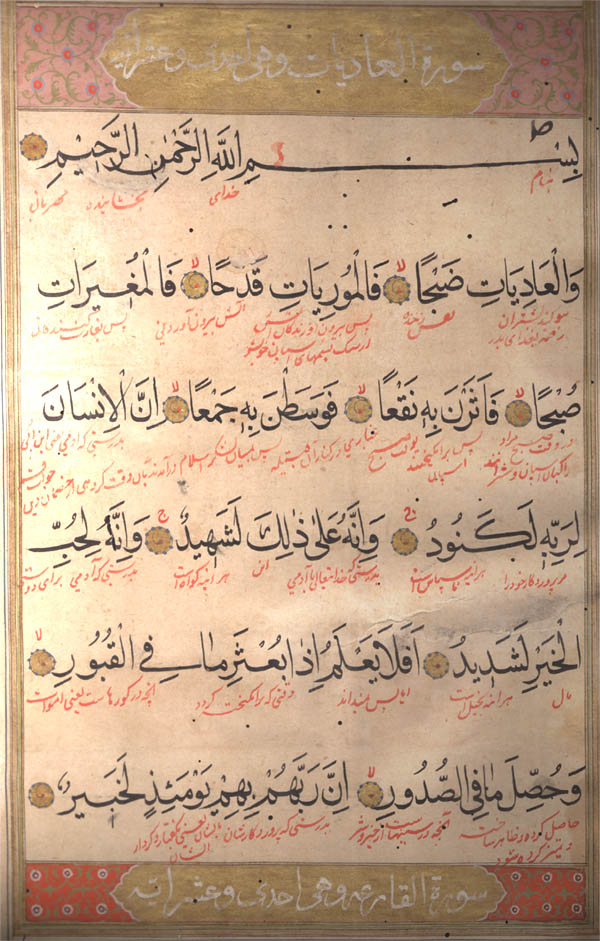
100th chapter of the Qur'an
| Field | Value |
|---|---|
| number | 100 |
| number-3 | 100 |
| name | Al-ʿĀdiyāt |
| name-ar | سورة العاديات |
| name-en | The War Horses |
| prev_sura | Quran 99 |
| next_sura | Quran 101 |
| classification | Meccan |
| othernames | The Chargers, The Assaulters |
| juz | 30 |
| rukus | |
| verses | 11 |
| words | 40 |
| letters | 168 |
| muqattaat | |
| sajdahs | |
| audio | Chapter 100, Al-Adiyat (Murattal) - Recitation of the Holy Qur'an.mp3 |
| number-3 = 100 | name-ar = سورة العاديات | name-en = The War Horses
Al-Adiyat or The War Horses which run swiftly (, al-ʿādiyāt, also known as "The Coursers, The Chargers") is the 100th chapter (sūrah) of the Qur'an, with 11 āyāt or verses. Regarding the timing and contextual background of the revelation (asbāb al-nuzūl), it is an earlier "Meccan surah", which means it is believed to have been revealed in Mecca, rather than later in Medina.
Summary
- 1-6 Oaths that man is ungrateful to his God
- 7-8 Man loves the things of this world
- 9-11 Man’s secret thoughts shall be discovered on the judgment day
Text
Text and meaning
In the name of Allāh, the Entirely Merciful, the Especially Merciful.
By the racers, panting,
And the producers of sparks (when) striking
And the chargers at dawn,
Stirring up thereby (clouds of) dust,
Arriving thereby in the center collectively,
Indeed mankind, to his Lord, is ungrateful.
And indeed, he is to that a witness.
And indeed he is, in love of wealth, intense.
But does he not know that when the contents of the graves are scattered
And that within the breasts is obtained,
Indeed, their Lord with them, that Day, is (fully) Aware.
Translation: Sahih International
Period of revelation
Whether this Surah Al-Adiyat is a Makki or a Madani is disputed. But the subject matter of the Surah and its style clearly indicate that it is not only Makki, but was revealed in the early stage of Makkan period.Source: Malik Al-Qur'an Translation Translator: Muhammad Farooq-i-Azam Malik Edition: First, Hardback Published: 1997 Publisher: The Institute of Islamic Knowledge, Houston, Texas, USA Abdullah bin Masud, Jabir, Hasan Basri, Ikrimah, and Ata say that it is Makki. Anas bin Malik, and Qatadah say that it is Madani; and from Ibn Abbas two views have been reported, first that it is a Makki Surah, and second that it is Madani. But the subject matter of the Surah and its style clearly indicate that it is not only Makki but was revealed in the earliest stage of Makkah. So the surah is considered to be Meccan conclusively.
Hadith
According to hadith, this surah is recommended in Maghrib prayer.
- Hisham ibn Urwah said that his father used to recite the surahs like Al-Adiyat, which was recited. Abu Dawud said: This indicates that those (traditions indicating long surahs) are abrogated, and this is more sound tradition.Sunan Abu Dawud 813 In-book reference: Book 2, Hadith 423 English translation: Book 2, Hadith 812
References
References
- [[George Sale's translation]]
- (1896). "A Complete Index to [[Sale's Text]], Preliminary Discourse, and Notes". Kegan Paul, Trench, Trubner, and Co.
- "Chronological Order of Surahs".
This article was imported from Wikipedia and is available under the Creative Commons Attribution-ShareAlike 4.0 License. Content has been adapted to SurfDoc format. Original contributors can be found on the article history page.
Ask Mako anything about Al-Adiyat — get instant answers, deeper analysis, and related topics.
Research with MakoFree with your Surf account
Create a free account to save articles, ask Mako questions, and organize your research.
Sign up freeThis content may have been generated or modified by AI. CloudSurf Software LLC is not responsible for the accuracy, completeness, or reliability of AI-generated content. Always verify important information from primary sources.
Report