From Surf Wiki (app.surf) — the open knowledge base
Akula-class submarine
Russian class of nuclear attack submarines
Russian class of nuclear attack submarines
| Field | Value | ||||
|---|---|---|---|---|---|
| section1 | {{Infobox ship/image | ||||
| image | AkulaProjekt971U right.png | ||||
| image_caption | Akula-class SSN profile | ||||
| section2 | {{Infobox ship/image | ||||
| image | АПЛ "Кузбасс".jpg | ||||
| section3 | {{Infobox ship/class overview | ||||
| name | Akula class | ||||
| builders | *Komsomolsk-on-Amur | ||||
| operators | |||||
| class_before | , | ||||
| class_after | |||||
| cost | est. $1.55 billion (1995 dollars) | ||||
| built_range | 1983–1999 | ||||
| in_commission_range | 1984–present | ||||
| total_ships_planned | 20 | ||||
| total_ships_completed | 15 | ||||
| total_ships_canceled | 4 (1 Iribis suspended 42% complete since 1996) | ||||
| total_ships_active | 4 (4 active +6 on modernization in Russia) | ||||
| total_ships_retired | 4 | ||||
| section4 | {{Infobox ship/characteristics | ||||
| type | Nuclear attack submarine | ||||
| displacement | *surfaced: | ||||
| length | *110.3 m for Akula I and Akula I Improved | ||||
| *{{convert | 113.3 | m | abbr | on}} for Akula II and Akula III | |
| beam | 13.6 m | ||||
| draught | 9.7 m | ||||
| propulsion | *one 190 MW OK-650B/OK-650M pressurized water nuclear reactor (HEU | ||||
| *1 OK-7 steam turbine {{convert | 43,000 | hp | MW | abbr | on}} |
| speed | *10 kn surfaced | ||||
| * submerged<ref name | Janes2008 | ||||
| endurance | 100 days | ||||
| test_depth | *480 m test depth for Akula I and Akula I Improved | ||||
| *{{convert | 520 | m | abbr | on}} for Akula II and III | |
| *{{convert | 600 | m | abbr | on}} maximum operating depth | |
| complement | 73 for Akula I & Improved, 62 (31 officers) for Akula II & III | ||||
| sensors | * MGK-540 active/passive suite | ||||
| EW | * Bukhta ESM/ECM | ||||
| armament | 4 × 533 mm torpedo tubes (28 torpedoes) and 4 × 650 mm torpedo tubes (12 torpedoes). (K-152 Nerpa* has 8 × 533 mm torpedo tubes) 40 torpedoes total | ||||
| notes | * Chiblis Surface Search radar |
the Soviet/Russian submarine class with NATO reporting name "Akula"
-
Severodvinsk
-
8,140 tons Akula I and Akula I Improved
-
8,450–8,470 tons Akula II and III
-
submerged:
-
12,770 tons Akula I and Akula I Improved
-
13,400–13,800 tons Akula II and III
-
113.3 m for Akula II and Akula III
-
1 OK-7 steam turbine 43,000 hp
-
2 OK-2 Turbo generators producing 2 MW
-
1 seven-bladed propeller
-
2 OK-300 retractable electric propulsors for low-speed and quiet maneuvering at 5 kn
-
28 - submerged
-
520 m for Akula II and III
-
600 m maximum operating depth
-
Flank arrays
-
Pelamida towed array sonar
-
MG-70 mine detection sonar
-
MG-74 Korund noise simulation decoys (fired from external tubes)
-
MT-70 Sonar intercept receiver
-
Nikhrom-M IFF
-
1–3 × Igla-M surface-to-air missile launcher fired from sail (surface use only)
-
Granat cruise missiles, now Kalibr
-
Medvyeditsa-945 Navigation system
-
Molniya-M Satellite communications
-
MGK-80 Underwater communications
-
Tsunami, Kiparis, Anis, Sintez and Kora Communications antennas
-
Paravan Towed VLF Antenna
-
Vspletsk Combat direction system
The Akula class, Soviet designation Project 971 Shchuka-B (, NATO reporting name Akula) is a series of fourth generation nuclear-powered attack submarines (SSNs) first deployed by the Soviet Navy in 1986. There are four sub-classes or flights of Shchuka-B, consisting of the original seven Project 971 boats (codenamed Akula I), commissioned between 1984 and 1990; six Project 971Is (Improved Akulas), commissioned between 1991 and 2009; one Project 971U (Akula II), commissioned in 1995; and one Project 971M (Akula III), commissioned in 2001. The Russians call all of the submarines Shchuka-B, regardless of modifications.
Some confusion may exist as the name Akula (Russian: Акула, meaning 'shark' in Russian) was used by the Soviets for a different class of submarines, the Project 941, which is known in the West as the . The Project 971 was named Shchuka-B by the Soviets but given the designation Akula by the West after the name of the lead ship, K-284.
According to defense analyst Norman Polmar, the launch of the first submarine in 1985, "shook everyone [in the West] up", as Western intelligence agencies had not expected the Soviet Union to produce such a boat for another ten years.
Design
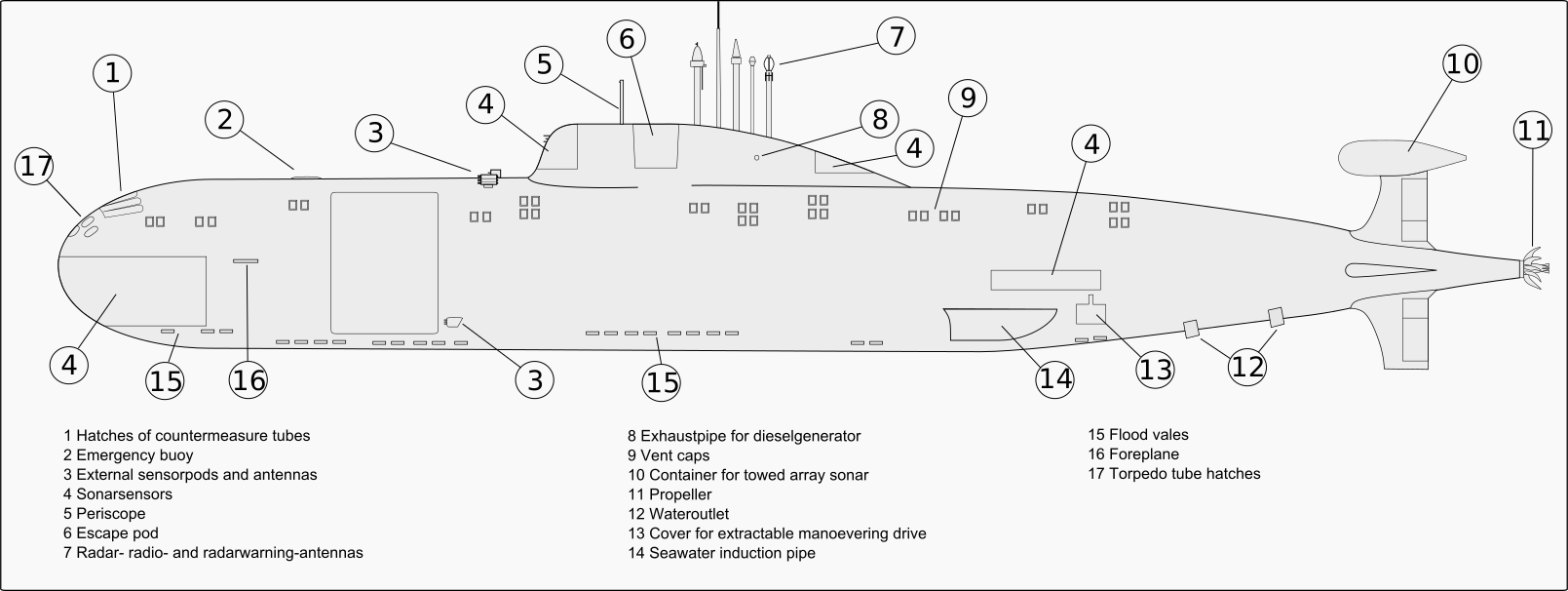
The Akula incorporates a double hull system composed of an inner pressure hull and an outer "light" hull. This allows more freedom in the design of the exterior hull shape, resulting in a submarine with more reserve buoyancy than its western analogs.
The distinctive "bulb" or "can" located on top of the Akula's rudder houses its towed sonar array when retracted. Most Akulas have the wake detection system () (SOKS) hydrodynamic sensors, which detect changes in temperature and salinity. They are located on the leading edge of the sail, on the outer hull casing in front of the sail and on the bottom of the hull forward of the sail.
Akulas (excluding Nerpa) are armed with four 533 mm torpedo tubes which can use Type 53 torpedoes or the RPK-2, RPK-6 missile, and four 650 mm torpedo tubes which can use Type 65 torpedoes or the RPK-7 missile. These torpedo tubes are arranged in two rows of four tubes each. The external tubes are mounted outside the pressure hull in one row, above the torpedo tubes, and can only be reloaded in port or with the assistance of a submarine tender. The 650 mm tubes can be fitted with liners to use the 533 mm weaponry. The submarine is also able to use its torpedo tubes to deploy naval mines.
Versions
As with many Soviet/Russian craft, information on the status of the Akula-class submarines is sparse, at best. Information provided by sources varies widely.
Project 971 (''Akula I'')
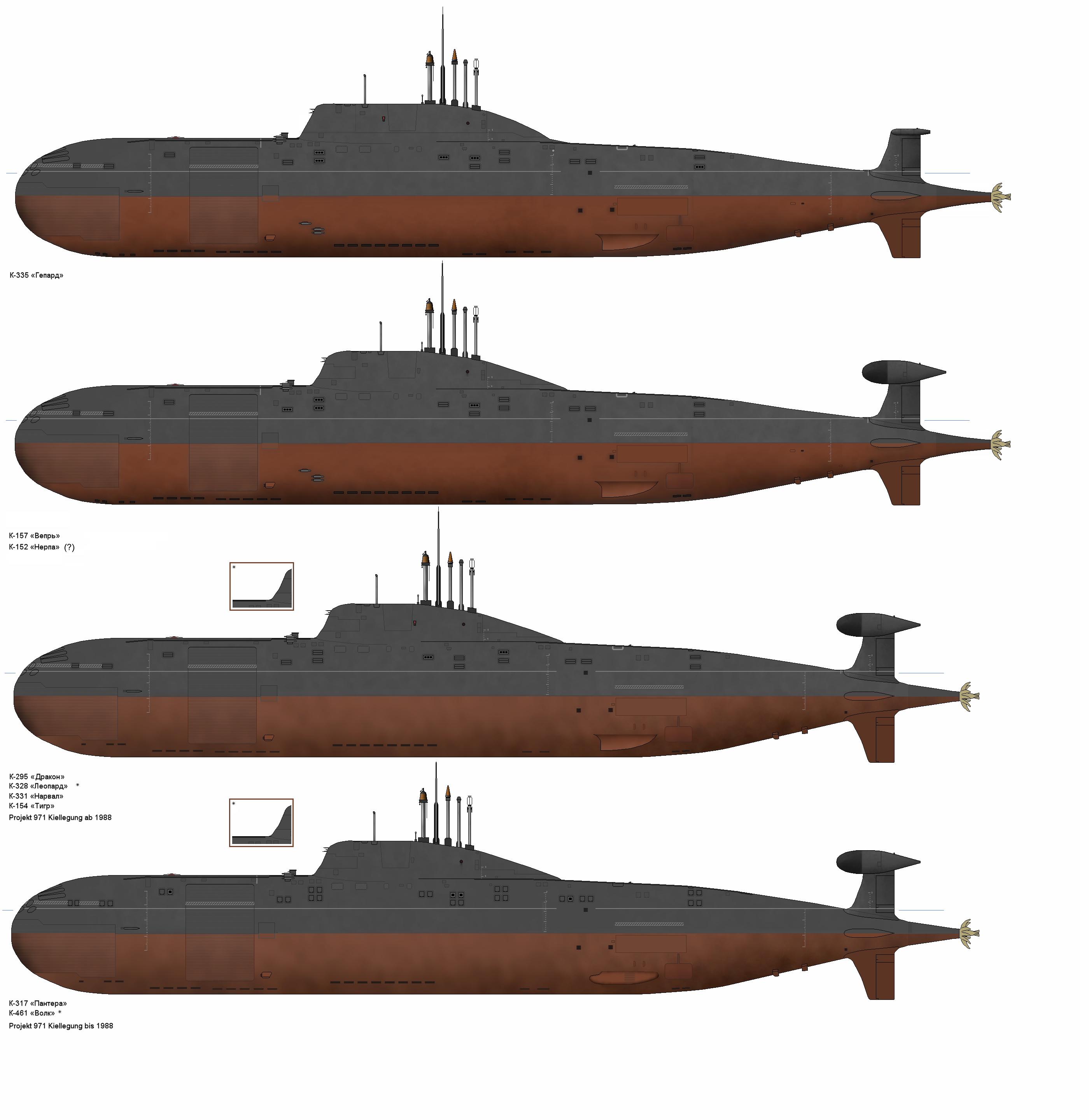
Of the seven original Akulas, only three are known to still be in service. These boats are equipped with MGK-540 Skat-3 sonar system (NATO reporting name Shark Gill). The lead boat of the class, K-284 Akula, was decommissioned in 2001, apparently to help save money in the cash-strapped Russian Navy. K-322 Kashalot and K-480 Bars [currently Ak Bars] are in reserve. K-480 Bars was put into reserve in 1998, and was being dismantled in February 2010. Pantera returned to service in January 2008 after a comprehensive overhaul. All were retrofitted with the SOKS hydrodynamic sensors. All submarines before K-391 Bratsk have reactor coolant scoops that are similar to the ones of the SSBNs, long and tubular. Bratsk and subsequent submarines have reactor coolant scoops similar to the short ones on the Oscar IIs (the Typhoon, Akula and Oscar classes use the similar OK-650 reactor).
Project 971 and 971I (Improved ''Akula I'')
The six Akulas of this class are all thought to be in service. They are quieter than the original Akulas. Sources also disagree as to whether construction of this class has been suspended, or if there are a further two units planned.
Improved Akula I Hulls: K-328 Leopard, K-461 Volk, K-154 Tigr, K-419 Kuzbass, K-295 Samara and K-152 Nerpa. These submarines are much quieter than early Akula-class submarines and all have the SOKS hydrodynamic sensors except Leopard.
Project 971U (''Akula II'')
K-157 Vepr is the only completed Akula II (see the table below). The Akula II is 3 m longer and displaces about 700 tons (submerged displacement) more than the Akula I. The added space was used for additional quieting measures. K-157 Vepr became the first Russian submarine that was quieter than the latest U.S. attack submarines of that time, which was the improved (SSN 751 and later). Two of these submarines were used to build the SSBNs.
Project 971M (''Akula III'')
The K-335 Gepard is the 14th submarine of the class and the only completed Akula III (see the table below) built for the Russian Navy. It was the first submarine commissioned in the Russian Navy since the Kursk disaster, as a result, its commissioning ceremony was an important morale boost for the Russian Navy with President Vladimir Putin in attendance. There is no NATO classification for the Akula III. It is longer and has a larger displacement compared to the Akula II, also it has an enlarged sail and a different towed-array dispenser on the vertical fin. Again, more noise reduction methods were employed. The Gepard was the most advanced Russian submarine before the submarines of the and Borei class were commissioned.
The Soviet advances in sound quieting were of considerable concern to the West, for acoustics was long considered the most significant advantage in U.S. submarine technology compared to the Soviets.
In 1983–1984 the Japanese firm Toshiba sold sophisticated, nine axis milling equipment to the Soviets along with the computer control systems, which were developed by Norwegian firm Kongsberg Vaapenfabrik. U.S Navy officials and Congressmen announced that this technology enabled the Soviet submarine builders to produce more accurate and quieter propellers. This is known as the Toshiba–Kongsberg scandal.
Due to the breakup of the Soviet Union in 1991, production of all Akulas slowed.
The 1999–2000 edition of Jane's Fighting Ships incorrectly listed the first Akula III as Viper (the actual name is "Vepr", "wild boar" in Russian), commissioned on 25 November 1995. Gepard (Cheetah), was launched in 1999 and was commissioned 5 December 2001.
Operational history
Between December 1995 and February 1996, submarine Volk was deployed to the Mediterranean along the Russian aircraft carrier , where she monitored activities of several NATO submarines under Captain 1st rank S. V. Spravtsev.
Between April and June 1996, Tigr was deployed in the Atlantic, where she detected a U.S. SSBN and tracked it on its combat patrol. On 23 July 1996, its commander, Captain 1st rank Alexey Burilichev, received a Hero of the Russian Federation award.
In August 2009, the news media reported that two Akula-class submarines operated off the East Coast of the United States, with one of the submarines being identified as a Project 971 Shchuka-B type. U.S. military sources noted that this was the first known Russian submarine deployment to the western Atlantic since the end of the Cold War, raising concerns within U.S. military and intelligence communities. U.S. Northern Command confirmed that this 2009 Akula-class submarine deployment did occur. One of the boats was likely Gepard that finished a relatively lengthy combat patrol between June and September that year under the command of the Captain 1st rank Alexey Vyacheslavovich Dmitrov, who on 15 February 2012 was awarded a title Hero of the Russian Federation for courage shown at work. The other submarine could have been Tigr under the command of Captain E. A. Petrov, given that she performed a combat patrol sometime between March and November 2009. It is unlikely that other submarines of the project 971 could have been present in the Atlantic that year. Pantera was in Severemorsk during summer, while Vepr, Leopard and Volk did not report any kind of activity in that year (1-3 submarines of the project are usually active with the Northern Fleet at any given moment).
In August 2012, the news media reported that another Akula-class submarine operated in the Gulf of Mexico purportedly undetected for over a month, sparking controversy within U.S. military and political circles, with U.S. Senator John Cornyn of the Senate Armed Services Committee demanding details of this deployment from Admiral Jonathan W. Greenert, the Chief of Naval Operations. Most likely, this was Tigr, as its commander Captain 1st rank Pavel Bulgakov received the Order of Courage on the Defender of the Fatherland Day on 22 February 2013.
Units
| # | Name | Project | Builders | Laid down | Launched | Commissioned | Fleet | Status | ||||||||
|---|---|---|---|---|---|---|---|---|---|---|---|---|---|---|---|---|
| K-284 | Akula | 971 | Amur Shipyard | 11 November 1983 | 27 June 1984 | 30 December 1984 | Pacific Fleet | Decommissioned in 2001. | ||||||||
| K-480 | Ak Bars | 971 | Sevmash | 22 February 1985 | 16 April 1988 | 29 December 1988 | Northern Fleet | Decommissioned in 2002, scrapping began in 2010 but the hull section was used in the construction of ballistic missile submarine Vladimir Monomakh. | ||||||||
| K-263 | Barnaul | 971 | Amur Shipyard | 9 May 1985 | 28 May 1986 | 30 December 1987 | Pacific Fleet | Decommissioned in 2011 | ||||||||
| K-322 | Kashalot | 971 | Amur Shipyard | 5 September 1986 | 18 July 1987 | 30 December 1988 | Pacific Fleet | Decommissioned on 9 October 2019. | ||||||||
| K-317 | Pantera | 971 | Sevmash | 6 November 1986 | 21 May 1990 | 27 December 1990 | Northern Fleet | Active, overhaul and modernization completed in 2007. | ||||||||
| K-461 | Volk | 971 | Sevmash | 14 November 1987 | 11 June 1991 | 29 December 1991 | Northern Fleet | Overhaul and modernization to finish in 2028. | ||||||||
| K-391 | Bratsk | 971 | Amur Shipyard | 23 February 1988 | 14 April 1989 | 29 December 1989 | Pacific Fleet | Decommissioned 2022, awaiting scrapping. | ||||||||
| K-328 | Leopard | 971 | Sevmash | 26 October 1988 | 28 June 1992 | 30 December 1992 | Northern Fleet | url=https://tass.ru/armiya-i-opk/10411469 | title=Источник: подлодка "Леопард" вернется в боевой состав ВМФ во второй половине 2021 года | trans-title=Source: the submarine "Leopard" will return to the combat strength of the Navy in the second half of 2021 | date=6 January 2021 | website=ТАSS | language=ru}} projected as likely to begin post-refit sea trials in 2022 | |||
| K-154 | Tigr | 971 | Sevmash | 10 September 1989 | 26 June 1993 | 29 December 1993 | Northern Fleet | Overhaul to finish in 2022. | ||||||||
| K-331 | Magadan | 971 | Amur Shipyard | 28 December 1989 | 23 June 1990 | 23 December 1990 | Pacific Fleet | In overhaul from July 2019 to 2022. | ||||||||
| K-157 | Vepr | 971U | Sevmash | 13 July 1990 | 10 December 1994 | 25 November 1995 | Northern Fleet | Active, overhaul and modernization completed in 2020. | ||||||||
| K-xxx | 971M | Amur Shipyard | 1990 | Not completed. | ||||||||||||
| K-419 | Kuzbass | 971 | Amur Shipyard | 28 July 1991 | 18 May 1992 | 31 December 1992 | Pacific Fleet | Active, overhaul and modernization completed in 2015. | ||||||||
| K-335 | Gepard | 971M | Sevmash | 23 September 1991 | 17 September 1999 | 5 December 2001 | Northern Fleet | Active, overhaul and modernization completed in 2015. | ||||||||
| K-xxx | 971M | Amur Shipyard | 1991 | Not completed. | ||||||||||||
| K-337 | Kuguar | 971U | Sevmash | 18 August 1992 | Not completed, the hull section was used in the construction of the Yury Dolgorukiy SSBN. | |||||||||||
| K-333 | Rys | 971U | Sevmash | 31 August 1993 | Not completed, the hull section was used in the construction of the Alexander Nevsky SSBN. | |||||||||||
| K-295 | Samara | 971 | Amur Shipyard | 7 November 1993 | 5 August 1994 | 17 July 1995 | Pacific Fleet | url=http://www.arms-expo.ru/news/armed_forces/dve_apl_dostavyat_s_tof_v_severodvinsk_dlya_modernizatsii/ | title=Две АПЛ доставят с ТОФ в Северодвинск для модернизации | trans-title=Two nuclear submarines will be delivered from the Pacific Fleet to Severodvinsk for modernization | date=21 August 2014 | language=ru | work=arms-expo.ru | archive-url=https://web.archive.org/web/20180104073327/http://www.arms-expo.ru/news/armed_forces/dve_apl_dostavyat_s_tof_v_severodvinsk_dlya_modernizatsii/ | archive-date=2018-01-04 | url-status=live}} |
| K-152 | Nerpa | |||||||||||||||
| (ex-Chakra) | 971I | Amur Shipyard | 1993 | 26 July 2006 | 28 December 2009 | Active, has been leased to India from 2012 until 2022, returned already in 2021. Proposed to decommission in 2023. | ||||||||||
| K-519 | Iribis | 971I | Amur Shipyard | 1994 | Construction halted at 42% in 1996, may be completed and leased to India. |
''Nerpa'' 2008 accident
On 27 October 2008, it was reported that K-152 Nerpa of the Russian Pacific Fleet had begun her sea trials in the Sea of Japan before handover under a lease agreement to the Indian Navy. On 8 November 2008, while conducting one of these trials, an accidental activation of the halon-based fire-extinguishing system took place in the fore section of the vessel. Within seconds the halon gas had displaced all breathable air from the compartment. As a result, 20 people (17 civilians and 3 seamen) were killed by asphyxiation. Dozens of others suffered freon-related injuries and were evacuated to an unknown port in Primorsky Krai. This was the worst accident in the Russian navy since the loss of the submarine K-141 Kursk in 2000. The submarine itself did not sustain any serious damage and there was no release of radiation.
Lease to India
Chakra II
Main article: INS Chakra (2011)

Three hundred Indian Navy personnel were trained in Russia for the operation of the Akula II submarine Nerpa. India has finalised a deal with Russia, in which at the end of the lease of these submarines, it has an option to buy them. The submarine is named INS Chakra as was the previous India-leased Soviet Charlie-I SSGN. Chakra was officially commissioned into the Indian Navy on 4 April 2012.
Whereas the Russian Navy's Akula-II could be equipped with 28 nuclear-capable cruise missiles with a striking range of 3000 km, the Indian version is reportedly armed with the 300 km-range Club-S nuclear-capable missiles. Missiles with ranges greater than 300 km cannot be exported due to arms control restrictions, since Russia is a signatory to the MTCR treaty.
In June 2021, Nerpa was reported in Singapore with Indian crew aboard and on its way back to Russia, despite one year remaining of the 10-year lease, commenced in April 2012. The stated reason was problems with maintenance of the nuclear reactors. Accordingly, the lease will not be prolonged after 2022, as was initially expected.
Chakra III
Russia said in December 2014 that it is ready to lease India more nuclear-powered submarines a day after President Vladimir Putin and Prime Minister Narendra Modi pledged to deepen defence ties.
In January 2015, it was reported that India was involved in negotiations involving the leasing of the Kashalot and the Iribis.
On 7 March 2019, India and Russia signed a $3 billion deal for lease of another Akula-class nuclear-powered attack submarine. The submarine, dubbed as Chakra III, should be delivered to the Indian Navy by 2025.
As of November 2024, the deal was delayed until at least 2028 according to multiple sources.
Gallery
File:Akula class submarine.JPG|Submarine K-322 Kashalot File:Парад кораблей 7 АПЛ Магадан.JPG|An Akula-class submarine during the Russian Navy Day in 2009 File:АПЛ "Кузбасс".jpg|Submarine K-419 Kuzbass File:К-317 «Пантера».jpg|Submarine K-317 Pantera

References
References
- (October 2018). "Russian submarines".
- (2008). "Jane's Fighting Ships 2008-09". [[Jane's Information Group]].
- (2010-01-28). "The Ship Day to be celebrated at SSN Kuzbass".
- "Specification: SSN Akula Class (Bars Type 971) Attack Submarine, Russia".
- (2012-07-24). "Typhoon (Akula) class (Project 941/941U) (Russian Federation)".
- "In-service ships".
- Norman, Colin. (31 March 1989). "Quiet Soviet Subs Prompt Concern". American Association for the Advancement of Science.
- Hambling, David. (23 October 2017). "How the Soviet Union Snooped Waters for Enemy Subs — Without Sonar".
- Trevithick, Joseph. (8 May 2019). "Royal Navy Sub Appears In Gibraltar Equipped With A Wake Detection System".
- "MGK-500 Shark Gill (Bow)".
- "Armament "MGK-500" automated sonar complex".
- Apalkov, Yu. V.. (2003). "Подводные лодки ВМФ СССР". Galeya Print.
- "K-317 Pantera".
- "Run Silent, Run Deep".
- "K-157 Vepr".
- Adm. Boorda, statement at a meeting of the Naval & Maritime Correspondents Circle, Washington, D.C., 27 February 1995.
- "K-335 Gepard".
- (4 December 2001). "President Vladimir Putin attended a ceremony of adopting the Gepard nuclear-powered submarine by the Russian Navy".
- Besserglik, Bernard. (4 December 2001). "Putin Inauguration of New Sub Seen As Balm To Russian Navy".
- (14 March 1988). "Quieter Soviet subs cost U.S. at least $30 billion". Navy News & Undersea Technology.
- "Подводная лодка К-154, "Тигр". Проект 971".
- "Буриличев Алексей Витальевич".
- (August 2, 2012). "Russian Subs Patrolling Off East Coast of U.S.". [[The New York Times]].
- (August 6, 2009). "Pentagon: Russian subs no cause for alarm". [[United Press International.
- Ewing, Phillip. (August 20, 2012). "Pentagon Denies Russian Sub Patrolled Gulf of Mexico". [[United States Naval Institute]].
- "Подводная лодка К-335, "Гепард". Проект 971".
- "Дмитров Алексей Вячеславович".
- "266-й экипаж подводной лодки. Проект 971".
- "Подводная лодка К-317, "Пантера". Проект 971".
- (August 19, 2012). "Reports of Russian sub in gulf downplayed". [[United Press International.
- (18 March 2013). "Подводные силы Северного флота – лучшее объединение ВМФ в составе Западного военного округа".
- "К-480, "Барс", "Ак Барс"".
- "Nuclear-Powered Submarines - Project 971".
- "К-317, "Пантера" Проект 971".
- (6 January 2021). "Source: the submarine "Wolf" with "Caliber" will return to the Navy in 2023".
- (14 August 2014). "Подлодка "Волк" отправилась на ремонт".
- (28 April 2017). "Бесшумные "Суперакулы" вооружили "Калибрами"". [[Izvestia]].
- (5 March 2024). "Источник: возвращение АПЛ "Волк" в боевой состав Северного флота планируется на 2028 год".
- (17 January 2022). "СМИ узнали о списании атомной подлодки "Братск"".
- (6 January 2021). "Источник: подлодка "Леопард" вернется в боевой состав ВМФ во второй половине 2021 года".
- (13 December 2013). "Плановый срок ремонта АПЛ серии "Щука-Б" составит не менее 3 лет".
- (26 December 2020). "Russian shipyard floats out nuclear-powered Akula-class sub after upgrade".
- "After ten years at yard, nuclear sub "Leopard" is soon to sail".
- (11 January 2021). "Подлодка "Тигр" "звериной" дивизии вернется в состав флота в 2022 году".
- "Подводная лодка К-154, "Тигр". Проект 971".
- (14 November 2020). "Модернизированная подлодка Магадан вернется в строй в 2022 году".
- (30 July 2019). "Russian shipbuilders start repairs of nuclear-powered subs for Pacific Fleet".
- Vavasseur, Xavier. (2020-10-02). "Russian Akula-class Submarine 'Magadan' to be Operational Again in 2022".
- (19 March 2020). "Атомная подлодка с "Калибрами" вышла на испытания".
- (5 August 2020). "Nuclear submarine Vepr returned to the Russian Navy after repair".
- (19 March 2016). "Отремонтированная АПЛ "Кузбасс" передана ТОФ".
- (18 December 2015). "Медведев в ДФО осмотрел модернизированную АПЛ К-419 "Кузбасс"". RIA Novosti.
- "Атомная подводная лодка "Гепард" вернулась в состав боевых кораблей подводных сил Северного флота".
- "К-337, "Кугуар" Проект 971".
- "К-333, "Рысь" Проект 971".
- (21 August 2014). "Две АПЛ доставят с ТОФ в Северодвинск для модернизации". arms-expo.ru.
- (January 23, 2012). "Russia hands over nuclear-powered attack submarine to India". [[The Times of India]].
- "СМИ: арендованная Индией атомная подлодка возвращается в Россию".
- (16 November 2023). "Главкомат ВМФ предложил утилизовать аварийную АПЛ "Нерпа"".
- "Владимир Путин пригласил слесаря-монтажника".
- Radyuhin, Vladimir. (2013-03-13). "India in talks with Russia on lease of second nuclear submarine". [[The Hindu]].
- LaGrone, Sam. (8 July 2013). "India Interested in Leasing Second Russian Nuclear Attack Sub". USNI News.
- (2008-11-09). "Accident on nuclear submarine kills 20 off eastern Russian coast". [[International Herald Tribune]].
- (9 November 2008). "20 Dead on Russian Nuclear-Powered Submarine". [[The New York Times]].
- (3 July 2008). "India to get Russian nuclear submarine after 17 years".
- (2012-04-04). "INS Chakra: Govt inducts Russian-origin Akula II class Nerpa into Navy". [[The Economic Times]].
- (2012-04-04). "INS Chakra formally inducted into Indian Navy".
- (1 July 2006). "Russia may lease nuclear submarine to India". [[The Hindu]].
- (12 December 2014). "Putin ready to lease nuclear submarines to India, minister says".
- (20 January 2015). "Индия возьмет у России в аренду атомную подлодку "Кашалот"".
- (5 March 2019). "India, Russia To Sign $3 Billion Nuclear Sub Deal This Week".
- (4 March 2019). "India, Russia to ink $3 billion nuclear submarine deal this week".
- (2024-10-24). "India launches its latest nuclear submarine with 75% indigenous tech: Here's what the new S4 means for regional security". The Economic Times.
- (2024-11-11). "Russia to deliver first of two missile frigates by month-end". The Times of India.
This article was imported from Wikipedia and is available under the Creative Commons Attribution-ShareAlike 4.0 License. Content has been adapted to SurfDoc format. Original contributors can be found on the article history page.
Ask Mako anything about Akula-class submarine — get instant answers, deeper analysis, and related topics.
Research with MakoFree with your Surf account
Create a free account to save articles, ask Mako questions, and organize your research.
Sign up freeThis content may have been generated or modified by AI. CloudSurf Software LLC is not responsible for the accuracy, completeness, or reliability of AI-generated content. Always verify important information from primary sources.
Report