From Surf Wiki (app.surf) — the open knowledge base
Akita Shinkansen
High-speed railway line in Japan
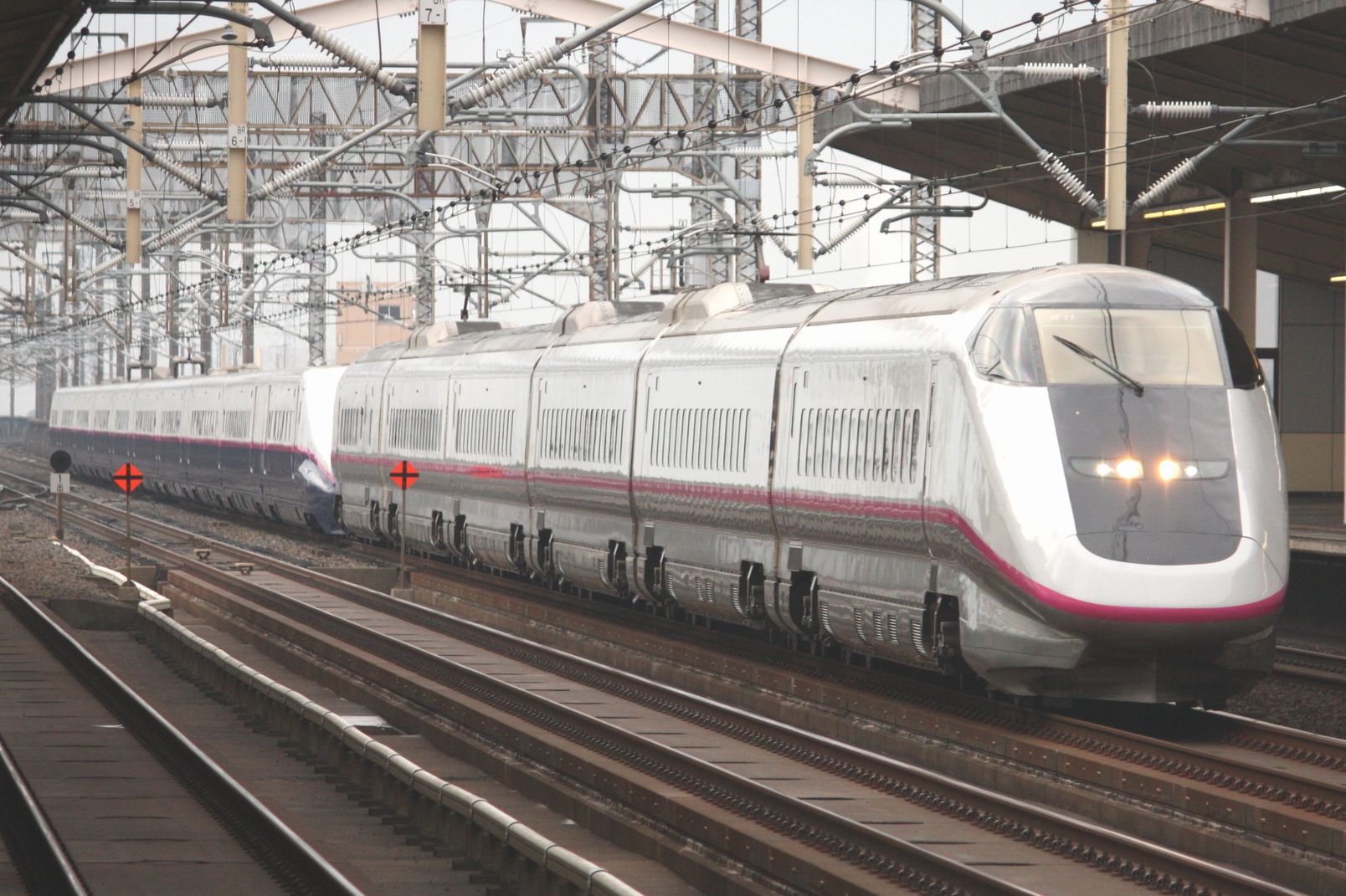
High-speed railway line in Japan
| Field | Value | |
|---|---|---|
| name | Akita Shinkansen | |
| native_name | 秋田新幹線 | |
| native_name_lang | ja | |
| color | ||
| routes | Komachi | |
| image | E6 series Z12 Komachi 20161013.jpg | |
| caption | An E6 series trainset on the Akita Shinkansen | |
| type | Mini-Shinkansen | |
| locale | Iwate and Akita prefectures | |
| start | ||
| end | (through service to ) | |
| stations | 6 | |
| mapcolor | Crimson | |
| open | ||
| owner | ||
| operator | JR East | |
| depot | Akita | |
| stock | E6 series | |
| linelength | 127.3 km | |
| tracks | 1 and 2 | |
| gauge | ||
| electrification | ||
| speed | 130 km/h | |
| map | [[File:JR Akita Shinkansen linemap.svg | 240px]] |
| map_name | Route map | |
| map_state | collapsed |
The Akita Shinkansen is a mini-Shinkansen route in Japan, operated by East Japan Railway Company (JR East). It provides service between Akita and Morioka over the Tazawako Line and Ōu Main Line. At Morioka, trains connect onto the Tōhoku Shinkansen tracks for through service to Tokyo.
History
The groundbreaking ceremony for the Akita Shinkansen was held in front of Akita Station on 13 March 1992, and track work began the same month. JR East introduced a continuous track renewal machine imported from the United States—the first time such equipment was used in Japan—significantly reducing labor requirements and construction time.
Construction proceeded in stages. A parallel single standard-gauge track was added to the 51.7 km section of the Ōu Main Line between Ōmagari and Akita. In addition, on the 13 km section between Jingūji and Mineyoshikawa, a third running rail was installed on one of the narrow-gauge tracks, allowing mini-Shinkansen trains to operate over either track. The final stage converted the 75 km narrow-gauge Tazawako Line between Morioka and Ōmagari to standard gauge and included construction of a connecting ramp at Morioka linking to the Tōhoku Shinkansen, completed in December 1996.
Following level-crossing problems that emerged after the opening of the Yamagata Shinkansen, 33 grade crossings (including pedestrian crossings) along the line were eliminated ahead of the Akita Shinkansen’s opening. As standard-gauge conversion progressed, all station buildings along the line were rebuilt, with the exception of Kakunodate Station which had been recently renovated, and a Shinkansen maintenance facility and storage tracks were constructed at the Minamiakita Depot (now the Akita Shinkansen Car Center).
The segment between Morioka and Akita began operating on 22 March 1997 with five-car E3 series trains, with formations lengthened to six cars in 1998.
All services were suspended on 11 March 2011 following the 2011 Tōhoku earthquake and tsunami, with partial operation resuming between Morioka and Akita from 18 March, although through services to the Tōhoku Shinkansen did not initially operate. Through services to Tokyo were restored on 29 April 2011, coinciding with the full reopening of the Tōhoku Shinkansen.
E6 series trains were introduced on Super Komachi services from 16 March 2013, operating at up to 300 km/h on the Tōhoku Shinkansen, and from 15 March 2014 all Komachi services were operated by E6 series sets, running at up to 320 km/h (200 mph) on the Tōhoku Shinkansen.
Services between Ōmagari and Akita were suspended from 22 to 29 July 2017 due to flooding after heavy rainfall. Services north of Nasushiobara Station were suspended on 13 February 2021 following the 2021 Fukushima earthquake.
On 6 March 2025, following the uncoupling of Hayabusa–Komachi 21 near Nishi-Nippori Station, coupled operations with Hayabusa services were suspended until further notice, and passengers travelling between Tokyo and Akita were advised to transfer at Morioka Station.
Operations
Services consist of Komachi trains which are 7-car E6 series mini-shinkansen sets coupled with E5 series Hayabusa trains for the portion of the journey between Tokyo and Morioka.
The Komachi services run at a maximum speed of 320 km/h on the Tohoku Shinkansen, and between Morioka and Akita, run as 7-car independent trains with a maximum speed of 130 km/h. However, 110 km/h is more typical for the line through the hills east of Akita, with trains frequently slowing to 90 km/h for curves such as those south of Ugo. The line from Morioka to Akita is prone to deep snow.
The fastest timetabled journey between Akita and Tokyo currently takes 3 hours and 37 minutes calling at four or five stops in between.
Rolling stock
As of March 2020, the following types are used on Akita Shinkansen services.
- E6 series 7-car sets, since 16 March 2013
Former rolling stock
- E3 series 6-car sets (originally 5-car sets) withdrawn by 15 March 2014
Non-revenue-earning-types

- East i (E926)
Stations
Between Tokyo and Morioka, the stations are the same as the Hayabusa service on the Tōhoku Shinkansen. Between Morioka and Akita, the stations are as shown below.
Legend:
| ● | ▲ |
|---|---|
| All trains stop | |
| Some trains stop |
| Station | Distance (km) | Komachi | Transfers | Location | From | From | |
|---|---|---|---|---|---|---|---|
| ↑ Through service to/from via the Tōhoku Shinkansen ↑ | |||||||
| 535.3 | 0 | ● | {{Plainlist | Morioka | Iwate | ||
| Prefecture | |||||||
| 552.9 | 16.0 | ▲ | Shizukuishi | ||||
| 579.4 | 40.1 | ▲ | Senboku | Akita | |||
| Prefecture | |||||||
| 600.0 | 58.8 | ▲ | {{Plainlist | ||||
| 618.5 | 75.6 | ● | {{Plainlist | Daisen | |||
| 670.2 | 127.3 | ● | {{Plainlist | Akita |
References
- JR Timetable, June 2009 issue
References
- (13 March 1992). "CONSTRUCTION BEGINS FOR THE THROUGH OPERATION OF SHlNKANSEN BETWEEN TAZAWAKO/MORIOKA AND AKITA OF OU LlNE".
- (1 May 1997). "JR East launches Akita Shinkansen".
- "JR東日本:プレスリリース:ビッグワンダー(連続軌道更新機)第二の人生について".
- Tamiya, Toshio. (March 1997). ""Komachi" Departure!! - A Brief History of the Akita Shinkansen Until Its Opening". Akita Sakigake Shimbun.
- (6 November 2012). link. Japan Railfan Magazine Online. Koyusha Co., Ltd.
- [[Yomiuri Shimbun]]: [http://www.yomiuri.co.jp/e-japan/akita/news/20090617-OYT8T00978.htm "JR東日本の新幹線 13年3月メドに「E6系」導入" (18 June 2009)]. Retrieved on 19 June 2009. {{in lang. ja
- (14 February 2021). "Tohoku Shinkansen line breaks from the base of utility poles".
- (October 2025). "東北新幹線が走行中分離、「こまち」側に連結解除の痕跡…原因判明まで新幹線の連結運転取りやめ(読売新聞オンライン)".
- {{cite magazine. (April 2012). Koyusha Co., Ltd.
This article was imported from Wikipedia and is available under the Creative Commons Attribution-ShareAlike 4.0 License. Content has been adapted to SurfDoc format. Original contributors can be found on the article history page.
Ask Mako anything about Akita Shinkansen — get instant answers, deeper analysis, and related topics.
Research with MakoFree with your Surf account
Create a free account to save articles, ask Mako questions, and organize your research.
Sign up freeThis content may have been generated or modified by AI. CloudSurf Software LLC is not responsible for the accuracy, completeness, or reliability of AI-generated content. Always verify important information from primary sources.
Report