From Surf Wiki (app.surf) — the open knowledge base
Akihito
Emperor of Japan from 1989 to 2019

Emperor of Japan from 1989 to 2019
| Field | Value | ||||
|---|---|---|---|---|---|
| name | Akihito | ||||
| {{native name | ja | 明仁 | italics | no | paren=omit}} |
| image | Emperor Akihito (2016).jpg | ||||
| caption | Akihito in 2016 | ||||
| succession | Emperor of Japan | ||||
| reign | 7 January 1989 – 30 April 2019 | ||||
| coronation | 12 November 1990 | ||||
| cor-type | Japan | ||||
| predecessor | Hirohito | ||||
| successor | Naruhito | ||||
| spouse | |||||
| issue | {{plain list | ||||
| era name | Heisei | ||||
| era dates | |||||
| 8 January 1989 – 30 April 2019 | |||||
| royal house | Imperial House of Japan | ||||
| father | Emperor Shōwa | ||||
| mother | Princess Nagako Kuni | ||||
| birth_name | Akihito, Prince Tsugu | ||||
| (継宮明仁親王) | |||||
| birth_date | |||||
| birth_place | Imperial Palace, Tokyo, Japan | ||||
| religion | Shinto | ||||
| signature | [[File:Heisei shomei.svg | class=skin-invert | 35px]] |
| ja | cor-type = Japan
- Naruhito, Emperor of Japan
- Fumihito, Crown Prince of Japan
- Sayako Kuroda 8 January 1989 – 30 April 2019 (継宮明仁親王) Akihito (born 23 December 1933) is a member of the Imperial House of Japan who reigned as the 125th emperor of Japan from 7 January 1989 until his abdication on 30 April 2019. The era of his rule was named the Heisei era, Heisei being an expression of achieving peace worldwide.
Akihito was born as the fifth child and first son of Emperor Hirohito and Empress Kōjun. During the Second World War, he moved out of Tokyo with his classmates and remained in Nikkō until the surrender of Japan. In 1952, his Coming-of-Age ceremony and investiture as crown prince were held, and he began to undertake official duties in his capacity as crown prince. The next year, he made his first journey overseas and represented Japan at the coronation of Elizabeth II in London. He completed his university education in 1956. In April 1959, he married Michiko Shōda, a commoner; it was the first imperial wedding to be televised in Japan, drawing about 15 million viewers. The couple has three children: Naruhito, Fumihito, and Sayako.
Akihito succeeded to the Chrysanthemum Throne and became emperor upon his father's death in January 1989, with an enthronement ceremony in 1990. He made efforts to bring the Japanese imperial family closer to the Japanese people, and made official visits to all forty-seven prefectures of Japan and to many of the remote islands of Japan. He has a keen interest in natural life and conservation, as well as Japanese and world history. Akihito abdicated in 2019, citing his advanced age and declining health, and assumed the title Emperor Emeritus. He was succeeded by his elder son, Naruhito, whose era is named Reiwa. At age , Akihito is the longest-lived verifiable Japanese emperor in recorded history. During his reign, 17 prime ministers served in 25 terms, beginning with Noboru Takeshita and ending with Shinzo Abe. He is the oldest living member of the Imperial House of Japan, following the death of Yuriko, Princess Mikasa on 15 November 2024.
Name
During his reign, Akihito was never referred to by his own name, but instead as "His Majesty the Emperor" which may be shortened to "the Emperor" or "His Majesty". The era of Akihito's reign from 1989 to 2019 bore the era name Heisei, and according to custom he will be posthumously renamed Emperor Heisei as the 125th emperor of Japan by order of the Cabinet.
Following his abdication, he is referred to by the title of , officially translated as "Emperor Emeritus".
Early life and education
Prince Akihito was born on 23 December 1933 at 6:39 am in the Tokyo Imperial Palace as the fifth child and eldest son of Emperor Hirohito and Empress Kōjun. Titled Prince Tsugu as a child, Akihito was educated by private tutors prior to attending the elementary and secondary departments of the Peers' School (Gakushūin) from 1940 to 1952. At the request of his father, he did not receive a commission as an army officer, unlike his predecessors.

During the American firebombing raids on Tokyo in March 1945 during World War II, Akihito and his younger brother Prince Masahito were evacuated from the city. Akihito was tutored in the English language and Western manners by Elizabeth Gray Vining during the Allied occupation of Japan, and later briefly studied at the department of political science at Gakushuin University in Tokyo, though he never received a degree.
Akihito was the heir apparent to the Chrysanthemum Throne from birth. His formal investiture as crown prince took place at the Tokyo Imperial Palace on 10 November 1952. In June 1953, Akihito represented Japan at the coronation of Queen Elizabeth II in London on his first journey abroad. He later completed his university education as a special student in 1956.
Marriage and family

In August 1957, Akihito met Michiko Shōda on a tennis court at Karuizawa near Nagano. Initially, there was little enthusiasm for the couple's relationship; Michiko Shōda was considered too low class for the young Crown Prince and had been educated in a Catholic environment. Therefore, in September 1958, she was sent away to Brussels to attend an international conference of the Alumnae du Sacré-Cœur. The Crown Prince was determined to keep in contact with his girlfriend but did not want to create a diplomatic incident. Therefore, he contacted the young King Baudouin of Belgium to send his messages directly to his loved one. Baudouin later negotiated the marriage of the couple with the Emperor, directly stating that if the Crown Prince was happy with Michiko, he would be a better emperor later on.
The Imperial Household Council formally approved the engagement of the Crown Prince to Michiko Shōda on 27 November 1958. The announcement of the then-Crown Prince Akihito's engagement and forthcoming marriage to Michiko Shōda drew opposition from traditionalist groups, because Shōda was from a Catholic family. Although she was never baptized, she had been educated in Catholic schools and seemed to share her parents' faith. Rumours also speculated that Prince Akihito's mother, Empress Kōjun had opposed the engagement. After the death of Empress Kōjun on 16 June 2000, Reuters reported that she was one of the strongest opponents of her son's marriage, and that in the 1960s, she had driven her daughter-in-law and grandchildren to depression by persistently accusing Shōda of not being suitable for her son. At that time, the media presented their encounter as a real "fairy tale", or the "romance of the tennis court". It was the first time a commoner had married into the Imperial Family, breaking more than 2,600 years of tradition. The engagement ceremony took place on 14 January 1959, and the marriage on 10 April 1959.
The couple have three children (two sons and a daughter):
- Naruhito, Prince Hiro
- Fumihito, Prince Aya
- Sayako, Princess Nori, following her marriage to urban designer Yoshiki Kuroda on 15 November 2005, Princess Nori gave up her imperial title and left the Imperial Family as required by 1947 Imperial Household Law, took the surname of her husband and became known as "Sayako Kuroda".
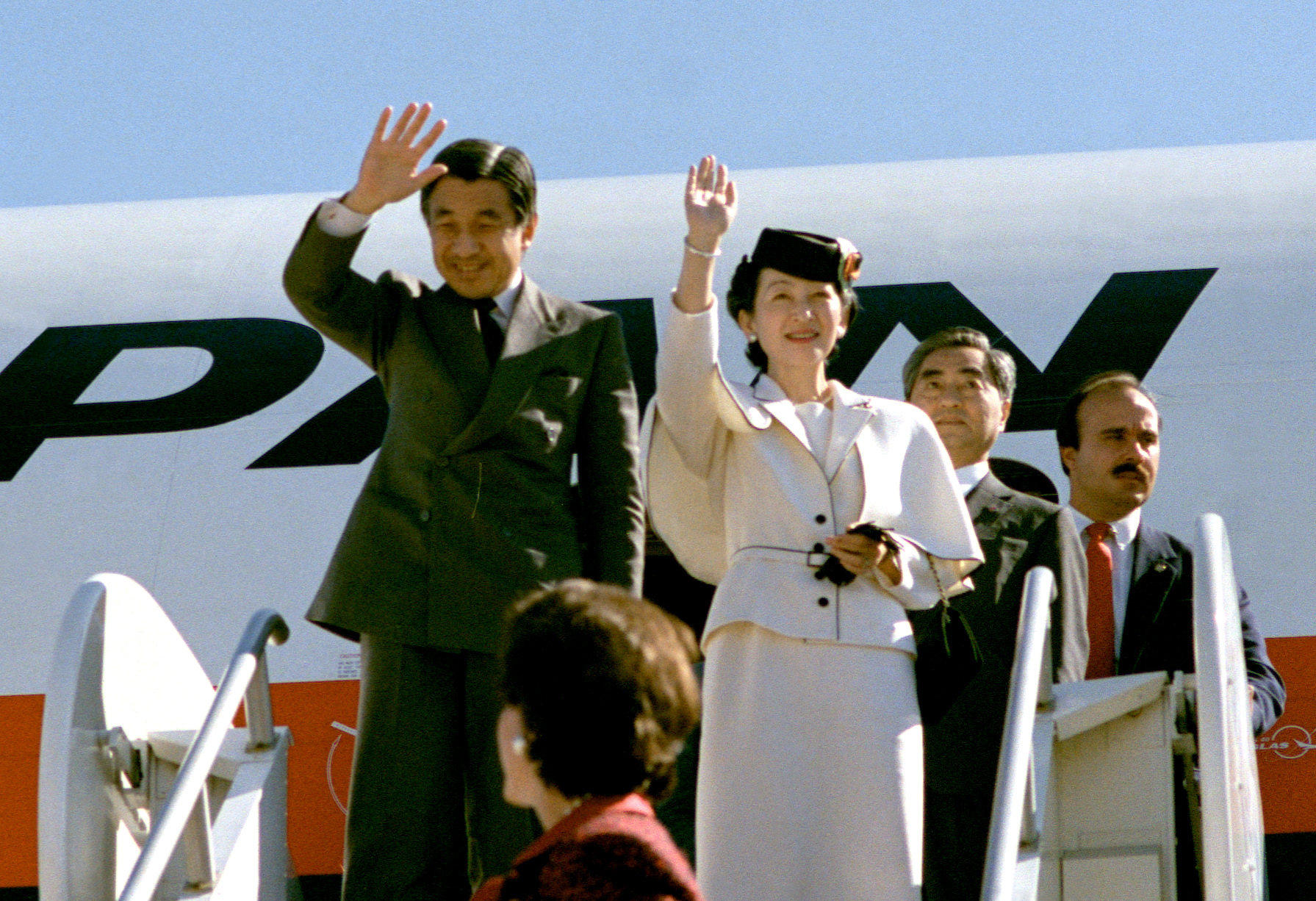
Crown Prince Akihito and Crown Princess Michiko made official visits to thirty-seven countries. As an Imperial Prince, Akihito compared the role of Japanese royalty to that of a robot. He expressed the desire to help bring the Imperial family closer to the people of Japan.
Reign

Upon the death of Emperor Hirohito on 7 January 1989, Akihito acceded to the throne, becoming the 125th Emperor of Japan. Owing to his father being the longest-reigning emperor in Japanese history, Akihito was the third oldest to ascend the Chrysanthemum Throne in history; he was 55 years old at the time. The enthronement ceremony took place on 12 November 1990. In 1998, during a state visit to the United Kingdom, he was invested with the Order of the Garter.
Following his accession, he began issuing several wide-ranging statements of remorse to Asian countries, for their suffering under Japanese occupation, beginning with an expression of remorse to China made in April 1989, three months after the death of his father, Emperor Hirohito. In October 1992, Akihito visited China, the first visit to China by a Japanese emperor. The visit marked a significant improvement in the China–Japan relationship.
On 23 December 2001, during his annual birthday meeting with reporters, the Emperor, in response to a reporter's question about tensions with South Korea, remarked that he felt a kinship with Koreans and went on to explain that, in the Shoku Nihongi, the mother of Emperor Kammu (736–806) is related to Muryeong of Korea, King of Baekje, a fact that was considered taboo for discussion.
In June 2005, the Emperor and Empress visited the island of Saipan (part of the Northern Mariana Islands, a U.S. territory), the site of a battle in 1944 during World War II. Akihito offered prayers and flowers at several memorials, honouring not only the Japanese who died, but also American servicemen, Korean labourers, and local islanders. It was the first trip by a Japanese monarch to a World War II battlefield abroad. The Saipan journey was received with high praise by the Japanese people, as were the Emperor's visits to war memorials in Tokyo, Hiroshima Prefecture, Nagasaki Prefecture and Okinawa Prefecture in 1995.
After succeeding to the throne, Akihito made an effort to bring the Imperial family closer to the Japanese people. He and Michiko made official visits to eighteen countries and to all forty-seven Japanese prefectures. Akihito has never visited Yasukuni Shrine, continuing his predecessor's boycott from 1978, due to its enshrinement of war criminals.
On 6 September 2006, the Emperor celebrated the birth of his first grandson, Prince Hisahito, the third child of the Emperor's younger son. Prince Hisahito was the first male heir born to the Japanese imperial family in 41 years (since his father Prince Akishino) and could avert the Japanese imperial succession crisis, as the only child of the Emperor's elder son, the then Crown Prince Naruhito, is his daughter, Princess Aiko, who is not eligible for the throne under Japan's male-only succession law. The birth of Prince Hisahito meant that proposed changes to the law to allow Aiko to ascend the throne were dropped.
In response to the 2011 Tōhoku earthquake and tsunami which also triggered the Fukushima nuclear accident, the Emperor made urging his people not to give up hope and to help each other.
Constitutional role

Abdication
Main article: Japanese imperial succession debate, 2019 Japanese imperial transition
.jpg)
On 13 July 2016, national broadcaster NHK reported that the then 82-year-old Emperor intended to abdicate in favour of his eldest son Crown Prince Naruhito within a few years, citing his age. An abdication within the Imperial Family had not occurred since Emperor Kōkaku in 1817. However, senior officials within the Imperial Household Agency denied that there was any official plan for the monarch to abdicate. Abdication by the Emperor required an amendment to the Imperial Household Law, which had no provisions for such a move. On 8 August 2016, the Emperor gave a rare televised address, where he emphasized his advanced age and declining health; this address was interpreted as an implication of his intention to abdicate.
On 19 May 2017, the bill that would allow Akihito to abdicate was issued by the Cabinet of Japan. On 8 June 2017, the National Diet passed it, whereupon it became known as the Emperor Abdication Law. This commenced government preparations to hand the position over to Naruhito. Prime Minister Shinzo Abe announced in December 2017 that Akihito's abdication would take place at the end of 30 April 2019, and that Naruhito would become the 126th Emperor as of 1 May 2019.
Post-abdication

On 19 March 2020, Akihito and his wife moved out of the Imperial Palace, marking their first public appearance since his abdication. On 31 March, they moved in to the Takanawa Residence.
In December 2021, Akihito celebrated his 88th birthday, making him the longest-living verifiable Japanese emperor in recorded history, ahead of his father. His daily routine is said to include morning and evening walks with his wife, reading and visits to an imperial biology institute.
In August 2023, Akihito and Michiko visited the tennis court where they first met and interacted with members of the organization responsible for its upkeep.
With the death of Princess Yuriko in November 2024, Akihito became the oldest living member of the Japanese imperial family.
Health
Emperor Akihito underwent surgery for prostate cancer on 14 January 2003. Later in 2011 he was admitted to hospital suffering from pneumonia. In February 2012, it was announced that the Emperor would be having a coronary examination; he underwent successful heart bypass surgery on 18 February 2012. In July 2018, he suffered from nausea and dizziness due to insufficient blood flow to his brain. In January 2020, he temporarily lost consciousness and collapsed at his residence, though "no abnormalities" were detected in his brain. He was diagnosed with heart failure in July 2022. In 2025, Akihito was diagnosed with myocardial ischemia and supraventricular tachycardia.
Children
.jpg)
Akihito and Michiko have two sons and a daughter.
| Name | Birth | Marriage | Children | Date | Spouse | Naruhito, Emperor of Japan | ||
|---|---|---|---|---|---|---|---|---|
| (Naruhito, Prince Hiro) | Fumihito, Crown Prince of Japan | |||||||
| (Fumihito, Prince Aya) | Sayako Kuroda | |||||||
| (Sayako, Princess Nori) | ||||||||
| 9 June 1993 | Masako Owada | Aiko, Princess Toshi | ||||||
| 29 June 1990 | Kiko Kawashima | |||||||
| 15 November 2005 | Yoshiki Kuroda |
Ichthyological research
In extension of his father's interest in marine biology, who published taxonomic works on the Hydrozoa, the Emperor Emeritus is a published ichthyological researcher, and has specialized in studies within the taxonomy of the family Gobiidae. He has written papers for scholarly journals such as Gene, Ichthyological Research, and the Japanese Journal of Ichthyology. He has also written papers about the history of science during the Edo and Meiji eras, which were published in Science and Nature. In 2005, a newly described goby was named Exyrias akihito in his honour, and in 2007 a genus Akihito of gobies native to Vanuatu also received his name. In 2021, the Imperial Household Agency announced Akihito had discovered two new species of goby fish. The discovery was catalogued in an English-language journal published by the Ichthyological Society of Japan.
In 1965, then-Crown Prince Akihito sent 50 Nile tilapia to Thai King Bhumibol Adulyadej in response to a request for fish that could solve malnutrition issues in the country. The species has since become a major food source in Thailand and a major export.
- JPN Member of the Ichthyological Society of Japan
- GBR Foreign member of the Linnean Society of London (1980)
- GBR Honorary member of the Linnean Society of London (1986)
- AUS Research associate of the Australian Museum
- GBR Honorary member of the Zoological Society of London (1992)
- ARG Honorary member of the Research Institute for Natural Science of Argentina (1997)
- SWE Honorary degree of the Uppsala University (2007)
Honours
| Country | Awards | |
|---|---|---|
| Kingdom of Afghanistan | [[File:Order of the Sun (Afghanistan) - ribbon bar.gif | 60px]] Order of the Supreme Sun |
| Austria | [[File:AUT Honour for Services to the Republic of Austria - 1st Class BAR.svg | 60px]] Decoration for Services to the Republic of Austria, Grand Star |
| Bahrain | [[File:Wisam al-Khalifa 1st class.gif | 60px]] Order of al-Khalifa, Collar |
| Belgium | [[File:BEL - Order of Leopold - Grand Cordon bar.svg | 60px]] Order of Leopold, Grand Cordon |
| Botswana | [[File:BWA Presidential Order of Botswana ribbon.svg | 60px]] Presidential Order |
| Brazil | [[File:BRA - Order of the Southern Cross - Grand Cross BAR.svg | 60px]] National Order of the Southern Cross, Grand Collar |
| Bulgaria | [[File:BUL Order Stara planina ribbon.svg | 60px]] Order of the Balkan Mountains, Grand Cross |
| Cambodia | [[File:KHM Ordre Royal du Cambodge - Grand Croix BAR.svg | 60px]] Royal Order of Cambodia, Grand Cross |
| Cameroon | [[File:Ordre de la Valeur (Cameroun) GC 2nd type ribbon.svg | 60px]] Order of Valour, Grand Cordon |
| Chile | [[File:CHL Order of Merit of Chile - Grand Cross BAR.svg | 60px]] Order of the Merit of Chile, Collar |
| Colombia | [[File:COL Order of Boyaca - Grand Cross BAR.svg | 60px]] Order of Boyaca, Grand Collar |
| Côte d'Ivoire | [[File:Cote d'Ivoire Ordre national GC ribbon.svg | 60px]] National Order of the Ivory Coast, Grand Cross |
| Czech Republic | [[File:CZE Rad Bileho Lva 3 tridy BAR.svg | 60px]] Order of the White Lion, Member 1st Class (Civil Division) with Collar |
| Denmark | [[File:Order of the Elephant Ribbon bar.svg | 60px]] Order of the Elephant, Knight (8 August 1953) |
| Egypt | [[File:EGY Order of the Nile - Grand Cordon BAR.svg | 60px]] Order of the Nile, Collar |
| Estonia | [[File:EST Order of the Cross of Terra Mariana - 1st Class BAR.svg | 60px]] Order of the Cross of Terra Mariana, The Collar of the Cross of Terra Mariana |
| Ethiopian Empire | [[File:ETH Order of Solomon BAR.png | 60px]] Order of the Seal of Solomon, Grand Cordon (1960) |
| Finland | [[File:FIN Order of the White Rose Grand Cross BAR.svg | 60px]] Order of the White Rose, Grand Cross with Collar |
| France | [[File:Legion Honneur GC ribbon.svg | 60px]] National Order of the Legion of Honour, Grand Cross |
| The Gambia | [[File:GAM Order of the Republic of the Gambia ribbon.svg | 60px]] Order of the Republic of the Gambia, Grand Commander |
| Germany | [[File:GER Bundesverdienstkreuz 9 Sond des Grosskreuzes.svg | 60px]] Order of Merit of the Federal Republic of Germany, Grand Cross Special Class |
| Greece | [[File:GRE Order Redeemer 1Class.svg | 60px]] Order of the Redeemer, Grand Cross |
| Hungary | [[File:HUN Order of Merit of the Hungarian Rep 1class Collar BAR.svg | 60px]] Order of Merit of the Republic of Hungary, Grand Cross with Chain |
| Iceland | [[File:ISL Icelandic Order of the Falcon - Grand Cross BAR.png | 60px]] Order of the Falcon, Collar with Grand Cross Breast Star |
| Indonesia | [[File:Bintang Republik Indonesia Adipurna rib.svg | 60px]] Star of the Republic of Indonesia, Member 1st Class (Adipurna) (31 January 1962) |
| Ireland | [[File:Decoration without ribbon - en.svg | 60px]] Freedom of the City of Dublin, awarded by Lord Mayor of Dublin |
| Italy | [[File:Cordone di gran Croce di Gran Cordone OMRI BAR.svg | 60px]] Order of Merit of the Republic, Knight Grand Cross with Collar |
| Jordan | [[File:JOR Al-Hussein ibn Ali Order BAR.svg | 60px]] Order of al-Hussein bin Ali, Collar |
| Kazakhstan | [[File:Ord.GoldenEagle-ribbon.gif | 60px]] Order of the Golden Eagle, Recipient |
| Kenya | [[File:Order of the Golden Heart of Kenya.svg | 60px]] Order of the Golden Heart, Chief |
| Kuwait | [[File:KUW Order of Mubarak the Great ribbon.svg | 60px]] Order of Mubarak the Great, Collar |
| Latvia | [[File:LVA Order of the Three Stars - Commander BAR.svg | 60px]] Order of the Three Stars, Commander Grand Cross with Chain |
| Liberia | [[File:Order of the Star of Africa (Liberia) - ribbon bar.png | 60px]] Order of the Star of Africa, Grand Cross |
| [[File:Order of the Pioneers of Liberia - ribbon bar.png | 60px]] Order of the Pioneers of Liberia, Grand Cordon | |
| Lithuania | [[File:LTU Order of Vytautas the Great with the Golden Chain BAR.png | 60px]] Order of Vytautas the Great, Golden Chain |
| Luxembourg | [[File:Huisorde van de Gouden Leeuw van Nassau Ribbon.gif | 60px]] Order of the Gold Lion of the House of Nassau, Knight |
| Malawi | [[File:Ord.LionMalawi.gif | 60px]] Order of the Lion, Grand Commander |
| Malaysia | [[File:MY Darjah Utama Seri Mahkota Negara (Crown of the Realm) - DMN.svg | 60px]] Most Exalted Order of the Crown of the Realm, Honorary Recipient |
| Mali | [[File:Mali Ordre national du Mali GC ribbon.svg | 60px]] National Order of Mali, Grand Cordon |
| Mexico | [[File:MEX Order of the Aztec Eagle 1Class BAR.png | 60px]] Mexican Order of the Aztec Eagle, Collar |
| Morocco | [[File:Ribbon Wissam al Mohamadi Morocco.png | 60px]] Order of Muhammad, Member Special Class |
| Nepal | [[File:Order of Ojaswi Rajanya (Nepal) - ribbon.svg | 60px]] Order of the Benevolent Ruler, Member (19 April 1960) |
| [[File:King Birendra Investiture Medal 1975.svg | 60px]] King Birendra Investiture Medal (24 February 1975) | |
| Netherlands | [[File:Order of the Netherlands Lion ribbon - Knight Grand Cross.svg | 60px]] Order of the Netherlands Lion, Knight Grand Cross |
| Nigeria | [[File:Order of the Federal Republic (civil) - Nigeria - ribbon bar.gif | 60px]] Order of the Federal Republic, Grand Commander |
| Norway | [[File:Order Sint Olaf 1 kl.png | 60px]] Royal Norwegian Order of Saint Olav, Grand Cross with Collar (11 August 1953) |
| Oman | [[File:Civil Order of Oman - First Class.png | 60px]] Order of Oman, Member 1st Class |
| Pakistan | [[File:Nishan-e-Pakistan ribbon bar.svg | 60px]] Nishan-e-Pakistan, Member 1st Class |
| Panama | [[File:PAN Order of Manuel Amador Guerrero - Grand Cross BAR.png | 60px]] Order of Manuel Amador Guerrero, Collar |
| Peru | [[File:PER Order of the Sun of Peru - Grand Cross BAR.png | 60px]] Order of the Sun, Grand Cross with Diamonds |
| Philippines | [[File:PHL Legion of Honor - Chief Commander BAR.png | 60px]] Philippine Legion of Honor, Chief Commander |
| [[File:PHL Order of Sikatuna - Grand Cross BAR.png | 60px]] Order of Sikatuna, Grand Collar (Raja) | |
| [[File:PHI Order of Lakandula Grand Collar BAR.svg | 60px]] Order of Lakandula, Grand Collar | |
| Poland | [[File:POL Order Orła Białego BAR.svg | 60px]] Order of the White Eagle, Knight |
| Portugal | [[File:PRT Order of Saint James of the Sword - Grand Collar BAR.png | 60px]] Military Order of Saint James of the Sword, Grand Collar (2 December 1993) |
| [[File:PRT Order of Prince Henry - Grand Collar BAR.svg | 60px]] Order of Prince Henry, Grand Collar (12 May 1998) | |
| Qatar | [[File:Order of Independence (Qatar) - ribbon bar.gif | 60px]] Collar of Independence |
| Saudi Arabia | [[File:Decoration without ribbon - en.svg | 60px]] Badr Chain |
| Senegal | [[File:SEN Order of the Lion - Grand Cross BAR.svg | 60px]] National Order of the Lion, Grand Cross |
| South Africa | [[File:Ord.GoodHope-ribbon.gif | 60px]] Order of Good Hope, Grand Cross in Gold (4 July 1995) |
| Spain | [[File:Order of the Golden Fleece ribbon bar.svg | 60px]] Distinguished Order of the Golden Fleece, Knight |
| [[File:ESP Charles III Order GC.svg | 60px]] Royal and Distinguished Spanish Order of Charles III, Grand Cross | |
| [[File:Order of Charles III - Sash of Collar.svg | 60px]] Royal and Distinguished Spanish Order of Charles III, Collar | |
| Sweden | [[File:Seraphimerorden ribbon.svg | 60px]] Royal Order of the Seraphim, Knight |
| Thailand | [[File:Order of the Rajamitrabhorn (Thailand) ribbon.svg | 60px]] Most Auspicious Order of the Rajamitrabhorn, Knight |
| [[File:Order of the Royal House of Chakri (Thailand) ribbon.svg | 60px]] Most Illustrious Order of the Royal House of Chakri, Knight | |
| [[File:King Rama IX 60th Accession to the Throne (Thailand) ribbon.svg | 60px]] King Bhumibol Adulyadej Diamond Jubilee Medal | |
| Ukraine | [[File:Order of Prince Yaroslav the Wise 1st 2nd and 3rd Class of Ukraine.png | 60px]] Order of Prince Yaroslav the Wise, Member 1st Class |
| United Arab Emirates | [[File:Ribbon bar of the Order of the Union (United Arab Emirates).svg | 60px]] Collar of the Federation |
| United Kingdom | [[File:Order of the Garter UK ribbon.svg | 60px]] Most Noble Order of the Garter, Stranger Knight Companion (985th member; 1998) |
| [[File:UK Royal Victorian Order honorary member ribbon.svg | 60px]] Royal Victorian Order, Honorary Knight Grand Cross (1953) | |
| [[File:UK Queen EII Coronation Medal ribbon.svg | 60px]] Queen Elizabeth II Coronation Medal (2 June 1953) | |
| FR Yugoslavia a | [[File:Order of the Yugoslavian Great Star Rib.png | 61px]] Order of the Yugoslav Star, Yugoslav Great Star |
| Zaire b | [[File:Ribbon bar of the National Order of the Leopard (Zaire).svg | 60px]] National Order of the Leopard, Grand Cordon |
:a FR Yugoslavia split into Serbia and Montenegro. As of 2006 this order is аbolished. :b Zaire is now the Democratic Republic of the Congo.
Other awards
- The Royal Society King Charles II Medal
- Golden Pheasant Award of the Scout Association of Japan (1971)
Overseas visits
The following tables include official visits jointly made by the Emperor and Empress from 1991 to 2017. Although Empress Michiko has made two official visits on her own, in 2002 (to Switzerland) and 2014 (to Belgium), they did not include the Emperor and are not included in this list.
1990s
| Dates | Location(s) | Details |
|---|---|---|
| 26 September – 6 October 1991 | "To foster friendly relations at the invitation of Thailand, Malaysia and Indonesia" | |
| 23–28 October 1992 | China | "To foster friendly relations at the invitation of China" |
| 6–9 August 1993 | Belgium | Attended the funeral of King Baudouin of Belgium. |
| 3–19 September 1993 | "To foster friendly relations at the invitation of Italy, Belgium and Germany" | |
| 10–26 June 1994 | United States | "To foster friendly relations at the invitation of the United States" |
| 2–14 October 1994 | "To foster friendly relations at the invitation of France and Spain" | |
| 30 May – 13 June 1997 | "To foster friendly relations at the invitation of Brazil and Argentina" | |
| 23 May – 5 June 1998 | "To foster friendly relations at the invitation of the United Kingdom and Denmark" |
2000s

| Dates | Location(s) | Details |
|---|---|---|
| 20 May – 1 June 2000 | "To foster friendly relations at the invitation of the Netherlands and Sweden" | |
| 6–20 July 2002 | "To foster friendly relations at the invitation of Czech Republic, Poland and Hungary" | |
| 7–14 May 2005 | Norway | "To foster friendly relations at the invitation of Norway" |
| 27–28 June 2005 | United States | Commemorations of the 60th anniversary of the end of World War II. |
| 8–15 June 2006 | Commemorations of the 40th anniversary of the establishment of diplomatic relations between Japan and Singapore; attended the 60th anniversary celebrations of the accession to the throne of King Bhumibol Adulyadej of Thailand. | |
| 21–30 May 2007 | Invited by Sweden and the United Kingdom to mark the 300th birth anniversary of Carl von Linné as an honorary member of the Linnean Society; invited by Estonia, Latvia, and Lithuania to conduct a state visit. | |
| 3–14 July 2009 | Canada | "To foster friendly relations at the invitation of Canada" |
| 15–17 July 2009 | United States | Visited Hawaii to mark the 50th anniversary of the Crown Prince Akihito Scholarship Foundation. |
2010s
| Dates | Location(s) | Details |
|---|---|---|
| 16–20 May 2012 | United Kingdom | Attended a luncheon hosted by Queen Elizabeth II on the occasion of her Diamond Jubilee. |
| 30 November – 6 December 2013 | India | "To foster friendly relations at the invitation of India" |
| 8–9 April 2015 | Palau | Commemorations of the 70th anniversary of the end of World War II. |
| 26–30 January 2016 | Philippines | "To foster friendly relations on the occasion of the 60th anniversary of the normalization of diplomatic relations at the invitation of the Philippines" |
| 28 February – 6 March 2017 | Vietnam | "To foster friendly relations at the invitation of Vietnam" |
| 5–6 March 2017 | Thailand | Met with King Vajiralongkorn and paid respect to the remains of the late King Bhumibol Adulyadej. |
Ancestry
Patrilineal descent
Akihito's patriline is the line from which he is descended father to son.
Patrilineal descent is the principle behind membership in royal houses, as it can be traced back through the generations, which means that Akihito is a member of the Imperial House of Japan.
;Imperial House of Japan
- Descent prior to Keitai is unclear to modern historians, but traditionally traced back patrilineally to Emperor Jimmu
- Emperor Keitai, ca. 450–534
- Emperor Kinmei, 509–571
- Emperor Bidatsu, 538–585
- Prince Oshisaka, ca. 556–???
- Emperor Jomei, 593–641
- Emperor Tenji, 626–671
- Prince Shiki, ???–716
- Emperor Kōnin, 709–786
- Emperor Kanmu, 737–806
- Emperor Saga, 786–842
- Emperor Ninmyō, 810–850
- Emperor Kōkō, 830–867
- Emperor Uda, 867–931
- Emperor Daigo, 885–930
- Emperor Murakami, 926–967
- Emperor En'yū, 959–991
- Emperor Ichijō, 980–1011
- Emperor Go-Suzaku, 1009–1045
- Emperor Go-Sanjō, 1034–1073
- Emperor Shirakawa, 1053–1129
- Emperor Horikawa, 1079–1107
- Emperor Toba, 1103–1156
- Emperor Go-Shirakawa, 1127–1192
- Emperor Takakura, 1161–1181
- Emperor Go-Toba, 1180–1239
- Emperor Tsuchimikado, 1196–1231
- Emperor Go-Saga, 1220–1272
- Emperor Go-Fukakusa, 1243–1304
- Emperor Fushimi, 1265–1317
- Emperor Go-Fushimi, 1288–1336
- Emperor Kōgon, 1313–1364
- Emperor Sukō, 1334–1398
- Prince Yoshihito Fushimi, 1351–1416
- Prince Sadafusa Fushimi, 1372–1456
- Emperor Go-Hanazono, 1419–1471
- Emperor Go-Tsuchimikado, 1442–1500
- Emperor Go-Kashiwabara, 1464–1526
- Emperor Go-Nara, 1495–1557
- Emperor Ōgimachi, 1517–1593
- Prince Masahito, 1552–1586
- Emperor Go-Yōzei, 1572–1617
- Emperor Go-Mizunoo, 1596–1680
- Emperor Reigen, 1654–1732
- Emperor Higashiyama, 1675–1710
- Prince Naohito Kanin, 1704–1753
- Prince Sukehito Kanin, 1733–1794
- Emperor Kōkaku, 1771–1840
- Emperor Ninkō, 1800–1846
- Emperor Kōmei, 1831–1867
- Emperor Meiji, 1852–1912
- Emperor Taishō, 1879–1926
- Emperor Hirohito, 1901–1989
- Emperor Akihito, b. 1933
Notes
References
References
- (10 February 1989). "Speeches by the Prime Minister and the Foreign Minister at the National Diet". Ministry of Foreign Affairs of Japan.
- (2009-04-09). "Imperial marriage created bond with people". [[The Japan Times]].
- Enjoji, Kaori. (1 December 2017). "Japan Emperor Akihito to abdicate on April 30, 2019". [[CNN]].
- (2019-04-30). "天皇陛下きょう退位 平成、30年余りで幕".
- (2019-02-25). "Japan emperor to be addressed with "emeritus" after abdication".
- (21 September 1988). "The Princeton Companion to Classical Japanese Literature". Princeton University Press.
- (14 April 2017). "Government panel outlines proposals on Emperor's abdication, titles".
- (22 April 2017). "Panel stresses clean break once emperor steps down".
- (2002). "Their Majesties the Emperor and Empress". Imperial Household Agency.
- Fukada, Takahiro, "[http://search.japantimes.co.jp/cgi-bin/nn20091124i1.html Emperor — poise under public spotlight]", ''[[The Japan Times]]'', 24 November 2009, p. 3. {{dead link. (May 2016)
- (26 April 2019). "De Brusselse romance van het Japanse keizerlijk paar, met dank aan Koning Boudewijn".
- [[Herbert P. Bix]], ''[[Hirohito and the Making of Modern Japan]]'', HarperCollins, 2001, p. 661
- (16 June 2000). "Japan's Dowager Empress Dead at 97". [[CBS News]].
- (23 March 1959). "The Girl from Outside".
- (1 September 2017). "The wedding that broke centuries of tradition". [[BBC News]].
- (27 August 2014). "Japanese Royal Wedding (1959)". [[British Pathé]].
- link. (14 August 2018 , ''The New York Times''. 14 November 1971.)
- (8 January 1989). "Hirohito Dies, Ending 62 Years as Japan's Ruler". [[Los Angeles Times]].
- "MOFA: The 20th Anniversary of His Majesty the Emperor's Accession to the Throne".
- (1992-10-29). "Japan's Akihito Ends Historic and Cordial Visit to China".
- "Press Conference on the Occasion of His Majesty's Birthday". [[Imperial Household Agency]].
- Chotiner, Isaac. (8 August 2016). "What Does the Japanese Emperor Do? And will Japan let him stop doing it?". Slate.
- Brooke, James. (28 June 2005). "Visiting Saipan, Japan's Emperor Honors Dead". [[The New York Times]].
- (14 August 2021). "Explainer: Why Yasukuni shrine is a controversial symbol of Japan's war legacy". Reuters.
- (27 March 2007). "Life in the cloudy Imperial fishbowl". Japan Times.
- (January 3, 2007). "Report: Japan to drop plan to allow female monarch". [[Gannett]].
- (29 April 2011). "Six days later, Japanese still confronting magnitude of quake crisis". CNN.
- (16 March 2011). "Message from His Majesty The Emperor". The Imperial Household Agency.
- (2019-05-01). "Japan abdication and accession: Your questions answered". BBC News.
- Rich, Motoko. (2017-01-23). "Japanese Panel Signals Support for One-Time Law to Let Emperor Abdicate". The New York Times.
- (13 July 2016). "天皇陛下 「生前退位」の意向示される ("His Majesty The Emperor Indicates His Intention to 'Abdicate'")". NHK.
- (13 July 2016). "Japanese Emperor Akihito 'wishes to abdicate'". BBC News.
- (8 August 2016). "Message from His Majesty The Emperor". The Imperial Household Agency.
- (8 August 2016). "Japan's Emperor Akihito hints at wish to abdicate". BBC News.
- (8 June 2017). "Japan passes landmark bill for Emperor Akihito to abdicate". BBC News.
- (19 March 2020). "Japan's former emperor, empress move out of palace after 26 yrs".
- (19 March 2020). "Japan's former emperor and empress move out of palace after 26 years". The Japan Times.
- Sugiura, Tatsuro. (23 December 2021). "Akihito turns 88, longest-living among Japanese emperors". The Asahi Shimbun.
- (22 December 2022). "Japan's Emperor Emeritus Akihito turns 89 in his 'peaceful' retirement". La Prensa Latina Media.
- (27 August 2023). "Japan's Ex-Emperor, Ex-Empress Visit Tennis Court of 1st Encounter". nippon.com.
- (23 December 2024). "Emperor Emeritus Akihito turns 91". The Japan Times.
- (18 January 2003). "Akihito has successful cancer operation". BBC.
- (24 November 2011). "Japan's Emperor Akihito leaves Tokyo hospital". BBC News.
- (1 February 2012). "Emperor Akihito to have coronary examination". Mainichi Daily News.
- (18 February 2012). "Report: Japan's Emperor undergoes successful cardiac bypass". CNN.
- (29 January 2020). "Japan's former emperor Akihito recovers from brief loss of consciousness". Reuters.
- (2022-07-26). "上皇上皇后両陛下の定例ご検査の結果について". Kunaicho.
- (10 May 2025). "Former emperor discharged from hospital after heart checkup". Kyodo News.
- (18 July 2025). "Japan's former emperor diagnosed with another heart condition". Kyodo News.
- [http://www.timesonline.co.uk/tol/news/uk/article1857043.ece Hamilton, Alan. "Palace small talk problem solved: royal guest is a goby fish fanatic"] {{Webarchive. link. (17 September 2011 , ''The Times'' (London). 30 May 2007)
- "Akihito[Author] - Search Results - PubMed".
- Mohri, Hideo. (2019). "Imperial Biologists: The Imperial Family of Japan and their Contributions to Biological Research". Springer.
- Akihito. (October 1992). "Early cultivators of science in Japan". Science.
- His Majesty The Emperor of Japan. (July 2007). "Linnaeus and taxonomy in Japan". Nature.
- "Emperor emeritus Akihito discovers 2 new types of goby fish {{!}} The Asahi Shimbun: Breaking News, Japan News and Analysis". The Asahi Shimbun.
- (20 May 2021). "Descriptions of two new species of Callogobius (Gobiidae) found in Japan". Ichthyological Research.
- Kamjan, Chananthorn. (5 November 2016). "A tale of fish and monarchs". [[Bangkok Post]].
- "Bundeskanzler Anfragebeantwortung".
- link. (29 May 2012 . ''borger.dk''.)
- "Akihito". president.
- "Valkoisen Ruusun ritarikunnan suurristin ketjuineen ulkomaalaiset saajat". Suomen Valkoisen Ruusun ja Suomen Leijonan ritarikunnat.
- (31 January 1962). "Crown Prince And Crown Princess Visit Southeast Asia". The Asahi Shimun.
- Presidency, [http://www.president.lv/images/modules/items/DOC/tzo%20registrs.doc table] {{Webarchive. link. (10 May 2013 of recipients of the Order of the Three Stars since 2004.)
- Decree 1K-974
- "Omsa.org".
- "Embassy of Japan in Nepal".
- (1954). "Norges Statskalender for Aaret 1954". Forlagt av H. Aschehoug & Co. (w. Nygaard).
- [http://www.ops.gov.ph/japan2002/news2.htm OPS.gov.ph] {{webarchive. link. (17 August 2008)
- "Gov.ph". Official Gazette of the Republic of the Philippines.
- "Cidadãos Estrangeiros Agraciados com Ordens Portuguesas". presidencia.pt.
- "Sahistory".
- (2014-05-23). link
- "List of Overseas visits by the Emperor and Empress (1989–1998)". The Imperial Household Agency.
- "List of Overseas visits by the Emperor and Empress (1999–2008)". The Imperial Household Agency.
- "List of Overseas visits by the Emperor and Empress (2009 or later)". The Imperial Household Agency.
- (26 April 2019). "De Brusselse romance van het Japanse keizerlijk paar, met dank aan Koning Boudewijn".
- Klitzke, Larissa. (2009-08-26). "Visit with Japanese emperor is tribute to local women's late father".
- (2012-05-21). "Japan's emperor to help mark queen's jubilee".
- (2017-03-05). "Japan's Emperor Pays Respects to Thailand's Late King".
- "New Thai king receives Japanese emperor".
- Bix, Herbert P.. (2001). "Hirohito and the making of modern Japan". Perennial.
- (4 May 2010). "Genealogy".
- [[Donald Keene. Keene, Donald]]. ''Emperor of Japan: Meiji And His World, 1852–1912''. Columbia University Press (2005). {{ISBN. 0-231-12341-8. pp. 320–321.
- "The Accession of Empress Taisho (1)". [[Nagasaki University]].
- "Genealogy of the Emperors of Japan". [[Imperial Household Agency]].
This article was imported from Wikipedia and is available under the Creative Commons Attribution-ShareAlike 4.0 License. Content has been adapted to SurfDoc format. Original contributors can be found on the article history page.
Ask Mako anything about Akihito — get instant answers, deeper analysis, and related topics.
Research with MakoFree with your Surf account
Create a free account to save articles, ask Mako questions, and organize your research.
Sign up freeThis content may have been generated or modified by AI. CloudSurf Software LLC is not responsible for the accuracy, completeness, or reliability of AI-generated content. Always verify important information from primary sources.
Report