From Surf Wiki (app.surf) — the open knowledge base
Akawaio people
.JPG)
The Akawaio are an Indigenous people who live in Roraima (Brazil), Guyana, and Venezuela.
History
Akawaio were known as prominent traders in the region. At the time of European contact, Akawaio lived on Guyana's coastal belt, moving inland as lands were taken for use as plantations. Akawaios, as well as Caribs, were used to capture other Amerindians as slaves as well as hunt down runaway slaves that has been brought from Africa.
In Guyana, Akawaio settlements are concentrated around the upper Mazaruni, Barama, upper Pomeroon, Demerara, Wenamu, and upper Cuyuni rivers.
Culture
Religion
Akawaios have polytheistic beliefs. Mythological figures like Makunaima, Kanaima, Iwarrika and Sigu are an important part of their culture. The most important god is Makunaima because, in their opinion, he created the tribe. Furthermore, they associate some natural phenomena to some divinities like Iwarrika who is blamed for flooding the earth. The Shaman plays an important part in their religious practice. He meets the god during hallucinogenic rituals when tobacco and a specific diet are used.
Food
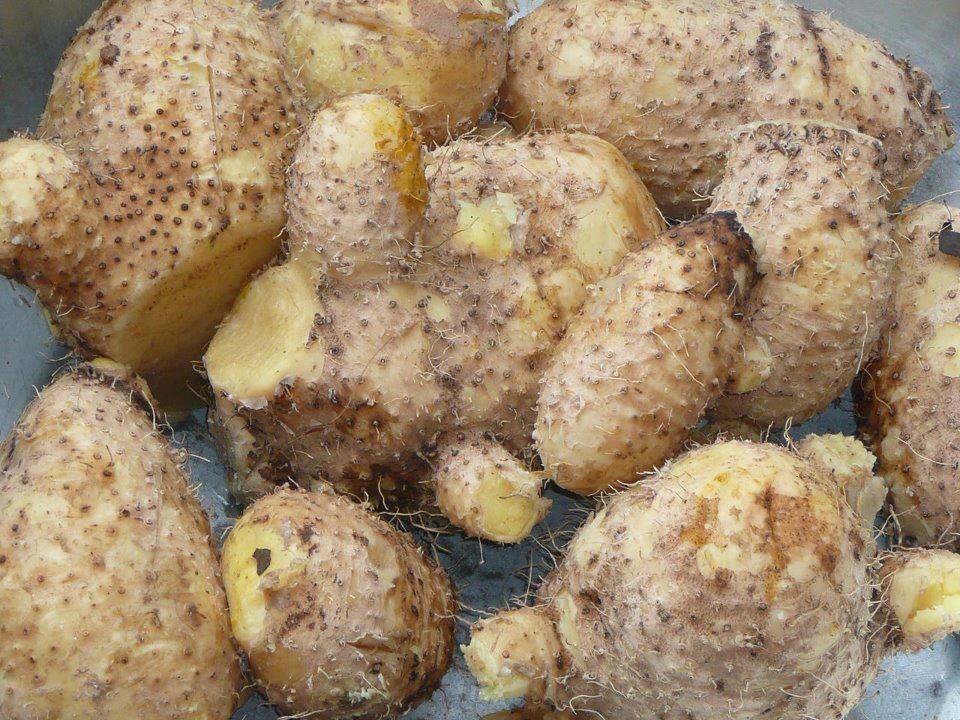
To be self-sufficient, the Akawaio people grow banana, yams, raw cane sugar, taro, cotton, calabash... However, they do not exclusively feed on plants, they also hunt deer, peccary, tapirs, agoutis or pacas. For hunting, they traditionally use blowpipes or bows and arrows but nowadays they also use guns. They make a lot of different alcoholic and non-alcoholic drinks.
Economic activities
Work in the Akawaio community is gender-based. Women work in weaving, pottery and house keeping. Meanwhile, men tend to devote to hunting or peddling. Akawaios trade quivers or other productions for clothes, fruits and weapons.
The tribe of Akawaio has a particular educational model based on non-violence and respect. Akawaio focus on dialogue and separating rivals during disagreements. Sharing is a central value. Indeed, in the village, no one has more property than the other members of the community.
References
References
- "Ingarikó".
- "Censo 2011 - Estructura poblacional indígena".
- (21 October 2009). "Tribal Names of the Americas: Spelling Variants and Alternative Forms, Cross-Referenced". McFarland.
- (2014-12-09). "Akawaio-English Dictionary and English-Akawaio Index".
- Edwards, W.. (1979). "An Ethnohistory of Amerindians in Guyana". Ethnohistory.
- "Akawaio Language and the Akawaio Indian Tribe (Akawayo, Kapon, Kapong, Waika)".
- caroleone. "Guyana /Venezuela/Brésil - Le peuple Akawaio".
This article was imported from Wikipedia and is available under the Creative Commons Attribution-ShareAlike 4.0 License. Content has been adapted to SurfDoc format. Original contributors can be found on the article history page.
Ask Mako anything about Akawaio people — get instant answers, deeper analysis, and related topics.
Research with MakoFree with your Surf account
Create a free account to save articles, ask Mako questions, and organize your research.
Sign up freeThis content may have been generated or modified by AI. CloudSurf Software LLC is not responsible for the accuracy, completeness, or reliability of AI-generated content. Always verify important information from primary sources.
Report