From Surf Wiki (app.surf) — the open knowledge base
Akasaka Palace
State guest house in Japan
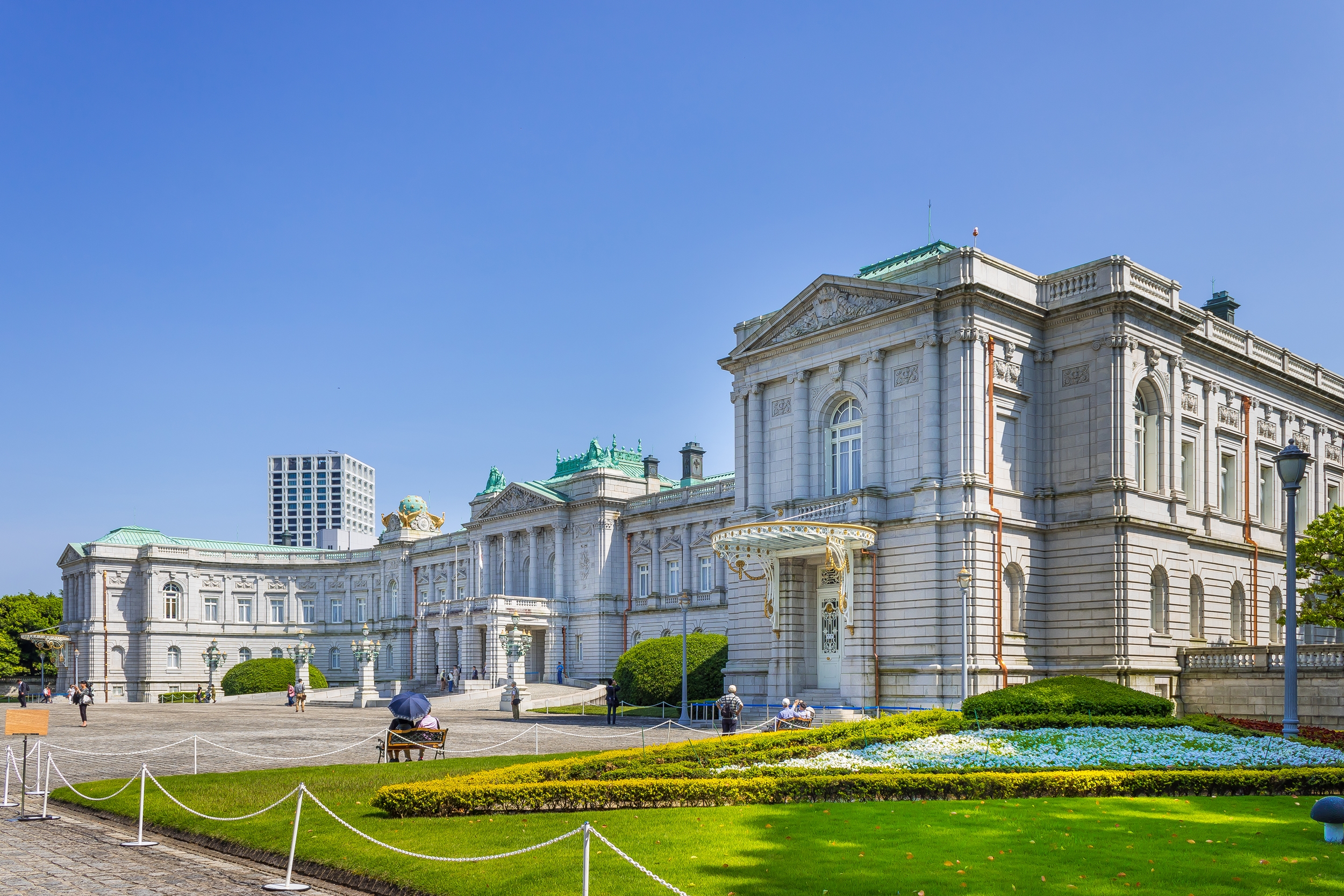
State guest house in Japan
| Field | Value |
|---|---|
| name | Akasaka Palace |
| native_name | 赤坂離宮 |
| native_language | Japanese |
| image | 2019_Akasaka_Palace_02.jpg |
| caption | Akasaka Palace |
| locmapin | Japan |
| coordinates | |
| location | Moto Akasaka, Minato, Tokyo, Japan |
| area | 15000 m2 (floor space) |
| 117000 m2 (site) | |
| built | 1899–1909 |
| built_for | Crown Prince |
| Daijō Tennō | |
| designation1 | Japan |
| designation1_date | 2009 |
the state guest house
117000 m2 (site) Daijō Tennō Akasaka Palace is a state guest house of the government of Japan. Other state guesthouses of the government include the Kyoto State Guest House.
The palace was originally built as the Imperial Palace for the Crown Prince in 1909. The palace is designated as an official accommodation for visiting state dignitaries by the government of Japan. Located in the Moto-Akasaka, Minato, Tokyo, the building took on its present function in 1974, having previously been an imperial detached palace. In 2009 the palace was designated as a National Treasure of Japan.
Overview

The building's address is Tokyo, Minato-ku, Moto-Akasaka-chome No. 1.
The building has 15,000 m2 of floor space, and together with a smaller structure in the Japanese style, occupies a 117,000 m2 site.
The main building is a Neo-Baroque style Western building, resembling in particular the Hofburg Palace and the Palace of Versailles. It is one of largest buildings constructed during the Meiji period.
The palace is surrounded by a footpath unobstructed by road crossings. The footpath is approximately 3.25 km long (roughly 2 miles).
The railway station nearest the Palace is Yotsuya Station.
History
The territory that Akasaka Palace now occupies was part of the residence of Kishū Domain, one of the major branches (gosanke) of the ruling Tokugawa clan, during the Tokugawa period. After the Meiji Restoration, the Owari presented the land to the Imperial Household.
Designed by the architect Katayama Tōkuma, who studied French architecture under Josiah Conder at the Imperial College of Engineering, the French Neo-Baroque structure was constructed between 1899 and 1909 as a residence for the Crown Prince. Originally it was named Tōgū Palace (ja. lit. "Palace for the Crown Prince") but was later renamed Akasaka Palace when the Crown Prince's residence was moved. Regent Crown Prince Hirohito resided at Akasaka Palace from September 1923 until September 1928, two months before his enthronement. The move was intended to be temporary, but lasted five years. During the renovation of his contemporary residence, Hirohito intended to lodge temporarily at Akasaka Palace, moving in on August 28, 1923. Four days later, Japan was hit by the Great Kantō earthquake on September 1. During his residence in Akasaka Palace, Crown Prince Hirohito married, and fathered two daughters, Princess Sachiko (who died at the age of 6 months) and Princess Shigeko.
After the Second World War, the Government of Japan relieved the Imperial Household of Akasaka Palace. Several governmental offices were installed in the palace, including the National Diet Library which was founded in 1948, Cabinet Legislation Bureau and Organizing Committee of Tokyo Olympics 1964.
As the post-war occupation of Japan after the Second World War ended and the country went back to the international stage, a State Guest House was needed. The former residence of Prince Asaka, currently Tokyo Metropolitan Teien Art Museum, was used as the state guest house for a brief period, but it was too small for that purpose. It was decided in 1967 to renovate the former Akasaka Palace as the new state guest house. The renovation was led by architect Togo Murano, took more than five years and 10.8 billion yen, and was completed in 1974.
The first official state guest at the renovated palace was Gerald Ford in 1974, which was the first visit of the incumbent President of the United States to Japan. Since then, the palace has provided accommodations for state and official guests and a venue for international conferences, which have included the G7 summit meetings (1979, 1986 and 1993) and APEC summits.
The venue was closed from 2006 to 2009 for renovation, and was reopened in April 2009. In December 2009, the main building, the main gate and the garden with fountain were designated as a National Treasure of Japan. It was the first designation of assets after the Meiji Restoration as a National Treasure of Japan.
Gallery
File:Geihinkan Akasaka Palace Front 2010.jpg|Main entrance and garden File:State Guest House Akasaka Palace main entrance.jpg|Main entrance File:Akasaka Palace 5.jpg|Main Garden File:JPN State Guest Houses Annex, Yushin-tei 1.jpg|Annex Yushin-tei File:JPN State Guest Houses Annex, Escort station 2.jpg|Safety facilities and national treasure accompanying Akasaka-yuen File:Akasaka Palace-1.jpg|Gate File:President Trump at the Akasaka Palace (47945531727).jpg|Japan's Prime Minister Abe Shinzo meeting U.S. President Donald J. Trump (May 27, 2019)
References
References
- link. (October 16, 2009). [[Agency for Cultural Affairs]]
- link. Cabinet Office, Government of Japan. (2008)
- link. 昭和聖徳記念財団 (Showa Memorial Foundation)
- link. 国立国会図書館 (National Diet Library)
This article was imported from Wikipedia and is available under the Creative Commons Attribution-ShareAlike 4.0 License. Content has been adapted to SurfDoc format. Original contributors can be found on the article history page.
Ask Mako anything about Akasaka Palace — get instant answers, deeper analysis, and related topics.
Research with MakoFree with your Surf account
Create a free account to save articles, ask Mako questions, and organize your research.
Sign up freeThis content may have been generated or modified by AI. CloudSurf Software LLC is not responsible for the accuracy, completeness, or reliability of AI-generated content. Always verify important information from primary sources.
Report