From Surf Wiki (app.surf) — the open knowledge base
AirPort Extreme
Residential gateway
-93731.jpg)
Residential gateway
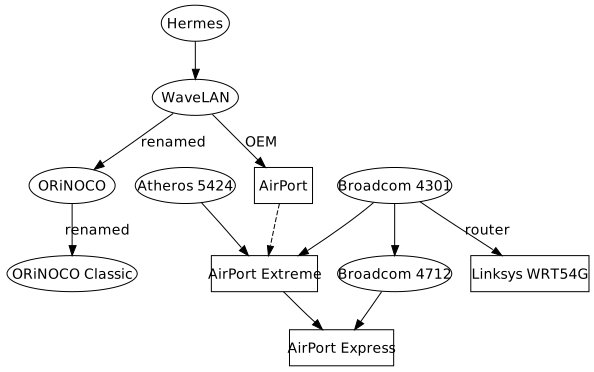
AirPort Extreme is a discontinued line of residential gateways made by Apple Inc. that combine the functions of a router, network switch, wireless access point and NAS as well as varied other functions. The latest model, the 6th generation, supports 802.11ac networking in addition to older standards. Versions of the same system with a built-in network-accessible hard drive are known as the AirPort Time Capsule.
Apple discontinued its wireless routers in 2018, but continues limited hardware and software support.
History
The first AirPort Extreme was announced at the MacWorld expo in San Francisco on January 7, 2003. It featured 802.11g wireless technology for the first time in an AirPort base station.
The name "AirPort Extreme" originally referred to any one of Apple's AirPort products that implemented the (then) newly introduced 802.11g Wi-Fi standard, differentiating it from earlier devices that ran the slower 802.11a and b standards. At that time (circa 2003) the gateway part of this lineup was known as the AirPort Extreme Base Station. With the addition of the even faster Draft-N standards in early 2009 the naming of "Base Station" was dropped, and was renamed to AirPort Extreme. Several minor upgrades followed with the wireless-N models, mostly to change antenna and wireless output power. In 2013, a major upgrade changed the physical structure of the device, added 802.11ac support, and added more antennas.
The AirPort Extreme has gone through three distinct physical forms. The earliest models had a similar plastic housing to the original AirPort Base Station, in a round "flying saucer" shape. From 2007 to 2013, the devices took on a flat rounded rectangle shape, similar in layout and size to the Mac mini or early models of the Apple TV. The 2013 model had a more vertical form, taller than it was wide.
Discontinuation
In 2016, Apple disbanded the wireless router team that developed the AirPort Time Capsule and AirPort Extreme router. In 2018, Apple formally discontinued both products, exiting the router market. Bloomberg noted that "Apple rarely discontinues product categories" and that its decision to leave the business was "a boon for other wireless router makers."
Features
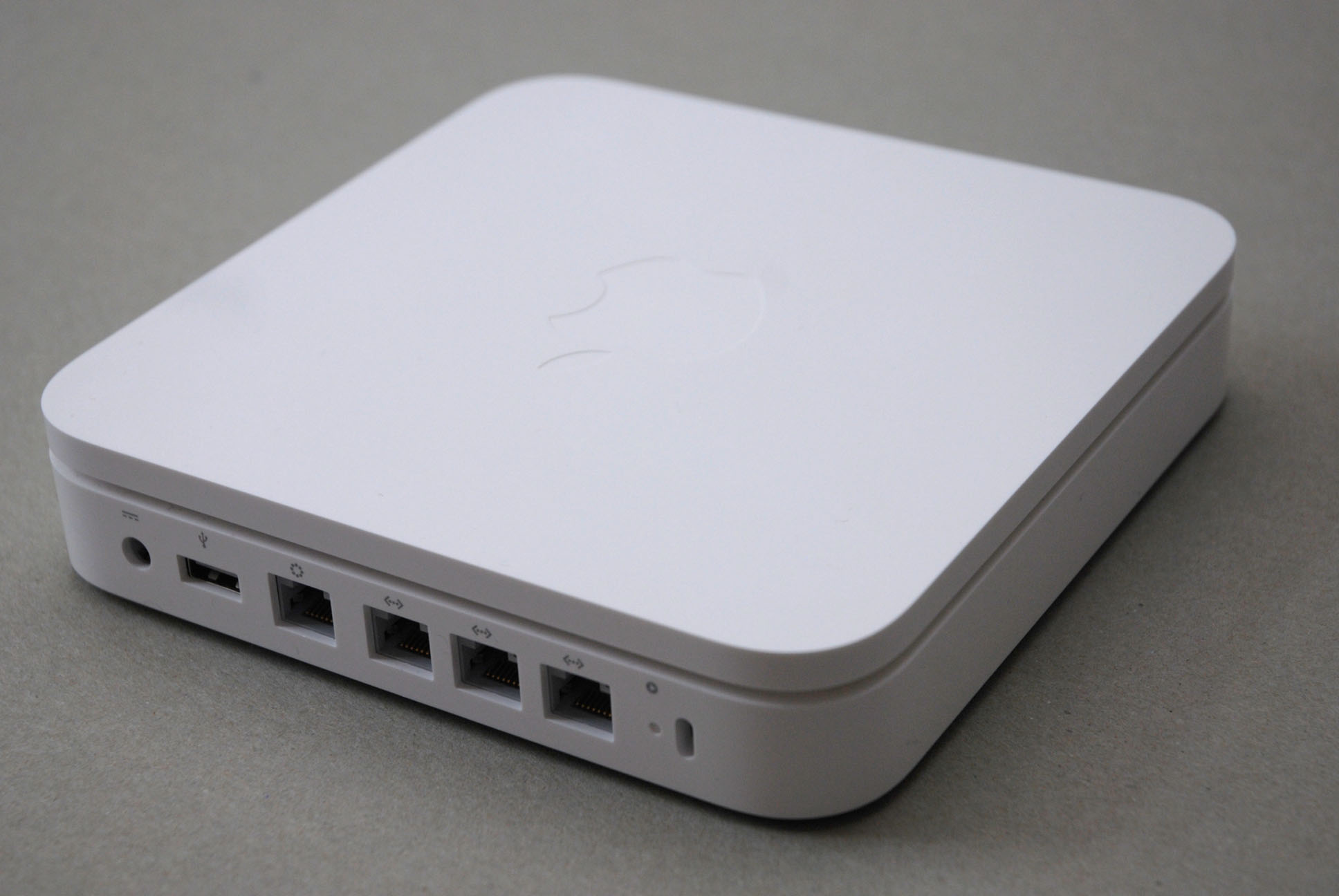
Overview
- Fully featured 802.11ac Wi-Fi base station
- Sleep Proxy Service{{cite web | access-date = 2021-10-06
- 4 Ethernet ports (3 LAN ports, 1 WAN port) — all ports are gigabit Ethernet on newer versions
- USB 2.0 interface for disk and printer sharing
- Built-in file server (AFP and SMB)
- Runs VxWorks Operating System by WindRiver or a customized version of NetBSD.
AirPort Disk
The AirPort Disk feature allows users to plug a USB hard drive into the AirPort Extreme for use as a network-attached storage (NAS) device for Mac OS X and Microsoft Windows clients. Users may also connect a USB hub and printer. The performance of USB hard drives attached to an AirPort Extreme is slower than if the drive were connected directly to a computer. This is due to the processor speed on the AirPort Extreme. Depending on the setup and types of reads and writes, performance ranges from 0.5 to 17.5 MB/s for writing and 1.9 to 25.6 MB/s for reading. Performance for the same disk connected directly to a computer would be 6.6 to 31.6 MB/s for writing and 7.1 to 37.2 MB/s for reading. NTFS-formatted drives are not supported.
Models by generation
Original generation (2003)
.jpg)
The original AirPort Extreme Base Station in 2003 was so named because of its support for the 802.11g standard of the day, as well as for its ability to serve up to 50 Macs or PCs simultaneously. One feature found in most models of this generation was an internal 56K dial-up modem, allowing homes that lacked a broadband connection to enjoy wireless connectivity, albeit at dial-up speeds. It was the only generation to use the "flying saucer" form factor. Later generations would adopt the short, rounded-square form factor that would be seen until 2013.
1st generation
On January 9, 2007 the AirPort Extreme began shipping, with support for 802.11n draft specification, and built-in wireless print and storage server.
2nd generation
On March 19, 2008, Apple released a firmware update for both models of the AirPort Extreme that, according to third-party reports, allowed AirPort Disks to be used in conjunction with Time Machine, similar to the functionality provided by AirPort Time Capsule.
3rd generation
On March 3, 2009, Apple unveiled a new AirPort Extreme with simultaneous dual-band 802.11 Draft-N radios. This allowed full 802.11 Draft-N 2x2 communication in both 802.11 Draft-N bands at the same time.
4th generation
On October 20, 2009, Apple unveiled an updated AirPort Extreme with antenna improvements.
5th generation
On June 21, 2011, Apple unveiled an updated AirPort Extreme, referred to as AirPort Extreme 802.11n (5th Generation).
The detailed table of output power comparison between the 4th generation model MC340LL/A and the 5th generation model MD031LL/A can be seen below:
:{| class="wikitable" border="1" style="text-align:center" |- ! Frequency range (MHz) ! Mode ! AirPort Extreme model ! Output power (dBm) ! Output power (mW) ! Comparison (percent) ! Difference (percent) |- | 4th generation | 24.57 | 286.42
| 100 |
|---|
| 5th generation |
| 24.10 |
| 257.04 |
| 89.7 |
| - |
| 4th generation |
| 21.56 |
| 143.22 |
| 100 |
| - |
| 5th generation |
| 24.88 |
| 307.61 |
| 214.8 |
| - |
| 4th generation |
| 21.17 |
| 130.92 |
| 100 |
| - |
| 5th generation |
| 24.11 |
| 257.63 |
| 196.8 |
| - |
| 4th generation |
| 23.07 |
| 202.77 |
| 100 |
| - |
| 5th generation |
| 25.14 |
| 326.59 |
| 161.1 |
| - |
| 4th generation |
| 22.17 |
| 164.82 |
| 100 |
| - |
| 5th generation |
| 25.28 |
| 337.29 |
| 204.6 |
| - |
| 4th generation |
| 21.44 |
| 139.32 |
| 100 |
| - |
| 5th generation |
| 25.94 |
| 392.64 |
| 281.8 |
| } |
| Note: A 3 dB increase is equivalent to a doubling of power output. |
6th generation
On June 10, 2013, Apple unveiled an updated AirPort Extreme, referred to as AirPort Extreme 802.11ac (6th Generation). The 6th generation AirPort Extreme (and 5th generation AirPort Time Capsule) featured three-stream 802.11ac Wi-Fi technology with a maximum data rate of 1.3 Gbit/s, which is nearly three times faster than 802.11n. Time Machine was now supported using an external USB hard drive connected to AirPort Extreme (802.11ac model only).
Comparison chart
| Approx. release date | Consumer nickname | AirPort Extreme | Model | Wireless standard | Gigabit Ethernet | Guest network | Radio type | MIMO | IPv6 router mode*** | Time-Machine Backup**** | CPU | RAM | FLASH |
|---|---|---|---|---|---|---|---|---|---|---|---|---|---|
| January 7, 2003 | Original/round | M8799LL/A | A1034 | 802.11b/g | Single band | ||||||||
| January 9, 2007 | 1st generation | MA073LL/A | A1143 | 802.11a/b/g/n* | Dual band | ||||||||
| 3×3:2 | Marvell 1850 step A0 (Feroceon core) [88F5281 Rev 4] | 64 MB | 16 MB | ||||||||||
| August 7, 2007 | 2nd generation | MB053LL/A | 3×3:2 | ||||||||||
| March 3, 2009 | 3rd generation | MB763LL/A | A1301 | Dual band (simultaneous) | |||||||||
| 2×2:2 (in each band) | |||||||||||||
| October 20, 2009 | 4th generation | MC340AM/A | A1354 | ||||||||||
| 802.11a/b/g/n | 3×3:3 (in each band) | , but not over PPPoE | , with latest software | ||||||||||
| June 21, 2011 | 5th generation | MD031LL/A | A1408 | , but not over PPPoE | , with latest software | ARM926E-S rev 1 (ARM9E-S core) | 128 MB | 16 MB | |||||
| June 10, 2013 | 6th generation | ME918LL/A | A1521 | 802.11a/b/g/n/ac** | , but not over PPPoE | BCM53019 (dual Cortex-A9) | 512 MB | 32 MB |
*802.11n draft-specification support in 1st- to 3rd-generation models.
**802.11ac draft-specification support in 6th-generation model.
***All models support IPv6 tunnel mode.
****Supported by Apple.
Discontinuation and support
According to a Bloomberg report on November 21, 2016, "Apple Inc. has disbanded its division that develops wireless routers, another move to try to sharpen the company’s focus on consumer products that generate the bulk of its revenue, according to people familiar with the matter."
In an April 2018 statement to 9to5Mac, Apple announced the discontinuation of its AirPort line, leaving the consumer router market. Apple continued supporting the AirPort Extreme.
Notes
References
- (January 7, 2003). "Apple Delivers AirPort Extreme 802.11g Wireless Networking".
- (November 23, 2016). "Apple Abandons Development of Wireless Routers". Bloomberg News.
- (April 27, 2018). "Apple Officially Discontinues Its AirPort Wireless Routers". Bloomberg News.
- "AirPort Extreme: Apple Breaks 90 Mbps".
- "AirPort Extreme – Sharing". Apple Inc..
- Klug, Brian. "Airport Extreme (5th Gen) and Time Capsule (4th Gen) Review – Faster WiFi". AnandTech.
- "AirPort Extreme".
- "AirPort Extreme – Technical Specifications".
- Patel, N.. (March 19, 2008). "Time Machine now works with AirPort Extreme's AirDisk feature".
- Dalrymple, Jim. (March 19, 2008). "Update allows Time Machine backups on AirPort Extreme". Macworld.
- [http://fccid.net/number.php?id=146107&fcc=BCGA1354 Test Report – Previous version] Federal Communications Commission (FCC)
- [http://fccid.net/number.php?id=878510&fcc=BCGA1408 Test Report – Current version] Federal Communications Commission (FCC)
- (January 29, 2021). "Backup disks you can use with Time Machine". Apple Inc..
- "Set up a guest network in AirPort Utility on Mac". Apple Inc..
- Hall, Zac. (April 26, 2018). "Apple officially discontinues AirPort router line, no plans for future hardware".
- "Vintage and obsolete products".
- (June 21, 2019). "Update the firmware on your AirPort base station".
This article was imported from Wikipedia and is available under the Creative Commons Attribution-ShareAlike 4.0 License. Content has been adapted to SurfDoc format. Original contributors can be found on the article history page.
Ask Mako anything about AirPort Extreme — get instant answers, deeper analysis, and related topics.
Research with MakoFree with your Surf account
Create a free account to save articles, ask Mako questions, and organize your research.
Sign up freeThis content may have been generated or modified by AI. CloudSurf Software LLC is not responsible for the accuracy, completeness, or reliability of AI-generated content. Always verify important information from primary sources.
Report