From Surf Wiki (app.surf) — the open knowledge base
Aircraft marshalling
Visual signalling between ground and aircraft

Visual signalling between ground and aircraft
Aircraft marshalling is visual signalling between ground personnel and pilots on an airport, aircraft carrier or helipad.
Activity
Marshalling is one-on-one visual communication and a part of aircraft ground handling. It may be as an alternative to, or additional to, radio communications between the aircraft and air traffic control. The usual equipment of a marshaller is a reflective safety vest, a helmet with acoustic earmuffs, and gloves or marshalling wands – handheld illuminated beacons.
At airports, the marshaller signals the pilot to keep turning, slow down, stop, and shut down engines, leading the aircraft to its parking stand or to the runway. Sometimes, the marshaller indicates directions to the pilot by driving a "Follow-Me" car (usually a yellow van or pick-up truck with a checkerboard pattern) prior to disembarking and resuming signalling, though this is not an industry standard.
At busier and better equipped airports, marshallers are replaced on some stands with a Visual Docking Guidance System (VDGS), of which there are many types.[[File:RAF C-17 being marshalled at Heathrow.ogv|thumb|A [[Royal Air Force]] [[Boeing C-17]] being marshalled at [[London Heathrow Airport]] (2011).]]
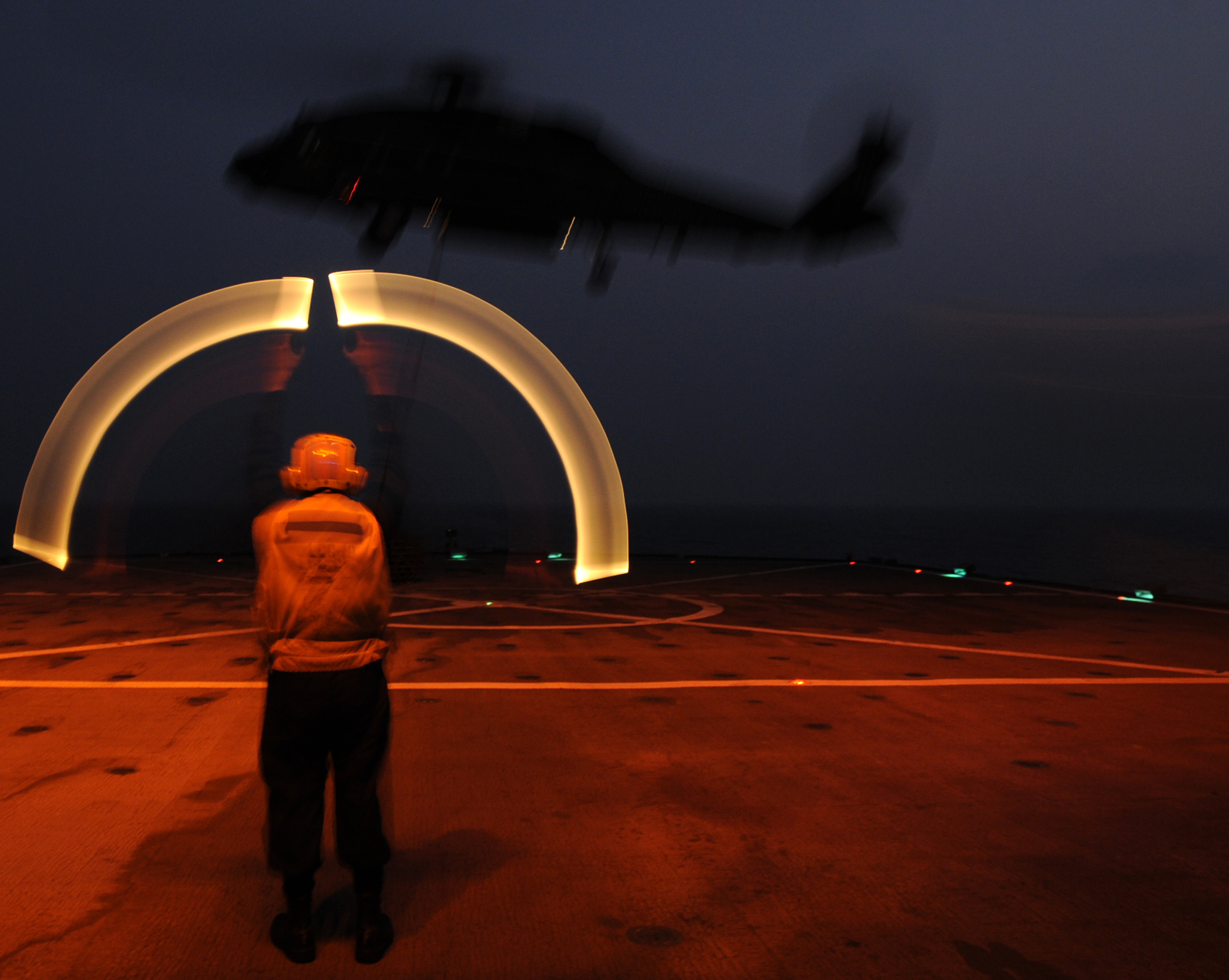
On aircraft carriers or helipads, marshallers give take-off and landing clearances to aircraft and helicopters, where the very limited space and time between take-offs and landings makes radio communications a difficult alternative.
U.S. Air Force procedures
Per the most recent U.S. Air Force marshalling instructions from 2012, marshallers "must wear a sleeveless garment of fluorescent international orange. It covers the shoulders and extends to the waist in the front and back. [...] During daylight hours, marshallers may use high visibility paddles. Self-illuminating wands are required at night or during restricted visibility."
Marshallers, like other ground personnel, must use protective equipment like protective goggles or "an appropriate helmet with visor, when in rotor wash areas or in front of an aircraft that is being backed using the aircraft's engines." It also prescribes "earplugs, muff-type ear defenders, or headsets in the immediate area of aircraft that have engines, Auxiliary Power Unit, or Gas Turbine Compressor running."[[Image:turkish air force transall c-160d followmecar arp.jpg|thumb|[[Turkish Air Force]] [[Transall C-160|Transall C-160D]] behind the Follow-me car at [[RAF Fairford]], [[England]].]]
Noise exposure
Excessive noise can cause hearing loss in marshallers, either imperceptibly over years or after a one-time acoustic trauma. In the United States noise limits at work are set by the Occupational Safety and Health Administration (OSHA).
Fixed wing aircraft hand signals
Despite efforts to standaridize aspects of aviation communication, such as terminology and language, hand signals used to guide aircraft on the ground still vary between various major organizations, such as the International Civil Aviation Organization North Atlantic Treaty Organization,
FAA hand signals
During darkness or periods of poor visibility, the signals remain the same, but the signaler should use illuminated marshaling wands, or another handheld light source. File:Aircraft hand signal all clear.svg|All clear (O.K.) File:Aircraft hand signal flagman directs.svg|Flagman directs pilot File:Aircraft hand signal insert chocks.svg|Insert chocks File:Aircraft hand signal pull chocks.svg|Pull chocks File:Aircraft hand signal start engine.svg|Start engine (Signaler points at engine to be started.) File:Aircraft hand signal cut engines.svg|Cut engines File:Aircraft hand signal proceed straight ahead.svg|Proceed straight ahead File:Aircraft hand signal turn left.svg|Turn left File:Aircraft hand signal turn right.svg|Turn right File:Aircraft hand signal slow down.svg|Slow down File:Aircraft hand signal stop.svg|Stop
Helicopter signals
File:Helicopter hand signal takeoff.svg|Take off File:Helicopter hand signal land.svg|Land File:Helicopter hand signal move upward.svg|Move upward File:Helicopter hand signal move downward.svg|Move downward File:Helicopter hand signal move left.svg|Move left File:Helicopter hand signal move right.svg|Move right File:Helicopter hand signal move forward.svg|Move forward File:Helicopter hand signal move rearward.svg|Move rearward File:Helicopter hand signal hold-hover.svg|Hold hover File:Helicopter hand signal release load.svg|Release sling load
References
References
- U.S. Air Force [http://static.e-publishing.af.mil/production/1/acc/publication/afi91-203_accsup/afi91-203_accsup.pdf Flying Operations and Movement on the Ground] {{Webarchive. link. (2018-01-23 Flight Rules and Procedures. AIR FORCE INSTRUCTION 11-218, 28 October 2011, Incorporating Change 1, 1 November 2012, 89 pp)
- Federal Aviation Administration (FAA) [http://www.hf.faa.gov/webtraining/Environment/Env3d.htm FAA Webtraining Environment] Human Factors Awareness Course, n.d., accessed 7 January 2015.
- (July 2005). "Annex 2 - Rules of the Air - Tenth Edition".
- (17 June 2021). "Aeronautical Information Manual (AIM)".
This article was imported from Wikipedia and is available under the Creative Commons Attribution-ShareAlike 4.0 License. Content has been adapted to SurfDoc format. Original contributors can be found on the article history page.
Ask Mako anything about Aircraft marshalling — get instant answers, deeper analysis, and related topics.
Research with MakoFree with your Surf account
Create a free account to save articles, ask Mako questions, and organize your research.
Sign up freeThis content may have been generated or modified by AI. CloudSurf Software LLC is not responsible for the accuracy, completeness, or reliability of AI-generated content. Always verify important information from primary sources.
Report