From Surf Wiki (app.surf) — the open knowledge base
Aircraft engine
Engine designed for use in powered aircraft

Engine designed for use in powered aircraft
An aircraft engine, often referred to as an aero engine, is the power component of an aircraft propulsion system. Aircraft using power components are referred to as powered flight. Most aircraft engines are either piston engines or gas turbines, although a few have been rocket powered and in recent years many small UAVs have used electric motors.
Manufacturing industry
As of 2025, four European and American manufacturers dominate the global market for aircraft engines:
| Manufacturer | Country | Market capitalization (2025) | Revenue (2024) | Profit margin (EBIT, 2024) |
|---|---|---|---|---|
| GE Aerospace | USA | 283 billion USD | 35.1 billion USD | 21% |
| Safran | France | 123 billion EUR | 27.3 billion EUR | 15% |
| Rolls-Royce | UK | 88 billion GBP | 18.9 billion GBP | 14% |
| MTU Aero Engines | Germany | 20 billion EUR | 7.5 billion EUR | 14% |
The market for aircraft engines, especially jet engines, has very high barriers to entry. Aircraft engines use highly advanced technology and materials, take around eight years and billions of dollars or euros to develop, and must pass exacting safety certifications by aviation safety authorities.
Consequently, entering the engine market is extremely capital- and time-intensive, which helps protect existing manufacturers from competition. The last successful entry in the global market for jet engines was General Electric in the 1970s. These barriers to entry make the market very lucrative for existing manufacturers. As of 2025, the leading jet engine manufacturers reported shareholder returns from between 100 and 1,000 percent over the last five years, compared to small or negative returns for their principal clients, Airbus and Boeing.
The engines themselves are typically sold at a loss, but manufacturers derive their profits from the sale of maintenance services and spare parts over the roughly thirty-year lifespan of an engine, following the razor and blades business model. This creates a perverse incentive for manufacturers to slow the production or delay the delivery of new engines, because they profit most from the use of old engines, which need more service and spare parts than new ones. This contributed to the unavailability of new engines, creating a bottleneck for Airbus and Boeing's efforts to ramp up aircraft production in the post-COVID resurgence of aviation after 2023.
Development history

- 1903: Manly–Balzer engine sets standards for later radial engines.
- 1910: Coandă-1910, an unsuccessful ducted fan aircraft exhibited at Paris Aero Salon, powered by a piston engine. The aircraft never flew, but a patent was filed for routing exhaust gases into the duct to augment thrust.
- 1914: Auguste Rateau suggests using exhaust-powered compressor – a turbocharger – to improve high-altitude performance;
- 1918: Sanford Alexander Moss picks up Rateau's idea and creates the first successful turbocharger
- 1926: Armstrong Siddeley Jaguar IV (S), the first series-produced supercharged engine for aircraft use.The world's first series-produced cars with superchargers came earlier than aircraft. These were Mercedes 6/25/40 hp and Mercedes 10/40/65 hp, both models introduced in 1921 and used Roots superchargers.
- 2020: Pipistrel E-811 is the first electric aircraft engine to be awarded a type certificate by EASA. It powers the Pipistrel Velis Electro, the first fully electric EASA type-certified aeroplane.
Shaft engines
Reciprocating (piston) engines
Main article: reciprocating engine
In-line engine
For other configurations of aviation inline engine, such as X-engines, U-engines, H-engines, etc., see inline engine (aeronautics).[[File:Ranger L-440.jpg|thumb|Ranger L-440 air-cooled, six-cylinder, inverted, in-line engine used in [[Fairchild PT-19]]]]
V-type engine

Main article: V engine}}{{Empty section
Horizontally opposed engine
Main article: Flat engine

H configuration engine
Main article: H engine}}{{Empty section
Radial engine

Main article: Radial engine
A radial engine has the cylinders placed in a circle around the crankshaft. The engine is air-cooled, which can be a problem since they may overheat. Compared to liquid-cooled engines, radial engines have the advantage of being more rugged and capable of absorbing damage.
Rotating Radial engine

Main article: Rotary engine
Rotating radial engines have the cylinders in a circle around the crankcase, as in a radial engine, (see above), but the crankshaft is fixed to the airframe and the propeller is fixed to the engine case, so that the crankcase and cylinders rotate. The advantage of this arrangement is that a satisfactory flow of cooling air is maintained even at low airspeeds, retaining the weight advantage and simplicity of a conventional air-cooled engine without one of their major drawbacks. The first practical rotary engine was the Gnome Omega designed by the Seguin brothers and first flown in 1909. Its relative reliability and good power to weight ratio changed aviation dramatically.
Wankel engine
Main article: Wankel engine

The Wankel is a type of rotary engine. The Wankel engine is about one half the weight and size of a traditional four-stroke cycle piston engine of equal power output, and much lower in complexity. In an aircraft application, the power-to-weight ratio is very important, making the Wankel engine a good choice. Because the engine is typically constructed with an aluminium housing and a steel rotor, and aluminium expands more than steel when heated, a Wankel engine does not seize when overheated, unlike a piston engine. This is an important safety factor for aeronautical use. Considerable development of these designs started after World War II, but at the time the aircraft industry favored the use of turbine engines. It was believed that turbojet or turboprop engines could power all aircraft, from the largest to smallest designs. The Wankel engine did not find many applications in aircraft, but was used by Mazda in a popular line of sports cars. The French company Citroën had developed Wankel powered helicopter in 1970's.
In modern times the Wankel engine has been used in motor gliders where the compactness, light weight, and smoothness are crucially important.{{cite web |access-date = 2006-11-24 | location = DE |archive-url = https://web.archive.org/web/20061008125929/http://www.alexander-schleicher.de/englisch/produkte/ash26/e_ash26_main.htm |archive-date = 2006-10-08}}
Combustion cycles
Starting in the 1930s, attempts were made to produce a practical aircraft diesel engine. In general, Diesel engines are more reliable and much better suited to running for long periods of time at medium power settings. The lightweight alloys of the 1930s were not up to the task of handling the much higher compression ratios of diesel engines, so they generally had poor power-to-weight ratios and were uncommon for that reason, although the Clerget 14F Diesel radial engine (1939) has the same power to weight ratio as a gasoline radial. Improvements in Diesel technology in automobiles (leading to much better power-weight ratios), the Diesel's much better fuel efficiency, and the high relative taxation of AVGAS compared to Jet A1 in Europe have all seen a revival of interest in the use of diesels for aircraft. Thielert Aircraft Engines converted Mercedes Diesel automotive engines, certified them for aircraft use, and became an OEM provider to Diamond Aviation for their light twin. Financial problems have plagued Thielert, so Diamond's affiliate — Austro Engine — developed the new AE300 turbodiesel, also based on a Mercedes engine.{{cite web |access-date = 2010-06-14 |archive-url = https://web.archive.org/web/20140618032748/http://www.flyingmag.com/pilot-reports/pistons/diamond-twins-reborn |archive-date = 2014-06-18 |url-status = dead
Power turbines
Turboprop

Main article: Turboprop}}{{Empty section
Turboshaft
_250_C20B.jpg)
Main article: Turboshaft}}{{Empty section
Electric power
A number of electrically powered aircraft, such as the QinetiQ Zephyr, have been designed since the 1960s. Some are used as military drones. In France in late 2007, a conventional light aircraft powered by an 18 kW electric motor using lithium polymer batteries was flown, covering more than 50 km, the first electric airplane to receive a certificate of airworthiness.
On 18 May 2020, the Pipistrel E-811 was the first electric aircraft engine to be awarded a type certificate by EASA for use in general aviation. The E-811 powers the Pipistrel Velis Electro.
Many big companies, such as Siemens, are developing high-performance electric engines for aircraft use; also, SAE shows new developments in elements as pure Copper core electric motors with a better efficiency. A hybrid system as emergency back-up and for added power in take-off is offered for sale by Axter Aerospace, Madrid, Spain.
Reaction engines
Main article: Jet engine}}{{Empty section
Jet turbines
Turbojet
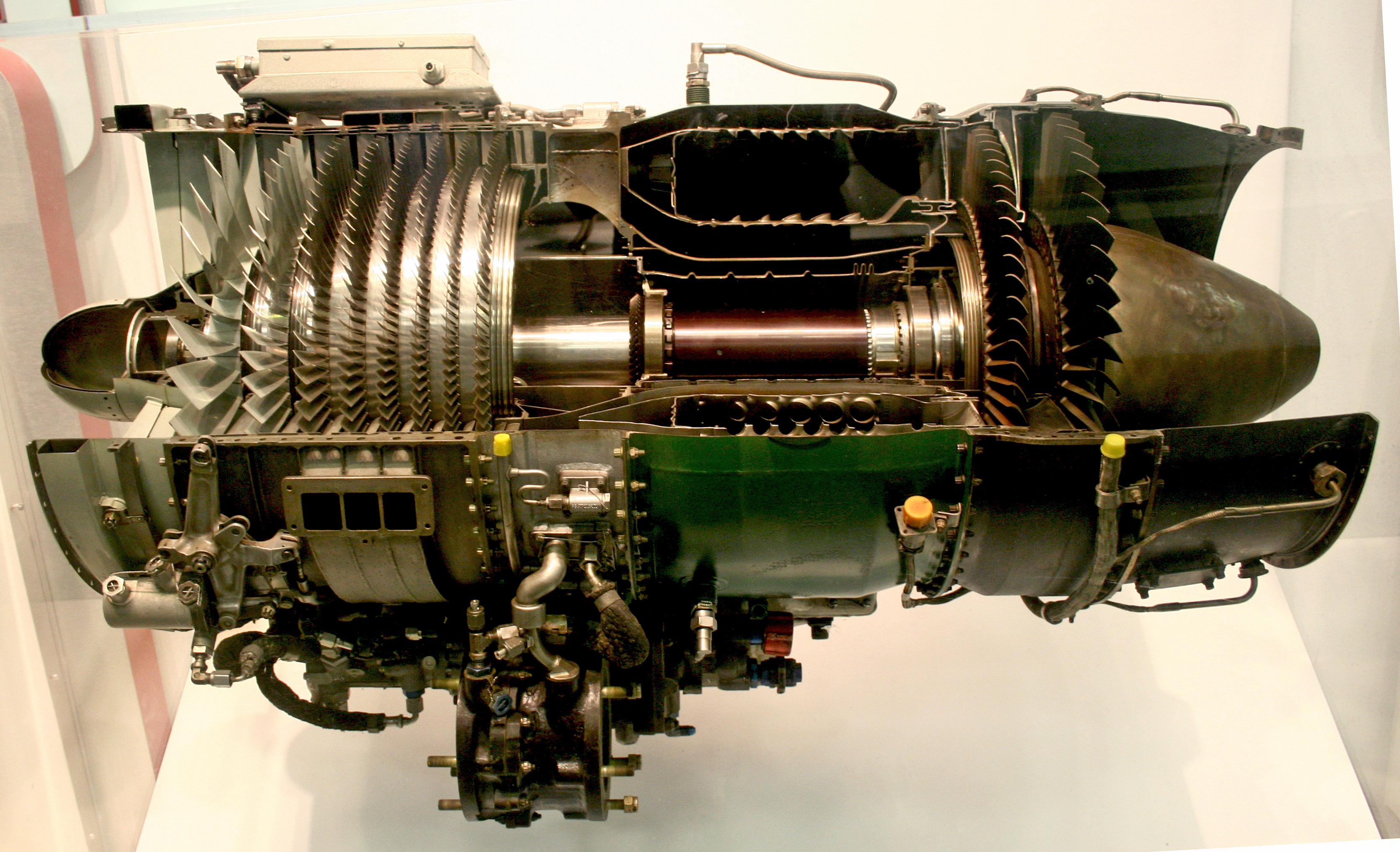
Main article: Turbojet}}{{Empty section
Turbofan

Main article: Turbofan}}{{Empty section
Advanced technology engine
Main article: Advanced technology engine
The term advanced technology engine refers to the modern generation of jet engines.
Pulsejets
Main article: Pulsejet}}{{Empty section
Gluhareff Pressure Jet
Main article: Gluhareff Pressure Jet}}{{Empty section
Rocket

Main article: Rocket engine}}{{Empty section
Rocket turbine engine
Main article: Rocket turbine engine
A rocket turbine engine is a combination of two types of propulsion engines: a liquid-propellant rocket and a turbine jet engine. Its power-to-weight ratio is a little higher than a regular jet engine, and it works at higher altitudes.
Precooled jet engines
Main article: Precooled jet engine}}{{Empty section
Piston-turbofan hybrid
At the April 2018 ILA Berlin Air Show, Munich-based research institute :de:Bauhaus Luftfahrt presented a high-efficiency composite cycle engine for 2050, combining a geared turbofan with a piston engine core.-- The 2.87 m diameter, 16-blade fan gives a 33.7 ultra-high bypass ratio, driven by a geared low-pressure turbine but the high-pressure compressor drive comes from a piston-engine with two 10 piston banks without a high-pressure turbine, increasing efficiency with non-stationary isochoric-isobaric combustion for higher peak pressures and temperatures.-- The 11,200 lb (49.7 kN) engine could power a 50-seat regional jet.
Its cruise TSFC would be 11.5 g/kN/s (0.406 lb/lbf/hr) for an overall engine efficiency of 48.2%, for a burner temperature of 1700 K, an overall pressure ratio of 38 and a peak pressure of 30 MPa. Although engine weight increases by 30%, aircraft fuel consumption is reduced by 15%. Sponsored by the European Commission under Framework 7 project LEMCOTEC, Bauhaus Luftfahrt, MTU Aero Engines and GKN Aerospace presented the concept in 2015, raising the overall engine pressure ratio to over 100 for a 15.2% fuel burn reduction compared to 2025 engines.
Engine position numbering

On multi-engine aircraft, engine positions are numbered from left to right from the point of view of the pilot looking forward, so for example on a four-engine aircraft such as the Boeing 747, engine No. 1 is on the left side, farthest from the fuselage, while engine No. 3 is on the right side nearest to the fuselage.{{cite book
In the case of the twin-engine English Electric Lightning, which has two fuselage-mounted jet engines one above the other, engine No. 1 is below and to the front of engine No. 2, which is above and behind.
Fuel
Refineries blend Avgas with tetraethyllead (TEL) to achieve these high octane ratings, a practice that governments no longer permit for gasoline intended for road vehicles. The shrinking supply of TEL and the possibility of environmental legislation banning its use have made a search for replacement fuels for general aviation aircraft a priority for pilots’ organizations.
Model aircraft typically use nitro engines (also known as "glow engines" due to the use of a glow plug) powered by glow fuel, a mixture of methanol, nitromethane, and lubricant. Electrically powered model airplanes and helicopters are also commercially available. Small multicopter UAVs are almost always powered by electricity, but larger gasoline-powered designs are under development.
Notes
References
References
- Wragg, David W.. (1973). "A Dictionary of Aviation". Osprey.
- Maier, Angela. (2025-08-30). "Triebwerksbauer haben die breitesten Burggräben". [[Neue Zürcher Zeitung]].
- Maier (2025), citing the investor [[Chris Hohn]]: "There have been no market entries for more than 50 years. The last entry was GE".
- (1990). "Encyclopedia of the History of Technology". Routledge.
- Gibbs-Smith, Charles Harvard. (1970). "Aviation: an historical survey from its origins to the end of World War II". [[Her Majesty's Stationery Office]].
- Gibbs-Smith, Charles Harvard. (1960). "The Aeroplane: An Historical Survey of Its Origins and Development". [[Her Majesty's Stationery Office]].
- Winter, Frank H.. (December 1980). "Ducted Fan or the World's First Jet Plane? The Coanda claim re-examined". Royal Aeronautical Society.
- (2010). "Henri Coandă and his technical work during 1906–1918". Editura Anima.
- Guttman, Jon. (2009). "SPAD XIII vs. Fokker D VII: Western Front 1918". Osprey.
- Anderson, John D. (2002). "The airplane: A history of its technology.". American Institute of Aeronautics and Astronautics.
- Gibbs-Smith, C.H.. (2003). "Aviation". NMSO.
- Boulay, Pierre. (1998). "Les hélicoptères français". Larivière (Editions).
- "Superconducting Turbojet". [[Physorg.com]].
- "Voyeur". Litemachines.
- (December 23, 2007). "Worldwide première: first aircraft flight with electrical engine". Association pour la Promotion des Aéronefs à Motorisation Électrique.
- (18 May 2020). "TCDS for E811 engine, model 268MVLC".
- (9 July 2020). "Pipistrel offers type certified electric motor". Seager Publishing.
- [http://axteraerospace.com/ Axter Aerospace]
- Wragg, David W.. (1973). "A Dictionary of Aviation". Osprey.
- "Analysis of the effect of factors on the efficiency of liquid rocket turbine" by Zu, Guojun; Zhang, Yuanjun ''Journal of Propulsion Technology '' no. 6, p. 38-43, 58.[http://adsabs.harvard.edu/abs/1992JPT......R..38Z]
- David Kaminski-Morrow. (24 April 2018). "Hybrid geared-fan and piston concept could slash fuel-burn". Flightglobal.
- "Composite Cycle Engine concept technical data sheet". Bauhaus Luftfahrt.
- "The composite cycle engine concept". Bauhaus Luftfahrt.
- Sascha Kaiser. (July 2015). "A Composite Cycle Engine Concept with Hecto-Pressure Ratio". AIAA Propulsion and Energy Conference.
- "English Electric Lightning F53 (53-671) – Power Plants".
- "EAA'S Earl Lawrence Elected Secretary of International Aviation Fuel Committee".
- "Electric Airplanes - RTF".
- "Amazon.com: Photography Drones Store: Buying Guide: Electronics".
- "RC Quadcopters".
- (27 May 2015). "Yeair! hybrid gasoline/electric quadcopter boasts impressive numbers".
- "Goliath – A Gas Powered Quadcopter".
- (2013-03-11). "Heavy Lifting Quadcopter Lifts 50 Pound Loads. It's a Gas Powered HULK (HLQ)".
This article was imported from Wikipedia and is available under the Creative Commons Attribution-ShareAlike 4.0 License. Content has been adapted to SurfDoc format. Original contributors can be found on the article history page.
Ask Mako anything about Aircraft engine — get instant answers, deeper analysis, and related topics.
Research with MakoFree with your Surf account
Create a free account to save articles, ask Mako questions, and organize your research.
Sign up freeThis content may have been generated or modified by AI. CloudSurf Software LLC is not responsible for the accuracy, completeness, or reliability of AI-generated content. Always verify important information from primary sources.
Report