From Surf Wiki (app.surf) — the open knowledge base
Airbus A320neo family
Re-engined version of the A320 family

Re-engined version of the A320 family
| Field | Value |
|---|---|
| name | A320neo family |
| A319neo/A320neo/A321neo | |
| logo | Logo Airbus A320neo.svg |
| image | IndiGo Airbus A320neo F-WWDG (to VT-ITI) (28915135713).jpg |
| alt | A twin-engined jet aircraft with distinctive winglets, in blue and white livery, against a blue sky |
| image_caption | An A320neo of IndiGo |
| aircraft_role | Narrow-body jet airliner |
| national_origin | Multi-national |
| manufacturers | Airbus |
| status | In service |
| primary_user | IndiGo |
| more_users | |
| number_built | 4,372 |
| construction_date | 2012present |
| introduction | 25 January 2016, with Lufthansa |
| first_flight | |
| developed_from | Airbus A320ceo family |
| related |
A319neo/A320neo/A321neo
The Airbus A320neo family is an incremental development of the A320 family of narrow-body airliners produced by Airbus. The A320neo family (neo being Greek for "new", as well as an acronym for "new engine option") is based on the enhanced variant of the previous generation A319, A320, and A321, which was then retroactively renamed the A320ceo family (ceo being an acronym for "current engine option").
Re-engined with CFM International LEAP or Pratt & Whitney PW1000G engines and fitted with sharklet wingtip devices as standard, the A320neo is 15% to 20% more fuel efficient than previous models, the A320ceo. It was launched on 1 December 2010, made its first flight on 25 September 2014 and was introduced by Lufthansa on 25 January 2016.
By 2019, the A320neo had a 60% market share against the competing Boeing 737 MAX; in 2023, the Chinese designed Comac C919 joined these two as another direct competitor. , a total of 11,529 A320neo family aircraft had been ordered by more than 130 customers, of which 4,372 aircraft had been delivered. The global A320neo fleet had completed more than 18 million flights over 38 million block hours with one hull loss being an airport-safety related accident.
Development
In 2006 Airbus started the A320 Enhanced (A320E) programme as a series of improvements targeting a 4–5% efficiency gain with large winglets (2%), aerodynamic refinements (1%), weight savings and a new aircraft cabin.
Airbus launched the sharklet blended wingtip device during the November 2009 Dubai Airshow. The installation adds 200 kg but offers a 3.5% fuel burn reduction on flights over 2,800 km.
New engine option
Compared to the re-engine improvement of 15%, an all-new single-aisle would have brought only 3% more gain while high volume manufacturing in carbon fibre could be much more expensive.
Airbus planned to offer two engine choices, the CFM International LEAP-1A and the Pratt & Whitney GTF (PW1100G), with 20% lower maintenance cost than current A320 engines.
At the February 2010 Singapore Air Show, Airbus said its decision to launch was scheduled for the July 2010 Farnborough Air Show. On 1 December 2010, Airbus launched the A320neo "New Engine Option" with 500 nmi more range or 2 t more payload, and planned to deliver 4,000 over 15 years. Development costs were predicted to be "slightly more than €1 billion [$1.3 billion]".
.jpg)
The 2010 order for 40 Bombardier CS300s (now known as Airbus A220-300) and 40 options from Republic Airways Holdings – then owner of exclusive A319/320 operator Frontier Airlines – pushed Airbus into the re-engine.
Introduction was then advanced to October 2015. Airbus claims a 15% fuel saving and "over 95 percent airframe commonality with the current A320". Its commonality helped to reduce delays associated with large changes. In March 2013, airlines' choices between the two engines were almost equal.
The new "Space-Flex" optional cabin configuration increases space-efficiency with a new rear galley configuration and a "Smart-Lav" modular lavatory design allowing an in-flight change of two lavatories into one accessible toilet. The "Cabin-Flex" configuration for the A321neo allows up to 20 more passengers without "putting more sardines in the can" by rearranging the door layout of the aircraft. Total fuel consumption per seat is reduced by over 20%, while the rearranged cabin allows up to nine more passengers for the A320neo.
The first Airbus A320neo rolled out of the Toulouse factory on 1 July 2014 and first flight was scheduled for September 2014.
File:Airbus A320neo CFM LEAP nacelle.jpg|CFM International LEAP-1A engine File:Airbus A320neo PW1100G nacelle.jpg|Pratt & Whitney PW1100G engine, also known as the Pratt & Whitney GTF
Flight testing
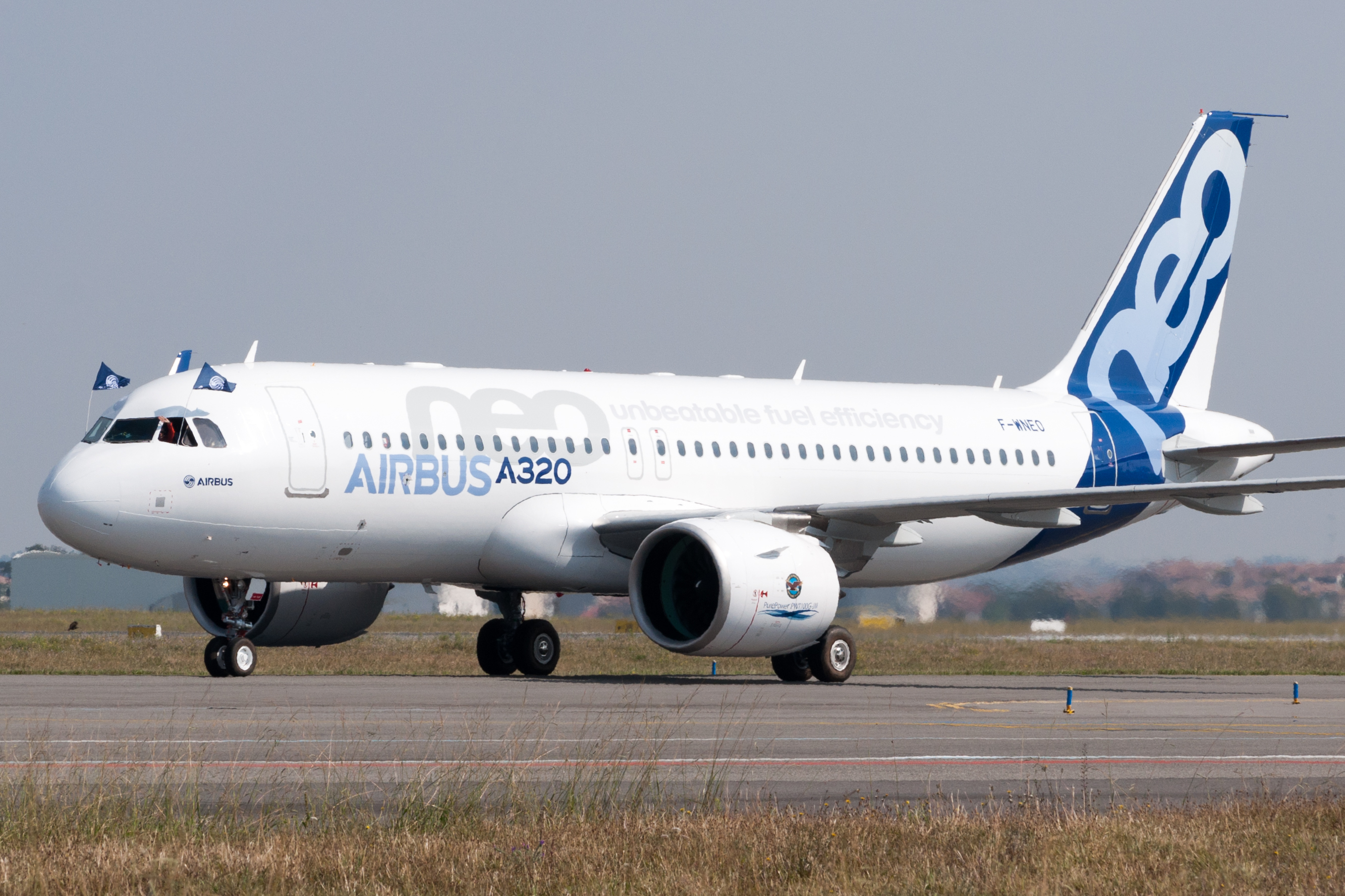
The first flight of the neo occurred on 25 September 2014. Its Pratt & Whitney PW1100G-JM geared turbofan ('GTF') engine was certified by the Federal Aviation Administration (FAA) on 19 December 2014.
After 36 months, the A320neo and A321neo had flown around 4,000 hours for certification of the two powerplant versions. This is about three-quarters of the certification effort of a new design.
Of these 4,000 hours flown, 2,250 were with PW GTFs and 1,770 with CFM LEAPs.
The A320neo is half as loud as an A320 at take-off, with an 85-decibel noise footprint. The LEAP-powered A321neo has 83.3 dB flyover noise, substantially lower than the older CFM56 and V2500.
Entry into service
The first delivery of the aircraft slipped slightly, Lufthansa taking delivery of the first A320neo on 20 January 2016 and deploying it on its first commercial flight from Frankfurt to Munich on 25 January 2016. Two hundred deliveries were targeted in 2017, but as Pratt & Whitney faced ramp-up difficulties, Airbus expected that thirty aircraft would be parked awaiting engines.
Production
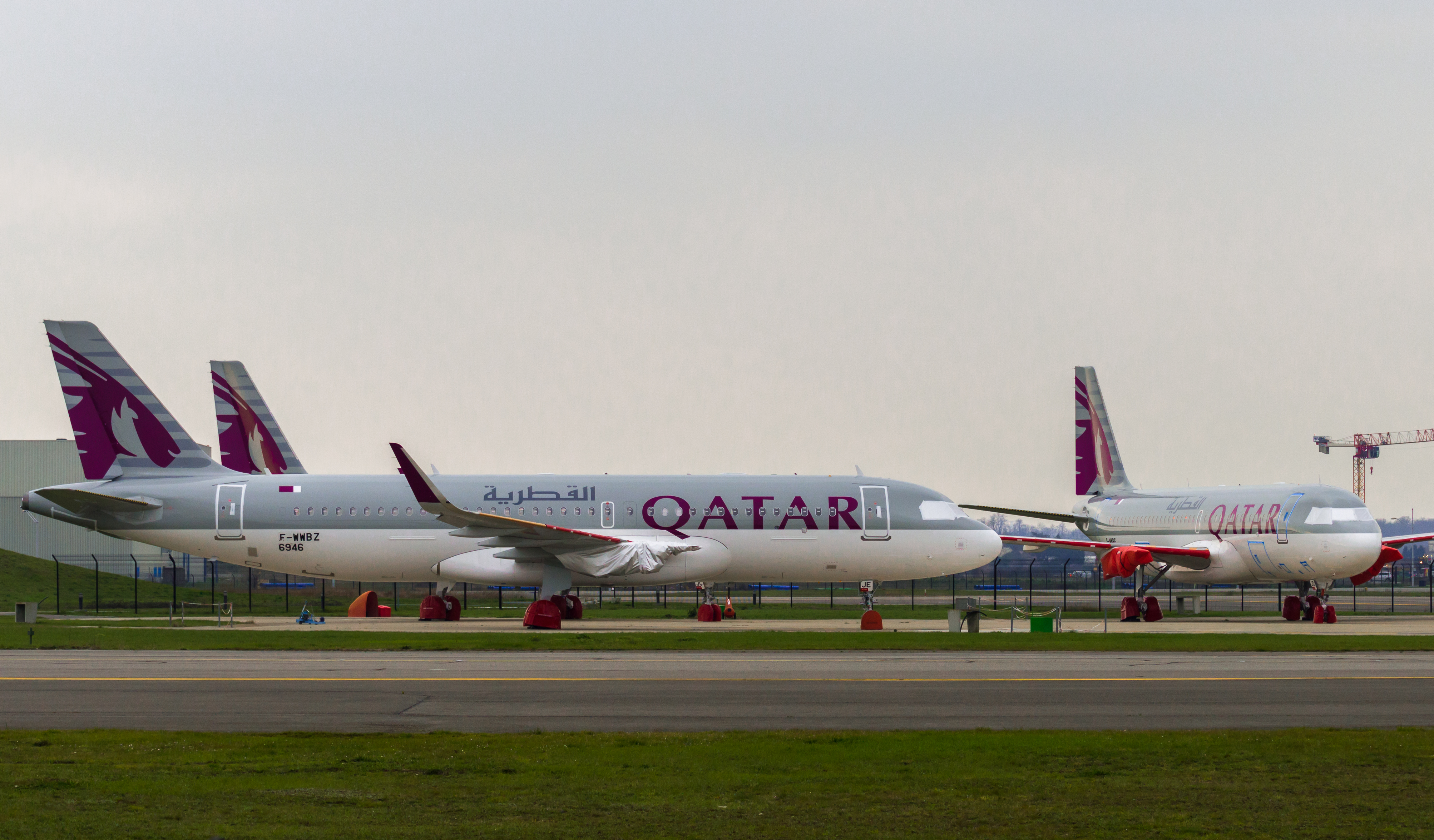
At the start of production in 2017, Airbus was delivering 50 A320-family aircraft per month, and targeted a production rate of 60 per month by 2019. By October 2017, only 90 A320neos had been delivered, and Airbus acknowledged it would miss its target of 200 deliveries for the year, even with increased fourth-quarter output. More than 40 completed aircraft were parked without engines, but as engine issues were largely resolved by early 2018, Airbus expected that more than half of all A320-family deliveries in 2018 would be neos.
Airbus reiterated its goal of producing 60 narrow-body aircraft per month by mid-2019 and examined higher rates. In April 2018, Airbus confirmed plans to increase monthly output to 63 from 55 in 2018, while studying rates of 70 to 75 aircraft per month beyond 2019, although engine supplier capacity constrained near-term expansion.
In February 2018, following in-flight shutdowns of the PW1100G caused by compressor aft hub and seal issues, the European Union Aviation Safety Agency and Airbus grounded portions of the A320neo fleet until replacement parts were available. Airbus subsequently stopped accepting PW1100G engines, and deliveries of GTF-powered aircraft resumed in May after Pratt & Whitney reverted to the original seal design as an interim fix.
By mid-2018, Airbus expected around 100 completed aircraft to be awaiting engines and aimed to deliver most of them in the second half of the year, targeting more than 800 total deliveries for 2018. The backlog of parked aircraft declined from a peak above 100 to 86 by the end of June. The 500th A320neo-family aircraft was delivered in October 2018.
Production line expansion
At the start of the A320neo programme, Airbus was producing the A320 family across six final assembly lines: three at the Hamburg Finkenwerder plant (A318/A319/A321), one at Toulouse–Blagnac facility (A320s), one at the Tianjin, China facility (A319/A320), and one at the Airbus U.S. Manufacturing Facility in Mobile, Alabama (A319/A320/A321).
A seventh final-assembly line in Hamburg, the fourth at that location, opened in July 2017.
By July 2019, with the A321neo accounting for approximately 40% of sales, Airbus began evaluating options to allocate additional production capacity to the stretched variant, including repurposing the former A380 final assembly line in Toulouse. In January 2020, Airbus confirmed the conversion of the A380 assembly line to the eighth final assembly line, dedicated to A321neo production by mid-2022, driven by strong demand for the A321LR and A321XLR variants. To support the A321XLR, Airbus established a dedicated aft-fuselage production line in Hamburg in February 2021 using a former A380 facility, allowing XLR-specific structures to be ramped up without disrupting overall A320neo-family output. In July 2023, Airbus inaugurated the A320neo-family final assembly line in Toulouse.{{cite news |title= À Toulouse, Airbus réduit le cycle d'assemblage des A320neo
In October 2025, Airbus opened its ninth and tenth A320neo-family final assembly lines: a second line at its U.S. facility and a second line in Tianjin.
Replacement airliner
By November 2018, Airbus was hiring in Toulouse and Madrid to develop a clean sheet successor for the A320. Although its launch was not guaranteed, it was expected to arrive from the middle of the following decade, after the A321XLR and a stretched A320neo "plus", and would have competed with the Boeing NMA that was, at the time, expected to be launched as early as 2019. Service entry would be determined by ultra-high bypass ratio engine developments pursued by Pratt & Whitney, testing its Geared Turbofan upgrade; Safran, ground testing a demonstrator from 2021; and Rolls-Royce Plc, targeting a 2025 UltraFan service entry. The production target is a monthly rate of 100 narrow-bodies, up from 60.
At the November 2019 Dubai Airshow, Airbus CEO Guillaume Faury said the company was considering the launch of a single-aisle programme in the second half of the 2020s for an introduction in the early 2030s. In June 2023, Faury said work had begun on eAction, a 20–25% more efficient successor to the A320neo family targeted for a 2035-2040 introduction and more conventional compared to the Airbus ZEROe hydrogen project. At a Civil Aviation Research Council (CORAC) meeting in December 2023, the French government committed €300 million ($330 million) per year to support research and development from 2024 to 2027, including for the CFM RISE open fan demonstrator, while support for hydrogen or electric propulsion receives €65 million. In February 2024, Faury confirmed that the successor aircraft, dubbed Next-Generation Single-Aisle (NGSA), would be designed specifically to run on sustainable aviation fuel to achieve carbon neutrality by 2050.
Composite wing
Wing of Tomorrow In 2015, Airbus started a new wing project, named Wing of Tomorrow (WoT), announced as the "Wing of the future" programme in 2016. A new $1–2 billion carbon-composite wing could be used in the A321neo-plus-plus, compared to $15 billion for a completely new design. The new wing is made from composite material. It is first seen as an upgrade to the existing, mostly metal A320 family wing, which was already upgraded many times. Composite wings are already in use on the A350, but the enhanced, new design will employ highly automated manufacturing suitable for inexpensive high-volume production. Announced in January 2016, a €44.8 million facility was built in Filton, with 300 engineers. The new wing design and tests take place in this Filton facility. Other Airbus locations in the UK, France, Spain and Germany are working with 30 partners on this wing project.
In May 2021, Airbus announced that for improved aerodynamic performance the wing will be longer and thinner with folding wingtips to access existing airport gates. By May 2021, assembly of the first demonstrator was to start in the coming weeks, as the project should be completed by 2023 before an eventual product launch. A “radical” A320 makeover is expected to cost over 4 billion euros ($4.9 billion, £3.7 billion), significantly less than the estimates of $15 billion to $20 billion for an all-new Boeing design.(£11 billion to £15 billion). Due to the increased length and increased lift, the new wings could also be used on an Airbus A322, an A321 lengthened by 4 passenger seat-rows, being studied by Airbus.
The current A320neo family wingspan of 36m with an aspect-ratio of 9 will be extended by ground-folding wingtips to 45m with an aspect-ratio of 14. Additional semi-aeroelastic hinges could lead to 52m wingspan with an aspect-ratio of 18, still fitting in a standard 36m airport gate. In September 2021, Airbus announced starting the assembly of in total 3 full-size "Wing of Tomorrow" prototypes. The first prototype was completed in December 2021. The flapping wing section flight tests are targeted to begin in late 2023. In June 2023, GKN Aerospace announced a further progress by delivering the first fixed trailing edge for the “Wing of Tomorrow”. It is manufactured in a high-rate low-cost resin transfer moulding out of autoclave composite process, which supports the targeted low-cost of Airbus by avoiding an autoclave.
Operational history
.jpg)
By January 2019, three years after its introduction, 585 neos were in commercial service with over 60 operators, led by IndiGo (87), Frontier Airlines (33) and China Southern (26).-- Lufthansa confirms the PW 16% fuel savings, 21% per seat with denser 180-seat layout up from 168, while Avianca states its LEAPs are 15–20% more efficient, quieter, reduce oil consumption and routine maintenance.-- Starting both GTFs initially took 6–7 min up from the A320ceo's 2 min, improving to 2–3 min by late 2017, still longer than the ceo.-- LEAP production bottlenecks led to early delivery delays, with no significant repercussions at Avianca or AirAsia; AirAsia's dispatch reliability is comparable to its ceos.
On 30 November 2021, two years after receiving the 1,000th member of the A320neo family, IndiGo took delivery of the 2,000th, an A321neo (MSN 10654) at Airbus Hamburg site.
, the global A320neo fleet had completed more than 18 million flights over 38 million block hours since its entry into service and had been contributing to 52 million tons of saving.
Engine and dispatch reliability
Engine vibration affects one GTF in 50, leading to premature replacement, but spare engine pools compete with new production: at Lufthansa, dispatch reliability has remained stagnant since service entry and is below its 99.8% goal, with a utilization rate 20% below its ceos.-- P&W cites a 99.91% dispatch reliability for GTF-powered neos, higher than other new engine introductions, while Airbus reports a 99.6% dispatch reliability.-- With engine deliveries resuming, there were expected to be fewer than 10 engine-less neos at the end of 2018; Airbus is on track to reach its target rate of 60 deliveries per month by mid-2019.-- Of the 6,362 orders, 2,456 are for CFM LEAP engines (%), 1,869 for Pratt & Whitney GTFs (%), and 2,037 for an as-yet unspecified engine choice (%). By 30 June 2019, Safran claimed the Leap has a 61% market share on the A320neo family, with 44 airlines operating 454 Leap powered aircraft having accumulated 3.3 million flight hours. In early 2022, 57% of in service A320neos were fitted with Leap engines, and 43% with PW1100G engines.
Flight control software update
In July 2019, Airbus disclosed two outwardly similar, though separate, issues which could result in excessive pitch up behaviour, one affecting the A320neo and the other the A321neo. Both issues were detected during analysis and laboratory testing, and have not been encountered in actual operation. Airbus has addressed the issues through temporary revisions to the flight manual, including loading recommendations and a change to the centre-of-gravity envelope, and expected to release updated flight control software in 2020. As Lufthansa waited for the 2020 flight software update, it blocked the last row of its aft-heavy layout of 180, offering only 174 seats.
Military conversion
In 2018, Airbus explored the possibility of military versions, for VIP transport, intelligence, surveillance and reconnaissance and maritime patrol for the armed forces of France, Germany and the Netherlands; or Asia-Pacific nations such as Indonesia, Malaysia, New Zealand, and the Philippines. Such conversions would be possible within a six-to-eight-month timescale.
Multifunctional Runway Light (MFRL)

The Multifunctional Runway Light (MFRL) system is a new exterior lighting system introduced by Airbus for its A320neo family aircraft. It replaces the old exterior lighting system of a separated set of lights, including the retractable landing light, all the lights on the nose gear (take off light, taxi light, runway turn off light) and combined them into a single LED light set which locates at the front of the center wing box.
It offers the following compared to the retractable light sets:
- Drag reduction
- Weight savings
- Improved reliability performance.

In March 2022, Airbus delivered the first MFRL-equipped A320neo (MSN 10758) to Eurowings.
Variants
Airbus offers three variants of the A320neo family: the A319, A320 and A321. A neo variant for the Airbus A318 was not proposed but could be developed should demand arise.
A319neo

The shortened-fuselage variant can seat up to 160 passengers or 140 in two classes, with a range of up to 3,750 nmi and improved takeoff performance, while its ACJ derivative can fly eight passengers 6,750 nmi or 15 hours.
Qatar Airways was set to be launch customer but upgraded its order to the larger A320neo in late 2013, with no new launch operator named since then. Spirit later ordered 47 new A319neo aircraft.
The A319neo made its first flight on 31 March 2017, powered by CFM LEAP engines. After 500 flight hours, the LEAP-powered A319neo achieved FAA/EASA Type Certification by 21 December 2018, allowing it to enter service in the first half of 2019. At the time 53 aircraft had been ordered, including 17 with Leap engines: 12 for Avianca, 4 for an unconfirmed Chinese operator (later revealed to be China Southern Airlines, which became the launch operator), and 1 ACJ319neo; and 36 with no engine selection: 8 for Avianca, 26 for unannounced customers, and 2 ACJ319neos. , certification of the PW1100G-powered version was planned for the end of 2019, with the same test aircraft to be converted during the first quarter and undergo 200 hours of flight testing. In 2018, an A319neo list price was US$101.5 million.
Interest in the variant has been low, and in January 2019 the A319neo's order backlog was only a fraction of that of the A220, following confirmation of orders from jetBlue and Breeze Airways for 60 A220s each. Also in January 2019, Airbus confirmed that it has no plans to discontinue the A319neo programme, although it expects fewer orders due to competition with the A220-300.
The Pratt & Whitney-powered variant made its maiden flight on 25 April 2019. It gained EASA type certification by the end of November 2019, after 90 sorties over 240 h.
As of May 2021, six ACJ319neo aircraft had been ordered. On 18 February 2022, China Southern Airlines received the first of its order of four A319neo with CFM LEAP engines.
A320neo
Timeline
_at_Frankfurt_Airport.jpg)
Nearly 28 years after the first A320, on 25 January 2016, the A320neo entered service with Lufthansa, the type's launch customer. It has a range of 6,300 km.
Reliability
Six months later at Farnborough Airshow, John Leahy reported that the eight in-service aircraft had achieved 99.7% dispatch reliability. By the end of February 2017, 28,105 scheduled flights had been performed by 71 A320neo aircraft with 134 cancellations for a 99.5% completion rate. Spirit Airlines reported PW1000G engine issues on four of its A320neos and did not fly them above 30,000 ft because the bleed air system froze shut on occasion due to cold temperatures; the same problem was reported by IndiGo.
Efficiency
After a year in service, Lufthansa confirmed the 20% efficiency gain per passenger with up to 180 seats, along with reduced noise and emissions. Operators confirm the 15% per seat fuel-burn savings even counterbalanced by the added weight on short sectors, which can rise to 16–17% on longer routes and to 20% or more for Lufthansa with 180 passengers up from 168 with two more seat rows.
Deliveries
By March 2017, 88 A320neos had been delivered to 20 airlines, 49 with the PW1000G and 39 with the CFM LEAP-1A, and the fleet had accumulated more than 57,600 flight hours and 37,500 cycles ( h average); over 142 routes the average stage length is 900 nmi and like the A320ceo the neo flies an average of 8.4 block hours and up to 10 cycles a day with Lufthansa operating 45 min sectors from Frankfurt to Hamburg or Munich, up to China Southern Airlines flying close to 6 hr sectors. Airbus planned to deliver about 200 A320neos in 2017. In 2018, new A320neos have a $49 million value, rising by 1–2% per year, and are leased for $330,000–350,000 per month (–%) due to intense lessor competition and low financing costs, while a recent A320ceo is leased for $300,000. In 2018, an A320neo list price was US$110.6 million.
Military A320M3A
In July 2018, Airbus was evaluating an A320neo variant for ISR missions, particularly maritime patrol and anti-submarine warfare, and military transport.
A321neo
Main article: Airbus A321neo#A321neo
The A321neo has the same length as the original A321ceo, but includes structural strengthening in the landing gear and wing, increased wing loading and other minor modifications due to a higher Maximum Takeoff Weight (MTOW).
Its first customer was ILFC. The Airbus A321neo prototype, D-AVXB, first flew on 9 February 2016. It suffered a tailstrike three days later and was flown to Toulouse for repairs, delaying the certification programme for several weeks.
It received its type certification with Pratt & Whitney engines on 15 December 2016, and simultaneous EASA and FAA certification for the CFM Leap powered variant on 1 March 2017. The first A321neo, leased by GECAS, was delivered in Hamburg to Virgin America, configured with 184 seats and LEAP engines, and entered service in May 2017.
A321LR
Main article: Airbus A321neo#A321LR

In October 2014, Airbus started marketing a longer range 97 t maximum takeoff weight variant with three auxiliary fuel tanks, giving it 100 nmi more operational range than a Boeing 757-200. Airbus launched the A321LR (Long Range) on 13 January 2015; it has a range of 4000 nmi with 206 seats in two classes. On 31 January 2018, the variant completed its first flight. Airbus announced its certification on 2 October 2018. On 13 November 2018, Arkia received the first A321LR.
A321XLR
Main article: Airbus A321neo#A321XLR

In January 2018, Airbus was studying an A321LR variant with a further increased MTOW. The proposed A321XLR, with an increased range of 4,500 nmi, was to be launched in 2019 to enter service in 2021 or 2022 and compete with the Boeing NMA. In November, Airbus indicated that the A321XLR would have an MTOW over 100 t and 700 nmi more range than the A321LR. The A321XLR was launched at the June 2019 Paris Air Show, with 4700 nmi of range from 2023, including a new permanent Rear Centre Tank (RCT) for more fuel, a strengthened landing gear for a 101 t MTOW; and an optimised wing trailing-edge flap configuration to preserve take-off performance. The company announced in June 2022 that the aircraft had completed its first flight. The A321XLR, powered by CFM LEAP-1A engines, received EASA type certification on 19 July 2024 and was expected to enter service at the end of the summer, while certification of the PW1000G engine powered A321XLR, was expected to follow later in the same year.
Airbus Corporate Jets

Two Airbus Corporate Jets variants are offered: the ACJ319neo, carrying eight passengers up to 6750 nmi, and the ACJ320neo, carrying 25 up to 6000 nmi. The CFM LEAP or Pratt & Whitney PW1100G lower fuel-burn provides additional range along with lower engine noise while the cabin altitude does not exceed 6,400 ft. To increase its fuel capacity, the ACJ319neo is offered with up to five additional centre tanks (ACT).
The first ACJ320neo was delivered in January 2019, with deliveries of the ACJ319neo expected to start a few months later. On 25 April 2019, the ACJ319neo, outfitted with five ACTs, completed its first flight, before a short test campaign and subsequent delivery to German K5 Aviation. The following day, the aircraft completed an endurance test flight lasting 16 hours and 10 minutes and setting a record for the longest A320-family flight by an Airbus crew.
Military variants
.png)
A321LR – Transport and MEDEVAC
The German Air Force operates two A321LR based on the A321neo; they are used for medical evacuation missions and can be configured for passenger transport.
A320neo – M3A
In July 2018, Airbus unveiled the concept of a Modular Multi-Mission Aircraft (M3A) family of aircraft. This family includes three variants:
- Maritime Patrol Aircraft (MPA)
- Airborne Early Warning and Control (AEW&C)
- Signal Intelligence (SIGINT)
This family of aircraft ended up never being selected by any military.
A321neo – MPA
In November 2024, Airbus revealed the A321 MPA aircraft, a proposed successor to the Atlantique 2 of the French Navy. The variant offered by Airbus is the A321XLR. The aircraft is in competition with a Falcon 10X offered by Dassault.
Equipment:
- 2 × dorsal fairings (SATCOM)
- 5 × blade antennas
- 1 × E/O gimball under the cockpit
- MAWS (Missile Approach Warning Systems)
- ESM (Electronic Support Measures)
- Tail cone, a bay for the weapons and the sonobuoys
Operators
Main article: List of Airbus A320 family operators
, 4,274 A320neo family aircraft are in service with 127 operators, 85 of which use CFM engines, and 42 PW engines. The five largest operators are IndiGo operating 340, Wizz Air 177, China Southern Airlines 169, China Eastern Airlines 148 and Frontier Airlines 147 aircraft.
Orders and deliveries
Main article: List of Airbus A320neo family orders and deliveries
At the A320neo programme launch on 1 December 2010, Airbus anticipated "a market potential of 4,000 A320neo Family aircraft over the next 15 years". By March 2013, a little over two years after launch, It had received 2,000 orders. At the first jet delivery in January 2016, the family had received almost 4,500 orders from nearly 80 customers. it had 5,052 orders : 49 A319neos (%), 3,617 A320neos (%) and 1,386 A321neos (%), with 1,712 of them powered by CFM LEAPs (%), 1,429 by PW GTFs (%) and 1,911 undisclosed (%). By 2019, the A320neo had a 60% market share against the competing Boeing 737 MAX. By December 2021, as many orders migrated to the larger A321neo, it became the most popular variant with 3,958 orders compared to 3,748 orders for the A320neo, while the previous A321 achieved a third of the A320 family orders. In June 2023, total orders for the A321neo reached 5,163, surpassing total orders for the A320ceo of 4,763, and making it the most-ordered variant of the A320 family. In July 2023 the total orders reached 5,259, surpassing the record 5,205 orders for the Boeing 737-800, becoming the most ordered variant of any airliner in the world. In December 2023, the A320neo family became the first airliner generation to reach a record order of 10,000 units and an order backlog of 7,000 units.
, a total of 11,529 A320neo family aircraft have been ordered by 130 customers, of which 4,372 aircraft have been delivered.
; 2011 In early January 2011, IndiGo reached a memorandum of understanding (MoU) for 150 A320neos along 30 A320ceos. On 17 January, Virgin America became the launch customer, ordering 60 A320s including 30 A320neos.
At the June 2011 Paris Air Show, it gathered 667 commitments worth US$60.9 billion, raising the backlog to 1,029. Malaysian low-cost carrier AirAsia ordered 200, the largest commercial aviation order at the time. IndiGo confirmed its 150 order. Airbus received orders from GECAS, Scandinavian Airlines, TransAsia Airways, IndiGo, LAN Airlines, AirAsia, GoAir, Air Lease Corporation and Avianca.
On 20 July 2011, American Airlines announced an order for 460 narrowbody jets including 130 A320ceos and 130 A320neos, and intended to order 100 re-engined 737 with CFM LEAPs, pending Boeing confirmation. The order broke Boeing's monopoly with the airline and forced Boeing into the re-engined 737 MAX. As this sale included a Most-Favoured-Customer Clause, the European airframer must refund any price difference to American if it sells to another airline at a lower price. As a result, Airbus was unable to offer the A320neo at a price which United Airlines deemed "competitive", leaving it with a Boeing-skewed fleet.
On 27 July 2011, Lufthansa ordered 25 A320neos and 5 A321neos. The November Dubai Airshow saw a further 130 orders, raising the total to 1,420 orders and commitments, making it the fastest selling aircraft ever.
; 2012 On 25 January, Norwegian and Airbus confirmed an order of 100 A320neos. In November, Virgin America deferred the deliveries of the A320neo aircraft until 2020, making ILFC the new launch customer along with the A321neo. In December 2012 Pegasus Airlines, the second largest airline in Turkey, signed a deal for up to 100 A320neo family aircraft, of which 75 (57 A320neo and 18 A321neo models) are firm orders.
; 2013 Lufthansa ordered an additional 70 A320neo and A321neo aircraft on 14 March 2013. easyJet, who already operates 195 A320ceo family aircraft, intends to acquire 100 Airbus A320neo for delivery between 2017 and 2022. As part of the deal, easyJet have options on a further 100 A320neo aircraft, and the Japanese carrier ANA is to order the A320neo and A321neo. Lion Air ordered 183. On 15 March 2013, Turkish Airlines ordered 82 A320s with 35 options including four A320neo and 53 A321neo.
; 2014 On 15 October 2014 IndiGo signed a MoU with Airbus for purchasing 250 A320neo family aircraft. The deal would be worth over $25.5 billion as per the list price per aircraft. This order will also be the largest by the airline, marking the largest number of jets ever sold by the European planemaker in a single order. The airline had earlier ordered 100 aircraft in 2005 and another 180 aircraft in 2011.
; 2017 On 15 November 2017 Airbus announced the signing of a MoU with Indigo Partners' four portfolio airlines for 430 A320neo family aircraft – a deal worth nearly $50 billion. On 14 December 2017 Delta Air Lines announced an order for 100 A321neo aircraft and 100 options, powered by Pratt & Whitney PW1100Gs.
; 2018 By September 2018, Airbus should deliver 3,174 A320neos compared with 2,999 Boeing 737 MAX through 2022.-- A320neo-family maintenance should rise from $650 million in 2018 to $3.3 billion in 2022.
; 2019 On 29 October 2019, IndiGo placed a firm order for 300 A320neo Family aircraft, marking one of Airbus' largest aircraft orders ever with a single airline operator. The order comprised a mix of A320neo, A321neo and A321XLR aircraft. This takes IndiGo's total number of A320neo Family aircraft orders to 730.
On 18 November 2019, the low-cost carrier Air Arabia ordered 120 A320neo family jets worth $14 billion at list prices: 70 A320neos and 50 A321neos/XLRs, to be delivered from 2024.
; 2022 On 1 July 2022, four Chinese airlines ordered 292 A320neo aircraft. China Eastern ordered 100, China Southern ordered 96 and signed lease agreements for 17 more, Air China ordered 64 and Shenzhen Airlines ordered 32. ; 2023 On 14 February 2023, Air India placed an order for 470 aircraft, the largest order at that time, comprising 140 A320neos, 70 A321neos and other airliners.
On 19 June 2023, IndiGo placed an order for 500 A320neo family aircraft, surpassing Air India's order four months earlier and becoming the largest aircraft order by volume with 125 A320neos and 375 A321neos.
Accidents and incidents
The A320neo family has recorded one airport-safety related hull-loss accident with no fatalities onboard and three fatalities on the ground .
As of 2023, the A320neo family had experienced 0.11 fatal hull loss accidents for every million takeoffs and 0.11 total hull loss accidents for every million takeoffs.
Accidents
On 2 September 2022, TAP Air Portugal Flight 1492, an Airbus A320neo registered as CS-TVI, from Lisbon to Conakry International Airport hit a motorbike during landing. Both occupants of the motorbike were killed and the aircraft received damage to its right engine. One rider of the motorbike was identified as the airport's security guard.
On 18 November 2022, LATAM Perú Flight 2213, an Airbus A320neo registered as CC-BHB, collided with a fire engine that was crossing the runway during takeoff from Lima, killing two firefighters and injuring a third, who died several months later. All 102 passengers and 6 crew aboard escaped, but 40 of them were injured, 4 of them seriously. The aircraft was written off.
Specifications
| Variant | A319neo | A320neo | A321neo | Cockpit crew | 2-class seats | 1-class maximum | Seat width | Cargo capacity | Length | Wingspan | Height | Max. takeoff weight | Max. payload | Operating empty | Minimum weight | Fuel capacity | Engines (×2) | Fan diameter | Max. thrust | Speed | Ceiling | Typical range | Takeoff | ICAO type | |||||||
|---|---|---|---|---|---|---|---|---|---|---|---|---|---|---|---|---|---|---|---|---|---|---|---|---|---|---|---|---|---|---|---|
| Two | |||||||||||||||||||||||||||||||
| 140 | 165 | 206: 16 J @ 36 in + 190 Y @ 30 in | |||||||||||||||||||||||||||||
| 160 | 195 @ 27 in | url= https://www.easa.europa.eu/sites/default/files/dfu/TCDS_EASA%20A%20064_%20Airbus_%20A318_A319_A320_A321_Iss_48_0.pdf | title= Type certificate Data sheet for Airbus A318 – A319 – A320 – A321 | publisher= EASA | date= May 2021 | access-date= 16 May 2021 | archive-date= 16 May 2021 | archive-url= https://web.archive.org/web/20210516190703/https://www.easa.europa.eu/sites/default/files/dfu/TCDS_EASA%20A%20064_%20Airbus_%20A318_A319_A320_A321_Iss_48_0.pdf | url-status= live }} | ||||||||||||||||||||||
| Economy at 6 abreast: 18 in, 3.7 m cabin width, Business at 4 abreast | |||||||||||||||||||||||||||||||
| 27 m3 | 37 m3 | 51 m3 | |||||||||||||||||||||||||||||
| 33.84 m | 37.57 m | 44.51 m | |||||||||||||||||||||||||||||
| 35.80 m | |||||||||||||||||||||||||||||||
| 11.76 m | |||||||||||||||||||||||||||||||
| 75.5 t | 79 t | 97 t | |||||||||||||||||||||||||||||
| 17.7 t | 20 t | 25.5 t | |||||||||||||||||||||||||||||
| {{#expr:60.3-17.7}} t | {{#expr:64.3-20}} t | {{#expr:75.6-25.5}} t | |||||||||||||||||||||||||||||
| 40.3-40.6 t | 46.3-46.6 t | ||||||||||||||||||||||||||||||
| 29,659 L (7,835 US gal) | 32,853 L (8,679 US gal) | ||||||||||||||||||||||||||||||
| CFM International LEAP-1A or Pratt & Whitney PW1100G | |||||||||||||||||||||||||||||||
| PW1100G: 81 in, LEAP-1A: 78 in | |||||||||||||||||||||||||||||||
| 24,100 lbf | 27120 lbf | 33110 lbf | |||||||||||||||||||||||||||||
| Cruise: 0.78 Mach, Max.: 0.82 Mach | |||||||||||||||||||||||||||||||
| 39100 - | |||||||||||||||||||||||||||||||
| 6,950 km (3,750 nmi; 3750 nmi) | 6,500 km (3,500 nmi; 3500 nmi) | 7,400 km (4,000 nmi; 4000 nmi) | |||||||||||||||||||||||||||||
| 1,829 m (6,000 ft) | 1,951 m (6,400 ft) | 1988 m | |||||||||||||||||||||||||||||
| A19N | A20N | A21N |
Notes
Engines
| Designation | Engines | Certification | Take-off thrust | Maximum continuous |
|---|---|---|---|---|
| A319-171N | PW1124G1-JM | 19 August 2019 | 107.82 kN | 106.91 kN |
| A319-151N | CFM LEAP-1A24 | 19 August 2019 | 106.80 kN | 106.76 kN |
| A319-153N | CFM LEAP-1A26 | 19 August 2019 | 120.64 kN | 118.68 kN |
| A320-271N | PW1127G-JM | 24 November 2015 | 120.43 kN | 117.18 kN |
| A320-272N | PW1124G1-JM | 19 August 2019 | 107.82 kN | 106.91 kN |
| A320-273N | PW1129G-JM | 19 August 2019 | 130.00 kN | 117.19 kN |
| A320-251N | CFM LEAP-1A26 | 31 May 2016 | 120.64 kN | 118.68 kN |
| A320-252N | CFM LEAP-1A24 | 17 January 2018 | 106.80 kN | 106.76 kN |
| A320-253N | CFM LEAP-1A29 | 19 August 2019 | 130.29 kN | 118.68 kN |
| A321-271N | PW1133G-JM | 15 December 2016 | 147.28 kN | 145.81 kN |
| A321-272N | PW1130G-JM | 27 June 2017 | 147.28 kN | 145.81 kN |
| A321-251N | CFM LEAP-1A32 | 10 July 2018 | 143.05 kN | 140.96 kN |
| A321-252N | CFM LEAP-1A30 | 17 January 2018 | 143.05 kN | 140.96 kN |
| A321-253N | CFM LEAP-1A33 | 10 July 2017 | 143.05 kN | 140.96 kN |
Notes
- A321-25xNX/-27xNX was the A321neo ACF (Airbus Cabin Flex) configuration and the A321LR.
- A321-25xNY/-27xNY was the A321XLR.
References
References
- (8 July 2012). "Airbus starts production of the A320neo Family". Airbus S.A.S..
- Georgiadis, Philip. (2022-07-18). "Airbus climbs past Boeing in single-aisle market share". Financial Times.
- (20 June 2006). "Pictures: Airbus aims to thwart Boeing's narrowbody plans with upgraded 'A320 Enhanced'". Flight International.
- Max Kingsley-Jones. (15 November 2009). "Dubai 09: A320s sharklets to deliver 3.5% lower fuel burn from 2012". Flight International.
- Max Kingsley-Jones. (31 December 2019). "How crucial single-aisle strategies a decade ago will shape the 2020s". Flightglobal.
- Scott Hamilton. (23 August 2010). "A320 NEO to have $7–8 million price premium". Flightglobal.
- (4 February 2010). "SINGAPORE 2010: Airbus targets early A320 re-engining decision, 2015 debut". Flightglobal.
- (1 December 2010). "Airbus offers new fuel saving engine options for A320 Family". Airbus.
- Kerry Reals. (7 December 2010). "Airbus outlines expected market impact of A320NEO". Flight International.
- (18 October 2017). "From war to partner: Airbus and the CSeries". Leeham.
- (6 April 2011). "PW1100G lead engine for A320neo development". Airbus.
- (5 December 2011). "Transaero Airlines firms up order for eight A320neo aircraft". Airbus.
- (19 March 2014). "Airbus A320NEO Enters FAL (MSN6101)". Theflyingengineer.
- (21 March 2013). "IN FOCUS: How to power A320neo is tough choice for airlines". Flightglobal.
- (August 2013). "Smart-Lav: Another cabin development for the A320 Family". [[Airbus]] Latin America.
- (13 June 2014). "Airbus reveals new A321neo layout: New 'Cabin-Flex' and larger doors". Australian business traveller.
- (12 June 2014). "Airbus Sees A321neo Exceeding 20% Fuel Burn Improvement". AviationWeek.
- (1 July 2014). "Airbus' first A320neo reaches completion". Airbus.
- (25 September 2014). "First A320neo successfully completes first flight". Airbus.
- (19 December 2014). "FAA Certifies PurePower Engine for A320neo Aircraft". UTC.
- Tim Wuerfel. (26 May 2017). "Flying The A321neo: Technology Upgrades Under The Skin". Aviation Week & Space Technology.
- Max Kingsley-Jones. (14 June 2017). "How Airbus managed a six-variant A320neo test campaign". Flightglobal.
- (10 April 2017). "EASA confirms A321neo Leap as quiet as PW1100G". Flightglobal.
- (30 December 2015). "Airbus Delays Delivery of First A320neo Until 2016". Wall street journal.
- (20 January 2016). "First A320neo delivery opens new era in commercial aviation". Airbus.
- Spaeth, Andreas. (25 January 2016). "First look: Lufthansa's A320neo reviewed". BusinessTraveller.
- (2 March 2015). "Analysts Flag Potential Airliner Glut". [[Aviation Week & Space Technology]].
- David Kaminski-Morrow. (26 June 2017). "Airbus expects to park around 30 engineless A320neos". Flightglobal.
- Alex Derber. (3 November 2017). "Airbus Aims To Consign Engine Issues To 2017". Aviation Week Network.
- Jens Flottau. (6 February 2018). "Airbus Eyes Ever Higher Production Rates". Aviation Week Network.
- Tim Hepher. (25 April 2018). "Airbus confirms plans to raise A320 output to 63 a month". Reuters.
- Stephen Trimble. (9 February 2018). "In-flight failures prompt emergency call for P&W-powered A320neos". Flightglobal.
- Jens Flottau. (3 June 2018). "Airbus:100 A320neos To Be Waiting For Engines By End Of June". Aviation Week Network.
- David Kaminski-Morrow. (6 July 2018). "Parked A320neo backlog declines after triple-figure peak". Flightglobal.
- James Field. (14 November 2018). "Photos: Airbus Delivers 85 Aircraft in October". AirwaysMag.
- François Duclos. (2 August 2019). "Airbus pourrait assembler des A321neo à Toulouse". Air Journal.
- (21 January 2020). "Airbus to build first A321neo line at Toulouse in place of A380 facility". Flight Global.
- (21 January 2020). "Airbus to build second production line in France for A321 jets". [[Radio France Internationale]].
- (3 February 2021). "Airbus separates A321XLR aft-fuselage work to avoid disrupting assembly line". Flight Global.
- (10 July 2023). "Toulouse. Airbus inaugure sa nouvelle ligne d'assemblage : Toutes les images".
- Underwood. (14 October 2025). "Airbus inaugurates new A320 Final Assembly Line at Mobile facility". Made in Alabama.
- Yu, Sophie. (22 October 2025). "Airbus opens second jet assembly line in China as it targets production growth". Reuters.
- Benjamin D Katz. (21 November 2018). "Airbus Reveals Plans for All-New Narrow-Body, Re-Engined A350".
- Max Kingsley Jones. (19 November 2019). "New single-aisle Airbus feasible by early 2030s – Faury". Flightglobal.
- Jens Flottau, Thierry Dubois. (20 December 2023). "France Funds Research Into Conventional A320neo Successor". Aviation Week.
- (15 February 2024). "A320neo successor would be based on new platform burning sustainable aviation fuel: Faury". Flight Global.
- Charlotte Ryan. (24 May 2021). "Airbus Backs Lightweight Wing to Preserve Lead Over Boeing".
- (17 January 2017). "Wing of the future". Airbus.
- Tim Hepher. (9 May 2017). "Airbus looks to upgrades to counter Boeing's new mid-market jet". Reuters.
- (1 September 2020). "Update: Lower wing skin, Wing of Tomorrow". [[Compositesworld]].
- Michael Gubisch. (7 June 2019). "Cost reduction central to Airbus future-wing programme". Flightglobal.
- (29 January 2016). "Investing in the future: Airbus announces new UK wing development and test centre". Airbus.
- (9 May 2019). "Building things with wings". Aerospace Manufacturing Magazine.
- Scott Hamilton: [https://leehamnews.com/2021/05/31/pontifications-the-wing-of-tomorrow-and-airbus-future/ Pontifications: The Wing of Tomorrow and Airbus’ future] Leeham News
- (20 September 2021). "Airbus X-Plane Will Test Inflight Folding Wingtips". [[Aviation Week Network]].
- (22 September 2021). "Airbus begins assembly of first future 'eco-wing' prototype". Airbus.
- (21 December 2021). "Airbus Completes First 'Wing of Tomorrow' Prototype". ASSEMBLY Magazine.
- Ginger Gardiner. (30 September 2021). "Airbus X-Wing will test flapping wing tips, multifunctional trailing edges for future aircraft". [[CompositesWorld]].
- [https://www.asdnews.com/news/aerospace/2021/09/23/gkn-delivers-1st-fixed-trailing-edge-airbus-wing-tomorrow-programme GKN Delivers the 1st Fixed Trailing Edge for Airbus' "Wing of Tomorrow" Programme] ASDNews
- [https://www.compositesworld.com/articles/one-piece-one-shot-17-meter-wing-spar-for-high-rate-aircraft-manufacture One-piece, one-shot, 17-meter wing spar for high-rate aircraft manufacture] CompositesWorld
- Mattias Calmunger, Mohamed Sahbi Loukil: [https://liu.se/en/article/innovativ-tillverkningsmetod-for-kompositmaterial Innovative and cost-effective manufacturing out of autoclave for composite materials] Linköping University
- (31 October 2025). "A320 FAMILY: the most successful aircraft family ever". Airbus.
- Michael Gubisch. (4 January 2019). "What operators have to say about the A320neo". Flightglobal.
- (8 October 2019). "Everything you need to know about the 6 biggest commercial engine manufacturers". Flightglobal.
- (2022). "Engine watch". Cirium.
- (19 July 2019). "Flight-control refinement to fix A321neo pitch-up issue". Flightglobal.com.
- (1 August 2019). "A320neo also potentially vulnerable to pitch-up scenario". Flightglobal.com.
- Jens Flottau. (11 September 2019). "Lufthansa Blocks Last Row Of A320neo Seats; Cites CG Issues". Aviation Week Network.
- Aaron Chong. (7 February 2018). "Airbus explores A320neo military derivatives". Flightglobal.
- (1 May 2023). "Aircraft Characteristics - Airport and Maintenance Planning". Airbus S.A.S..
- (1 December 2010). "Airbus could eventually offer Neo version of A318: Leahy". [[Flightglobal]].
- (31 December 2013). "Qatar swaps A319neo to A320neo; just 29–39 orders remain". Leeham News.
- Stephen Trimble. (31 March 2017). "Airbus completes A319neo first flight". Flight Global.
- (21 December 2018). "A319neo with CFM LEAP-1A engines wins joint Type Certification from FAA and EASA".
- Michael Gubisch. (21 December 2018). "Leap-powered A319neo gains joint approval from EASA and FAA". Flightglobal.
- Michael Gubisch. (21 December 2018). "Airbus aiming to get GTF-powered A319neo certificated next year". Flightglobal.
- "AIRBUS AIRCRAFT 2018 AVERAGE LIST PRICES* (USD millions)". Airbus.
- (4 January 2019). "New A220 orders eclipse total A319neo sales". Flightglobal.com.
- (17 January 2019). "Airbus A320, A220 Evolution Considered As Mobile Expands". Aviation Week Network.
- (25 April 2019). "Commercial Aircraft Pratt & Whitney engine-powered A319neo makes maiden flight". Airbus.
- Michael Gubisch. (30 November 2019). "EASA approves P&W-powered A319neo". Flightglobal.
- (17 May 2021). "Airbus Corporate Jets wins order for the ACJ319neo". Airbus.
- Alfred Chua. (23 February 2021). "China Southern takes first pair of A319neos". Flightglobal.
- (1 July 2014). "PICTURE: Airbus rolls out A320neo". flightglobal.
- (25 September 2014). "A320neo makes maiden flight". Flightglobal.
- (24 November 2015). "Airbus A320neo receives joint EASA and FAA Type Certification". Airbus.
- (25 January 2016). "EXCLUSIVE: Onboard the Inaugural Airbus A320neo Low-Key Lufthansa Launch". Airways News.
- (7 October 2021). "A320neo {{!}} A320 {{!}} Aircraft {{!}} Airbus Aircraft".
- (12 July 2016). "Airbus reveals A320neo dispatch reliability". Flight Global.
- (2 March 2017). "An Analysis of A320neo Flight Operations through February 2017". AirInsight.
- Benjamin Bearup. (10 April 2017). "Report: Spirit A320neo Fleet Suffering PW1000G Engine Challenges". Airways Magazine.
- (30 December 2016). "Lufthansa welcomes its fifth A320neo into its fleet". Lufthansa.
- Jens Flottau and Guy Norris. (24 March 2017). "Airlines Praise Airbus A320neo Performance, But Engine Issues Remain". Aviation Week & Space Technology.
- Aircraft Value News. (12 November 2018). "Transitioning Product Line Impacts Values of Outgoing Models".
- (20 July 2018). "Airbus evaluates an A320neo multi-mission version". Airbus.
- (8 March 2011). "ILFC selects 100 A320neo Family aircraft". Airbus.
- (9 February 2016). "Airbus A321neo completes first flight after engine switch.". Reuters.
- (12 February 2016). "Accident: Airbus A321 at Perpignan on Feb 12th 2016, tail strike on landing". The Aviation Herald.
- (15 December 2015). "Airbus A321neo with P&W engines receives Type Certification". Airbus.
- (1 March 2017). "A321neo powered by CFM LEAP-1A engines receives type certification". Airbus.
- Aaron Karp. (20 April 2017). "Virgin America receives first A321neo as Alaska mulls future fleet". Aviation Week.
- (21 October 2014). "Exclusive: Airbus launches "A321neoLR" long range to replace 757-200W". Leeham News.
- (13 January 2015). "Airbus Launches Long-Range A321neo". Aviation International News.
- (13 January 2015). "Airbus Launches Long-Range A321neo Version". [[Aviation Week]].
- (31 January 2018). "Airbus A321LR long-range jet completes maiden flight". Reuters.
- (2 October 2018). "EASA and FAA certify long-range capability for A321neo". Airbus.
- David Kaminski Morrow. (13 November 2018). "Arkia chief: A321LR first single-aisle to beat 757-300 economics". Flightglobal.
- Jens Flottau. (31 January 2018). "Airbus Studying Higher-Capacity A321neo". Aviation Week Network.
- (20 July 2018). "Airbus Moves Ahead With A321XLR Definition". Aviation Week & Space Technology.
- (13 November 2018). "Airbus indicates A321XLR would have over 100t MTOW". Flightglobal.
- (17 June 2019). "Airbus launches longest range single-aisle airliner: the A321XLR". Airbus.
- O'Connor, Kate. (17 June 2022). "Airbus A321XLR Completes First Flight".
- (19 July 2024). "Airbus A321XLR receives EASA type certification". Aircraft Interiors International.
- "Corporate Jets : ACJneo". Airbus.
- (17 January 2019). "Acropolis Aviation takes delivery of 1st ACJ320neo". aviationnews.eu.
- (25 April 2019). "ACJ319neo makes successful first flight". Airbus.
- (29 April 2019). "ACJ319neo sets record during test flight". Airbus.
- (2022-08-23). "Innovation am Himmel – die Abnahme des neuen Airbus A321LR für die Luftwaffe".
- "A320neo M3A Modular Multi-Mission Aircraft".
- Satam, Parth. (2024-11-13). "Airbus Reveals A321 MPA as French Navy Prepares to Replace its Atlantique 2".
- (16 November 2011). "Airbus wins 211 orders and commitments worth US$20.5 billion". Airbus.
- (22 March 2013). "Turkish Airlines places its biggest order ever with Airbus". Airbus.
- (20 January 2016). "First A320neo delivery opens new era in commercial aviation". Airbus.
- Tim Hepher. (29 April 2019). "Why Airbus isn't pouncing on Boeing's 737 MAX turmoil". Reuters.
- David Kaminski-Morrow. (8 December 2021). "Orders for A321neo overtake those for A320neo". Flightglobal.
- Kaminski-Morrow, David. (7 July 2023). "A321neo overtakes original A320 as Airbus's most-ordered model". Flight Global.
- (31 July 2023). "Boeing Orders and Deliveries (737)". Boeing.
- Derber, Alex. (14 June 2018). "Inside MRO: Boeing 737-800 Not Expected To Peak Until 2021". Aviation Week & Space Technology.
- Robert Wall. (12 January 2011). "IndiGo Becomes First A320NEO Customer With Huge Order". [[Aviation Week]].
- Lori Ranson. (11 January 2011). "IndiGo's potential A320neo order heats up engine competition". Flightglobal.
- (17 January 2011). "Virgin America Confirms Order for 60 New Aircraft". Virgin america.
- (23 June 2011). "Airbus With New Order Record At Paris Air Show 2011". Airbus.
- (23 June 2011). "AirAsia orders 200 A320neo aircraft". Airbus.
- Ghim-Lay Yeo. (22 June 2011). "PARIS: IndiGo firms A320 MOU". Flightglobal.
- (20 July 2011). "AMR Corporation Announces Largest Aircraft Order in History With Boeing and Airbus". American Airlines.
- (20 July 2011). "American Orders 460 Narrow Jets from Boeing and Airbus". The New York Times.
- Edward Russell. (4 October 2017). "United goes airframer 'agnostic' on future orders". Flightglobal.
- (27 July 2011). "Lufthansa purchases 30 A320neo Family aircraft". Airbus.
- (16 November 2011). "Airbus wins 211 orders and commitments worth US$20.5 billion". Airbus.
- "Norwegian commits to 100 A320neo aircraft {{pipe}} Airbus News & Events". Airbus.com.
- (16 November 2012). "Virgin America Cuts Airbus Order, Delays Jets to Survive". [[Bloomberg L.P..
- (18 December 2012). "Pegasus selects up to 100 A320neo Family Aircraft {{pipe}} Airbus News & Events". Airbus.com.
- (14 March 2013). "Lufthansa Supervisory Board gives go-ahead for major Airbus order {{pipe}} Airbus Press release". Airbus.com.
- "easyJet Media Centre". easyjet.com.
- Max Kingsley-Jones. (15 March 2013). "Turkish unveils huge A320 family order, including 57 Neos". Flightglobal.
- (15 October 2014). "Record Indigo jet order fails to stem Airbus share slide". Reuters India.
- (15 November 2017). "Airbus just inked its biggest airplane order ever".
- (14 December 2017). "Delta Air Lines places order for 100 A321neo ACF aircraft". Airbus.
- Alex Derber. (29 August 2018). "How The A320 Overtook The 737, And MRO Implications". Aviation Week Network.
- (29 October 2019). "IndiGo signs for 300 A320neo Family aircraft". Airbus.
- (18 November 2019). "Air Arabia signs $14 billion Airbus A320neo order". [[reuters]].
- "Air India Confirms Orders for 470 Airbus and Boeing Aircraft".
- (19 June 2023). "India's IndiGo places record order for 500 A320 Family aircraft". Airbus.
- "Aviation Safety Network > ASN Aviation Safety Database > Aircraft type index > Airbus A320neo".
- "Aviation Safety Network > ASN Aviation Safety Database > Aircraft type index > Airbus A321neo".
- (September 2023). "Statistical Summary of Commercial Jet Airplane Accidents". Boeing.
- "Accident: TAP A20N at Conakry on Sep 2nd 2022, hits motorbike on landing".
- Ranter, Harro. "ASN Aircraft accident Airbus A320-271N CC-BHB Lima-Jorge Chávez International Airport (LIM)".
- (July 2017). "Airbus Family figures". Airbus.
- (13 January 2015). "Airbus Launches Long-Range A321neo Version". [[Aviation Week]].
- (6 April 2015). "Meet the "A320neo MAX 195". Leeham News.
- (May 2021). "Type certificate Data sheet for Airbus A318 – A319 – A320 – A321". [[EASA]].
- (June 2020). "Airbus Family figures June 2020". Airbus.
- [https://leehamnews.com/2015/01/15/airbus-formally-launches-a321lr-we-look-behind-the-lr-to-see-whats-there/ Airbus formally launches A321LR; we look behind the “LR” to see what’s there] {{Webarchive. link. (23 May 2021 Leeham News)
- (7 January 2013). "Hawaiian signs MOU for 16 A321neos". Flightglobal.com.
- (17 June 2019). "Airbus launches longest range single-aisle airliner: the A321XLR". Airbus.
- (Feb 2018). "A319 aircraft characteristics: Airport and maintenance planning". Airbus.
- (Feb 2018). "A320 aircraft characteristics: Airport and maintenance planning". Airbus.
- (Feb 2018). "A321 aircraft characteristics: Airport and maintenance planning". Airbus.
- [https://www.airbus.com/content/dam/corporate-topics/publications/backgrounders/techdata/aircraft_characteristics/Airbus-Commercial-Aircraft-AC-A320.pdf Airport and Maintenance Planning AC A320/A320neo] {{Webarchive. link. (24 April 2019 (PDF). Airbus. December 2020.)
- (Dec 2021). "A321 aircraft characteristics – airport and maintenance planning". Airbus.
- (17 June 2019). "PARIS: Airbus details design changes of A321XLR". Flightglobal.
- "PurePower Engine Family Specs Chart". [[Pratt & Whitney]].
- (2013). "CFM LEAP Engine Brochure". [[CFM International]].
- (23 November 2015). "Type Certificate data sheet for PW1100G-JM Series Engines". [[EASA]].
- (21 December 2016). "Type Certificate data sheet for LEAP-1A & LEAP-1C Series Engines". [[EASA]].
- "Airbus A320neo Technology". [[Airbus]].
- "A319NEO Key figures". Airbus.
- "A320NEO Key figures". Airbus.
- https://www.aircraft.airbus.com/sites/g/files/jlcbta126/files/2025-07/AC_A319_20250715.pdf
- (1 December 2018). "AIRBUS A320 Aircraft Characteristics Airport and Maintenance Planning".
- Mike Gerzanics. (26 May 2017). "Flight test: A321neo stretches its legs". Flight Global.
- "DOC 8643 – Aircraft Type Designators". ICAO.
- (6 March 2017). "Type certificate Data sheet for Airbus A318 – A319 – A320 – A321". [[EASA]].
This article was imported from Wikipedia and is available under the Creative Commons Attribution-ShareAlike 4.0 License. Content has been adapted to SurfDoc format. Original contributors can be found on the article history page.
Ask Mako anything about Airbus A320neo family — get instant answers, deeper analysis, and related topics.
Research with MakoFree with your Surf account
Create a free account to save articles, ask Mako questions, and organize your research.
Sign up freeThis content may have been generated or modified by AI. CloudSurf Software LLC is not responsible for the accuracy, completeness, or reliability of AI-generated content. Always verify important information from primary sources.
Report