From Surf Wiki (app.surf) — the open knowledge base
Airbus A220
Canadian narrow-body airliner family

Canadian narrow-body airliner family
| Field | Value |
|---|---|
| name | Airbus A220 |
| logo | Logo Airbus A220.svgclass=skin-invert |
| image | Airbus A220-300.jpg |
| image_caption | An A220-300, the larger and more common variant, shown in Airbus livery |
| other_names | Bombardier CSeries |
| aircraft_role | Narrow-body airliner |
| national_origin | Canada |
| manufacturers | |
| status | In service |
| primary_user | Delta Air Lines |
| more_users | |
| number_built | 482 |
| construction_date | 2012present |
| introduction | with Swiss Global Air Lines |
| first_flight |
The Airbus A220 is a family of five-abreast narrow-body airliners by Airbus Canada Limited Partnership (ACLP). It was originally developed by Bombardier Aviation and had two years in service as the Bombardier CSeries (BCS). The program was launched on 13 July 2008. The smaller A220-100 (formerly CS100) first flew on 16 September 2013, received an initial type certificate from Transport Canada on 18 December 2015, and entered service on 15 July 2016 with launch operator Swiss Global Air Lines. The longer A220-300 (formerly CS300) first flew on 27 February 2015, received an initial type certificate on 11 July 2016, and entered service with airBaltic on 14 December 2016. Both launch operators recorded better-than-expected fuel burn and dispatch reliability, as well as positive feedback from passengers and crew.
In July 2018, the aircraft was rebranded as the A220 after Airbus acquired a majority stake in the programme through a joint venture that became ACLP in June 2019. The A220 thus became the only Airbus commercial aircraft programme managed outside of Europe. In August, a second A220 final assembly line opened at the Airbus Mobile facility in Alabama, supplementing the main facility in Mirabel, Quebec. In February 2020, Airbus increased its stake in ACLP to 75% through Bombardier's exit, while Investissement Québec held the remaining stake.
Powered by Pratt & Whitney PW1500G geared turbofan engines under its wings, the twinjet features fly-by-wire flight controls, a carbon composite wing, an aluminium-lithium fuselage, and optimised aerodynamics for better fuel efficiency. The aircraft family offers maximum take-off weights from 63.1 to 70.9 t, and cover a 3450 - range. The 35 m (115 ft) long A220-100 seats 108 to 133, while the 38.7 m (127 ft) long A220-300 seats 130 to 160. The ACJ TwoTwenty is the business jet version of the A220-100, launched in late 2020.
Delta Air Lines is the largest A220 customer and operator with 82 aircraft in its fleet . A total of 949 A220s have been ordered of which 482 units have been delivered and 478 are in commercial service with 25 operators. The global A220 fleet has completed more than 1.81 million flights over 3.17 million block hours, transporting more than 100 million passengers, with one smoke-related accident. The A220 family complements the A319neo in the Airbus range and competes with Boeing 737 MAX 7, as well as the smaller four-abreast Embraer E195-E2 and E190-E2, with the A220 holding over 55% market share in this small airliner category.
Development
BRJ-X forerunner concept
Bombardier began discussions with Fokker on 5 February 1996 about acquiring that company's assets, including the 100-seat Fokker 100 short-haul aircraft. However, after evaluating the potential purchase, Bombardier announced an end to the talks on 27 February, and two weeks later, on 15 March, Fokker was declared bankrupt. Bombardier then launched the BRJ-X, or "Bombardier Regional Jet eXpansion" on 8 September, a larger regional jet than the CRJ Series or "Canadair Regional Jet" due to enter service in 2003. Instead of 2–2 seating, the BRJ-X was to have a wider fuselage with 2–3 seating for 85 to 110 passengers, and underwing engine pods. It was comparable to the smallest narrow-body jetliners, like the 2–3 DC-9/MD-80/Boeing 717 or the 3–3 Airbus A318 and Boeing 737-500/737-600. At the end of 2000, the project was shelved by Bombardier in favour of stretching the CRJ700 into the CRJ900.
Meanwhile, Embraer launched its four-abreast E-Jet family for 70 to 122 passengers in June 1999, which entered service in 2004. Airbus launched its 107–117 passengers A318 on 21 April 1999, which entered service in July 2003, as Boeing had the 737-600 first delivered in September 1998.
CSeries feasibility study
Bombardier appointed Gary Scott on 8 March 2004 to evaluate the creation of a New Commercial Aircraft Program. A feasibility study for a five-seat abreast CSeries was then launched at the biennial Farnborough Airshow in July to investigate development of an aircraft to replace rival manufacturers' aging models: DC-9/MD-80, Fokker 100, Boeing 737 Classic and BAe-146 with 20% lower operating costs, and 15% lower operating costs than then-in-production models: Embraer E-Jet, Boeing 717, etc. The smaller variant (C110) should carry 110 to 115 passengers and the larger (C130) between 130 and 135 passengers over 3,200 nautical miles. The C110 was planned to weigh 133,200 lb at MTOW and have a length of 114.7 ft, while the C130 should be 125.3 ft long and have a 146,000 lb MTOW. The aircraft would have 3-by-2 standard seating and 4-abreast business class, 7 ft stand-up headroom, fly-by-wire and side stick controls. 20 percent of the airframe weight would be in composite materials for the centre and rear fuselages, tail cone, empennage and wings. The first flight was planned for 2008 and entry into service for 2010.
Bombardier's Board of Directors authorized marketing the CSeries on 15 March 2005, seeking firm commitments prior to program launch. In May, the CSeries development was evaluated at US$2.1 billion, shared with suppliers and partner governments for one-third each. The Government of Canada would invest US$262.5 million, the Government of Quebec US$87.5 million and the Government of the United Kingdom US$340 million (£180 million), repayable on a royalty basis per aircraft. The UK contribution is part of an investment partnership for the location of the development of the composite wings and other parts at the Belfast plant, where Bombardier bought Short Brothers in 1989.
Search for engines and one-year development break
.jpg)
Despite government support, Bombardier had difficulty finding the right powerplant for the CSeries in June 2005 after failing to get the two engine consortia International Aero Engines and CFM International to compete for the CSeries contract. The former engine manufacturer had offered a new centreline engine in the 93 to thrust class, while the latter was not yet ready to offer its next-generation CFM56 engine, as Bombardier required a significant upgrade in the event of an engine derivative for the CSeries program. Both prospective engine suppliers for the CSeries program were uncertain about the aircraft market projections after Bombardier failed to address these concerns, but they left the door open to future discussions of a potential program. Bombardier then returned to Pratt & Whitney (P&W) in search of the right engine for the CSeries, although the company had already rejected a PW6000 derivative offered by P&W a year earlier, maintaining its original plan to launch the all-new aircraft program only with a new centreline engine as well.
Bombardier announced on 31 January 2006 that market conditions could not justify the launch of the program, and that the company would reorient CSeries project efforts, team and resources to regional jet and turboprop aircraft. A small team of employees were kept to develop the CSeries business plan and were further tasked to include other risk-sharing partners in the program.
Bombardier announced on 31 January 2007 that work on the aircraft would continue, with entry into service planned for 2013. In November 2007, Bombardier finally selected the P&W Geared Turbofan (GTF), now the PW1500G, already selected to power the Mitsubishi Regional Jet, to be the exclusive powerplant for the CSeries, rated at 23,000 lb(f).
Program launch and type redesignation

Bombardier's Board of Directors authorized offering formal sales proposals of the CSeries to airline customers on 22 February 2008, due to its 20% lower fuel burn and up to 15% better operating costs compared to similarly sized aircraft produced at the time. This interested Lufthansa, Qatar Airways and ILFC. In a press conference on the eve of the opening of the Farnborough Airshow on 13 July, Bombardier Aerospace formally launched the CSeries, with a letter of interest from Lufthansa for 60 aircraft, including 30 options, at a US$46.7 million list price. The aircraft fuel efficiency would be 2 L/100km per passenger in a dense seating. Bombardier estimated the market for the 100- to 150-seat segment at 6,300 aircraft over twenty years, representing more than $250 billion in revenue, with the company expected to generate up to half of that.
Bombardier redesignated the C110 and C130 as CS100 and CS300, respectively in March 2009. The models were offered in standard- and extended-range (ER) variants; and additionally, an extra thrust (XT) variant of the CS300 was also offered. Bombardier subsequently settled on a single variant, with the ER becoming the new standard.
Prototype manufacturing
At the program launch in July 2008, Bombardier announced that final assembly of the CSeries would be done in Mirabel, wings would be developed and manufactured in Belfast and the aft fuselage and cockpit would be manufactured in Saint-Laurent, Quebec. The centre fuselage was to be built by China Aviation Industry Corporation (AVIC)'s affiliate Shenyang Aircraft Corporation. In March 2009, Bombardier confirmed major suppliers: Alenia Aeronautica for the composite horizontal and vertical stabilisers, Fokker Elmo for the wiring and interconnection systems and Goodrich Corporation Actuation Systems: design and production of the flap and slat actuation systems.
By June 2009, 96% of billable materials had been allocated, with the company settling on various companies for remaining components and systems: Rockwell Collins for the avionics, Zodiac Aerospace for the interiors, Parker Hannifin for the fully integrated fuel and hydraulics systems, Liebherr-Aerospace for the air management system, and it was also anticipated that wireless In-Flight Entertainment (IFE) might be feasible when the CSeries entered service. By November, the first wing had been assembled at the Bombardier Aerostructures and Engineering Services (BAES) site in Belfast, Northern Ireland. In the same month, construction of a composite wing manufacturing facility at the Belfast site started and the first flight of the CSeries was expected by 2012. In 2010, Ghafari Associates was retained to develop the Montreal manufacturing site to accommodate the aircraft production.
Test preparation and high-density concept

Bombardier was about to reach the design freeze for the CSeries in January 2010 and announced that CS100 deliveries were planned to start in 2013, and CS300 deliveries would follow a year later. In November 2011, Bombardier expected a second-half 2012 first flight as it wasn't to receive the first fuselage package until mid-2012 at the earliest and Pratt & Whitney still had "a little bit more work to do" to meet the requirement. In June 2012, Bombardier reaffirmed the first flight should happen before the year's end with subsequent entry into service remaining 2013. In July 2012, Bombardier began discussions with AirAsia at the Farnborough Airshow about a 160-seat high-density CS300 concept, which was subsequently added to the CSeries program in November, despite the low cost airline's refusal to order 100 units of this version. In the same month, Bombardier announced a six-month delay in both the first flight to June 2013 and the entry into service (EIS) of the CS100 a year later due to unspecified supplier issues in some areas of the program.
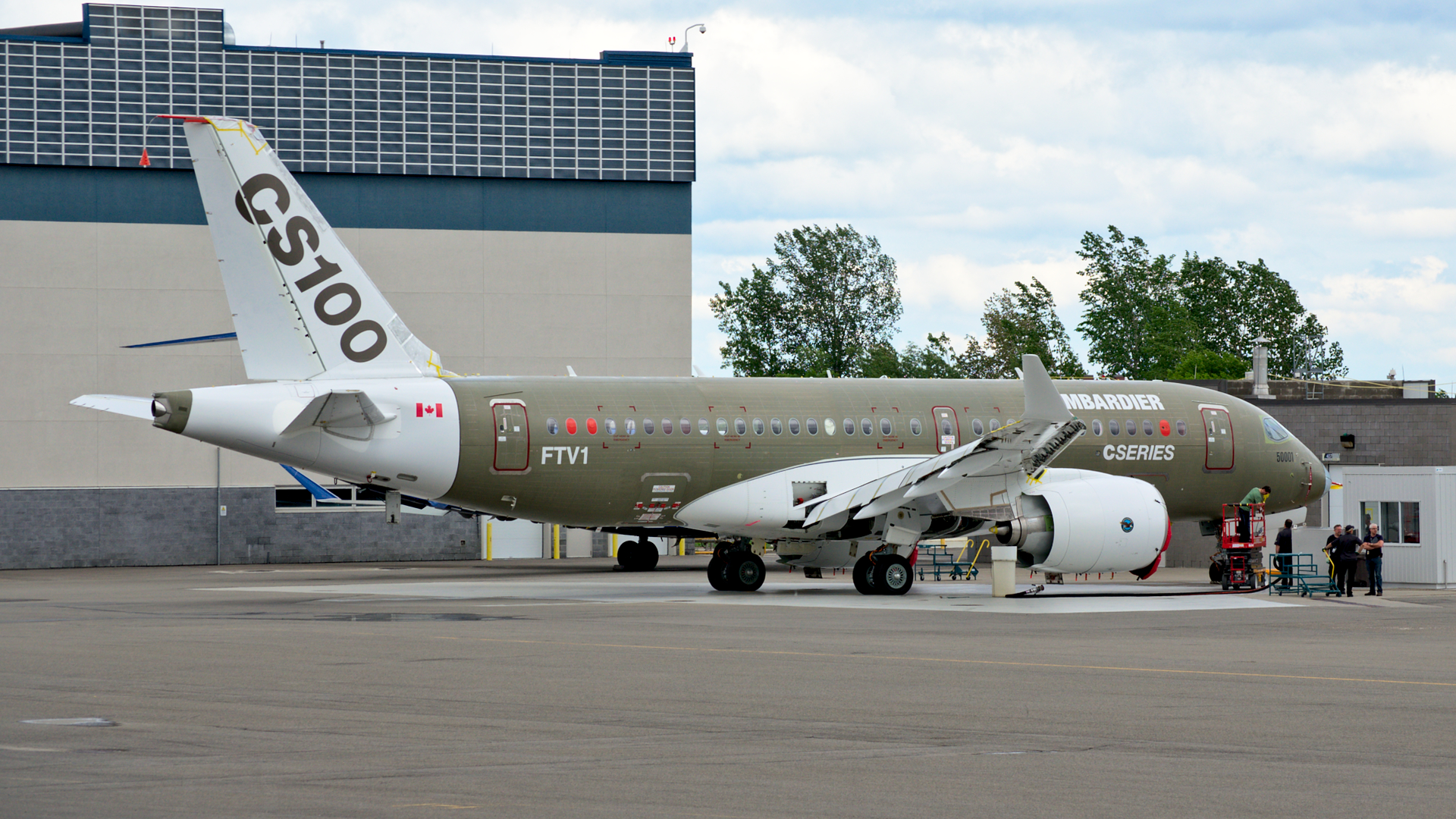
An extensive program update was presented on 7 March 2013, with the Flight Test Vehicle 1 (FTV1) was displayed in a near-complete state, along with three other FTVs in various states of assembly: one such FTV confirmed the 160 seat high-density concept for the CS300, featuring two sets of over-wing emergency exits. The first FTV's electrical system was powered up in March, while tests on the static airframe proceeded satisfactorily and on schedule. In June, Bombardier again delayed the first flight into July on account of software upgrades and final ground testing. On 24 July, after a protracted system integration process, the first flight was delayed into "the coming weeks". On 30 August, Bombardier received the flight test permit from Transport Canada, granting permission to perform high speed taxi testing and flight testing.
Flight testing & program delays

The CS100 (FTV1) took off for its maiden flight from Bombardier's facility at Montréal–Mirabel International Airport in Quebec on 16 September 2013. After reconfiguration and software upgrades, FTV1 flew for the second time on 1 October. The FTV2 completed its first flight on 3 January 2014, while the planned entry-into-service date was delayed into the second half of 2015 due to certification testing issues. On 29 May 2014, the FTV1 suffered an uncontained engine failure and flight testing of the four FTVs was subsequently suspended until an investigation could be completed. The incident kept Bombardier from displaying the CSeries at one of the most important aerospace events in that year, Farnborough Airshow. On 7 September, flight testing was resumed after the engine problem had been isolated to a fault in the lubrication system. On 18 September, Bombardier relocated the FTV4 to Wichita, Kansas (USA) joined FTV3 at the Bombardier Flight Test Center to take advantage of better weather for flight testing.

The CS300 (FTV7) made its maiden flight from Mirabel airport on 27 February 2015, seven days after the four tested FTVs had accumulated over 1,000 flight hours. The flight test results surpassed the company's guarantees for noise, economics and performance, meaning a longer range than advertised could be possible. The fifth CS100 (FTV5) with a complete interior made its first flight on 18 March, while the sixth CS100 (not officially designated as FTV6) was the first production unit used for function and reliability flights. At the Paris Air Show in June, Bombardier released updated performance data, showing improvements over the initial specifications. The CS100 passed the required certification tests by mid-November. On 25 November, Bombardier completed the first phase of its route proving capabilities, with a 100% dispatch reliability. The final prototype, FTV8, the second CS300 with a complete interior, made its first flight on 3 March 2016.
Type certification
The smallest model in the series, the 110- to 125-seat CS100, received type certificate from Transport Canada on 18 December 2015, and simultaneously from US Federal Aviation Administration (FAA) and European Aviation Safety Agency (EASA) in June 2016, clearing the way for delivery to the launch operator, Swiss International Air Lines.
The largest model, the 130- to 145-seat CS300, obtained its type certificate from Transport Canada on 11 July 2016, from the EASA on 7 October that cleared the delivery to its launch operator airBaltic, and from the FAA on 14 December 2016.
Both models were awarded a common type rating on 23 November 2016 simultaneously from Transport Canada and EASA, allowing pilots to qualify on both types interchangeably.
Bombardier conducted steep 5.5˚ approach landings tests at London City Airport (LCY) in March 2017, and announced one month later, April 2017, that the CS100 received Transport Canada and EASA steep approach certification.
Entry into service
.jpg)
The first CSeries, a CS100, was delivered to Swiss Global Air Lines on 29 June 2016 at Montréal–Mirabel International Airport, and began commercial service on 15 July with a flight between Zürich and Paris. The launch operator stated in August, that "the customer feedback is very positive with the expected remarks concerning the bright cabin, reduced noise, enough leg room and space for hand luggage as well as the comfortable seats. Also, the feedback from our pilots is gratifying. They especially like the intuitive flying experience."
.jpg)
The first CS300 was delivered to second CSeries operator AirBaltic on 28 November, and began revenue service on 14 December with a flight from Riga to Amsterdam in a two-class, 145-seat configuration. The type launch operator lauded lower noise levels for passengers and more space for luggage than its Boeing 737-300s.
Upon introduction, both variants were performing above their original specifications, with airBaltic reporting that the CS300 range was 2% better, as were its per seat and per trip cost, and burned over 1% less fuel at 2,600 L/h. On long missions, the CS100 was up to 1% more fuel efficient than the brochure and the CS300 up to 3%. Therefore, Bombardier would update its performance specifications later in 2017. The CS300 burned 20% less fuel than the Airbus A319ceo, 21% less than the Boeing 737 Classic while the CS100 18 to 27% less per seat than the Avro RJ100. Furthermore, the CS300 was designed to be 6 t lighter than the Airbus A319neo and nearly 8 t lighter than the Boeing 737 MAX 7, giving it an operating cost advantage of up to 12%.
_operating_LX465_taxiing_to_the_runway_at_LCY,_May_2021_03_(cropped).jpg)
After 28,000 engine hours in 14 in-service aircraft with a dispatch reliability of 99.9%, Swiss replaced an engine pair in May 2017 after 2,400 hours, while airBaltic replaced another one in June. Swiss initially flew six sectors a day and by July up to nine a day with an average time of 1 hours 15 minutes. airBaltic's flight length averaged 3 hours, and the average fleet daily usage was 14 hours. On 8 August, following the steep approach certification by EASA, Swiss operated its first revenue flight from Zurich to London City, replacing the Avro RJ. As of September, the CSeries fleet had undergone 20 A Checks with no significant maintenance issues, and over 1.5 million passengers had 16,000 revenue flights in the 18 aircraft in service, making up to 100 revenue flights per day on 100 routes: most used were up to 17 hours per day and up to 10 legs per day. Thirty-five minute turnarounds allowed 11 legs per day. On 22 December, after months of engine delivery delays, Korean Air became the third and latest operator of CSeries after receiving its first CS300, and completed its first revenue flight from Seoul to Ulsan on 20 January 2018.
A220 rebranding
The aircraft was rebranded A220 as a family name (formerly CSeries) with A220-100/300 (formerly CS100/CS300) as variant name on 10 July 2018, following the Airbus partnership ten days earlier. Financial issues at Bombardier due to the CSeries programme and production delays, stiff competition, and ultimately a dumping petition by Boeing, paved the way for the partnership.
Poor financial situation (''CSALP'' joint venture)
A feasibility study prior to the programme launch estimated development costs of $2.1 billion for the CSeries in May 2005, shared equally by Bombardier, suppliers and partner governments. In November 2009, when the first CSeries wing was assembled for prototype manufacture, development costs rose to approximately $3.5 billion. Programme delays during the test preparation and flight test phase also resulted in order cancellations, including from a Swedish lessor. In August 2014, Bombardier changed the programme's management and slashed its workforce.
In 2015, in exchange for help in the final development stages of the "overdue and over-budget" aircraft, Bombardier offered to sell a controlling stake in the CSeries programme to Airbus but had to look for alternatives after Airbus confirmed in October that it had turned down the offer. Just days prior, the Government of Quebec reiterated its willingness to provide Bombardier with financial aid, if it were requested. On 29 October, Bombardier took a write-down on the CSeries. The Trudeau government indicated that it would reply to Bombardier's request for $350 million in assistance after it took power in early November. On the same day, the Quebec government invested in the company to save the struggling programme. In early November, a Scotiabank report indicated that the company and the programme would probably need a second bailout, and that even then the CSeries would probably not make money. When Transport Canada granted type certification for the CS100 in December 2015, CSeries' total development costs, including the aforementioned write-offs, were $5.4 billion. At the time, the CSeries had 250 firm orders and letters of intent, plus commitments for another 360, mostly for the CS300.
Bombardier reportedly requested a aid package from the Canadian Government in April 2016. The Government then offered an aid package without divulging the amount or conditions imposed. In July, Bombardier set up the C Series Aircraft Limited Partnership (CSALP) together with Investissement Québec. The Government finally announced in February 2017 a package of in interest-free loans for the company, with the programme to receive one-third.
Delays in aircraft production
In 2016, Bombardier achieved its goal of delivering seven CSeries aircraft to both launch operators, Swiss and airBaltic. Production was then set to ramp to 30–35 aircraft deliveries in 2017 after PW1500G engine supply and start issues were resolved. However, the CSeries delivery goal for 2017 had to be revised to 20–22 aircraft only, due to persistent engine delivery delays, and finally, only 17 deliveries were completed in the year.
By the time the Airbus partnership came into effect on 1 July 2018, a total of 37 CSeries had been delivered, up to half of that (157 units) would be delivered by the company itself. However, the average production rate of the six available models (B737-700, A318/A319, CS100/CS300 and E195) was fewer than 80 aircraft per year for the first 10.5 years.
Market stiff competition
The effect of stiff competition and production delays was apparent in early 2016. On 20 January, United Continental Holdings ordered 40 Boeing 737-700s instead of the CSeries due to the availability of the type that already in full production, and commonality with the United's 737 fleet of 310 aircraft. Boeing also reportedly gave United a massive 73% discount on the 737 deal, dropping the price to $22 million per unit, well below the CS300 market value at $36 million. David Tyerman, an analyst with Canaccord Genuity said to the Toronto Star: "This just shows how difficult it is for Bombardier to win orders these days.[...]. It also raises the question of how profitable the next C Series order they win will be for them."
The CSeries also competed with the smaller variants of the A320 family aircraft. The 2010 order for 40 CS300s and 40 options from Republic Airways Holdings then owner of exclusive A319/320 operator Frontier Airlinesalso pushed Airbus into the A320neo re-engine. Airbus opted to compete aggressively against the CSeries rather than ignoring it, as Boeing had done with Airbus. Airbus dropped the A320's price in head-to-head competition, successfully blocking Bombardier from several deals.
Boeing dumping petition
Main article: CSeries dumping petition by Boeing
Airbus programme acquisition (''ACLP'' joint venture)
Bombardier and Airbus announced on 16 October 2017 that Airbus would acquire a 50.01% majority stake in the CSALP partnership, with Bombardier keeping 31% and Investissement Québec 19%. Airbus paid no money, incurred no debt and assumed no liability for its share in the programme, but its supply chain expertise should save production costs, and a second assembly line would be built at its production facility, Airbus Mobile, in Mobile, Alabama. While assembling the aircraft in U.S. could circumvent the 292% duties proposed in the Boeing dumping petition, Airbus CEO Tom Enders and Bombardier CEO Alain Bellemare assured that this factor did not drive the partnership. However, negotiations began in August 2017 after the filing in April and the decision in June to proceed, and Boeing was therefore suspicious. Airbus CCO John Leahy considered that Boeing indirectly forced the CSeries programme into Airbus hands by pressing the U.S. administration for massive tariffs on the aircraft. Bombardier CEO predicted that the partnership would significantly accelerate sales as it would bring certainty to the CSeries programme through Airbus's global scale. AirInsight estimated that Airbus's corporate strength would increase the CSeries share of the 100- to 150-seat aircraft market over 20 years, from 40% of 5,636 aircraft (2,254 sales) to 55–60%, around 3,010 aircraft. Airbus would retain Bombardier as a strategic partner beyond the period required in the clauses, allowing it to acquire Investissement Québec's stake no earlier than 2023 and Bombardier's stake no earlier than 2025, but with main production remaining in Mirabel, Québec until at least 2041. The partnership was subject to regulatory approvals, and during competition investigation, Airbus and Bombardier were to operate separately and clean teams planned the integration with privileged access to competitively sensitive data but separated from their management.
Embraer assured at the Dubai Airshow in November 2017 that its base country Brazil would sue Canada for its subsidies to Bombardier through the World Trade Organization, because the competitor viewed CSeries as a heavy, expensive, and long, thin-haul aircraft outperforming the range of its own E-Jet E2, a close rival for market share. Previously, in October 2017, Boeing was reportedly concerned over its ability to match fleet package deals enabled by the partnership. Then, in December 2017, The Wall Street Journal reported Boeing was planning to offer Embraer more than the company's $3.7 billion market value to set up a joint venture, in what aviation industry analysts said was a reaction to the partnership. The Boeing–Embraer joint venture was announced in February 2019, but before the antitrust investigations were completed, the deal was unilaterally terminated by Boeing in April 2020 due to impact of the 2019–20 coronavirus pandemic on aviation.
.jpg)
The antitrust investigation was due to be completed ahead of Farnborough Airshow 2018 to allow for a marketing boost, and it was planned to rebrand the CSeries as an Airbus model, with A200 suggested as a family name and A210/A230 for the CS100 and CS300. On 8 June, following regulatory approval, the partnership confirmed that Airbus would take a majority stake on 1 July. The head office, and leadership team would remain in Mirabel, while the programme team would be formed by leaders from both Airbus and Bombardier and headed by Philippe Balducchi, then Head of Performance Management at Airbus Commercial Aircraft. Bombardier would fund any required cash shortfalls up to US$ million from the second half of 2018 to 2021. Ten days after programme control was transferred to Airbus, the aircraft was rebranded with A220 as the family name (formerly CSeries) and A220-100/300 for the former CS100/CS300 variants. Later, on 1 June 2019, the CSALP joint venture was renamed Airbus Canada Limited Partnership (ACLP) and adopted the Airbus logo as its sole visual identity. The A220 became the only Airbus commercial aircraft programme managed outside of Europe, making Canada Airbus's largest presence other than Europe.
Bombardier exit participation
After reassessing its participation in January 2020, Bombardier exited the A220 programme in February 2020, selling its share to Airbus for $591 million. Airbus thus owned 75% of the programme; the remaining 25% of shares were held by Investissement Québec. Under the acquisition terms Airbus acquired Bombardier's option to buy out Investissement Québec's share from 2023, with a revised option date of 2026. Airbus also agreed to acquire A220 and A330 work package production capabilities from Bombardier in Saint-Laurent, to be taken through the Airbus subsidiary, Stelia Aerospace.
Airbus and the government of Quebec agreed in February 2022 to invest a further $1.2b in Airbus Canada, to support the acceleration of the A220 production rate to 14 A220s per month. Accordingly, Airbus would invest $900m into the aircraft programme and Investissement Québec $300m, allowing the partnership to continue until the programme becomes profitable in the middle of the decade. In addition, 2030 had been set as the new earliest date for Airbus to acquire the remaining shares, with Quebec hoping to definitely profit from the sale. Under the latest agreement in July 2024 the threshold for Airbus to buy out Québec's share will be further extended to 2035, securing that two-thirds of the jobs linked to the production of the A220 will remain in Quebec. Meanwhile, the A220 held a market share of over 55% in its category and PwC estimated the aircraft programme will have an economic impact in Canada of more than $40 billion over the next 20 years.
Production

The Airbus partnership in July 2018 decided to keep the primary final assembly line (FAL) in Mirabel, Quebec, with its 2,200 workforce. The secondary FAL in Mobile would start deliveries in 2020 with a monthly production rate of four, rising to six for a capacity of eight while the main Mirabel FAL could go to ten. Airbus CFO predicted a production potential of more than 100 A220 per year. The company targeted over 100 orders of A220 in 2018 and 3,000 over 20 years, half of the 100- to 150-seat market, and needed a supply chain cost reduction over 10%. It then sought to reduce costs from all suppliers, including Bombardier, wing builder Short Brothers and engine manufacturer Pratt & Whitney, and had reportedly pushed its suppliers to lower their prices by 20% for more volume, or to switch them, towards 150 yearly deliveries.
As of January 2019, the A220 suppliers were Liebherr for the landing gear, air management system and pneumatics; UTC Aerospace for the electrical system and lighting; Parker for the fuel, hydraulics and fly by wire systems, Goodrich for the engine nacelle; Meggitt for the wheels and brakes; Michelin for the tires; Spirit for the pylons; Honeywell for the APU; and PPG supplies the windows. Supplier costs could be cut by 30–40% through Airbus's market power, as a 10% procurement costs decrease would add six gross margin points to the programme. Airbus waited to win several new orders before increasing pressure on suppliers and catching their attention in 2019 with the sale of 135 A220s to U.S. airlines, including a follow-up order from Delta. The market share was split between 80% A220-300 and 20% A220-100. Delivery rates continued to climb with the new brand, reaching a total output of 33 in 2018, and then rising to 48 A220 in 2019.

The groundbreaking ceremony for the $300 million final assembly line (FAL) at the Airbus Mobile plant in Mobile, Alabama was held on 16 January 2019; on this occasion Airbus confirmed its confidence that there is enough demand to justify two assembly sites and that the airliner can be profitable. On 5 August 2019, production started at the Mobile facility, which was not due to be finished until 2020; work started early to ensure that the first delivery schedule could be met.
The removal of Bombardier's financial constraints in February 2020 gave Airbus greater latitude for further investment in the programme, which will be needed to ramp up production rates, though this will push back the break-even point of the programme to the mid-2020s. The program cost was US$ 7 billion. On 2 June 2020, the first A220 produced in Alabama completed its first flight. By that date, production of the first aircraft for JetBlue Airways had also started. The first US-assembled A220 aircraft, an A220-300, was delivered to Delta on 22 October 2020.
In January 2021, as Airbus reviewed its production rates following a shift in demand away from wide-bodies affected by the COVID-19 pandemic, the A220 was expected to reach a production rate of five aircraft per month by the end of the first quarter as previously foreseen. In May 2021, Airbus targeted a production rate of six per month from early 2022, and intends to reach 14 (ten in Quebec and four in Alabama) per month by the middle of the decade to be profitable.
On 10 January 2022, Airbus introduced a "sub-assembly line" or the A220 pre-FAL, a U-shaped pre-assembly line with four stations used for preparatory work and seven for the actual equipping, in order to install systems earlier, stabilising the production process. The equipped fuselage sections are then moved to the FAL in Mirabel or in Mobile at a rate of six per month as of November 2022. These investments had accelerated A220 production and confirmed that the programme is on track to reach its target rate of 14 aircraft per month by mid-decade. After 1,600 new hires over the last two years, an increase of 75%, a total of 3,500 employees were working on the A220 programme in Quebec as of July 2024. The 100th US-assembled A220 aircraft, an A220-300, was delivered to Breeze Airways on 23 July 2025.
Further development
Performance improvements
After beating performance promises by 3%, performance improvement packages shaving operating costs were explored prior to the Airbus partnership; these could include putting doors on the exposed main wheels, reducing drag but adding weight and complexity, and adding two to three more seats by moving the aft lavatory, without reducing the seat pitch. On 21 May 2019, Airbus announced a 2,268 kg MTOW increase from the second half of 2020, from 60.8 to 63.1 t for the A220-100 and 67.6 to 69.9 t for the A220-300, expanding the range by 450 nmi to: 3,400 nmi for the A220-100 and 3,350 nmi for the A220-300. With the Airbus ruleset (90 kg passengers with bags, 3% enroute reserve, 200 nmi alternate and 30 minutes hold), the 108-seat A220-100 could reach 3,800 nmi and the 130-seat A220-300 would achieve a range of 3,500 nmi while being limited by its fuel capacity. With a denser economy seating at a 30-inch pitch down from 32, a 116-seat A220-100 would still reach 3,700 nmi and a 141-seat A220-300 would exceed 3,350 nmi.
In February 2020, Airbus announced an increase in payload capacity, achieved through a 1.8 t increase in the maximum zero-fuel weight and maximum landing weight of both the -100 and the -300, to be introduced as an option from 2022. From 2021, David Neeleman's Breeze Airways project should receive A220-300s with extra fuel tanks for 4,000 nmi of range, allowing transatlantic flights or long routes like Orlando–Curitiba, Brazil, more range than the A321LR with 70% lower trip costs than A330s.
In March 2021, Airbus offered a further 1 t increase to the MTOW of the A220-300, to 70.9 t, available from mid-2021 and providing another 200 nmi of additional range to 3550 nmi. On long routes the payload will be increased by about 900 kg. In November 2022, Airbus finally worked on the highest passenger capacity versions, i.e. the 160-seat high-density A220-300, as well as 135-seat high-density A220-100.
At the Aircraft Interiors Expo in April 2025, Airbus launched the A220 Airspace cabin with Air Canada, which would receive its first A220 with this improved cabin in March 2026.
Business jet (ACJ TwoTwenty)
.jpg)
In October 2020, Airbus announced an Airbus Corporate Jets (ACJ) variant of the A220-100, to be known as the ACJ TwoTwenty, with a range of 5650 nmi and cabin space of 73 sqm for 18 passengers. On 17 May 2021, the first section of the ACJ TwoTwenty, the mid-fuselage section, had arrived at the A220 Final Assembly Line in Mirabel within the programme time frame and marked the start of the first Airbus corporate jet ever assembled in Canada. The business jet made its first flight on 14 December 2021, before delivery to Comlux to be outfitted with a VIP cabin in Indianapolis.
Stretched variant (A221)
In May 2015, The Wall Street Journal reported that a stretched variant, tentatively dubbed the CS500, was being studied to compete with the 160- to 180-seat versions of the Boeing 737 and A320 airliners. The existing wing would be capable of supporting such a stretched version. After the Airbus partnership in 2018, the possible stretched variant was appropriately renamed the A220-500, which would allow Airbus to enlarge its A320-family replacement to better compete with the proposed Boeing New Midsize Airplane. In January 2019, Airbus hinted that a larger A220 variant could be developed, owing to ramped-up production and market demand for the current production models.
Speculation about a stretched variant continued in November 2019, with Air France mentioning an A220-500 during an investor briefing on its modernisation strategy. In January 2022, Luxembourg flag carrier Luxair expressed interest in the A220-500 as the airline sought to simplify its operations and avoid operating a mixed fleet of narrow-body aircraft, similarly to airBaltic, which was also said to be looking forward to the stretched variant to complement its A220-300 fleet, while Breeze Airways eyed a longer-range variant. In the same month, following Allegiant Air's decision to walk away from the A220, due in part to the uncertainty surrounding the launch of the A220-500, Airbus CCO Christian Scherer said the stretched A220 variant was planned, although it was not an agenda item for a short-term decision.
In July 2022, Airbus solicited an engine proposal from Pratt & Whitney and CFM International as a possible second supplier for the newly stretched variant, as well as the existing variants. In September, Airbus CEO Guillaume Faury signalled to investors at Capital Markets Day that a stretched variant is necessary to increase the A220 family's share of the narrowbody market, adding, "but we don't want to be right too early". The A220-500 could be launched only once the production is geared up and the programme is profitable. If launched in 2025, it would enter service in 2028-2029 and Airbus could accept the risk for the A320neo backlog, more so as Boeing is not expected to launch a new narrowbody before 2030. Another issue is that with the same wing and uprated engines, the A220-500 would have a shorter range than the -300 variant, which essentially has the same range as the A320neo of 3,400 nmi, less than the Boeing 737 MAX 8 advertised by Boeing at 3,550 nmi. Increasing the range to at least the level of the A320neo would require extensive modification work, making development more expensive and reducing the aircraft's competitiveness.
In May 2023, Bloomberg reported that Airbus was reviewing the proposed stretched variant to compete more directly with the 737 MAX 8 and free up space for more A321 production. The concept, which Airbus now calls the A221, is gaining clarity as the company mulls an upgrade to the A220 wing design and accelerates design studies. These efforts aim to meet growing market demand and improve the aircraft's overall performance to become a more distinct model within the A220 Family. At the 2025 Paris Air Show, Benoît Schultz, CEO of Airbus Canada LP, said the company would have completed “very advanced studies” on the A221 by the end of the year, addressing the question of whether a new engine would be needed.
Further certification
In December 2018, the EASA approved Category IIIa/IIIb instrument approaches for autolanding the A220 with no decision height but runway visibility minimum requirements.
In January 2019, A220 powered with PW1500G gained ETOPS 180 approval from Transport Canada, allowing direct routes over water or remote regions. The A220 was the first commercial airliner to obtain domestic ETOPS certification from Transport Canada.
In July 2021, the EASA had officially approved an increase in the A220-300's maximum seating to 149 passengers, subject to a modification on an overwing exit slide. In September 2021, Airbus entered into talks with the Civil Aviation Administration of China over the certification of the A220 in order to enter the large Chinese aviation market, particularly in the western part of the country. At the 2023 Dubai Airshow, Airbus confirmed that it is seeking certification of the A220-300 for steep approach landings at London City Airport (LCY). In June 2025, Airbus was to begin certification work on the 160-seat high-density A220-300, having learned much from the A320neo, including "enhanced climb derate", which reduces engine usage during climb, increasing time on the wing, while maintaining maximum climb capability, and "dual motoring to start", which allows crews to start both engines more quickly at the gate.
Design
The Airbus A220 family is a five-abreast single-aisle airliner developed specifically for the 100- to 150-seat market segment between regional airliners and mainline airliners, which includes two models, the 35 m long A220-100 and the larger, 38.71 m long A220-300. The design goal of the unique aircraft was to improve fuel efficiency, as well as operating costs, passenger comfort and range while reducing noise and emissions. These environmental benefits make the A220 family aircraft suitable for urban operations and noise-sensitive airports.
Airframe

Commonality between both variants of the A220 family is over 99%. To support higher loads, the A220-300's wing and centre wing box are structurally reinforced, as is the centre fuselage, which is 3.4 m longer than the -100 variant, and the main landing gear. Extensive use of aluminium–lithium in the fuselage, and carbon composite in wings, empennage, rear fuselage section, and engine nacelles reduces weight and increases corrosion resistance, resulting in better maintainability. The overall airframe consists of 70% advanced lightweight materials, comprising 46% composite materials and 24% aluminium–lithium. The aircraft features a low drag nose and tailcone design, minimum fuselage wetted area and optimised wing aerodynamics.
The nose landing gear is common for both variants, while the -300 main landing gear is slightly reinforced. The -100 has three pairs of disc brakes, the -300 one more.
Cabin
.jpg)
The five-abreast cabin cross section has 18.5 in wide economy seats, 19 in wide middle seats, and a 20 in wide aisle for fast turnarounds of 20 minutes. The rotating overhead bins offer 70 L of storage per passenger to allow one carry-on bag per passenger. Each row has power cables, so all seats are equipped with charging capabilities. Lavatories have improved accessibility for passengers with reduced mobility. Two flex zones allow modular cabin elements such as stowage areas and partitions to be customised. The cabin is lighted naturally through 11x16 in windows at every seat row and artificially by customisable colour LEDs. The aircraft offers overhead video display, wireless content distribution and Ku band connectivity, and can be equipped with in-flight-entertainment. The A220 has a larger window than the A320. The onboard environment, entertainment offerings and mood lighting are controlled via an integrated cabin management system.
It has a 4 in higher ceiling as well as 20% larger luggage bins than other aircraft in its class. The seat is 2.5 cm wider than the Airbus A320 and 5.0 cm wider than the Boeing 737. The new A220 Airspace XL bins would offer up to 19 additional passenger bags on the A220-300 and accommodate longer and heavier payload items thanks to the four-frame design. The bins would also reduce maintenance and the effort for cabin crew to close the bin doors, resulting in an overall shorter turnaround time and about 300 lb lighter cabin structure. To complement the Airspace XL bins, an improved Passenger Service Unit (PSU) was developed in line with the Airspace design.
Cockpit
.jpg)
The cockpit features the Rockwell Collins Pro Line Fusion avionics suite, which incorporates five 15.1 in displays along with comprehensive navigation, communications, surveillance, engine-indicating and crew-alerting system (EICAS), electronic checklist, aircraft maintenance systems, and can be equipped with head-up displays. Other elements of the avionics and other subsystems include Parker Hannifin's flight control, fuel and hydraulics systems; Liebherr Aerospace's air management system; and United Technologies Corporation's air data system, flap and slat actuation systems. The cockpit includes a dual flight management system, multi-scan weather radar, fly-by-wire flight controls with full envelope protection & speed stabilisation, Cat IIIa Autoland, and side-stick controllers. The cockpit layout is common to the -100 and the -300 variants, enabling pilots to fly either variant with the same type rating.
Engine
.jpg)
The A220 is powered by two Pratt & Whitney PW1500G underwing turbofans. Its geared turbofan (GTF) architecture and advanced engine core improves efficiency and reduces the stage and parts count. The PW1500G has a 20 dB margin to Chapter IV noise limits, and high-efficiency components and advanced combustor technologies reduce and NOx emissions. It was certified in February 2013, the first variant in the PW1000G range. At that time, the PW1500G was the turbofan engine with the highest bypass ratio (BPR) of 12:1, only slightly lower than the 12.5:1 BPR of the later released PW1100G powering the A320neo family. Each engine can produce 84.5 to of thrust flat rated at ISA +15°C. The PW1500G was designed to reach 12% better fuel economy than previous generation engines.
Efficiency
The A220 manufacturer states that the structural technology, aerodynamic design, ultra-high bypass GTF engine, and state-of-the-art flight control and systems together can save fuel burn per seat, and NOx emissions, as well as provide a reduction in maintenance costs and operating cost per seat, plus a reduced noise footprint with a 18 EPNdB margin to chapter 4 noise limits. Around two thirds of the overall fuel efficiency are attributed to the GTF engines, and one third to lightweight structures, state-of-the-art aerodynamics and systems.
Operational history
After successfully entering commercial service with positive feedback from customers in Europe and Asia, the A220's operations have been expanded worldwide to include the Americas, Africa, Australia and Oceania.

; 2018 On 20 July 2018, the first aircraft with Airbus branding, an A220-300, was delivered to the type launch operator airBaltic, and in the same month, the airline launch customer of the type, Korean Air, received also its first rebranded A220-300. On 26 October, the first American operator Delta Air Lines received its first A220, an A220-100, of its order for 75, which was previously disputed by Boeing. Delta configured the A220-100 with 109 seats, including 12 first class, 15 in Delta Comfort+ and 82 in the main cabin, and on 7 February 2019, the airline operated its maiden A220-100 flight with service from New York–LaGuardia Airport to Dallas–Fort Worth. On 21 December 2018, Air Tanzania received its first A220, an A220-300, to be based in Dar es Salaam. The flag carrier became the first African operator and the fifth worldwide to operate the A220 family aircraft, which had already been flying in Europe, Asia and America.

; 2019 As of April 2019, the global A220 fleet of 60 aircraft had completed more than 90,000 flights in 120,000 block hours on more than 170 routes to 130 destinations and carried 7 million passengers: most used were up to 18 hours and 13 legs per day. By July, the launch operator, Swiss Air Lines successfully completed C checks on its A220 fleet, performed by SAMCO Aircraft Maintenance in its MRO facilities at Maastricht Airport. On 6 September 2019, Egyptair received its first A220 of its order for 12, a -300 with 140 seats: 15 premium and 125 economy seats. Its final A220-300 was delivered on 5 October 2020.
On 29 November 2019, the 100th A220, an A220-300, was delivered to the type launch operator, airBaltic. At that time the airline operated the longest flight by an A220 – a 6.5-hour flight from Riga to Abu Dhabi. That year, airBaltic became the first airline capable of providing a full scope of maintenance for the A220-300. Canada's flag carrier began A220 flights on 16 January 2020 between Calgary and Montreal. The airline expected A220-300s to be 15% cheaper to operate per seat than the Embraer 190s they will replace.

; 2020 During the height of the COVID-19 pandemic, the number of flights on many routes was reduced by more than 80% over the same period in 2019. The A220's features made it popular with airlines, as they preferred smaller aircraft with similar range and economic performance as larger ones, in order to keep the load factor high enough. Delta grounded their 62 A320s, for example, but continued to sell flights on their 31 A220-100 models and Swiss only operated 30% of their A320s but maintained flights on 45% of their 29 A220s. Between May and December 2020, airBaltic operated all its flights with its A220-300s to minimize complexity.
By November, the global A220 fleet of 135 aircraft had completed more than 295,000 flights over 440,000 block hours on more than 400 routes to 225 destinations with a daily utilisation of up to 18 hours and 13 legs per day. On 31 December, JetBlue took delivery of its first A220-300 from a total order of 70 aircraft. The second US operator of A220 family aircraft began its revenue flight from Boston Logan International Airport to Tampa International Airport and expected around 30% lower direct operating cost per seat than its E190 fleet to be replaced, which came from both fuel and non-fuel savings. JetBlue configured its A220-300 with 140 seats and an expanded width of 18.6 in, including ViaSat-2 connectivity.

; 2021 By January 2021, airBaltic's A220 fleet had completed close to 60,000 flights over 141,000 block hours, carrying over 5.6 million passengers as it completed C checks on the first seven aircraft of its fleet. On 22 April 2021, Air Manas received its first A220-300 of planned three aircraft to be based in Bishkek, Kyrgyzstan and became the first operator in the CIS states to introduce the A220. On 26 May 2021, Swiss took delivery of its thirtieth and last A220 at Zurich Airport.
On 27 July 2021, Réunion Island-based Air Austral became the first French A220 operator after receiving its first A220-300 of three planned to replace its ATR 72-500 and Boeing 737-800 aircraft, to be operated to Mauritius, Mayotte, Seychelles, South Africa, Madagascar and India. On 29 September 2021, Air France, the largest A220 customer in Europe, received its first A220-300 from an order for 60 aircraft, to be operated on the airline's medium-haul network with a 148 passengers single-class cabin. From August 2020 to July 2021, the A220 average on-time performance (OTP) was 99%, led by Korean Air with 99.63%, giving the airline the "Airbus A220 Best Operational Excellence 2021" award on 4 October 2021, during IATA's Annual General Meeting. On 17 December 2021, Breeze Airways, took delivery of its first A220-300, which was ferried from Airbus Mobile to Tampa International Airport. On 29 December 2021, Air Senegal, the flag carrier of the Republic of Senegal. became the fourth A220 operator in Africa after receiving its first A220-300, which was delivered from Montreal via Paris to the carrier's home base in Dakar.
_at_Milan_Linate.jpg)
;2022 By January 2022, the global A220 fleet of 193 aircraft had completed more than 440,000 flights over 675,000 block hours on more than 550 routes to 275 destinations with 99.0% operational reliability. On 7 January, Iraqi Airways, the national carrier of Iraq, took delivery of its first out of five A220-300 aircraft from the Mirabel site. The airline began the type's commercial operation ten months later on 8 November 2022, becoming the second after Egyptair to operate the A220 in the MENA region. On 6 May, Air Austral resumed its route between Réunion and Chennai that had been suspended at the height of the COVID-19 pandemic. At 2870 nmi, the flight is the world's longest A220 route, a record previously held by airBaltic's Riga–Dubai flight of 2684 nmi.
On 12 July, approximately six years after the type entered service, Airbus delivered the 220th A220 to JetBlue Airways, the type's largest customer at the time, where the global A220 fleet had carried 60 million passengers on over 700 routes ranging from 30-minute to 7-hour flights to 300 destinations. In October, a batch of A220-300s originally destined for Russian airline Azimuth were delivered to ITA Airways (Italia Trasporto Aereo), the new Italian flag carrier, instead by their lessor. On 16 October, ITA Airways entered its A220-300 into service on a flight from Rome to Genoa.
_Airbus_A220-300_departing_Canberra_Airport.jpg)
;2023 In early 2023, several operators: Iraqi Airways, airBaltic, Air Tanzania and Swiss Air Lines had to ground some of their A220s due to GTF engine problems amid aviation supply chain issues after the pandemic. According to Air Tanzania, the PW1524G-3 engines had to be removed for maintenance before 1,000 landings, when they were supposed to be removed after 5,260 landings. In July, five years after the A220 joined the Airbus aircraft family, the fleet of more than 260 A220s had flown over a billion kilometers on more than 1,100 routes ranging from 30 minutes to 8 hours, carrying more than 90 million passengers to over 375 destinations across the globe. On 21 July, Cyprus Airways welcomed its first two A220-300s leased from ALC. The islands' flag carrier nicknamed its new fleet member the Cyprus Airways Greenliner as the A220 is to reduce the company's emissions by around 40%, and put it into service on 9 August with a flight from Larnaca to Athens. On 28 November, Nigerian operator Ibom Air took delivery of its first new A220-300, one of ten on order. The airline had already gained experience with A220 operations, having temporarily leased a pair from EgyptAir in 2021. On 16 December QantasLink took delivery of its first A220-300 of 29 units on order, making it the 20th operator of the type, which would serve metropolitan and regional destinations across Australia. The full-service carrier put its A220 into service on 1 March 2024, operating from Melbourne to Canberra and Brisbane.
,_25.05.2025@Frankfurt_Airport.jpg)
;2024 By January 2024 the global A220 fleet of 314 aircraft had completed more than 1,000,000 flights over 1,700,000 block hours on more than 1,350 routes to 400 destinations with 98.9% operational reliability. In February 2024, EgyptAir sold its relatively young fleet of 12 A220s to leasing company Azzora. Serviceability rates on the PW1500G engines were believed to be a factor in the decision. As of July 2024, the global A220 fleet had carried more than 100 million passengers. On 29 July 2024, the flag carrier Croatia Airlines took delivery of its first A220-300, part of a single type fleet renewal and the largest project in the airline's 35-year history. The first revenue flight took place on 6 August 2024 domestically from Zagreb to Split, and a day later internationally from Zagreb to Frankfurt, Germany, on the same route on which the airline operated its first international flight in 1992. On 20 September, the state-owned TAAG Angola Airlines took delivery of its first A220-300 as part of the modernization and growth of its fleet, and put it into commercial service on 11 November, connecting Luanda to a key Lusophony connection, São Tomé Island. Smartwings received its first A220-300 on 24 November and deployed it a day later on the Prague – Paris route under the Czech Airlines brand. Romanian airline AnimaWings received its first A220-300 from lessor Azorra on 16 December and was due to complete its first revenue flight on 27 December, making it the tenth A220 operator in Europe.
;2025 By January 2025 the global A220 fleet of 389 aircraft had completed more than 1,440,000 flights over 2,500,000 block hours on more than 1,500 routes to 470 destinations with 98.8% operational reliability. In March, Airbus investigated corrosion issues on a "limited number" of A220s, affecting some passenger seat fittings and wing components, including the wing fairing, which does not pose an immediate safety concern. In mid-April, an A220-300 from Egypt Air's former fleet was being dismantled as part of an agreement between lessor Azorra and Delta Material Services to supply spare parts for the repair of Delta's A220 fleet and other international airlines, where the engines were also leased to Delta. On 11 September, Papua New Guinea's flag carrier, Air Niugini, became the 25th A220 operator, strengthening the position in the Asia-Pacific market. The A220-300, nicknamed "People's Balus", was specially painted to commemorate the country's 50th anniversary and the delivery to Port Moresby International Airport marked the beginning of Air Niugini's fleet modernisation programme, with eight A220-100s ordered directly from Airbus and three A220-300s leased from Azorra. By November, the global A220 fleet of 455 aircraft had completed more than 1,810,000 flights over 3,170,000 block hours on more than 1,800 routes to 480 destinations with 99.0% operational reliability.
Decarbonisation
The A220 family plays a key role in Airbus's commitment to its decarbonisation targets. The fuel-efficient aircraft can already fly with a blend of up to 50% Sustainable Aviation Fuel (SAF) and, like all other Airbus commercial aircraft, will be certified for 100% SAF capability by 2030. On 25 August 2025, Air France took delivery of its 46th A220-300 with a ferry flight from Airbus Canada, which for the first time used a fuel blend containing 50% SAF, certified directly by Airbus.
Dispatch reliability

The clean sheet airliner was targeted to have a 99.0% dispatch reliability at entry into service. In August 2016, Swiss reported "much higher" reliability than other all-new airliners, citing Airbus's A320, A380 and Boeing's 787. After four months of service with Swiss, this goal seemed to have been met based on only three aircraft and 1,500 hours flown; "nuisance messages" from the integrated avionics suite and engine start-up delays had been the main griefs. Dispatch reliability rates of 99.0% were met in April 2017. A year after introduction, in July 2017, launch operators had fewer issues than expected for an all-new aircraft program. At this time point, airBaltic had already a 99.3–99.4% dispatch reliability, similar to the established Q400 but less than the relatively ubiquitous Boeing 737 Classic's 99.8%. The dispatch reliability improved further to 99.85% in October 2017.
Engine issues
Noise
The engines can emit a loud howl for a few seconds during throttle movements at low power settings. This distinctive howl was likened to the mating call of an orca whale, and led to noise complaints from residents near Zurich Airport when Swiss International Air Lines started operating the A220. A Pratt and Whitney official says that the engine noise is caused by a "low power transient combustor tone" which generally occurs on approach when the engine is at low or idle power. Under those conditions, the flame front inside the combustor causes pressure perturbations that interact with the walls of the combustor to create the whale sound. The noise has no repercussions on the operation of the engine.
Reliability
Since the PW1500G mount generates less strain on the turbine rotor assembly than the A320neo's PW1100G, it does not suffer from start-up and bearing problems but still from premature combustor degradation. An updated combustor liner with a 6,000–8,000 hour limit has been developed and a third generation for 2018 will raise it to 20,000 hours in benign environments.
After three inflight engine failures in 2019, Transport Canada issued an emergency airworthiness directive (EAD) limiting the power to 94% of N1 (Low Pressure Spool rotational speed) above 29,000 ft, disengaging the autothrottle for the climb over this altitude before engaging it again in cruise.
Maintenance
The A check is scheduled after 850 flight hours: the check originally took 5 hours and has since been reduced to less than 3 hours, within an 8-hour shift.
Variants
There are two main variants of the five-abreast A220 family: the 35 m long A220-100 including the ACJ TwoTwenty corporate jet version, and the 3.7 m longer A220-300. Their commonality over 99% allows a common spare part inventory, reducing investment and maintenance costs.
A220-100

The A220-100 (ICAO code: BCS1) is the shorter variant of the A220 family at 35 m in length that can fly between 100 and 135 passengers over a distance of 6667 km (6667 km; 6667 km). The former CS100 made its maiden flight on 16 September 2013 and was first delivered to the launch operator Swiss Global Air Lines on 29 June 2016. The type entered service on 15 July 2016 with a revenue flight between Zurich and Paris. The A220-100 has a takeoff distance of 4800 ft and a landing distance of 4550 ft and is also certified for steep approaches by Transport Canada and EASA, The model marketing designation is the BD-500-1A10 for aircraft from serial number 50011, including the first aircraft delivered to Swiss (MSN-50010).
The A220-100, the smallest jetliner within the Airbus product line, competes with largest members of the four-abreast Embraer E-Jet E2 family, the E195-E2 and E190-E2, replacing the previous generation E-195, E190, as well as the five/six-abreast Boeing 717, 737-600, Airbus A318 and ageing models: McDonnell Douglas DC-9/MD-87, Fokker 100, BAe-146, and Boeing 737-500. The A220-100 is well ahead of the two E-Jet E2 variants in terms of range and payload, but the latter has a lower base price due to its more conservative design and correspondingly cheaper production costs. The unit price of an A220-100 is estimated at $81 million, while an E-190 E2 and E-195 E2 are priced at $61 million and $69 million, respectively. , there are 74 A220-100s in revenue service with five operators, where Delta is the largest operator with 45 aircraft in its fleet.
A220-300

The A220-300 (ICAO code: BCS3) is the larger variant with a 38.71 m long fuselage or 3.7 m longer than A220-100 and can carry between 120 and 160 passengers over a distance of {{#expr:3400+200}} nmi. The former CS300 had its maiden flight on 27 February 2015, and the first delivery to airBaltic, the type launch operator, in November 2016. The type entered service on 14 December with a revenue flight from Riga to Amsterdam in a 145 seat two-class configuration. In several performance improvements, the MTOW and thus the permissible tank content were increased, where Delta received the first improved aircraft on 18 June 2019. Airbus offered a further 1 t increase to the MTOW of the A220-300, to 70.9 t in March 2021, providing another 200 nmi of additional range to 3550 nmi. On long routes the payload will be increased by about 900 kg. The model marketing designation is the BD-500-1A11 for aircraft from serial number 55003.
The A220-300 complements the A319neo in the Airbus fleet and competes with the Boeing 737 MAX 7 and, to some extent, with the Embraer E195-E2, replacing previous generation airliners, smaller variants of the 737 Next Gen/737 Classic and McDonnell Douglas MD-90/MD-80 series. The A220-300 was designed to be 6 t lighter than the A319neo and nearly 8 t lighter than the 737 MAX 7, giving it better operating costs of up to 12%. Furthermore, the unit price of an A220-300 is estimated at just $91.5 million, while an A319neo is priced at $101.5 million. These cost advantages and other aspects contribute to the A220-300 outselling the A319neo as well as the 737-7. , there are 404 A220-300s in commercial service with 23 operators, where JetBlue is the largest operator with 58 aircraft in its fleet.
ACJ TwoTwenty
Since 2020, the Airbus A220 has also been available as a business jet under the name ACJ TwoTwenty, which is a variant of the A220-100 with a range of 5650 nmi and customisable cabin space of 73 sqm for 18 passengers. To increase its range the type is offered with up to five removable auxiliary centre fuel tanks. The ACJ TwoTwenty made its first flight on 14 December 2021, and was to be outfitted with a VIP cabin in Indianapolis, before its first delivery to Comlux expected in 2023.
Operators
.jpg)
Main article: List of Airbus A220 operators
The A220 family has a market share of more than 55% in the small commercial aircraft sector.
Orders and deliveries
.jpg)
Main article: List of Airbus A220 orders and deliveries
Accidents and incidents
The A220 family recorded one engine-related accident (no hull loss) with one fatality due to smoke on board .
Accidents
- On 23 December 2024, a SWISS International Air Lines A220-300 operating as Flight 1885 from Henri Coanda International Airport to Zurich Airport, diverted to Graz Airport after smoke developed in the cabin and cockpit due to an engine problem, while in cruise flight at FL400. All 79 people on board were evacuated via emergency slides, and the five crew members plus twelve passengers received medical treatment, while an incapacitated cabin crew member was rushed to hospital by helicopter, but died a week later on 30 December.
Incidents
- After three inflight shutdowns due to PW1500G engine failure in July, September, and October 2019, Swiss International Air Lines temporarily withdrew its fleet for inspection.
- On 1 January 2024, a trespasser on the apron at Salt Lake City International Airport died after climbing into the idling engine of a Delta Air Lines A220 that was standing at a de-icing pad.
- On 4 January 2025, an Air Canada A220-300 operating as AC609 from Halifax Stanfield International Airport to Toronto-Pearson International Airport suffered a pressurization issue during the climb. Unable to adjust the cabin altitude in manual control, the crew decided to return to base (RTB). After replacing the aft cargo vent flap idler bearing, which had sheared off and caused the vent to open, the aircraft was returned to service.
Aircraft on display
- The third flight test vehicle or FTV3 (A220-100) with around 1,400 flight hours was officially donated on 17 October 2018 at St-Hubert airport to Quebec’s École Nationale d’Aérotechnique (ÉNA), the Canadian province’s sole provider of technical training for aerospace workers, a school affiliated with cégep Édouard-Montpetit.
- The first flight test vehicle or FTV1 (A220-100) with around 760 flight hours was converted into an A220 full-size mock-up on 28 May 2021, at the Airspace Customer Showroom (ACS) located in Toulouse, France. The mock-up will be used by customers who have already selected the A220 and for Airbus to design new cabin layouts. Airlines that are in the final stages of configuring their aircraft will be able to test their lighting and seat selection on the mock-up before their aircraft is delivered.
- Flight test vehicles FTV2 (A220-100) and FTV7 (A220-300) were repatriated In December 2023 from Wichita, Kansas (USA) to the main facility in Mirabel, Quebec, where both became part of the A220 Flight and Integration Tests Center, which began operations on 1 January 2024. It is the second Airbus flight test center, consisting of the two aforementioned test aircraft and aircraft test beds, and is intended to ensure continuous improvement of the A220 family aircraft, in particular by supporting the development of sustainable aviation fuels and studies on the recycling of aviation materials through the partnerships between Airbus, SMEs, research centers and universities.
Specifications
| Variant | url= http://news.commercialaircraft.bombardier.com/wp-content/uploads/2015/06/C-Series-Factsheet_CS100.pdf | title= CS100 Factsheet | publisher= Bombardier | date= June 2015 | archive-date=October 15, 2017 | archive-url=https://web.archive.org/web/20171015044040/http://news.commercialaircraft.bombardier.com/wp-content/uploads/2015/06/C-Series-Factsheet_CS100.pdf}} | url= http://news.commercialaircraft.bombardier.com/wp-content/uploads/2015/06/C-Series-Factsheet_CS300.pdf | title= CS300 Factsheet | publisher= Bombardier | date= June 2015 | archive-date=March 4, 2016 | archive-url=https://web.archive.org/web/20160304065427/http://news.commercialaircraft.bombardier.com/wp-content/uploads/2015/06/C-Series-Factsheet_CS300.pdf}} | Cockpit crew | Max. seating | Typical 2-class seating | Seat pitch | Seat width | Cargo volume | Length | Wing | Height | Fuselage diameter | Cabin | Cabin length | MTOW | Maximum payload | OEW | Fuel capacity | Range | Cruise speed | Takeoff distance (@ MTOW) | Landing distance (@ MLW) | Ceiling | Engines | url= https://prd-sc102-cdn.rtx.com/-/media/pw/products/commercial-jet-engines/pratt-and-whitney-gtf/family/files/pw_gtf_pc_pw1500g_2021_web.pdf | title= PW1500G Powering the A220 | publisher= Pratt & Whitney | date= July 2024 | access-date= 16 August 2024 }} | url=https://www.icao.int/publications/DOC8643/Pages/Search.aspx | title=Aircraft Type Designators | publisher=ICAO | access-date=20 October 2017 | archive-date=1 October 2017 | archive-url=https://web.archive.org/web/20171001025516/https://www.icao.int/publications/DOC8643/Pages/Search.aspx | url-status=live }} |
|---|---|---|---|---|---|---|---|---|---|---|---|---|---|---|---|---|---|---|---|---|---|---|---|---|---|---|---|---|---|---|---|---|---|---|---|---|---|---|---|---|---|---|---|---|---|---|
| Two | ||||||||||||||||||||||||||||||||||||||||||||||
| 135 | 160 | |||||||||||||||||||||||||||||||||||||||||||||
| 100–120 | 120–150 | |||||||||||||||||||||||||||||||||||||||||||||
| 28 in in Y, 38 in in J | ||||||||||||||||||||||||||||||||||||||||||||||
| 18.5 to | ||||||||||||||||||||||||||||||||||||||||||||||
| 23.7 m3 | 31.6 m3 | |||||||||||||||||||||||||||||||||||||||||||||
| 35 m | 38.71 m | |||||||||||||||||||||||||||||||||||||||||||||
| 35.1 m span | ||||||||||||||||||||||||||||||||||||||||||||||
| 112.3 m2 area ( AR) | ||||||||||||||||||||||||||||||||||||||||||||||
| 11.5 m | ||||||||||||||||||||||||||||||||||||||||||||||
| 3.5 m | ||||||||||||||||||||||||||||||||||||||||||||||
| 3.28 m width, 2.11 m height | ||||||||||||||||||||||||||||||||||||||||||||||
| 23.7 m | 27.5 m | |||||||||||||||||||||||||||||||||||||||||||||
| 63.1 t | 70.9 t | |||||||||||||||||||||||||||||||||||||||||||||
| 15.1 t | 18.7 t | |||||||||||||||||||||||||||||||||||||||||||||
| 77650 lb | 81750 lb | |||||||||||||||||||||||||||||||||||||||||||||
| 21918 L | ||||||||||||||||||||||||||||||||||||||||||||||
| 6700 km (6700 km; 6700 km) | 3400 nmi | |||||||||||||||||||||||||||||||||||||||||||||
| 0.82 Mach max at 27,500 ft | ||||||||||||||||||||||||||||||||||||||||||||||
| 0.78 Mach typical | ||||||||||||||||||||||||||||||||||||||||||||||
| 4800 ft | 6200 ft | |||||||||||||||||||||||||||||||||||||||||||||
| 4550 ft | 4950 ft | |||||||||||||||||||||||||||||||||||||||||||||
| 41000 ft | ||||||||||||||||||||||||||||||||||||||||||||||
| 2× Pratt & Whitney PW1500G | ||||||||||||||||||||||||||||||||||||||||||||||
| PW1519G: 88 kN | ||||||||||||||||||||||||||||||||||||||||||||||
| PW1521G: 98 kN | ||||||||||||||||||||||||||||||||||||||||||||||
| PW1524G: 108.5 kN | ||||||||||||||||||||||||||||||||||||||||||||||
| PW1525G: 108.5 kN | PW1521G-3: 98 kN | |||||||||||||||||||||||||||||||||||||||||||||
| PW1524G-3: 108.5 kN | ||||||||||||||||||||||||||||||||||||||||||||||
| PW1525G-3: 108.5 kN | ||||||||||||||||||||||||||||||||||||||||||||||
| BCS1 | BCS3 |
Aircraft type designations
| Aircraft model | Certification date | url= https://www.easa.europa.eu/en/downloads/20962/en | title= Type certificate data sheet No. EASA.A.570 for AIRBUS A220 SERIES | date= 5 July 2023 | publisher= European Aviation Safety Agency}} |
|---|---|---|---|---|---|
| A220-100 | 9 May 2023 | PW1519G | |||
| A220-100 | 18 October 2021 | PW1521G | |||
| A220-100 | 16 June 2016 | PW1524G | |||
| A220-300 | 7 October 2016 | PW1521G-3 | |||
| A220-300 | 26 April 2017 | PW1524G-3 |
References
References
- "Fokker 100 Leaflet". Fokker Services.
- (27 February 1996). "Bombardier Ends Talks With Fokker". Bombardier.
- (20 March 1996). "Fokker bankrupt". Flightglobal.
- (19 September 2000). "Bombardier puts BRJ-X on hold". [[Flightglobal]].
- "The CSeries: a timeline". Montreal Gazette.
- Gunston, Bill. (2009). "Airbus: The Complete Story". Haynes Publishing.
- (12 May 1999). "Putting the family to work".
- (26 February 2004). "Bombardier Aerospace appoints head of new commercial aircraft program". Bombardier.
- (19 July 2004). "Bombardier announces new commercial aircraft family name at Farnborough Airshow 2004".
- (15 March 2005). "Bombardier Aerospace Granted Authority to Offer CSeries Aircraft to Customers". Bombardier.
- (13 May 2005). "Bombardier Announces Location of Final Assembly Site and Work Packages for the CSeries". Bombardier.
- (13 May 2005). "Bombardier and U.K. Government Sign Letter of Intent on CSeries". Bombardier.
- (12 June 1989). "Bombardier of Canada Wins Competition to Buy Short Brothers". [[Aviation Week & Space Technology]].
- (6 June 2005). "Bombardier Still Looking for Right Engine for C-Series Airliner Family". Aviation Week.
- (17 May 2005). "CSeries wins aid as engine makers quit". Flight Global.
- (24 May 2005). "Bombardier returns to P&W in search for CSeries engine §". Flight Global.
- (31 January 2006). "Bombardier Announces CSeries Decision". Bombardier.
- (31 January 2007). "Bombardier Updates Market on Status of its CSeries Commercial Aircraft Program". Bombardier.
- (13 November 2007). "Bombardier chooses geared turbofan to power CSeries". [[Flightglobal]].
- (22 February 2008). "Bombardier Grants Authority to Offer CSeries". Bombardier.
- (17 July 2008). "Bombardier Launches CSeries". Aviation Today.
- (11 March 2009). "Bombardier makes tweaks to CSeries specs". [[Flightglobal]].
- (13 July 2008). "Bombardier Launches CSeries Aircraft Program".
- (14 July 2008). "Bombardier Plans New Jetliner". The Wall Street Journal.
- (24 March 2009). "Bombardier Announces Three Key European Suppliers for CSeries Aircraft Program". Bombardier.
- (1 June 2009). "Majority of CSeries supplier contracts already awarded". [[Flightglobal]].
- Tomesco, Frederic. (9 November 2009). "Bombardier's Beaudoin Sees Further Aerospace Cutbacks (Update2)". Bloomberg.
- McCullough, Chris. (14 February 2017). "British Airways owner 'lined up to buy' C Series jets from Bombardier". [[Belfast Telegraph]].
- (17 November 2009). "Bombardier officially begins construction of Belfast CSeries site". [[Flightglobal]].
- (16 August 2010). "Bombardier awards contract to Ghafari to redevelop CSeries Aircraft Manufacturing Complex".
- (27 January 2010). "CSeries poised for design freeze as joint definition phase concludes". [[Flightglobal]].
- (November 12, 2011). "CSeries 'On Track' for First Flight in Second-Half of 2012". Aviation International News.
- (7 November 2012). "Bombardier Announces Financial Results for the Third Quarter Ended September 30, 2012". Bombardier.
- (13 June 2012}} {{dead link). "Bombardier's Beaudoin still upbeat on CSeries". The Vancouver Sun.
- (12 July 2012). "AirAsia boss confirms talks for 100 CSeries CS300". [[Flightglobal]].
- (29 November 2012). "Bombardier moves CS300 into detailed design with high-density variant included". [[Flightglobal]].
- (7 March 2013). "CSeries Aircraft Program Making Excellent Progress Towards First Flight". Bombardier.
- (25 March 2013). "Bombardier Powers On the First CSeries Flight Test Vehicle and Completes Wing Static Testing Required for First Flight". Bombardier.
- (26 June 2013). "Bombardier Completes CSeries Aircraft Ground Vibration Tests and Final Software Upgrades In Preparation for First Flight". Bombardier.
- (24 July 2013). "Bombardier CSeries Aircraft First Flight to Take Place in the Coming Weeks". Bombardier.
- (30 August 2013). "Bombardier CSeries Aircraft Awarded Transport Canada Flight Test Permit". [[Bombardier Aerospace]].
- (16 September 2013). "Bombardier CSeries jet completes maiden flight". CBC/Radio-Canada.
- (16 September 2013). "Bombardier's CSeries Aircraft Completes Historic First Flight". Bombardier.
- (1 October 2013). "FTV1 Flies Again!". Bombardier.
- (16 January 2014). "Bombardier Aerospace Confirms Change to its CSeries Aircraft's Entry-into-Service". Bombardier.
- Howard, Courtney. (17 January 2014). "Bombardier Aerospace delays CSeries entry-into-service until second half of 2015". Military Aerospace.
- Campion-Smith, Bruce. (30 May 2014). "Bombardier CSeries test jet suffers engine failure". Toronto Star.
- (22 September 2014). "Bombardier moves CSeries test flight to Kansas". Wings Magazine.
- Wall, Robert. (13 July 2014). "Bombardier Sees CSeries Test Flights Resuming in Weeks". [[The Wall Street Journal]].
- (8 September 2014). "CSeries flight ends 100-day grounding". [[Flightglobal]].
- (27 February 2015). "CS300 completes first flight". [[Flightglobal]].
- Warwick, Graham. (27 February 2015). "Bombardier Completes First Flight Of 135-160-Seat CS300". Aviation Week.
- (20 February 2015). "CSeries aircraft program progressing well with more than 1,000 flight test hours achieved". Bombardier.
- (3 March 2015). "Exclusive: CSeries performance better than guarantees, "favorable" to brochure; range better than advertised". leehamnews.
- (20 March 2015). "Bombardier FTV5 Takes To The Skies". Aero-News Network.
- Gold, Ian. (November 2015). "CSeries Test Update". Aerospace Testing International.
- (14 June 2015). "Flight Tests Show Bombardier C Series Aircraft Performance Better than Targets". Bombardier.
- (17 November 2015). "Bombardier Celebrates the Completion of its CS100 Aircraft's Certification Flight Test Program". Bombardier.
- (25 November 2015). "Bombardier Completes First Phase of C Series Route Proving". Bombardier.
- (April 2016). "A BIG YEAR - 2016 is a critical time for the Bombardier CSeries with first deliveries scheduled.". [[Air Transport World]].
- Lu, Vanessa. (18 December 2015). "Bombardier's CSeries jet certified for commercial service". Toronto Star.
- The Canadian Press. (16 June 2016). "European and U.S. aviation bodies certify Bombardier CSeries 100 aircraft finally clearing the way for takeoff". Financial Post.
- (11 July 2016). "Bombardier CS300 Aircraft Awarded Type Certification by Transport Canada". Bombardier.
- (7 October 2016). "Bombardier CS300 Wins EASA Nod". Aviation International News.
- (14 December 2016). "Bombardier's CS300 Enters Service with Air Baltic". Aviation International News.
- (23 November 2016). "Bombardier Obtains Same Type Rating for Both C Series Jetliners". Bombardier.
- (27 March 2017). "Bombardier Flies C Series Demo from London City to New York". Aviation International News.
- (26 April 2017). "Transport Canada and EASA Award Steep Approach Certifications to Bombardier CS100 Aircraft". Bombardier.
- (29 June 2016). "First CSeries aircraft is delivered to SWISS". Air Transport World.
- (29 June 2016). "Bombardier Delivers First C Series Aircraft to Launch Operator SWISS". Bombardier.
- (15 July 2016). "SWISS Launches Revenue Service with State-of-the-Art Bombardier C Series Aircraft". [[Bombardier Aerospace]].
- (15 July 2016). "Bombardier's CSeries holds its maiden commercial flight from Zurich to Paris". Financial Post.
- Owram, Kristine. (24 August 2016). "Bombardier Inc's CSeries showing 'much higher' reliability than competitors, Swiss Air Lines says". Financial Post.
- (28 November 2016). "Bombardier delivers first CS300 to Air Baltic". Flight Global.
- van der Linde, Damon. (28 November 2016). "Bombardier hands over its largest CSeries jet to Latvian carrier, the first in 20-plane order". [[The Financial Post]].
- (14 August 2017). "New York, L.A. Seen by Delta as Bases for Newest Bombardier Jet". Bloomberg.
- "Fleet". airBaltic.
- (20 October 2017). "Airlines Praise C Series Performance, Manage Early Issues". Aviation Week & Space Technology.
- (9 August 2017). "SWISS to replace A319s with CSeries aircraft". Aviation Week Network.
- (13 December 2016). "The Plastic Airplane: a Review of the World's First Bombardier CS300 Airliner". Centre for Transport Strategies.
- (8 August 2017). "Swiss completes first CSeries revenue flight to London City". flightglobal.
- (September 2017). "Cseries program update". Bombardier.
- (22 December 2017). "Bombardier Delivers Korean Air Line's First CS300 Airliner". [[Bombardier Aerospace]].
- (22 December 2017). "Korean Air becomes third operator for CSeries". Flightglobal.
- (6 February 2018). "Bombardier Foresees 2,050 new aircraft for Asia-Pacific by 2036". [[Bombardier Aerospace]].
- (8 January 2015). "Jet Maker Bombardier Finds Bigger Proves Far From Better". Wall Street Journal.
- (19 August 2014). "More Bombardier executive reshuffling as CSeries still grounded". Reuters.
- Owram, Kristine. (7 October 2015). "Bombardier Inc's Airbus talks signal 'the beginning of the end' for CSeries, experts say". [[Financial Post]].
- Tomesco, Frederic. (29 September 2015). "Bombardier Called 'Huge Asset' as Quebec Vows Aid If Needed". Bloomberg.
- (8 October 2015). "Is the CSeries Doomed?". Access Intelligence.
- (29 October 2015). "Quebec makes high-risk bet with $1-billion Bombardier investment". [[The Globe and Mail]].
- (29 October 2015). "Bombardier CSeries, aerospace industry too important to give up: Quebec government". The Canadian Press.
- (2 November 2015). "Bombardier Inc could need a second bailout within 12–18 months: Scotiabank". [[Financial Post]].
- (18 December 2015). "Bombardier receives CSeries certification from Transport Canada". CBC/Radio Canada.
- (18 December 2015). "Transport Canada announces type certification for CSeries". [[Flightglobal]].
- Lu, Vanessa. (28 April 2016). "Despite Delta's order, Bombardier wants Ottawa's help". The Star.
- (15 April 2016). "Bombardier Rejects Aid Proposal From Canadian Government". Bloomberg.
- "Working on A220 – Overview". Bombardier.
- Marowits, Ross. "Ottawa to give Bombardier $372.5 million in loans". CTVNews.
- (5 January 2017). "Bombardier meets goal of seven CSeries deliveries in 2016". FlightGlobal.
- (6 December 2016). "Bombardier: CSeries aircraft performing better than expected". Aviation Week Network.
- (2 November 2017). "Bombardier discloses tentative deal covering 61 CSeries jets". Flightglobal.
- Hemmerdinger, Jon. (2018-01-02). "Bombardier falls short of 2017 CSeries delivery target".
- (8 June 2018). "Can Airbus make the CSeries realise its potential?". Flightglobal.
- Van Praet, Nicolas. (21 January 2016). "Bombardier snubbed as United to buy 40 Boeing jets". Globe and Mail.
- (8 March 2016). "Boeing Gives United A Smoking Deal On 737s To Block Bombardier From Gaining Traction". Forbes.
- (19 February 2015). "Report: Where Are the Sales for Bombardier's CSeries Jet?". [[Airways News]].
- The Canadian Press. (21 January 2016). "Boeing beats Bombardier to United airliner sale". Toronto Star.
- Rapoport, Geoff. (17 October 2017). "Airbus To Revive C-Series". AVweb.
- (16 October 2017). "Airbus, Bombardier Forge Industry-Shaking C Series Agreement". Aviation Week network.
- (18 October 2017). "From war to partner: Airbus and the CSeries". Leeham.
- Marowits, Ross. (16 October 2017). "European giant Airbus to buy majority stake in Bombardier's CSeries program". Toronto Star.
- (19 October 2017). "Re-Examining The Potential Market For The CSeries". AirInsight.
- (20 Oct 2017). "Airbus CEO expects to sell 'thousands' of C Series aircraft". CBC.
- (16 October 2017}} [http://www.airbus.com/newsroom/press-releases/en/2017/10/airbus-bombardier-cseries-agreement.html Airbus] {{Webarchive). "Airbus and Bombardier Announce C Series Partnership".
- (11 December 2017). "Airbus, Bombardier Launch 'Clean Teams' for C Series Effort". AIN.
- (21 November 2017). "Industry Closely Watching Airbus". Aviation Week & Space Technology.
- Dana Mattioli, Dana Cimilluca and Liz Hoffman. (December 21, 2017). ["Boeing Held Takeover Talks With Brazilian Aircraft Maker Embraer"](https://www.wsj.com/articles/boeing-held-takeover-talks-with-brazilian-aircraft-maker-embraer-1513874742 ). The Wall Street Journal.
- (December 21, 2017). "Boeing Is in Talks for Combination With Regional-Jet Maker Embraer". Bloomberg.
- (April 25, 2020). "Boeing Terminates Agreement to Establish Joint Ventures with Embraer". Boeing.
- (16 March 2018). "Airbus Sees C Series Deal Closing as Early as Mid-Year".
- (25 April 2018). "Bombardier C Series Set to Become Just Another Airbus After Deal".
- (2 May 2018). "C Series Aircraft Partnership update". AirInsight.
- (8 June 2018). "Airbus, Bombardier and Investissement Québec agree C Series Partnership closing effective July 1, 2018".
- (10 July 2018). "Airbus introduces the A220-100 and A220-300". Airbus.
- (31 May 2019). "Airbus Canada Limited Partnership new name comes into effect June 1". Airbus.
- (13 September 2024). "Airbus marks 40 years of growth in Canada with helicopter order for Ontario". [[Airbus]].
- (13 February 2020). "Airbus takes 75% of A220 programme as Bombardier exits". Flightglobal.
- (4 February 2022). "Airbus, Quebec reach $1.2 bln investment deal for A220 jet program". Reuters.
- (20 November 2023). "Quebec expects possible profit with planned sale of A220 jet program stake in 2030". Reuters.
- Kaminski-Morrow, David. (24 July 2024). "Airbus and Quebec extend A220 shareholder partnership after new $1.2bn funding agreement". Flight Global..
- (23 July 2024). "Quebec government invests US$300 million more in Airbus A220 production". The Montreal Gazette.
- (23 July 2024). "Airbus continues to invest in the A220 and extends its partnership with the Government of Quebec". Newswire.
- (8 June 2018). "Airbus–C Series deal closes July 1; presents challenges for Boeing, Embraer". Leeham News.
- (26 July 2018). "A220 has treble-figure annual production potential". Flightglobal.
- (10 July 2018). "Airbus Seeks 100-Plus Orders for Bombardier Jet Now Called A220".
- (27 July 2018). "Airbus réclame 20 % de baisse des prix aux fournisseurs de l'A220". [[Les Echos (France).
- Airbus. (14 January 2019). "A220 global partners".
- (14 January 2019). "A220 wins 180 ETOPS". Leeham News.
- (15 January 2020). "A220 cost reductions on 'track' as Airbus seeks to make the Quebec programme profitable". Flight Global.
- (16 January 2019). "Airbus Breaks Ground: New A220 FAL in Mobile". Airways International.
- (17 January 2019). "ANALYSIS: Airbus lifts A220's future with Mobile groundbreaking". Flightglobal.com.
- "Airbus in Alabama: A220 Production Begins". Airliner World.
- (5 August 2019). "Airbus begins U.S. production of A220 aircraft". Airbus.
- (17 January 2019). "Airbus A320, A220 Evolution Considered As Mobile Expands". Aviation Week Network.
- (13 February 2020). "Bombardier Sells Remaining A220 Shareholding To Airbus, Quebec". Aviation Week Network.
- (13 February 2020). "A220 break-even pushed back to mid-2020s". Flight Global.
- (20 February 2020). "Bombardier "Couldn't Afford" CSeries Alone, Admits CEO Alain Bellemare".
- Jon Hemmerdinger. (3 June 2020). "First A220 assembled in Mobile takes flight". Flightglobal.
- (22 October 2020). "Airbus delivers its first U.S.-assembled A220 from Mobile, Alabama". Airbus.
- (21 January 2021). "Airbus updates production rates in response to market environment". Airbus.
- (18 February 2021). "Airbus strives for break-even on A220 and low-rate twin-aisles". Flight Global.
- (14 January 2019). "Airbus steps up pressure on suppliers over Canadian jet". Reuters.
- (27 May 2021). "Airbus looks to take monthly A320neo output to 64 within two years". Flightglobal.
- (September 2023). "A220 Facts and Figures". Airbus.
- (14 November 2022). "Airbus Prepares For Much Higher A220 Rates, New Versions". Aviationweek.
- Meier, Ricardo. (23 July 2025). "Airbus Delivers 100th A220 Assembled in the US to Breeze Airways". Air Data News..
- (17 January 2019). "PIPs planned for A220 to improve operating costs". Leeham News.
- (21 January 2019). "The Airbus North America Tour". Leeham News.
- (21 May 2019). "Airbus announces major performance improvement to its latest single-aisle aircraft – the A220 Family". Airbus.
- (30 May 2019). "Airbus' A220 gets increased range next year". Leeham news.
- (3 February 2020). "Airbus to hike maximum zero-fuel weight on A220". Flight Global.
- (Sep 12, 2019). "Neeleman To Set Up Another U.S. Airline Operating Used E195s". Aviation Week Network.
- (23 March 2021). "Airbus extracts more range from A220-300 with further weight increase". Flight Global.
- Dubois, Thierry. (8 April 2025). "Airbus Launches A220 Airspace Cabin with Air Canada". [[Aviation Week]].
- (6 October 2020). "Airbus Corporate Jets launches ACJ TwoTwenty business jet".
- (17 May 2021). "Airbus welcomes first ACJ TwoTwenty section in Mirabel / Canada". Canadian Aviation News.
- (14 December 2021). "Newly launched ACJ TwoTwenty completes first flight". Airbus.
- Ostrower, Jon. (21 May 2015). "Bombardier Weighs Third CSeries Jet Model". [[The Wall Street Journal]].
- (8 July 2016). "Bombardier confirms CSeries wing could accommodate larger variant". Flightglobal.com.
- (27 October 2017). "Airbus/Bombardier C Series Deal Has Broad Implications". Aviation Week & Space Technology.
- (16 January 2019). "Airbus open to developing larger version of A220". Flightglobal.
- (8 November 2019). "Will Air France fleet renewal include stretched A220?". Flightglobal.
- (15 January 2022). "Luxair eyes Airbus A220-500, the most wanted non-existent aircraft". Aerotime Hub.
- Unnikrishnan, Madhu. (10 January 2022). "Airbus Uncertain of Timeline For Stretched A220". Airline Weekly.
- (21 July 2022). "Airbus advances A220-500 strategy around transcon and possible second engine". The air current.
- (23 September 2022). "A220-500 would turn twinjet into 'powerful' product range: Airbus chief". Flightglobal.
- (23 September 2022). "Airbus admits launching the A220-500". [[Air Data News]].
- (23 January 2023). "Daily Memo: Airbus' Not So Simple A220 Stretch Scenarios". Aviationweek.
- (2023-05-05). "Airbus Bets on a Stretched A220 Jet to Beat Boeing's 737". Bloomberg.com.
- (26 June 2023). "The Airbus A221 begins to come into focus". theaircurrent.com.
- Flottau, Jens. (19 June 2025). "Airbus A220 Stretch Studies Focus On Whether New Engine Is Needed". [[Aviation Week]].
- (3 December 2018). "Airbus A220 obtains Cat III autoland approval". Flightglobal.
- (14 January 2019). "Airbus A220 Gains ETOPS 180 Approval". Airways Magazine.
- (14 January 2019). "A220 airliner wins approval from Transport Canada for 180 minutes ETOPS capability". Airbus.
- (5 February 2019). "Airbus A330neo and A220 approved for ETOPS". Aviation News Journal.
- (27 July 2021). "EASA clears A220-300 to take up to 149 passengers". Flightglobal.
- (28 September 2021). "Airbus in talks with China over potential A220 certification". AeroTime Hub.
- Boynton, Christine. (13 November 2023). "AirBaltic Orders 30 A220-300s As Airbus Works On LCY Certification". /Aviationweek.
- Kaminski-Morrow, David. (12 June 2025). "Airbus prepares to start certification work on 160-seat A220". Flight Global..
- (10 July 2018). "Airbus Introduces the A220-100 and A220-300". Airline Suppliers.
- (16 June 2021). "A220 Family - Purpose built for efficiency".
- (30 April 2019). "A220 Family – the story so far". Airbus technical magazine.
- "Introducing Air Canada’s A220".
- Welt, Flying. (2023-07-24). "Airbus A220: Redefining the Future of Regional Aviation".
- (6 June 2023). "A220 steps into the Airspace Family with new cabin design features". Airbus.
- (13 July 2008). "Bombardier Selects Rockwell Collins Pro Line Fusion(TM) for CSeries". Rockwell Collins.
- (16 June 2021). "Commercial aircraft. Cockpits".
- "PurePower PW1500G Engine". Pratt & Whitney.
- "PW1000G". [[MTU Aero Engines.
- (14 July 2008). "A New Bombardier Jet Draws Only Tepid Demand". The New York Times.
- (20 July 2018). "Pictures: Air Baltic receives first Airbus A220-branded jet". Flight Global.
- (17 August 2018). "PAirbus and Boeing delivery review – July 2018; Airbus adds A220 series to delivery books as its productivity improves 64%; Boeing down 33%". Anna Aero.
- (26 October 2018). "Delta takes North America's first A220". Flightglobal.
- (7 February 2019). "Delta Air Lines' A220s takes to the skies for first commercial flight".
- (21 December 2018). "Air Tanzania becomes first African-based A220 operator". Airbus Commercial Aircraft.
- (28 June 2019). "SAMCO and Swiss successful in completing heavy maintenance checks on Airbus A220". Aviator Aero.
- (6 September 2019). "First A220 delivery to EGYPTAIR". Airbus.
- (5 October 2020). "EgyptAir receives final A220-300 aircraft from Airbus". [[Egypt Independent]].
- (29 November 2019). "Airbus celebrates the 100th A220 aircraft produced". Airbus.
- (20 December 2019). "Air Canada takes delivery of its first A220". Airbus.
- (21 December 2019). "Air Canada receives its first A220". Flight Global.
- (15 January 2019). "Air Canada studies dozens of potential A220 routes". Flight Global.
- (18 May 2020). "Airbus A220 – The Star of the Post-Coronavirus Travel World". Tourism Review.
- (17 December 2020). "airBaltic Says Goodbye to Final Boeing 737". Aviation Pros.
- (12 November 2020). "Airbus : A220 Family Facts & Figures". MarketScreener.
- (1 January 2021). "JetBlue takes delivery of first A220-300". Flight Global.
- (26 April 2021). "JetBlue's First Airbus A220-300 Featuring Incredible Comfort, Lower Operating Costs and Superior Performance Enters Scheduled Service". JetBlue.
- (20 January 2021). "airBaltic has Performed Seven Airbus A220-300 C Checks". AviationPros.
- (22 April 2021). "Kyrgyzstan's Air Manas introduces CIS states' first A220". Flight Global.
- (26 May 2021). "SWISS concludes Airbus A220 fleet renewal with 30th delivery". Travel Daily News.
- (27 July 2021). "Indian Ocean based Air Austral becomes first French Airbus A220 operator (days before Air France)". Aviation 24 Belgium.
- (29 September 2021). "Airbus delivers first of 60 A220s to Air France". Airbus.
- (5 October 2021). "Korean Air selected as best A220 operator". Korean Air.
- (17 December 2021). "US's Breeze Airways inducts first A220".
- (5 January 2022). "Air Senegal Becomes Fourth Airbus A220 Operator In Africa".
- (14 January 2022). "Facts and Figures – A220 FAMILY: PURPOSE BUILT FOR EFFICIENCY". Airbus.
- (7 January 2022). "Iraqi Airways receives its first A220-300". Airbus.
- (11 November 2022). "Iraqi Airways debuts A220 flight operations".
- (7 May 2022). "Air Austral resumes world's longest Airbus A220 flight".
- (12 July 2022). "The A220 confirms its breakthrough on the small single-aisle market". Airbus.
- [https://www.aero.de/news-43672/ITA-Airways-erhaelt-ersten-Airbus-A220.html aero.de] (German) 12 October 2022
- (18 October 2022). "ITA Airways Enters New Airbus A220 into Service".
- Kaminski-Morrow, David. (12 May 2023). "Iraqi regulator confirms engine incidents behind A220 grounding". FlightGlobal.
- Wakabi, Michael. (20 March 2023). "African carriers lose patience with P&W over grounded A220 fleets". AirInsight.
- Cross, Lee. (5 May 2023). "A220 Engine Woes Continue As More Operators Forced to Ground Airframes". Airways.
- (16 June 2023). "Bulgaria Air takes delivery of its first A220". Airbus.
- (10 July 2023). "The A220: celebrating five years in the Airbus Family". [[Airbus]].
- (21 July 2023). "Cyprus Airways welcomes its first Airbus A220-300 to its fleet". World Airline News.
- (21 June 2023). "Cyprus Airways leases two A220-300s from ALC". CH-Aviation.
- Olstad, Adrian. (6 June 2023). "Cyprus Airways reveals first A220 'Greenliner'". Aviation Source.
- (9 August 2023). "Cyprus Airways puts its first Airbus A220-300 into revenue service". World Airline News.
- Kaminski-Morrow, David. (28 November 2023). "Nigeria's Ibom takes first A220 from order for 10". Flight Global..
- (16 December 2023). "Qantas Group takes delivery of first A220-300". CH-Aviation.
- Nelson, Jake. (1 March 2024). "First commercial QantasLink A220 flight touches down in Canberra". [[Australian Aviation]].
- (January 2024). "Facts and Figures – A220 FAMILY: PURPOSE BUILT FOR EFFICIENCY". Airbus.
- Dron, Alan. (1 February 2024). "EgyptAir Divests Its Airbus A220 Fleet In 'Fleet Transition'". [[Aviation Week & Space Technology.
- (29 July 2024). "Croatia Airlines takes delivery of its first A220 in new livery". [[Airbus]].
- (6 August 2024). "Croatia Airlines flies first passengers aboard new Airbus A220-300 aircraft".
- (7 August 2024). "Croatia Airlines flies first passengers aboard new Airbus A220-300 aircraft".
- (20 September 2024). "TAAG Angola Airlines modernises fleet with Airbus A220". Times Aerospace.
- Karantzavelou, Vicky. (11 November 2024). "TAAG performs first commercial flight with the Airbus A220-300 to São Tomé Island". Travel Daily News.
- Orban, André. (24 November 2024). "Smartwings introduces Airbus A220, revitalising CSA Czech Airlines legacy".
- Bailey, Charlotte. (16 December 2024). "AnimaWings receives Romania's first A220-300".
- (January 2025). "Facts and Figures – A220 FAMILY: PURPOSE BUILT FOR EFFICIENCY". [[Airbus]].
- Van Cleave, Kris. (11 March 2025). "Airbus investigating corrosion issues on some of its A220 passenger jets". [[CBS News]].
- Derber, Alex. (15 April 2025). "Delta Subsidiary Starts A220 Part-Out". [[Aviation Week]].
- Oleinik, Ivan. (12 September 2025). "Air Niugini Takes Delivery Of First Airbus A220-300". Airways Magazine.
- (October 2025). "Facts and Figures – A220 FAMILY: PURPOSE BUILT FOR EFFICIENCY". [[Airbus]].
- (26 August 2025). "Air France-KLM takes delivery of 46th A220 on a landmark ferry flight with Airbus using 50% sustainable aviation fuel". Air France-KLM Group.
- Stephen Trimble. (29 June 2016). "Breakthrough CSeries gets ready for a 'flawless' EIS". [[Flightglobal]].
- (29 November 2016). "Swiss grades CS100 after four months in service". Flight Global.
- (9 June 2017). "CSeries advancing, slowly". Flightglobal.
- (November 6, 2018). "Airbus A220 'Whisperjet' is too loud, according to Zurich residents". The Sydney Morning Herald Traveller.
- Petchenik, Ian. (2020-12-04). "AvTalk Episode 99: Solving the mystery of the whale song".
- (28 Oct 2019). "A220 operators told to limit engine thrust at high altitude". Flightglobal.
- (14 July 2017). "How has the CSeries performed in service?". Flightglobal.
- (2021-10-07). "A220-100 {{!}} A220 {{!}} Aircraft {{!}} Airbus Aircraft".
- Polek, Gregory. (29 March 2017). "Embraer E195-E2 Narrowbody Airliner Takes Flight". AIN Online.
- (18 October 2018). "Type Certificate Data Sheet T0008NY for the CSALP BD-500". Federal Aviation Administration.
- "Civil Database".
- Walsh, Sean. (31 May 2023). "How Much Does an Airbus Plane Cost?".
- Hamilton, Scott. (26 February 2018). "Pontifications: OEMs hike list prices". Leeham News.
- (2021-10-07). "A220-300 {{!}} A220 {{!}} Aircraft {{!}} Airbus Aircraft".
- Kaminski-Morrow, David. (18 June 2019). "PARIS: Delta to take higher-weight A220". FlightGlobal.
- Kamoun, Skander. (28 September 2020). "Infographic – Will the Airbus A220 be the narrow-body aircraft of tomorrow?".
- (30 June 2025). "Boeing Orders and Deliveries (737)". Boeing.
- (6 September 2021). "ACJ TwoTwenty {{!}} Airbus Corporate Jets".
- (13 October 2021). "ACJ TwoTwenty On Schedule For 2023 Debut". AVweb.
- (September 2025). "Global Airline Guide 2025 - AirBaltic".
- (December 2025). "Safety Database of the Airbus A220".
- Ranter, Harro. "Accident Airbus A220-300 HB-JCD, Monday 23 December 2024".
- Kaminski-Morrow, David. (31 December 2024). "Swiss cabin crew member dies after A220's engine-related diversion". [[FlightGlobal]].
- (October 15, 2019). "Third Swiss A220 failure spurs urgent engine checks". FlightGlobal.
- (Oct 15, 2019). "Swiss Grounds Airbus A220 Planes After Finding Engine Fault".
- (January 2, 2024). "Man dies after crawling inside jet engine at Salt Lake City airport CNN". CNN.
- (January 2, 2024). "Man found dead inside plane engine after breaching security at Salt Lake airport".
- "Loss of pressurization Incident Airbus A220-300 C-GUPG, Saturday 4 January 2025".
- Van Leeuven, Marcel. (17 October 2018). "CSeries Aircraft Lands at École nationale d'aérotechnique to Start New Training Mission". [[Aviation News]].
- (28 May 2021). "Airbus reveals its new A220 full size cabin display". [[Airbus]].
- (23 July 2024). "Airbus continues to invest in the A220 and extends its partnership with the Government of Quebec". Market Watch.
- (June 2015). "CSeries brochure". Bombardier.
- (29 January 2018). "Type certificate data sheet". EASA.
- (1 August 2024). "Airbus A220 Aircraft characteristics publication". Airbus.
- (June 2015). "CS100 Factsheet". Bombardier.
- (June 2015). "CS300 Factsheet". Bombardier.
- (18 October 2018). "CS100 Airport planning publication". Bombardier.
- (18 October 2018). "CS300 Airport planning publication". Bombardier.
- (July 2024). "PW1500G Powering the A220". Pratt & Whitney.
- "Aircraft Type Designators". ICAO.
- (5 July 2023). "Type certificate data sheet No. EASA.A.570 for AIRBUS A220 SERIES". European Aviation Safety Agency.
- Bombardier Inc.. (21 March 2012). "COMAC and Bombardier Sign Definitive Agreement to Establish Commonality Opportunities Between C919 and CSeries Aircraft".
- Bombardier Inc.. (28 August 2013). "Bombardier, IRKUT Entering Exploratory Discussions on Customer Support for the MS-21 Aircraft".
This article was imported from Wikipedia and is available under the Creative Commons Attribution-ShareAlike 4.0 License. Content has been adapted to SurfDoc format. Original contributors can be found on the article history page.
Ask Mako anything about Airbus A220 — get instant answers, deeper analysis, and related topics.
Research with MakoFree with your Surf account
Create a free account to save articles, ask Mako questions, and organize your research.
Sign up freeThis content may have been generated or modified by AI. CloudSurf Software LLC is not responsible for the accuracy, completeness, or reliability of AI-generated content. Always verify important information from primary sources.
Report