From Surf Wiki (app.surf) — the open knowledge base
Air Training Corps
British volunteer youth organisation, primarily focussing on military aviation

British volunteer youth organisation, primarily focussing on military aviation
| Field | Value | |||
|---|---|---|---|---|
| unit_name | Air Training Corps | |||
| image | Air Training Corps crest.svg | |||
| image_size | 175px | |||
| alt | A heraldic badge of the Air Training Corps. Its motto, 'Venture Adventure' is contained in a stylised scroll at the foot of the badge. | |||
| caption | Corps badge | |||
| dates | 1941 – present | |||
| country | United Kingdom | |||
| branch | (sponsor) | |||
| type | Volunteer youth organisation | |||
| role | ||||
| size | ||||
| command_structure | Royal Air Force Air Cadets | |||
| garrison_label | Headquarters | |||
| garrison | RAF Cranwell | |||
| nickname | ATC | |||
| patron | The Princess of Wales | |||
| motto | Venture Adventure | |||
| march | The Air Cadets March | |||
| anniversaries | ATC Sunday (First Sunday of February, celebrating the formation of the ATC) | |||
| website | www.raf.mod.uk/aircadets | |||
| commander1_label | Commandant Air Cadets | |||
| commander1 | Air Commodore Allen Lewis | |||
| commander2_label | Warrant Officer RAFAC | |||
| commander2 | Warrant Officer Donna Hall | |||
| commander3_label | Honorary Ambassador | |||
| commander3 | Wing Commander Emma Wolstenholme | |||
| commander4 | The Princess of Wales | |||
| commander4_label | Air Commodore-in-Chief | |||
| commander5 | Mr S.J. Ensor | |||
| commander5_label | National Chair | |||
| commander6 | Reverend Gareth Jones | |||
| commander6_label | National Chaplain | |||
| identification_symbol_label | Ensign | |||
| identification_symbol | [[File:Ensign of the Air Training Corps.svg | Ensign of the Air Training Corps | 150px | alt=]] |
| aircraft_trainer |
The Air Training Corps (ATC) is a British volunteer youth organisation; aligned to, and fostering the knowledge and learning of military values, primarily focusing on military aviation. Part of the Royal Air Force Air Cadets (RAFAC), the ATC is sponsored by the Royal Air Force (RAF) and the wider Ministry of Defence (MoD). The majority of Air Training Corps staff are volunteers, though some staff are paid for full-time work; including Commandant RAF Air Cadets, who is a Royal Air Force officer as part of a Full Term Reserve Service commitment. In addition to the Commandant, who is responsible for the organisation’s uniformed activities, RAFAC also has a National Chair, who serves as the senior representative of the trustee pillar; the current incumbent is Mr Stuart Ensor OBE.
Members of the Air Training Corps are known as Air Cadets, which is often interchanged with the term 'ATC cadets'. Although many ATC cadets subsequently go on to join the Royal Air Force, or the other branches of the British Armed Forces (or have the desire to do so), the ATC is not a recruiting organisation for its parent service (the Royal Air Force).
Activities undertaken by the Air Training Corps include sport, adventure training (such as walking and paddle-sports), ceremonial drill, rifle shooting, fieldcraft, air experience flights in both powered aircraft and sail-plane gliders, and other outdoor activities, as well as educational classification training. Week-long trips, or 'camps' to RAF stations, along with other camps offering adventure training or music, allow the opportunity for cadets to gain a taste of military life, and often some flying experience in RAF gliders and RAF training aircraft such as the Grob G 115, an aerobatic-capable elementary flying training aircraft, known in UK military service as the Tutor T1. The Viking T1 glider is used to train cadets on gliding the manufacturer name for the Viking T1 is the Grob G103a Twin II, manufactured by Grob.

, the ATC strength is 34,070 cadets (30% female) and 9,190 adult volunteers (30% female).
History
Foundation
Main article: John Adrian Chamier
Air Commodore Sir John Chamier is affectionately known as the 'father of the air cadet movement'. He joined the Royal Flying Corps (RFC), the forerunner of the Royal Air Force, where he served as a pilot in World War I. He transferred to the Royal Air Force (RAF) upon its formation in 1918. After retiring from the service in 1929, Chamier became Secretary-General of the Air League; an organisation made up of people who wanted to make the British public aware of the importance of military aviation.
Air Defence Cadet Corps

The purpose of the Air Defence Cadet Corps (ADCC), set up in 1938 by Air Commodore Chamier, was to train young men in various aviation-related skills. The ADCC proved popular, with thousands joining up. In February 1941, to provide the means of giving part-time air training to teenagers and young men who might later join the Royal Air Force, the ADCC was formally established as the Air Training Corps by Royal Warrant.
Air Training Corps
.jpg)
On , the Air Training Corps (ATC) was officially established, with King George VI agreeing to be the Air Commodore-in-Chief, and issuing a Royal Warrant setting out the Corps' aims. Within the first month of its existence, the size of the old ADCC, now the ATC, virtually doubled to more than 400 squadrons, and continued to grow thereafter. A new badge was designed for the ATC and, once approved by the King, was distributed in August 1941. The motto 'Venture Adventure', devised by Air Commodore Chamier, was adopted by the ATC and incorporated into the badge.
The new ATC squadrons adopted training programmes to prepare young men for entry into the Royal Air Force. Squadrons arranged visits to RAF and Fleet Air Arm stations as part of the cadets' training, where a flight might be a possibility. Such opportunities were not widely available, however, and many cadets were disappointed. One solution was to introduce opportunities for flying, as a way to allow a cadet to get the feel of an aircraft in flight and to handle an aircraft's controls whilst airborne. After the end of the Second World War, gliding lessons became available.
Before the 1980s, females were unable to join the ATC, although they were able to join an attached unit of the Girls Venture Corps (GVC) which had been formed in the early years of the Second World War, if one was available at their location.
Before May 2008, cadets would spend a lot of time in the classroom before obtaining First Class classification, studying the following subjects: The Air Training Corps, The Royal Air Force, History of Flight, Initial Expedition Training, Basic Communications, and Airmanship I. After many lectures, and when the cadet felt ready, they would take a multiple-choice examination, either on paper or on a computer. Some wings ran courses that would involve the cadet spending a few days learning, and then awarded the appropriate classification if successful in their exams. In May 2008, Headquarters Air Cadets (HQAC) decided to change the training programme for junior and second class cadets, sensing that recruits were being deterred by exams. In March 2016, after a review of the then current training syllabus, the new 'Progressive Training Syllabus' was introduced, which provided for four levels of each badge (blue, bronze, silver, and gold).
Investigation into sexual abuse

In 2012, payouts made to victims of sexual abuse by the MOD, across all Cadet Forces, totalled £1,475,844. The payouts in 2013 totalled £64,782, and £544,213 in 2014.
In 2017, a BBC Panorama episode entitled 'Cadet Abuse Cover-Up' highlighted sexual abuse cases in the British Cadet Forces. Through the years 2012 to 2017, there were 134 allegations of sexual abuse made against ATC volunteers, including historical allegations; 96 cases were referred to the Police for investigation, and 9 offenders were dismissed.
Air Cadet Organisation
Main article: Royal Air Force Air Cadets
Until October 2017, advertising material such as leaflets and official websites branded the Air Training Corps and Combined Cadet Force collectively as the Air Cadet Organisation (ACO). This term was replaced by the Royal Air Force Air Cadets (RAFAC).
Structure and organisation
The United Kingdom is split into six regions (akin to the former geographic groups of the RAF), each commanded by a Full-Time Reserve Group Captain in the RAF Reserves, and having a Regional Chairman and Regional Chaplain. Each region is sub-divided into many wings. There were historically six wings per region, however, as of 2013 there were 34 wings, most named after the one or two counties of the United Kingdom that they operate in. Wings are further sub-divided into sectors. Within the sectors lie squadrons, and it is the squadron that is the focal point for the majority of members of the Corps. As of October 2025, there were over 1,000 ATC squadrons.
Regions
| Region | Regional Commandant | Regional Chair | ||||||||||||
|---|---|---|---|---|---|---|---|---|---|---|---|---|---|---|
| date= | title=Central & East Region Air Cadets | url=http://www.centraleast-atc.org.uk | archive-url= | archive-date= | website=CentralEast-ATC.org.uk | publisher=Central & East Region Air Cadets }} | title=Region Staff – Central & East Region Air Cadets | url=https://centraleast-rafac.org.uk/about-us/region-staff | access-date=3 January 2026 | language=en-GB | archive-url= | archive-date=}} | David Ellis GCGI | |
| date= | title=London & South East Region | url=http://www.laseratc.org | archive-url= | archive-date= | website=LaSERATC.org}} | Group Captain Kevin Walton RAF | Colin Gale | |||||||
| date= | title=North Region | url=http://www.aircadetsnorth.org/ | url-status=dead | archive-url=https://web.archive.org/web/20061010195456/http://www.aircadetsnorth.org/ | archive-date=10 October 2006 | website=AirCadetsNorth.org}} | title=North Region Staff | url=https://www.aircadetsnorth.com/welcome-from-rc | access-date=3 January 2026 | website=North Region RAFAC | language=en | archive-url= | archive-date=}} | Julie Delaney |
| date= | title=Scotland & Northern Ireland Region | url=http://www.aircadets-sni.org.uk/ | url-status=dead | archive-url=https://web.archive.org/web/20070219061418/http://aircadets-sni.org.uk/ | archive-date=19 February 2007 | website=AirCadets-SNI.org.uk}} | Group Captain Sohail Khan RAF | Eddie Carr | ||||||
| date= | title=Invoice Factoring Companies – Invoice Factoring Company | url=http://www.aircadet.info | archive-url= | archive-date= | website=AirCadet.info}} | Group Captain Jason Chalk RAF | Anthony Clavell | |||||||
| date= | title=Wales & West Region Air Cadets Pinel | url=http://www.aircadets-walesandwest.org.uk | url-status=dead | archive-url=https://web.archive.org/web/20060825000052/http://www.aircadets-walesandwest.org.uk/ | archive-date=25 August 2006 | access-date=22 August 2006 | website=AirCadets-WalesAndWest.org.uk}} | Group Captain Roger Simon MA RAFR | Andrew Maund |
Wings
| Central & East | London & South East | North | Scotland & Northern Ireland | South West | Wales & West |
|---|---|---|---|---|---|
| Bedfordshire & Cambridgeshire Wing | London Wing | Central & East Yorkshire Wing | North Scotland Wing | Bristol & Gloucestershire Wing | Warwickshire & Birmingham Wing |
| Hertfordshire Wing | Kent Wing | Cumbria & Lancashire Wing | South East Scotland Wing | Devon & Somerset Wing | No. 1 Welsh Wing |
| Norfolk & Suffolk Wing | Middlesex Wing | Durham Northumberland Wing | West Scotland Wing | Dorset & Wiltshire Wing | No. 2 Welsh Wing |
| South & East Midlands Wing | Surrey Wing | Greater Manchester Wing | Central Scotland Wing | Hampshire & Isle of Wight Wing | No. 3 Welsh Wing |
| Trent Wing | Sussex Wing | South & West Yorkshire Wing | Northern Ireland Wing | Plymouth & Cornwall Wing | Staffordshire Wing |
| Essex Wing | Merseyside Wing | Thames Valley Wing | West Mercian Wing |
Governance
National
Headquarters Royal Air Force Air Cadets (HQ RAFAC, formerly Headquarters Air Cadets or HQAC) is based at RAF Cranwell in Lincolnshire, England. There are subordinate headquarters at region and wing levels, staffed by RAF and RAFAC officers and civil servants. HQ RAFAC controls two National Air Cadet Adventure Training Centres (NACATC): at Fairbourne, Gwynedd, Wales (currently closed); and Windermere, Cumbria, England. These NACATCs provide a range of adventure training courses and accommodation for squadron and wing expeditions. HQ RAFAC also controls () twelve Volunteer Gliding Squadrons (VGS) around the UK, through the Air Cadet Central Gliding School at RAF Syerston.
Local
ATC squadrons are established in most large towns in the United Kingdom. There are also ATC units in Cyprus, Germany, Gibraltar, the Channel Islands, and the Isle of Man. In towns not large enough to sustain a squadron of 30 cadets, or as a supplement to an existing squadron in a larger town or city, a Detached Flight (DF) may be formed. A detached flight operates much like any other unit, but is a component part of a nearby, larger squadron. , there were over 1,000 ATC squadrons.
An Officer Commanding (OC) a squadron is typically a flight lieutenant (RAFAC). If a squadron commanded by an SNCO, warrant officer, pilot officer, or flying officer, they are referred to as Officer in Charge (OIC) (unless they have completed their Squadron Commanders Course at RAF Cranwell, then they retain the title of Officer Commanding). Officers were previously appointed in the Royal Air Force Volunteer Reserve (Training Branch) RAFVR(T), but now receive a Cadet Forces Commission, introduced in 2017.
Civilian committees
In addition to the uniformed command structure, the ATC squadrons are supported by a parallel trustee pillar. A Civilian Committee (or 'CivCom') underpins fundraising and the management of non-public funds used to support activities and equipment that are not provided through central RAF funding beyond core services. Trustees operate at squadron, wing, regional, and national levels. The National Chair, who is the senior representative of the trustee pillar, is Mr Stuart Ensor OBE.
As with any charity, three officers (Chairperson, Secretary and Treasurer) are elected at an annual general meeting (AGM) and then exist as an independent group to raise and manage funds in a lawful manner in accordance with the Charities Act.
A Squadron's Civilian Committee is responsible for overseeing the initial unit formation and direction, and will monitor the welfare of cadets. Trustees are often parents of cadets and friends. Many squadron charities decide to operate against the RAFAC document known as ACP-11, which has been the traditional constitution. However, there is no requirement to do so, as long as the civilian committee establishes a constitution with acceptable charitable object statements; these may be similar to those in ACP-11. The Charity Commission has produced a model constitutions for this purpose.
Culture
Aims and motto

The aims of the Air Training Corps, as set out in the Royal Warrant and approved by King George VI in 1947, are:
- To promote and encourage among young men a practical interest in aviation and to fit them to serve their country in Our Air Force, its reserves and auxiliaries, and also in the Air Branch of Our Navy or in Our Army;
- To provide training which will be useful both in the Air Service and in civil life;
- To foster the spirit of adventure, to promote sports and pastimes in healthy rivalry and to develop the qualities of mind and body which go to the making of a leader and a good citizen.
The corps' motto is 'Venture, Adventure'.
Oath
Upon enrolment into the Air Training Corps, every cadet has to make the following promise, usually at a ceremony presided over by the unit's padre or commanding officer:
:"I, Full Name, hereby solemnly promise on my honour to serve my Unit loyally and to be faithful to my obligations as a member of the Air Training Corps. I further promise to be a good citizen and to do my duty to (God and^) the King, my Country and my Flag."
Ensign
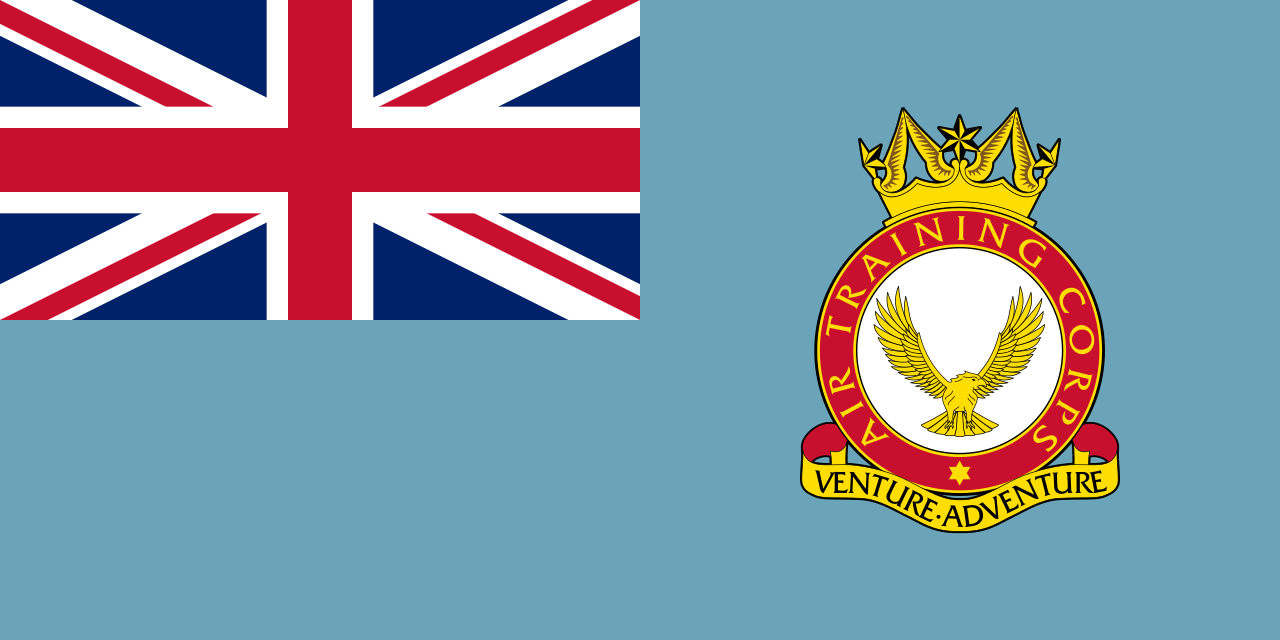
The Air Training Corps Ensign is a flag, bearing the yellow falcon of the Air Training Corps with the motto below, which was authorised in June 1941.
Uniform

All cadets are issued with a uniform that is derived from that worn by RAF personnel, and are regulated by dress regulations known as ACP 1358. Cadets primarily wear one of three uniforms:
- No. 2A (Full) Service Dress -AKA 'Best Blues'— consisting of a light blue (Wedgewood) shirt and black tie, a blue V-neck wool jumper, a brassard, blue-grey trousers or skirt / slacks, and an RAF blue beret with an Air Training Corps cap badge. The jumper is removed in variation No. 2A (Long Sleeved) Service Dress.
- No. 2C Service Dress — AKA 'Working/Dark Blues'- as above, but replacing the light blue shirt and tie with a dark blue shirt, worn with the top button undone. May be worn with or without the jumper.
- No. 3 Service Dress - Field Clothing — AKA 'Greens/Combats'- consisting of either CS95 or PCS-MTP field clothing.
In No. 3 Service Dress staff and cadets wear Tactical Recognition Flashes (TRF) on the right arm, formerly Officers wore the RAF tactical recognition flash, Adult Warrant Officers and Senior Non-Commissioned Officers wore the RAFAC Staff formation flash, and cadets wore RAFAC Cadet formation flash consisting of the former Air Cadets logo above the RAF logo in subdued colours on a green background. In 2024 the RAF Air Cadets adopted a new Tactical Recognition Flash (TRF) which features an eagle and the lettering "RAF" above the eagle, and "AIR CADETS" below the eagle all in gold, against the RAF TRF background. This new TRF is worn by all members of the organisation, staff and cadets.
Squadron insignia
The first fifty Air Training Corps squadrons that were formed retain an 'F' to show they are 'founder' squadrons, e.g., 10F (Luton) Squadron, 48F (Hampstead) Squadron, or 1F (City of Leicester) Squadron.
Activities
Main article: Activities of the Air Training Corps

.jpg)

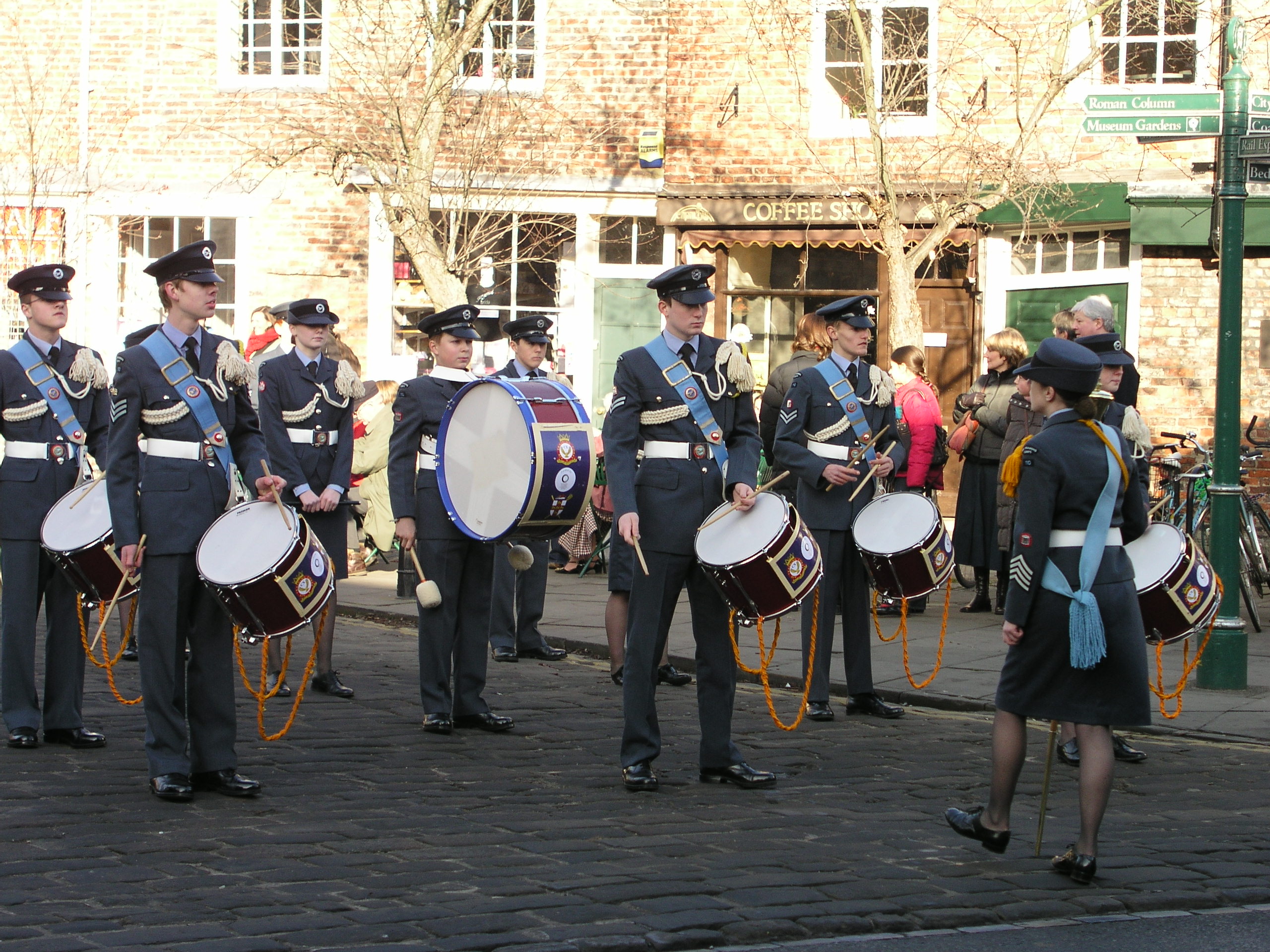
ATC activities which include annual camps, in the UK and overseas, are intended to help develop teamwork as well as leadership skills.
One large annual camp is the Royal International Air Tattoo (RIAT) camp held annually in July for the major airshow at RAF Fairford. Each year, cadets aged above 16 years and their staff spend between one and three weeks, carrying out essential work in the preparation, and the subsequent taking-down of the infrastructure for RIAT.
Corps-wide trophies
Air Training Corps squadrons each have a chance annually to win the two most prized trophies in the corps. The Sir Alan Lees trophy is awarded by the commandant Air Training Corps to the squadron with the best statistics and overall impression when inspected. The Morris Trophy is awarded to one of the six regional candidates upon inspection by the commandant.
| year | winning ATC squadron | ATC wing | Officer Commanding | ||||||||
|---|---|---|---|---|---|---|---|---|---|---|---|
| 1952 | No. 187 (Worcestershire) Squadron | West Mercian Wing | Sqn Ldr Charles Baynton-Hughes MBE RAFVR(T) | ||||||||
| 1971 | No. 187 (City of Worcester) Squadron | West Mercian Wing | Sqn Ldr Charles Baynton-Hughes MBE RAFVR(T) | ||||||||
| 1976 | 176 (Hove) Squadron | Sussex Wing | Flt Lt F P Le Duc MBE RAFVR(T) | ||||||||
| 1979 | 93 (City of Bath) Squadron | Somerset Wing | Sqn Ldr Brian T Higgins RAFVR(T) | ||||||||
| 1980 | 1084 (Market Harborough) Squadron | South Midlands Wing | Flt Lt Donald Edge RAFVR(T) | ||||||||
| 1981 | 2427 (Biggin Hill) Squadron | Kent Wing | |||||||||
| 1982 | 93 (City of Bath) Squadron | Somerset Wing | Sqn Ldr Brian T Higgins MBE RAFVR(T) | ||||||||
| 1983 | 93 (City of Bath) Squadron | Somerset Wing | Sqn Ldr Brian T Higgins MBE RAFVR(T) | ||||||||
| 1984 | 444 (Shoreditch) Squadron | London Wing | Flt Lt Ronald S Frewin MBE RAFVR(T) | ||||||||
| 1985 | 866 (Immingham) Squadron | Central & East Region | Flt. Lt Tony Lark MBE RAFVR(T) | ||||||||
| 1991 | 2375 (Neston) Squadron | Merseyside Wing | Flt. Lt H Wellings RAFVR(T) | ||||||||
| 1993 | No. 424 (Southampton) Squadron | Hampshire & Isle of Wight | Sqn Ldr A Jones MBE RAFVR(T) | ||||||||
| 1994 | No. 111 (Sunderland) Squadron | Durham & Northumberland Wing | Flt Lt David Harris RAFVR(T) | ||||||||
| 1995 | No. 1145 (Dunfermline) Squadron | Dundee & Central Scotland Wing | Flt Lt Ross Mitchell RAFVR(T) | ||||||||
| 1996 | No. 2152 (North Bristol) Squadron | Bristol & Gloucestershire Wing | Flt Lt David Cox RAFVR(T) | ||||||||
| 2000 | No. 230 (Congleton) Squadron | Staffordshire Wing | Flt Lt Rod Goodier RAFVR(T) | ||||||||
| 2001 | No. 215 (City of Swansea) Squadron | No.3 Welsh Wing | Sqn Ldr Phillip Flower MBE RAFVR(T) | ||||||||
| 2005 | No. 215 (City of Swansea) Squadron | No.3 Welsh Wing | Sqn Ldr Phillip Flower MBE RAFVR(T) | ||||||||
| 2007 | No. 1145 (Dunfermline) Squadron | Dundee & Central Scotland Wing | Flt Lt Ross Mitchell RAFVR(T) | ||||||||
| 2008 | No. 241 (Wanstead and Woodford) Squadron | London Wing | Sqn Ldr Jerry Godden RAFVR(T) | ||||||||
| 2009 | No. 610 (Chester) Squadron | Merseyside Wing | Flt Lt John Kendal RAFVR(T) | ||||||||
| 2010 | No. 1475 (Dulwich) Squadron | London Wing | Sqn Ldr Kevin Mehmet MBE RAFVR(T) | ||||||||
| 2011 | title=Air Cadets News – Best of the best... Swansea squadron wins Lees Trophy | url=http://www.raf.mod.uk/aircadets/newsandevents/index.cfm?topic=1C52325B-F6AD-6C90-D1AD0277EBE01144&storyid=CD2175F1-5056-A318-A8F353F500BF7334 | website=RAF.MoD.uk | publisher=Air Cadet News | date= | access-date=13 July 2011 | archive-url=https://web.archive.org/web/20111012155348/http://www.raf.mod.uk/aircadets/newsandevents/index.cfm?topic=1C52325B-F6AD-6C90-D1AD0277EBE01144&storyid=CD2175F1-5056-A318-A8F353F500BF7334 | archive-date=12 October 2011 | url-status=dead}} | No. 3 Welsh Wing | Sqn Ldr Phillip Flower MBE RAFVR(T) |
| 2012 | No. 2160 (Sleaford) Squadron | Trent Wing | Flt Lt Mel Walker RAFVR(T) | ||||||||
| 2013 | No. 2344 (Longbenton) Squadron | Durham & Northumberland Wing | Flt Lt Gary Richardson RAFVR(T) | ||||||||
| 2014 | No. 1349 (Woking) Squadron | Surrey Wing | Flt Lt Ben White RAFVR(T) | ||||||||
| 2015 | No. 56 (Woolwich) Squadron | London Wing | Flt Lt Mark Bird RAFVR(T) | ||||||||
| 2016 | No. 31 (Tower Hamlets) Squadron | London Wing | Flt Lt Rex Nicholls RAFVR(T) | ||||||||
| 2017 | No. 187 (City of Worcester) Squadron | West Mercian Wing | FS (ATC) Karl Nicholson | ||||||||
| 2018 | No. 2480 (Holywell) Squadron | Number Two Welsh Wing | Flt Lt D Anglesea RAFAC | ||||||||
| 2019 | No. 111 (Sunderland) Squadron | Durham & Northumberland Wing | Flt Lt James Yeo RAFAC | ||||||||
| 2022 | No. 241 (Wanstead and Woodford) Squadron | London Wing | Sqn Ldr Jerry Godden RAFAC | ||||||||
| 2023 | date=2 October 2023 | title=Top cadets and staff celebrated at RAF Cranwell | url=https://www.raf.mod.uk/aircadets/news/top-cadets-and-staff-celebrated-at-raf-cranwell/ | access-date=22 September 2024 | website=Royal Air Force Air Cadets | archive-url= | archive-date=}} | Greater Manchester Wing | Flt Lt Kate Clarke RAFAC | ||
| 2024 | date=16 July 2024 | title=Royal Air Force Air Cadets awards winners 2024 | url=https://www.raf.mod.uk/aircadets/news/royal-air-force-air-cadets-awards-winners-2024/ | access-date=25 September 2024 | website=Royal Air Force Air Cadets | archive-url= | archive-date=}} | Essex Wing | Sqn Ldr Elly Shipley RAFAC |
| year | winning ATC squadron | ATC wing | Officer Commanding | ||||||
|---|---|---|---|---|---|---|---|---|---|
| 1978 | 176 (Hove) Squadron | Sussex Wing | Flt Lt F P Le Duc MBE RAFVR(T) | ||||||
| 1983 | 444 (Shoreditch) Squadron | London Wing | Flt Lt Ronald S Frewin MBE RAFVR(T) | ||||||
| 1997 | No. 2465 (Icknield) Squadron | Beds and Cambs Wing | Flt Lt P R Smith RAFVR(T) | ||||||
| 2006 | title=2409 Sqn presented with Morris Trophy by Commd't Air Cadets | url=http://hbwing.blogspot.com/2007/11/2409-sqn-presented-with-morris-trophy.html | website=hbwing.blogspot.com | date=17 November 2007 | url-status=dead | archive-url=https://web.archive.org/web/20110708041538/http://hbwing.blogspot.com/2007/11/2409-sqn-presented-with-morris-trophy.html | archive-date=8 July 2011}} | Herts and Bucks Wing | Sqn Ldr Jerry Davies RAFVR(T) |
| 2008 | No. 1855 (Royton) Squadron | East Lancashire Wing | Flt Lt Mark Hamilton RAFVR(T) | ||||||
| 2009 | No. 1211 (Swadlincote) Squadron | South and East Midlands Wing | Flt Lt Alyn Thompson RAFVR(T) | ||||||
| 2010 | No. 126 (City of Derby) Squadron | South and East Midlands Wing | Sqn Ldr Ian Marshall RAFVR(T) | ||||||
| 2011 | No. 1855 (Royton) Squadron | East Lancashire Wing | Flt Lt Mark Hamilton RAFVR(T) | ||||||
| 2012 | No. 633 (West Swindon) Squadron | Dorset & Wiltshire Wing | Flt Lt Helene Woodham RAFVR(T) | ||||||
| 2013 | No. 2516 (Droitwich) Squadron | West Mercian Wing | Flt Lt Paul Wilde RAFVR(T) | ||||||
| 2014 | No. 184 (Manchester South) Squadron | Greater Manchester Wing | Flt Lt Tom Warner RAFVR(T) | ||||||
| 2015 | No. 1271 (Bathgate) Squadron | West Scotland Wing | Flt Lt Margaret Greer RAFVR(T) | ||||||
| 2016 | No. 126 (City of Derby) Squadron | South and East Midlands Wing | Sqn Ldr Ian Marshall MBE RAFVR(T) | ||||||
| 2017 | No. 1211 (Swadlincote) Squadron | South and East Midlands Wing | Flt Lt Ruth Morgan RAFVR(T) | ||||||
| 2018 | No. 7 Overseas (Jersey) Squadron | Dorset and Wiltshire Wing | Flt Lt Victoria Atherton MBE RAFAC | ||||||
| 2022 | No. 2344 (Longbenton) Squadron | Durham & Northumberland Wing | Flt Lt Gary Richardson RAFAC | ||||||
| 2023 | No. 261 (Guildford) Squadron | Surrey Wing | Flt Lt Andy Brittain RAFAC | ||||||
| 2024 | No. 2175 (Rolls Royce) Squadron | West Scotland Wing | Flt Lt Stuart McLellan MBE RAFAC |
The Foster Trophy is awarded to the cadet who has achieved the highest academic results in the entire corps over their time in the Air Training Corps, after finishing the cadet syllabus that leads to a BTEC Level 2 Certificate in Aviation Studies. In addition, there are also trophies presented annually by the Royal Air Forces Association (RAFA). These trophies include the 'Sir Douglas Bader Wings Appeal Trophy' for the ATC squadron collecting the most money on a per capita basis, the squadron achieving second place is awarded the 'Sir Augustus Walker Trophy'. The 'Sir Robert Saundby Trophy' is awarded for collecting the highest net Wings Appeal amount.
The Quinton Memorial Trophy is a national award presented annually to the adult non-commissioned officer (NCO) who has gained the top academic results in the senior non-commissioned officer (SNCO) initial courses held at the Air Cadet Adult Training Facility, Royal Air Force College Cranwell (RAFC). This trophy is named in honour of Flight Lieutenant John Quinton.Flight Lieutenant John Alan Quinton was an RAF navigator on a Wellington aircraft, which was flying an air cadet on an Air Experience Flight in 1951. During the flight, the aircraft was involved in a mid-air collision, and Flight Lieutenant Quinton gave the only parachute within reach to the cadet, pushing him out of the aircraft. His quick thinking and heroic action saved the life of the cadet but cost him his own, for which he was posthumously awarded the George Cross.
Air Training Corps ranks
Young people who have begun their 2nd year of Secondary School (Year 8), and are under 16 3/4 years old can join the Air Training Corps (ATC). They are initially given the title 'Junior Cadet', and can go along to most squadron (or flight) meetings to get a feel for the ATC. Enrolment confers the status of Second Class Cadet, and upon completion of the First Class syllabus, they become First Class Cadets and receive their First Class badge to be worn on their brassard. As cadets become more experienced within the Air Training Corps (ATC), and if suitable, they can be promoted by their squadron's commanding officer (CO) to the status of cadet non-commissioned officers (NCOs). These ranks include Corporal, Sergeant, Flight Sergeant and Cadet Warrant Officer.
The Cadet NCO ranks within the ATC mirror those of the RAF's non-technical / non-flying trades, and are, in descending order of seniority:
It is common within the ATC to abbreviate these ranks by dropping the prefix 'cadet'. Cadet Warrant Officers are not addressed as 'Sir' or 'Ma'am', but as 'Cadet Warrant Officer' or informally as 'CWO' (pronounced 'si', 'wəʊ', or alternatively as an acronym), the former being preferred by cadets and staff, in order to reduce ambiguity with the adult substantive rank of Warrant Officer. This is the only rank in the Corps to accommodate the 'Cadet' prefix upon being referred to by members of the Corps.
Cadet classification syllabus
_Method_of_Instruction_lanyard.jpg)
Whilst not all cadets who join the Air Training Corps (ATC) will be eligible for promotion, all cadets can progress through the (ATC) training system and, by passing exams, achieve different classifications. The classification levels are Junior Cadet, Second Class Cadet (this is automatically achieved on enrolment), First Class Cadet, Leading Cadet, Senior Cadet, and Master Air Cadet.Often incorrectly referred to as 'Master Cadet' - ACTO 1 does not use this terminology.
The Method of Instruction course is not a classification as such, but rather a qualification. This allows them to teach other cadets a variety of subjects. Although this is not compulsory, ATC Wings ordinarily feed this hand-in-hand with the Staff Cadet Course (see below). Upon successful completion of this course, the cadet will be awarded a yellow lanyard to distinguish them. Leading Cadet, Senior Cadet, and Master Air Cadet exams consist of multiple assessment criteria each containing two questions. A cadet must achieve either 1 or 2 marks (50% or 100%) for each module in order to pass. All exams are taken online on a system called Bader Learn.
In September 2010, a new classification structure, syllabus and examination process came into force. The Senior Cadet badge shows a four-bladed propeller with a small four pointed star in the centre in an X orientation. The Master Air Cadet badge for the brassard shows an ATC Falcon surrounded by laurel leaves. For each badge, cadets must pass three of the following subjects, for Master Air Cadet they may not use the same three subjects they used on Senior Cadet:
- Aircraft handling and flying techniques
- Air Power
- Piston engine propulsion
- Jet engine propulsion
- Rocketry
- Airframes
- Avionics and aircraft electrical systems
- Basic air navigation
- Basic principals of pilot navigation
- Advanced radio and radar
- Data communications
Specialist Instructor and Leadership Qualifications
_wearing_the_blue_QAI_lanyard.jpg)
_Junior_Leaders_lanyard_-e1429811098300.jpg)
Qualified Aerospace Instructors
Alongside Instructor Cadet there is another lanyard that can be awarded to cadets who are interested in specialising in teaching aerospace subjects. These qualified cadets are known as Qualified Aerospace Instructors (QAIs), and wear a light blue lanyard over their left shoulder. The Qualified Aerospace Instructors Course (QAIC) has been available since September 2008. The course is held at RAF Linton-on-Ouse, and as of 2011, also at MOD Boscombe Down (as of RAF Linton-on-Ouse's closure in December 2020, the North centre was moved to Inskip Cadet Centre as of QAIC 14). The course is held from early September to Easter of the following year, beginning with a selection weekend in early September, and seven total weekends (as of QAIC 8, prior to this there were only six training weekends) from late September until early March. The course culminates in a 'Graduation Week' which is organised to coincide with the Easter holidays to avoid clashing with school programmes. After completing training in various modules, they carry out examinations in all modules (air traffic control, air power, flight simulators, aerodynamics, and Instructional Teaching and Presentation Skills (ITPS)); satisfactory performance in all exams results in the cadet being awarded the pale blue QAIC lanyard and flight suit badge. Upon completion of the course, graduating students are offered affiliated membership to the Royal Aeronautical Society.
Junior Leaders Course
For those interested in fieldcraft teaching and leadership, there is the Junior Leaders Course. Successful completion of the course awards the participant a maroon lanyard to be worn over their left shoulder and a junior leaders badge to sew on to the left sleeve of their No.3 Service Dress (field uniform) to show they are a qualified Junior Leader. The course used to run from September to Easter, involving six weekend training camps and an assessment week. The course is aimed at more senior cadets, and as such, an age restriction of 17 years applies. Not only this, but the course also requires the participant to hold the rank of Cadet Sergeant or higher. The course culminates in the award of a Level 3 Certificate in Leadership & Management from the Institute of Leadership and Management. The course is also open to Sea Cadets and Army Cadets.
Adult staff and ranking
.jpg)
Three categories of supervisory staff run the Air Training Corps (ATC) at the unit level: commissioned officers, senior NCOs, and civilian instructors (CIs). All uniformed staff must attend training courses run by the Royal Air Force at the Royal Air Force Air Cadets (RAFAC) Adult Training Facility (ATF), located at RAF College Cranwell (RAFC), usually within a year of appointment, with further courses as they progress up the rank structure.
Officers
Since December 2017, all RAFAC officers in the Air Training Corps are commissioned with a Cadet Forces Commission (CFC) and ranks framework, with previous RAFVR(T) officers having their commissions transferred to CFC commissions.
Squadrons are usually commanded by CFC Flight Lieutenants (Flt Lt) and Flying Officers (Fg Off), who are also found as Wing and Regional staff officers, along with Squadron Leaders (Sqn Ldr) and Wing Commanders (Wg Cdr). Particularly large squadrons are sometimes commanded by Squadron Leaders (typically when the squadron has 100 or more cadets). The most senior rank in the Cadet Forces Commission is that of Wing Commander, with the exception of the ambassador to the Air Cadets, and the single Senior RAFAC Volunteer, who both hold the honorary rank of Group Captain (Grp Capt) RAFAC, under a CFC. The current ambassador is Emma Wolstenholme.
| insignia | rank | abbr | ||||
|---|---|---|---|---|---|---|
| [[File:RAFAC AC.jpg | 60px | alt=]] | [[File:RAFAC GC.jpg | [[File:RAFAC WC.jpg | 60px | alt=]] |
| Air Commodore | Group Captain (R) / | |||||
| Group Captain (RAFAC)Group Captains who perform the role of Regional Commandant are commissioned as members of the Royal Air Force Reserve, RAF(R), and so wear standard Group Captain rank insignia. Group Captain (RAFAC) is only held by the Honorary Ambassador to the Air Cadets. | Wing Commander (RAFAC) | |||||
| Air Cdre | Gp Capt | Wg Cdr |
Ambassador to the Air Cadets
In April 2013, Sir Chris Hoy was appointed the first Ambassador to the Royal Air Force Air Cadets (RAFAC), and assumed the rank of Honorary Group Captain RAFVR(T).
In November 2014, Carol Vorderman accepted the appointment of Ambassador to the Royal Air Force Air Cadets, saying: "I am truly honoured to be appointed as an ambassador for the RAF Air Cadets. I can't wait to meet the cadets, and the adult volunteer staff who give so much of their time to support them. The cadets themselves are a shining example of the best of British youngsters, standing with them on a parade square will be a great privilege." Vorderman assumed the rank of Honorary Group Captain RAFVR(T) (changed to Group Captain RAFAC from December 2017) for the duration of her appointment. She is the first female to be appointed Ambassador.
In November 2021, rower Emma Wolstenholme was appointed Wing Commander (RAFAC) and Honorary Ambassador to the Air Cadets. She is a former serving Royal Air Force officer, and planned to row solo across the Atlantic Ocean in early 2022. However, this attempt and later ones were postponed due to sub-optimal weather conditions. A successful attempt was made on Sunday 4 June 2023, rowing 2,000 miles around Great Britain.{{bulleted list| | |
Air Commodore-in-Chief
King George VI was the first person to hold the position of Air Commodore-in-Chief of the Air Training Corps, which he held from 1941 to 1952. Upon Elizabeth II's accession to the throne in 1952, Prince Philip, Duke of Edinburgh was appointed Air Commodore-in-Chief of the Air Training Corps. On 16 December 2015, Prince Philip stepped down from the role and was succeeded by the then Duchess of Cambridge as honorary Air Commodore-in-Chief.
NCOs and WOs
Adults may also be appointed as senior non-commissioned officers (SNCO), these being ranks within the Air Training Corps. Adult SNCOs and warrant officers (WO) are uniformed in the same way as their RAF counterparts, except that the embroidered text of 'RAF AIR CADETS' appears below their rank insignia. Since December 2017, Air Training Corps SNCOs and WOs had their ranks transferred to the new RAFAC commissions and ranks framework. A gilt RAFAC badge is worn on the lapels when in No.1 dress uniform, to denote membership within the cadet forces.
In 2020, all RAFAC Warrant Officers and Warrant Officers (Aircrew) in the Air Training Corps were granted use of the Royal Arms insignia, to bring the RAFAC other ranks insignia into alignment with those of their Royal Air Force counterparts.
| groundcrew | |||||||||||
|---|---|---|---|---|---|---|---|---|---|---|---|
| insignia | aircrew | ||||||||||
| insignia | title | ||||||||||
| Adult staff who are working in aircrew roles, such as at Volunteer Gliding Squadrons or at Air Experience Flights are authorised to wear the Aircrew insignia for their rank accordingly. | abbr | ||||||||||
| [[File:RAFAC WO1.png | 70px | alt=]] | [[File:RAFAC WO.png | 70px | alt=]] | [[File:RAFAC FS.png | 70px | alt=]] | [[File:RAFAC Sgt.png | 70px | alt=]] |
| [[File:RAFAC MA.png | 70px | alt=]] | [[File:RAFAC WO Air.png | 70px | alt=]] | [[File:RAFAC FS Air.png | 70px | alt=]] | [[File:RAFAC Sgt Air.png | 70px | alt=]] |
| Warrant Officer / | |||||||||||
| Master Aircrew | Warrant Officer | ||||||||||
| (until 2020)No longer used, as of October 2020, all WO (RAFAC) now use the Royal Arms badge, and all MAcr (RAFAC) use the MAcr badge. | Flight Sergeant | Sergeant | |||||||||
| WO / MAcr | WO | FS | Sgt |
Staff (adult) ranks pre-December 2017
_Officer_Cadet_Rank_Slide.png)
Air Training Corps officers were previously commissioned into the Royal Air Force Volunteer Reserve (Training Branch), RAFVR(T), a specific training branch of the Royal Air Force Volunteer Reserve, the RAFVR (military reservists). They previously wore a gilt 'VRT' pin badge upon their rank braid, while warrant officers and SNCOs wore a gilt 'ATC' pin badge. The Air Training Corps ranks of adult SNCOs and WOs were Sergeant (ATC), Flight Sergeant (ATC), and Warrant Officer (ATC).Prior to the 'LaSER (London and South East Region) Review' of 2003, the adult ranks of Sergeant and Flight Sergeant did not exist, meaning that the non-commissioned rank structure of a squadron was more straightforward, i.e., Cadet, Cadet Corporal, Cadet Sergeant, Cadet Flight Sergeant, Cadet Warrant Officer, Adult Warrant Officer. This has been disturbed by inserting the ranks of Sgt (RAFAC) and FS (RAFAC) and WO (RAFAC). The rank of Sgt (RAFAC) is senior to all cadet ranks, including CWO. However, this does allow a wider scope for developing staff to progress as Senior Non-Commissioner Officers, and brings the ATC's adult rank structure more in line with those of the other cadet forces, whose adult ranks begin at Sergeant or service equivalent.
| insignia | description | ||
|---|---|---|---|
| [[File:ATC Pin.jpg | 120px | alt=]] | The 'ATC' pin badge was formerly worn on the lower edge of shoulder rank slides or lapels of those that were an ATC NCO. |
| [[File:VRT Pin.jpg | 120px | alt=]] | Royal Air Force Volunteer Reserve (Training Branch) officers in the ATC, abbreviated RAFVR(T), were identified by the 'VRT' pin badge, as formerly worn on the lower-edge of shoulder rank slides and lapels. |
Chaplains
Air Training Corps chaplains are usually civilian members of the local clergy (although uniformed forces chaplains may join as Service Instructors). The role of the chaplain in the ATC is to 'provide appropriate pastoral care for all personnel within the Air Cadet Organisation, irrespective of religious belief or status'. A chaplain's role in the local squadron is to offer guidance and leadership to cadets and members of staff on moral and spiritual matters. The commitment expected of a chaplain is a monthly visit to lead what is termed 'the Padre's hour', and to conduct the formal Enrolment Service when new cadets join. ATC chaplains are supported by the Royal Air Force Chaplains Branch. ATC chaplains do not wear uniform, but are recognised by a chaplain's badge on their lapel, and a larger version on their tippet (preaching scarf), vestments, or other clerical clothing. Even if it is not their custom to do so, ATC chaplains are expected to wear a clerical collar ('dog collar') when on an RAF station. The equivalent No.2 working dress for a chaplain is a dark sweater with chaplain's badge and a clerical collar.
| rank | identifying clothing and insignia |
|---|---|
| Civilian instructor (CI) | No official uniform, although may be seen with a lapel pin or an armband, or may be wearing a sweatshirt or polo shirt with an Air Training Corps logo. |
| Chaplain | RAF station]]. |
Notes
References
References
- (11 August 2023). "Further Military Appointments for Members of the Royal Family".
- (15 August 2024). "New Commandant Royal Air Force Air Cadets announced".
- (31 December 2023). "Royal Air Force Air Cadets New Year Honours List 2024".
- (30 November 2025). "New National Chaplain for the RAF Air Cadets".
- (2006). "Air Cadet Organisation: Annual Report 2006". [[Air Cadet Organisation]].
- (2007). "Welcome to the Air Training Corps". [[Air Cadet Organisation]].
- (29 December 2023). "Order of the British Empire".
- "Royal Air Force Air Cadets New Year Honours List 2024".
- "Who we are". [[Royal Air Force Air Cadets]].
- "Tutor T1 {{!}} Royal Air Force".
- "Viking T1 {{!}} Royal Air Force".
- "MOD sponsored cadet forces statistics: 2024".
- "History of The Air League". Kenleyairshow.co.uk.
- "Ministry of Defence – About Defence – What we do – Reserve Forces and Cadets – DRFC – History of the Cadet Forces". [[Ministry of Defence (United Kingdom).
- (2015). "RAF timeline 1941". [[Royal Air Force]].
- Kidd, H. R.. (2014). "Horizons: The History of the Air Cadets". Pen & Sword Aviation.
- (2000). "General Service Training". [[Air Cadet Organisation]].
- "The Girls Venture Corps Air Cadets". GVCAC HQ.
- (2 March 2017). "New Progressive Training Syllabus launched". [[Royal Air Force Air Cadets]].
- "New Progressive Training Syllabus". 42F (King's Lynn) Squadron Air Training Corps.
- Quinn, Ben. (28 December 2014). "Ministry of Defence pays out £2m to settle cadets' sexual abuse claims". [[The Guardian]].
- (4 July 2017). "Sex abuse was covered up at cadet forces, Panorama finds". [[BBC News]].
- (Winter 2017). "HM The Queen approves new commission for cadet force volunteers". [[Royal Air Force]], [[Ministry of Defence (United Kingdom).
- (May 2017). "Regional Commandant biography".
- "Find A Squadron". RAF.
- "Central & East Region Air Cadets". Central & East Region Air Cadets.
- "Region Staff – Central & East Region Air Cadets".
- "London & South East Region".
- "New Regional Commandant takes the helm in London & South East".
- "THE AIR CADETS LONDON AND SOUTH EAST GENERAL PURPOSES FUND - Charity 261691".
- "North Region".
- "North Region Staff".
- "Scotland & Northern Ireland Region".
- "New RAF Air Cadet unit opens in Enniskillen".
- "Invoice Factoring Companies – Invoice Factoring Company".
- "THE WELFARE AND GENERAL PURPOSES FUND OF THE SOUTH WEST REGION OF THE AIR TRAINING CORPS - Charity 262255".
- "Wales & West Region Air Cadets Pinel".
- "Who We Are {{!}}".
- "AIR CADETS (WALES AND WEST) WELFARE AND SPORTS FUND - Charity 500607".
- Mehta, Amar. (21 September 2021). "Duchess of Cambridge goes abseiling and mountain biking with air cadets during Lake District visit". [[Sky News]].
- "RAF Syerston". [[Ministry of Defence (United Kingdom).
- {{London Gazette. (20 February 2018)
- "Why join as a volunteer".
- "Guidance for charities with a connection to a non-charity". [[HM Government]].
- "Why join as a volunteer".
- (15 July 2015). "ACP-11". [[HM Government]].
- (11 October 2022). "Charity Commission Constitutions". [[HM Government]].
- "The History of the ATF". 1260 Squadron.
- (2000). "General Service Training". [[Air Cadet Organisation]].
- (2004). "RAF Form 3822: Cadet Record of Service". [[Air Cadet Organisation]].
- "The Colours of the Fleet". The Flag Institute.
- "AP1358 - Uniform Dress & Appearance Regulations for the Royal Air Force".
- "Uniform Dress and Appearance Regulations for the Air Cadet Organization". [[RAF Air Cadets]].
- (30 September 2024). "New Tactical Recognition Flash for the RAF Air Cadets".
- "1F (City of Leicester) Squadron Royal Air Force Air Cadets meet 1 (Fighter) Squadron RAF". [[RAF Air Cadets]].
- "Adventurous Training - Air Cadet Organisation".
- (Autumn 2016). "Cadets steal the show at RIAT". Air Cadet.
- (25 September 2022). "Winners of the Lees Trophy and the Morris Trophy announced".
- "Air Cadets News – Best of the best... Swansea squadron wins Lees Trophy". Air Cadet News.
- "Longbenton Squadron are the Lees Trophy winners". Air Cadet News.
- (22 September 2022). "Winners of the Lees Trophy and the Morris Trophy announced". Air Cadet News.
- (2 October 2023). "Top cadets and staff celebrated at RAF Cranwell".
- (16 July 2024). "Royal Air Force Air Cadets awards winners 2024".
- "2465 Luton Icknield Squadron, Air Training Corps".
- (17 November 2007). "2409 Sqn presented with Morris Trophy by Commd't Air Cadets".
- Sqn Ldr Wilson. (17 July 2010). "126 Squadron wins the Morris Cup". South and East Midlands Wing.
- "Droitwich Squadron wins the Morris Trophy". Air Cadet News.
- (22 September 2022). "Winners of the Lees Trophy and the Morris Trophy announced". [[Royal Air Force Air Cadets]].
- (29 May 2019). "Air cadets win national trophies". Ilkley Gazette.
- (1 January 2014). "Sgt Constant ATC Awarded Quinton Memorial Trophy".
- (2023). "Ranks – Royal Air Force Air Cadets". [[Royal Air Force Air Cadets]].
- (2000). "General Service Training". [[Air Cadet Organisation]].
- "Bader Learn". Bader Learn.
- "Master Air Cadet (ATC only)". AIR CADET 101.
- "Senior Cadet". AIR CADET 101.
- "QAIC 8 covering letter". QAIC Support Admin Centre.
- "About the course".
- (19 May 2016). "Junior Leaders Course 18 calling letter". Officer Commanding Junior Leaders.
- "Leadership training". [[Royal Air Force Air Cadets]].
- "Leadership training".
- "Uniformed staff training". [[Royal Air Force Air Cadets]].
- (Winter 2017). "HM The Queen approves new commission for Cadet Force Volunteers". Warners Midlands plc.
- "Rank structure". Air Cadets North.
- "Royal Warrant for Cadet Force commission". [[HM Government]].
- "CFC explained". Air Cadet 101.
- (11 June 2020). "MOD Sponsored Cadet Forces statistics April 2020". [[HM Government]].
- (22 April 2013). "Air Cadets strike gold with Sir Chris Hoy". [[Royal Air Force]].
- (Winter 2015). "Carol Vorderman joins the cadets". Warners Midlands plc.
- (18 November 2021). "Solo female Atlantic rower made Honorary Ambassador to the RAF Air Cadets". [[Royal Air Force Air Cadets]].
- "air commodore-in-chief {{!}} air force {{!}} king {{!}} 1950 {{!}} 1255 {{!}} Flight Archive".
- "The Air Cadet Organisation Web Site".
- Heald, Tim. (1991). "The Duke: A Portrait of Prince Philip". [[Hodder and Stoughton]].
- "The Duke of Edinburgh hands Air Cadet patronage to The Duchess of Cambridge, 16 December 2015". [[Royal Air Force]].
- (31 October 2020). "New rank insignia for WO RAFAC from today.".
- "Join as a Chaplain". [[Royal Air Force Air Cadets]].
- (19 March 2015). "Uniform dress and Appearance Regulations for the Air Cadet Organisation". 2484 Squadron ATC.
This article was imported from Wikipedia and is available under the Creative Commons Attribution-ShareAlike 4.0 License. Content has been adapted to SurfDoc format. Original contributors can be found on the article history page.
Ask Mako anything about Air Training Corps — get instant answers, deeper analysis, and related topics.
Research with MakoFree with your Surf account
Create a free account to save articles, ask Mako questions, and organize your research.
Sign up freeThis content may have been generated or modified by AI. CloudSurf Software LLC is not responsible for the accuracy, completeness, or reliability of AI-generated content. Always verify important information from primary sources.
Report