From Surf Wiki (app.surf) — the open knowledge base
AIPAC
Pro-Israel lobby group in the United States

Pro-Israel lobby group in the United States
| Field | Value | |
|---|---|---|
| name | American Israel Public Affairs Committee | |
| logo_alt | Logo of AIPAC, a Star of David in the style of U.S. flag followed by the organization's name and slogan | |
| image | American_Israel_Public_Affairs_Committee_(AIPAC)_(53840039086).jpg | |
| caption | AIPAC headquarters in Mount Vernon Triangle, Washington, D.C. | |
| size | 250px | |
| tax_id | 53-0217164 | |
| mission | "To strengthen and expand the U.S. - Israel relationship in ways that enhance the security of the United States and Israel." | |
| --> | founded | |
| logo | AIPAC_logo_(2020).svg | |
| headquarters | Washington, D.C., U.S. | |
| coords | ||
| status | 501(c)(4) organization | |
| employees | 376 | |
| employees_year | 2022 | |
| volunteers | 47 | |
| volunteers_year | 2022 | |
| revenue | $156,448,717 | |
| revenue_year | 2023–24 | |
| expenses | $100,363,669 | |
| expenses_year | 2023–24 | |
| endowment | $13,070,967 | |
| leader_name | Michael Tuchin | |
| leader_title | President, board of directors | |
| leader_name2 | Betsy Berns Korn | |
| leader_title2 | Chairman, board of directors | |
| leader_name3 | Howard Kohr | |
| leader_title3 | Chief executive officer | |
| subsidiaries | 251 Massachusetts Avenue LLC, | |
| American Israel Educational Foundation, | ||
| AIPAC-AIEF Israel RA, | ||
| AIPAC-PAC, | ||
| United Democracy Project | ||
| slogan | America's Pro-Israel Lobby | |
| --> | website | |
| formerly | American Zionist Committee for Public Affairs (1954-1959) |
--| founded = American Israel Educational Foundation, AIPAC-AIEF Israel RA, AIPAC-PAC, United Democracy Project --| website =
The American Israel Public Affairs Committee (AIPAC ) (formerly "American Zionist Committee for Public Affairs") is a pro-Israel lobbying group that advocates its policies to the legislative and executive branches of the United States. It is one of several pro-Israel lobbying organizations in the United States, and has been called one of the most influential lobbying groups in the U.S. As of 2025, AIPAC says it has more than 5 million members in the U.S.
Until 2021, AIPAC did not raise funds for political candidates itself; its members raised money for candidates through political action committees unaffiliated with AIPAC and by other means. In late 2021, AIPAC formed its own political action committee and announced plans for a Super PAC, which can spend money on candidates' behalf. AIPAC's critics have said it acts as an agent of the Israeli government and that it has a "stranglehold" on the United States Congress. AIPAC has been accused of being strongly allied with Israel's Likud party and the U.S. Republican Party. An AIPAC spokesman has called this a "malicious mischaracterization".
AIPAC describes itself as a bipartisan organization. It says it has five million members, 17 regional offices, and "a vast pool of donors". AIPAC's supporters say its bipartisan nature can be seen at its yearly policy conference, which in 2016 included both major parties' nominees: Democrat Hillary Clinton and Republican Donald Trump. AIPAC has been criticized as unrepresentative of American Jews who support Israel and supportive only of right-wing Israeli policy and viewpoints.
AIPAC was founded in 1954 by Isaiah L. Kenen, a lobbyist for the Israeli government, partly to counter international criticism of Israel's Qibya massacre of Palestinian villagers that year. AIPAC became a powerful organization during the 1980s. In 2002, it expressed intent to lobby Congress to authorize use of force in Iraq, and in 2003, the Iraq War was defended at AIPAC events. In 2005, a Pentagon analyst pleaded guilty to espionage charges of passing U.S. government secrets to senior AIPAC officials, in what became known as the AIPAC espionage scandal.
History
Formation (1943–1970s)
In 1943, Abba Hillel Silver, a rabbi from Cleveland, Ohio, formed the American Zionist Emergency Council (AZEC) to organize American Jews to contact their local representatives to support Jews in Mandatory Palestine. In 1949, AZEC was renamed the American Zionist Council (AZC). Isaiah L. Kenen, an American journalist and lobbyist for the Israeli government, was AZEC's information director.
In 1951 and 1952, Kenen began a lobbying effort to help Israel's troubled economy and secured $65 million and $73 million in U.S. aid for Israel.
In 1953, Kenan was worried he would be investigated by the State Department for not registering as a "foreign agent". He formed a separate entity that was not tax-exempt and could lobby for a foreign government, the American Zionist Committee for Public Affairs (AZCPA).
Kenen had previously worked for the Israeli Ministry of Foreign Affairs. As a lobbyist, he diverged from AZC's usual public relations efforts by trying to broaden support for Israel among traditionally non-Zionist groups. The founding of the new organization was in part a response to international criticism of the October 1953 Qibya massacre, in which Israeli troops under Ariel Sharon killed at least 69 Palestinian villagers, two-thirds of them women and children. As the Eisenhower administration suspected the AZC of being funded by the Israeli government, it was decided that the lobbying efforts should be separated into a separate organization with separate finances.
In 1959, AZCPA was renamed the American-Israel Public Affairs Committee, reflecting a broader membership and mission. Kenen led the organization until retiring in 1974, when he was succeeded by Morris J. Amitay. According to commentator M. J. Rosenberg, Kenen was "an old-fashioned liberal" who did not seek to win support by donating to campaigns or otherwise influencing elections, but was willing to "play with the hand that is dealt to us".
Rise (1970s to 1980s)
By the 1970s, the Conference of Presidents of Major American Jewish Organizations and AIPAC had assumed overall responsibility for Israel-related lobbying within the Jewish communal landscape. The Conference of Presidents was responsible for speaking to the Executive Branch of the U.S. government, while AIPAC dealt mainly with the Legislative Branch. Although it had worked effectively behind the scenes since its founding in 1953, AIPAC only became a powerful organization in the 15 years after the Yom Kippur War in 1973.
By the mid-1970s, AIPAC had achieved the financial and political clout necessary to sway congressional opinion, according to former Israeli Diplomat to the United States Michael Oren. George Lenczowski notes a similar, mid-1970s timeframe for the rise of AIPAC power: "It the [Jimmy Carter presidency] also coincides with the militant emergence of the American Israel Public Affairs Committee (AIPAC) as a major force in shaping American policy toward the Middle East."
In 1980, Thomas Dine became the executive director of AIPAC, and developed its grassroots campaign. By the late 1980s, AIPAC's board of directors was "dominated" by four successful businessmen—Mayer (Bubba) Mitchell, Edward Levy, Robert Asher, and Larry Weinberg.
AIPAC scored two major victories in the early 1980s that established its image among political candidates as an organization "not to be trifled with" and set the pace for "a staunchly pro-Israel" Congress over the next three decades. In 1982, activists affiliated with AIPAC in Skokie, Illinois, backed Richard J. Durbin to oust U.S. representative Paul Findley (R-Illinois), who had shown enthusiasm for PLO leader Yasir Arafat. In 1984, Senator Charles H. Percy (R-Illinois), then-chairman of the Senate Foreign Relations Committee and a supporter of a deal to allow Saudi Arabia to buy sophisticated airborne early warning and control (AWAC) military planes was defeated by Democrat Paul Simon. Simon was asked by Robert Asher, an AIPAC board member in Chicago, to run against Percy.
Contemporary period (Post-1980s)
In 2005, Lawrence Franklin, a Pentagon analyst pleaded guilty to espionage charges of passing U.S. government secrets to AIPAC policy director Steve J. Rosen and AIPAC senior Iran analyst Keith Weissman, in what is known as the AIPAC espionage scandal. Rosen and Weissman were later fired by AIPAC. In 2009, charges against the former AIPAC employees were dropped.
In February 2019, freshman U.S. representative Ilhan Omar (D-Minnesota), one of the first two Muslim women (along with Rashida Tlaib) to serve in Congress, tweeted that House Minority Leader Kevin McCarthy's (R-California) support for Israel was "all about the Benjamins" (i.e. about money). The next day, she clarified that she meant AIPAC. Omar later apologized but also made another statement attacking "political influence in this country that says it is okay to push for allegiance to a foreign country." The statements aroused anger among AIPAC supporters, but also vocal support among the progressive wing of the Democratic Party and "revived a fraught debate" in American politics over whether AIPAC has too much influence over American policy in the Middle East, while highlighting the deterioration of some relationships between progressive Democrats and pro-Israel organizations.
In August 2024, AIPAC's headquarters in Washington, D.C. were vandalized by anti-Israel activists. In the 2024 election cycle, AIPAC spent a record $45.2 million to defeat two progressive legislators critical of Israel, Jamaal Bowman and Cori Bush.
In 2025, several Democratic politicians who had previously received AIPAC support, including Deborah Ross, Valerie Foushee, Morgan McGarvey and Seth Moulton, said they would no longer accept donations from AIPAC. According to The Nation, "Clearly, the pro-Israel consensus has evaporated among the Democratic and liberal base. Not only that—being uncritical of Israel and its regime of control over Palestinians today is becoming an impediment to Democratic politicians." David Frank, a professor of communication at the University of Oregon, said, "AIPAC is on the ropes. It's being defeated and losing its hold on the American public. The Track AIPAC is grassroots in identifying how powerful AIPAC is. The founders wanted to show how much money is going to each member of Congress. They want to make the money toxic, so that even the recipients of smaller donations will want to return the money."
Aims, activities, size, and successes
AIPAC's stated purpose is to lobby the Congress of the United States on issues and legislation related to Israel. AIPAC regularly meets with members of Congress and holds events where it can share its views.
Size
As of early 2019, AIPAC had 17 regional and satellite offices and a new headquarters on K Street in Washington, D.C. AIPAC spent $3.5 million on lobbying in 2018, a relatively large sum in the realm of foreign policy (more than 10 times J Street's lobbying expenditure), It has also been noted that, simple dollar value comparisons aside, AIPAC has "a somewhat unique model" that often begins donating early in careers of politicians with "long-term promise".
Generating support among policymakers
.jpg)
Thomas Dine developed a network to reach every member of congress. American Jews, the "vital core" of AIPAC membership, made up less than 3% of the U.S. population and was concentrated in only nine states. Today, thousands of AIPAC supporters gather at AIPAC's annual Policy Conference in Washington, D.C. every year. Donors and VIPs are invited to the Leadership Reception on the final night of the conference, which hosts hundreds of members of Congress.
AIPAC has created "caucuses" in every congressional district, with AIPAC staffers organizing every district's Jewish community, regardless of size. Campaign contributions were bundled and distributed to candidates in congressional districts and where they would do some good. According to journalist Connie Bruck, by the end of the 1980s, there were "dozens" of political action committees with no formal relation to AIPAC, but whose leader was often an AIPAC member. The Wall Street Journal reports that in 1987 at least 51 of 80 pro-Israel PACs were operated by AIPAC officials. Some committees that "operate independently" of AIPAC but "whose missions and membership align" with it include the Florida Congressional Committee, NORPAC in New Jersey, To Protect Our Heritage PAC near Chicago, and the Maryland Association for Concerned Citizens near Baltimore.
The Washington Post states that "its Web site, which details how members of Congress voted on AIPAC's key issues, and the AIPAC Insider, a glossy periodical that handicaps close political races, are scrutinized by thousands of potential donors. Pro-Israel interests have contributed $56.8 million in individual, group, and soft money donations to federal candidates and party committees since 1990, according to the non-partisan OpenSecrets. Between the 2000 and the 2004 elections, the 50 members of AIPAC's board donated an average of $72,000 each to campaigns and political action committees." According to Dine, in the 1980s and 1990s contributions from AIPAC members often constituted "roughly 10 to 15% of a typical congressional campaign budget."
AIPAC influences lawmakers in other ways by:
- matching an AIPAC member with shared interests to a member of Congress. Sheryl Gay Stolberg calls the system of "key contacts" AIPAC's "secret" and quotes activist Tom Dine as saying that AIPAC's office can call on "five to 15" key contacts for every senator including "standoffish" ones.
- carefully curated trips to Israel for legislators and other opinion-makers, all-expenses-paid for by AIPAC's charitable arm, the American Israel Education Foundation. In 2005 alone, more than 100 members of Congress visited Israel, some multiple times.
- cultivating student leaders such as student body presidents. At colleges, it provides "political leadership training" to undergraduate student groups. This is an effort to "build a stronger pro-Israel movement among students on and off campuses nationwide."
- sympathy for Israel among the general public.
AIPAC has supported loyal incumbents (such as Senator Lowell P. Weicker Jr., R-Connecticut) even when opposed by Jewish candidates, and the organization has worked to unseat pro-Palestinian incumbents (such as Representative Paul Findley) or candidates perceived to be unsympathetic to Israel (Senator Charles H. Percy). However, a Jewish member of Congress, Representative Jan Schakowsky (D-Illinois), who had maintained good relations with AIPAC and had been given campaign contributions by its members, was opposed by the group in her 2010 reelection campaign after she was endorsed by the advocacy group J Street.
According to former representative Brian Baird (D-Washington), "Any member of Congress knows that AIPAC is associated indirectly with significant amounts of campaign spending if you're with them, and significant amounts against you if you're not with them." "AIPAC-connected money" amounted to about $200,000 in each of his campaigns for office—"and that's two hundred thousand going your way, versus the other way: a four-hundred-thousand-dollar swing." AIPAC-directed campaign contributions—as with many interest groups—came with considerable "tactical input". AIPAC staffers told Baird and other lawmakers, "No, we don't say it that way, we say it this way." Baird complained, "There's a whole complex semantic code you learn. ... After a while, you find yourself saying and repeating it as if it were fact."
Goals
AIPAC strongly supports substantial U.S. aid to Israel. In March 2009, AIPAC executive director Howard Kohr appeared before the House Committee on Appropriations' Foreign Operations subcommittee and requested that Israel receive $2.775 billion in military aid in fiscal year 2010, as called for in the 2007 Memorandum of Understanding between the U.S. and Israel that allocates $30 billion in aid for Israel over 10 years. Kohr stated that "American assistance to Israel serves vital U.S. national security interests and advances critical U.S. foreign policy goals." The military hardware Israel must purchase to face the increased threat of terrorism and Islamist radicalism is increasingly expensive due to the recent spike in petroleum prices which have enabled countries such as Iran to augment their military budgets, according to Kohr.
The Iraq War
The day after George W. Bush addressed the United Nations General Assembly to call for action against Iraq, AIPAC said to the Jewish Telegraphic Agency that "[i]f the president asks Congress to support action in Iraq, AIPAC would lobby members of Congress to support him." John Judis wrote in The New Republic that although AIPAC lobbying was not widely reported to prevent Arab states from connecting Bush's war plans to Israel, executive director Kohr called quietly' lobbying Congress to approve the use of force in Iraq" one of AIPAC's successes at a January 2003 AIPAC meeting. AIPAC spokesman Josh Block told The New Republic that AIPAC did no lobbying and that Kohr was misquoted. In articles for The Washington Post, both Dana Milbank and Glenn Frankel noted that while AIPAC, like the Israeli government, officially had no position on the merits of going to war with Iraq, Bush administration officials were applauded at AIPAC events for defending the Iraq War. Jeffrey Goldberg reported in The New Yorker that AIPAC had lobbied Congress in favor of the war, but that Iraq was not one of its chief concerns. J. The Jewish News of Northern California explained that while AIPAC never explicitly supported or lobbied for the Iraq War, some in the pro-Israel community had seen the war as aligning the United States and Israel against Arab and Muslim radicalism. However, by the time of the 2007 AIPAC annual policy conference, continuing violence in Iraq had undermined that view, and at a conference session, the war was blamed for an increase in global terrorism.
Iran policy

AIPAC's official position on Iran is to encourage a strong diplomatic and economic response coordinated among the United States government, its European allies, Russia, and China.
In 2012, AIPAC called for "crippling" sanctions on Iran in a letter to every member of Congress. In line with this approach, AIPAC has lobbied to levy economic embargoes and increase sanctions on Iran (known as the Nuclear Weapon Free Iran Act of 2013). However, according to The New York Times, its effort "stalled after stiff resistance from President Obama."
On agriculture and agricultural trade AIPAC lobbies for greater cooperation between the two countries.
Successes
AIPAC has been compared to firearms, banking, defense, and energy lobbies as "long" being "a feature of politics in Washington." Its promotional literature notes that the Leadership Reception during its annual Policy Conference "will be attended by more members of Congress than almost any other event, except for a joint session of Congress or a State of the Union address." The New York Times has described AIPAC as "a major force in shaping United States policy in the Middle East" that is able to push numerous bills through Congress. "Typically," these "pass by unanimous votes."
A House of Representatives resolution condemning the UN Goldstone Report on human rights violations by Israel in Gaza, for example, passed 344–36 in 2009.
In 1997, Fortune magazine named AIPAC the second-most powerful influence group in Washington, D.C.
AIPAC advises members of Congress about the issues that face today's Middle East, including the dangers of extremism and terrorism. It was an early supporter of the Counter-Terrorism Act of 1995, which resulted in increased FBI resources being committed to fight terrorism.
AIPAC also lobbies for financial aid from the United States to Israel, helping to procure up to $3 billion in aid yearly, making Israel "the largest cumulative recipient of U.S. foreign assistance since World War II." According to the Congressional Research Service (CRS), these include providing aid "as all grant cash transfers, not designated for particular projects, and...transferred as a lump sum in the first month of the fiscal year, instead of in periodic increments. Israel is allowed to spend about one quarter of the military aid for the procurement in Israel of defense articles and services, including research and development, rather than in the United States."
2016 Policy Conference

Prominent officers and supporters
Elliot Brandt was named CEO of AIPAC starting in late 2024. Brandt succeeded Howard Kohr, who had been the CEO of AIPAC since 1996.
Presidents
| President | Date range | Short bio | |||||||
|---|---|---|---|---|---|---|---|---|---|
| Robert Asher | 1962–1964 | Lighting-fixtures dealer in Chicago | |||||||
| Larry Weinberg | 1976–1982 | Real-estate broker in Los Angeles and a former owner of the Portland Trail Blazers | |||||||
| Edward Levy Jr. | Ended 1988 | Building-supplies executive in Detroit | |||||||
| Mayer "Bubba" Mitchell | 1990–1992 | Real estate developer in Mobile, Alabama | |||||||
| David Steiner | Resigned 1992 | Construction and real estate executive | |||||||
| Steven Grossman | 1992–1996 | Communications executive and former Democratic Party chairman | |||||||
| Melvin Dow | Started 1996 | Houston attorney | |||||||
| Lonny Kaplan | 1998–2000 | New Jersey insurance executive | |||||||
| Tim Wuliger | Ended 2001 | Cleveland investor | |||||||
| Amy Friedkin | 2002–2004 | San Francisco, active in grassroots Jewish organisations | |||||||
| Bernice Manocherian | title=AIPAC To Appoint First Woman President in Over a Decade | url=https://forward.com/news/breaking-news/336458/aipac-to-appoint-first-woman-president-in-over-a-decade/ | access-date=June 15, 2021 | work=JTA | publisher=The Forward | date=March 20, 2016}} | |||
| Howard Friedman | 2006–2010 | ||||||||
| Lillian Pinkus | Started 2016 | ||||||||
| Betsy Berns Korn | last=Kampeas | first=Ron | date=March 25, 2019 | title=AIPAC names 'female football fan' entrepreneur next president of lobby | url=https://www.timesofisrael.com/aipac-names-female-football-fan-entrepreneur-next-president-of-lobby/ | access-date=March 9, 2022 | work=Times of Israel | language=en-US}} | Former AIPAC vice president and former NFL employee |
Supporters

He cited a 2009 House resolution he opposed condemning the Goldstone Report on civilian deaths. "When we had the vote, I said, 'We have member after member coming to the floor to vote on a resolution they've never read, about a report they've never seen, in a place they've never been. Baird worries that AIPAC members and supporters believe that they're "supporting Israel" when they are "actually backing policies" such as the killing of civilians in Gaza, "that are antithetical to its highest values and, ultimately, destructive for the country."
A criticism of AIPAC's proposal for tougher sanctions on Iran is that the primary incentive P5+1 negotiators can give Iran to stop its nuclear program is reduction in the sanctions that have harmed Iran's economy. By imposing even harsher sanctions on Iran, AIPAC takes this chip away. According to a "senior" Obama Administration official, the administration told AIPAC leadership that its tougher sanctions on Iran "would blow up the negotiations—the Iranians would walk away from the table." The official asked them, "Why do you know better than we do what strengthens our hand? Nobody involved in the diplomacy thinks that."
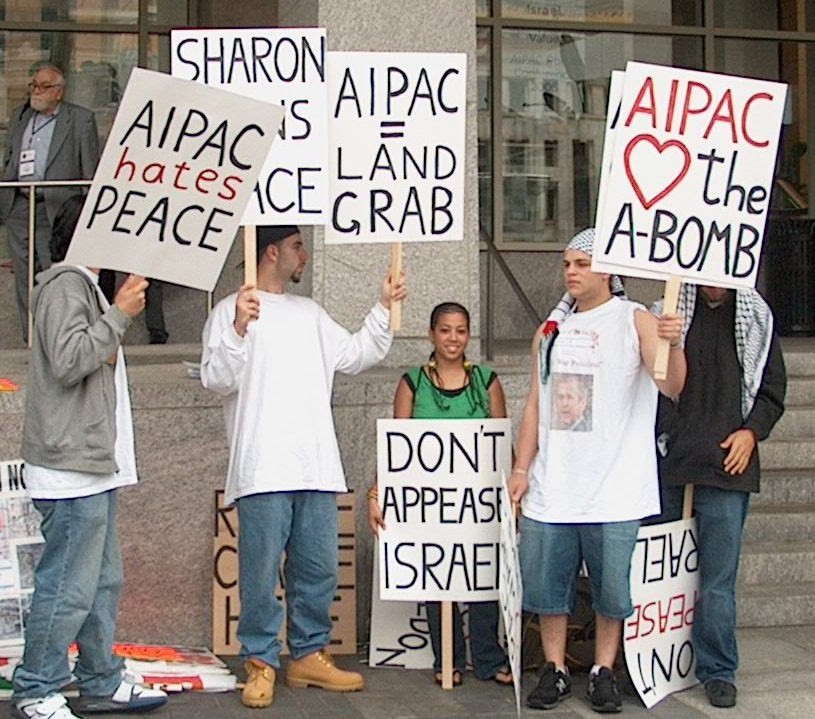
AIPAC has been criticized as being unrepresentative of American Jews who support Israel, and supportive only of right-wing Israeli policy and viewpoints. A PEW center poll found that only 38% of American Jews believe that the Israeli government is sincerely pursuing peace; 44% believe that the construction of new settlements damages Israel's national security.
Among the best-known critical works about AIPAC is The Israel Lobby and U.S. Foreign Policy, by University of Chicago professor John Mearsheimer and Harvard Kennedy School professor Stephen Walt. In the working paper and resulting book, they accuse AIPAC of being "the most powerful and best known" component of a larger pro-Israel lobby that distorts American foreign policy. They write:
[AIPAC's] success is due to its ability to reward legislators and congressional candidates who support its agenda, and to punish those who challenge it. ... AIPAC makes sure that its friends get strong financial support from the many pro-Israel political action committees. Anyone who is seen as hostile to Israel can be sure that AIPAC will direct campaign contributions to his or her political opponents. ... The bottom line is that AIPAC, a de facto agent for a foreign government, has a stranglehold on Congress, with the result that US policy towards Israel is not debated there, even though that policy has important consequences for the entire world.
AIPAC has also been the subject of criticism by prominent politicians including Democrats J. William Fulbright, Dave Obey and Mike Gravel, as well as Republicans John Hostettler and Thomas Massie.
Democratic congressman Jim Moran from Northern Virginia has been a vocal critic of AIPAC, causing national controversy in 2007 and drawing criticism from many Jewish groups after he told California Jewish magazine Tikkun that AIPAC had been "pushing the [Iraq War] from the beginning," and that, "I don't think they represent the mainstream of American Jewish thinking at all, but because they are so well organized, and their members are extraordinarily powerful—most of them are quite wealthy—they have been able to exert power." AIPAC's membership has been described as "overwhelmingly Democratic" by one conservative columnist (Jennifer Rubin).
In 2020, Democratic congresswoman Betty McCollum accused AIPAC of hate speech and said the group is a hate group.
In 2020, Senator Bernie Sanders said AIPAC provides a platform for bigotry and said he will not attend their conference. In 2023 (February 19), on CBS Face the Nation, Sanders said that AIPAC, formerly bipartisan, had evolved towards attempting to "destroy" the American progressive movement.
Alleged complicity with antisemitism
Critics have alleged that AIPAC is antisemitic, complicit in antisemitism, or silent concerning antisemitism coming from Donald Trump and other right-wing politicians. Eva Borgwardt, writing for The Nation, criticized AIPAC for alleged complicity with antisemitism, stating that the organization "has welcomed Trump—and his top donors—with open arms, while refusing to condemn his blatantly antisemitic remarks."
In August 2022, AIPAC tweeted that "George Soros has a long history of backing anti-Israel groups...Now he's giving $1 million to help @jstreetdotorg support anti-Israel candidates and attack pro-Israel Democrats. AIPAC works to strengthen pro-Israel mainstream Democrats. J Street & Soros work to undermine them." In response to the tweet, the left-wing Jewish organization IfNotNow denounced AIPAC for antisemitism, tweeting that "AIPAC is the antisemitic far right...They are not a Jewish org, nor claim to be one."
Controversies
Former Senator William Fulbright, in the 1970s, and former senior CIA official Victor Marchetti, in the 1980s, contended that AIPAC should have registered under the Foreign Agents Registration Act (FARA). FARA requires those who receive funds or act on behalf of a foreign government to register as a foreign agent. However, AIPAC states that the organization is a registered American lobbying group, funded by private donations, and maintains it receives "no financial assistance" from Israel or any other foreign group.{{cite web | access-date =September 9, 2008| archive-url= https://web.archive.org/web/20080917204558/http://aipac.org/about_AIPAC/Learn_About_AIPAC/26.asp| archive-date= September 17, 2008 | url-status= live}}
In 2006, Representative Betty McCollum (DFL) of Minnesota demanded an apology from AIPAC, claiming an AIPAC representative had described her vote against the Palestinian Anti-Terrorism Act of 2006 as "support for terrorists." McCollum stated that AIPAC representatives would not be allowed in her office until she received a written apology for the comment.{{cite magazine | access-date =September 9, 2008}} AIPAC disputed McCollum's claim, and McCollum has since declared the incident over.{{cite news |access-date=September 9, 2008 |archive-url=https://web.archive.org/web/20080610134359/http://www.forward.com/articles/lawmaker-aipac-feud-after-fight-over-hamas-bill/ |archive-date=June 10, 2008 |url-status=live
Steiner resignation
In 1992, AIPAC president David Steiner was forced to resign after he was recorded boasting about his political influence in obtaining aid for Israel. Steiner also claimed that he had "met with (then H.W. Bush U.S. Secretary of State) Jim Baker and I cut a deal with him. I got, besides the $3 billion, you know they're looking for the Jewish votes, and I'll tell him whatever he wants to hear ... Besides the $10 billion in loan guarantees which was a fabulous thing, $3 billion in foreign, in military aid, and I got almost a billion dollars in other goodies that people don't even know about." Steiner also claimed to be "negotiating" with the incoming Clinton administration over who Clinton would appoint as secretary of state and secretary of the National Security Agency. Steiner stated that AIPAC had "a dozen people in [the Clinton] campaign, in the headquarters... in Little Rock, and they're all going to get big jobs."
New York real estate developer Haim Katz told The Washington Times that he taped the conversation because "as someone Jewish, I am concerned when a small group has a disproportionate power. I think that hurts everyone, including Jews. If David Steiner wants to talk about the incredible, disproportionate clout AIPAC has, the public should know about it."
Spying allegations
Main article: Lawrence Franklin espionage scandal, United States v. Franklin
In April 2005, AIPAC policy director Steven Rosen and AIPAC senior Iran analyst Keith Weissman were fired by AIPAC amid an FBI investigation into whether they passed classified U.S. information received from Lawrence Franklin on to the government of Israel. They were later indicted for illegally conspiring to gather and disclose classified national security information to Israel. AIPAC agreed to pay the legal fees for Weissman's defense through appeal if necessary.
In May 2005, the Justice Department announced that Lawrence Anthony Franklin, a U.S. Air Force Reserves colonel working as a Department of Defense analyst at the Pentagon in the office of Douglas Feith, had been arrested and charged by the FBI with providing classified national defense information to Israel. The six-count criminal complaint identified AIPAC by name and described a luncheon meeting in which, allegedly, Franklin disclosed top-secret information to two AIPAC officials.
Franklin pleaded guilty to passing government secrets to Rosen and Weissman and revealed for the first time that he also gave classified information directly to an Israeli government official in Washington. On January 20, 2006, he was sentenced to 151 months (almost 13 years) in prison and fined $10,000. As part of the plea agreement, Franklin agreed to cooperate in the larger federal investigation. All charges against the former AIPAC employees were dropped in 2009.
Support for 2020 election deniers
After the formation of its first political action committee (PAC) in early March 2022, AIPAC was criticized for backing the election campaigns of 37 Republican members of Congress who voted against certifying Biden's 2020 U.S. presidential election victory after the 2021 United States Capitol attack.
The endorsement of the politicians was described as "morally bankrupt and short-sighted" by Richard Haass, president of the Council on Foreign Relations, while Abe Foxman, former head of the Anti-Defamation League, called it a "sad mistake", and Dan Kurtzer, a former U.S. ambassador to Israel, urged AIPAC to reconsider the move.
AIPAC defended the endorsements by stating that it was "no moment for the pro-Israel movement to become selective about its friends".
Financing pro-Israel Democrats in 2022
Having endorsed over 100 Republican members of Congress who had voted against certifying Joe Biden's election, AIPAC spent $24 million, via its political action committee, the United Democracy Project, to defeat candidates not considered pro-Israel enough in the primaries of the Democratic Party that select candidates for the 2022 midterm elections. Substantial contributions to this funding were obtained from Republican Trump campaign financiers such as Paul Singer and Bernie Marcus, together with Haim Saban. It spent $4 million to support Haley Stevens and defeat the Jewish congressman Andy Levin who is known to be critical of AIPAC's support for hardline Israeli policies. It spent $7 million to defeat the favorite in a Maryland July primary, Donna Edwards, who had failed to back resolutions in support of Israel during the 2012 Gaza War. A number of AIPAC supporters assert that reports focusing on AIPAC's campaign funding against candidates critical of Israel's policies are 'antisemitic'.
AIPAC in film
The Israeli documentary film The Kings of Capitol Hill features interviews with former and current AIPAC personalities and depicts how AIPAC has moved toward the political right wing and away from political positions most American Jews hold.
References
References
- "[https://projects.propublica.org/nonprofits/organizations/530217164/202542169349301719/full Form 990: Return of Organization Exempt from Income Tax]". ''American Israel Public Affairs Committee''. [[ProPublica]]. Year ending September 30, 2024.
- Rossinow, Doug. (2018). ""The Edge of the Abyss": The Origins of the Israel Lobby, 1949–1954". Cambridge University Press (CUP).
- [https://projects.propublica.org/nonprofits/organizations/521623781/202412219349301641/full Form 990: Return of Organization Exempt from Income Tax]". ''American Israel Education Foundation''. [[ProPublica]]. Year ending September 30, 2023.
- Bennis, Phyllis. (July 15, 2014). "Why Opposing the Israel Lobby Is No Longer Political Suicide". The Nation.
- Hussain, Murtaza. (November 18, 2023). "Meet the Secret Donors Who Fund AIPAC's Israel Trips for Congress".
- "AIPAC - AIPAC and Israel: Myths and Facts".
- Mearsheimer, John. (March 23, 2006). "The Israel Lobby". London Review of Books.
- Terris, Ben. (March 26, 2015). "Jeremy Ben-Ami, winning a place at the table for J Street". The Washington Post.
- "About AIPAC".
- "About Us".
- (September 1, 2014). "Friends of Israel".
- (March 21, 2016). "Biden Tells AIPAC Two-state Solution the 'Only Way' to Security". VOA News.
- (March 28, 2017). "AIPAC Policy Conference, Senators Harris and Menendez". C-SPAN.
- Kornbluh, Jacob. (2025-04-08). "AIPAC attacks Democrats who voted to stop arms sales to Israel".
- Nelson, Nancy Jo (1980) The Zionist Organizational Structure, Journal of Palestine Studies, 10:1, 80–93, {{doi. 10.2307/2536485. p.84.
- (April 22, 2024). "The pro-Israel groups planning to spend millions in US elections". The Guardian.
- (1997). "Abba Hillel Silver and American Zionism". Frank Cass.
- Tivnan, Edward. (1988). "The Lobby: Jewish political power and American foreign policy". Simon & Schuster.
- (2018). ""The Edge of the Abyss": The Origins of the Israel Lobby, 1949–1954". Modern American History.
- (1995). "Jewish Organizational Life in the United States Since 1945". [[The American Jewish Year Book]].
- Langer, Emily. (February 13, 2023). "Morris Amitay, ardent advocate for Israel, dies at 86". The Washington Post.
- (September 1, 2014). "Friends of Israel".
- United States President]] [[Gerald Ford]] rescinded his '[[Gerald Ford#Middle East
- Lenczowski, George. (1990). "American Presidents and the Middle East". [[Duke University Press]].
- (September 1, 2014). "Friends of Israel".
- Halimi, Serge. (2025-12-01). "Is the United States’ patience with Israel running out?".
- (June 10, 2005). "Guilty plea entered in Pentagon Spy Case". Ynetnews.
- (May 2, 2009). "U.S. to Drop Spy Case Against Pro-Israel Lobbyists". The New York Times.
- (February 11, 2019). "Democratic leaders call Ilhan Omar's Israel tweets 'deeply offensive'". The Washington Post.
- (March 6, 2019). "The controversy over Ilhan Omar and AIPAC money, explained". Vox.
- (March 4, 2019). "Ilhan Omar's Criticism Raises the Question: Is Aipac Too Powerful?". The New York Times.
- (March 7, 2019). "House Votes to Condemn All Hate as Anti-Semitism Debate Overshadows Congress". The New York Times.
- (March 6, 2019). "Ilhan Omar, Aipac and Me". The New York Times.
- Starr, Michael. (August 27, 2024). "AIPAC headquarters vandalized by anti-Israel activists". Jerusalem Post.
- Strack, Haley. (August 7, 2024). "Anti-Israel Radicals Vandalize AIPAC Headquarters in Washington". National Review.
- Al-Sheikh, Y. L.. (2025-10-23). "Democrats Are Getting a Brutal Lesson in How Much the Politics on Israel Have Changed". [[The Nation]].
- Anderson, Brooke. (4 December 2025). "No more fear: 'Track AIPAC' website, a sign of rapidly changing US public positions on Palestine and Israel".
- (August 7, 2024). "Why Pro-Israel PACs are helping oust Democrats in their primaries". NPR News.
- (September 1, 2014). "Friends of Israel".
- (September 1, 2014). "Friends of Israel".
- Rosenberg, M. J.. (February 14, 2019). "This Is How AIPAC Really Works". The Nation.
- ''The Wall Street Journal'', June 24, 1987, p.1
- (2007). "American Policy Toward Israel: The Power and Limits of Beliefs". Routledge.
- Frankel, Glenn. (July 16, 2006). "A Beautiful Friendship?". [[The Washington Post]].
- (September 1, 2014). "Friends of Israel".
- (September 1, 2014). "Friends of Israel".
- Jewish Telegraphic Agency, January 13, 2006
- (September 1, 2014). "Friends of Israel".
- (June 2, 2019). "Jewish Lobby in the United States Handbook: Organization, Operations ...". International Business Publications..
- (September 1, 2014). "Friends of Israel".
- (September 1, 2014). "Friends of Israel".
- [https://jta.org/news/article/2009/03/27/1004048/aipac-head-testifies-on-israel-aid AIPAC head testifies on Israel aid] by Eric Fingerhut, Jewish Telegraphic Agency (JTA), March 27, 2009.
- (September 13, 2002). "Jewish Groups Laud Bush's Words in Clearest Statement Yet on Iraq". Jewish Telegraphic Agency.
- (October 1, 2007). "Moran Down".
- Milbank, Dana. (April 1, 2003). "For Israel Lobby Group, War Is Topic A, Quietly". The Washington Post.
- Goldberg, Jeffrey. (July 4, 2005). "Real Insiders".
- (March 16, 2007). "AIPAC meeting wasn't supposed to be partisan, but". J. The Jewish News of Northern California.
- [http://www.asiaone.com/News/AsiaOne%2BNews/World/Story/A1Story20100310-203620.html US-Israel group demands "crippling" Iran sanctions] March 10, 2010. AFP
- "What We've Accomplished". AIPAC.
- (February 7, 2014). "AIPAC Clarifies Position on Iran Sanctions Bill in Letter to Supporters". algemeiner.com.
- Heiberger, Richard. (2022). "Capturing the Changing Nature of the "Jewish Enterprise"". [[Springer Nature Switzerland AG]].
- (September 1, 2014). "Friends of Israel".
- Shipler, David K.. (July 6, 1987). "On Middle East Policy, A Major Influence". The New York Times.
- (February 3, 2014). "Potent Pro-Israel Group Finds Its Momentum Blunted". The New York Times.
- (November 3, 2009). "House Vote On Passage: H. Res. 867: Calling on the President and the Secretary of State to". GovTrack.
- (September 1, 2014). "Friends of Israel".
- Kurtzman, D. (November 11, 1998). "AIPAC listed 2nd most powerful group on Fortune list".
- "Friends of Israel".
- Sharp, Jeremy M.: "U.S. Foreign Aid to Israel", Introduction, "CRS Report for Congress", Order Code RL33222
- Migdalovitz, Carol: "Israel: Background and Relations with the United States", page 29. "CRS Report for Congress", Order Code RL33476
- Reznik, Ethan. (April 27, 2016). "Special Report: AIPAC Policy Conference strengthens American-Israel alliance". Webb Canyon Chronicle.
- (June 5, 2024). "AIPAC names Elliot Brandt as next CEO amid uncertain future for US-Israel relations". The Times of Israel.
- Sharon, Jeremy. (September 9, 2018). "32. Howard Kohr". The Jerusalem Post.
- "In Memoriam: AIPAC Trailblazer Larry Weinberg". AIPAC.
- (December 22, 1988). "Reported Shake-ups at Aipac Put Lobby Back in the Headlines". Jewish Telegraphic Agency.
- (September 27, 2007). "Mitchell 'lived the American dream'". Alabama.com.
- (November 5, 1992). "Aipac President Quits After Boasting of Influence over Baker and Clinton". Jewish Telegraphic Agency.
- (January 17, 1997). "AIPACs Steve Grossman takes Democratic Party post". jweekly.
- (December 10, 1996). "Court Again Casts Doubt On Status of Israeli Lobby". The New York Times.
- (June 3, 2017). "Lionel (Lonny) Kaplan". Funeral Home Orlands Memorial Chapel Ewing New Jersey.
- (March 23, 2001). "Arafat, intifada giving AIPAC new direction". jweekly.
- (March 1, 2012). "An Interview with Amy Friedkin". The iCenter.
- (March 20, 2016). "AIPAC To Appoint First Woman President in Over a Decade". The Forward.
- "Howard E. Friedman Director Biography".
- Kampeas, Ron. (March 25, 2019). "AIPAC names 'female football fan' entrepreneur next president of lobby". [[The Times of Israel.
- (March 4, 2020). "Question of bipartisanship dominated AIPAC Policy Conference".
- (May 24, 2005). "AIPAC's Big, Bigger, Biggest Moment". The Washington Post.
- (September 1, 2014). "Friends of Israel".
- (January 26, 2007). "The hidden cost of free congressional trips to Israel".
- (March 1, 2013). "AIEF Israel Seminar: Motley Rice member travels with other leaders interested in U.S.-Israel relations".
- "American Israel Education Foundation". Charles and Lynn Schusterman Family Foundation.
- (September 9, 2011). "Members Flock to Israel With Travel Loophole". Roll Call.
- Traiman, Alex. (August 11, 2019). "72 representatives don't #skipthetrip, join largest-ever delegation to Israel".
- (August 8, 2011). "81 Congressmen to Visit Israel in Coming Weeks". The Jerusalem Post.
- (August 15, 2011). "A Recess Destination With Bipartisan Support: Israel and the West Bank". The New York Times.
- "Hill Staff". AIPAC.
- (January 26, 2007). "The hidden cost of free congressional trips to Israel".
- Bowden, John. (August 14, 2019). "Activist group files ethics complaint against AIPAC over congressional Israel trips".
- Goldsberry, Jenny. (2025-08-10). "Matt Gaetz claims he found AIPAC ‘dude’ in hotel room on congressional trip to Israel".
- "American Israel Public Affairs Committee Political Action Committee". Federal Election Commission.
- Kampeas, Ron. (December 16, 2021). "After 70 years on the sidelines, AIPAC will now officially fundraise for politicians". [[The Times of Israel]].
- Nahmias, Omri. (December 21, 2021). "What's behind the AIPAC strategy shift?". [[The Jerusalem Post]].
- Shapiro, Dimitriy. (December 19, 2021). "AIPAC joins political finance arena with launch of 2 PACs". [[Israel Hayom]].
- Samuels, Ben. (January 10, 2022). "Former AIPAC Officials Warn Against Organization's New Political Moves". Haaretz.
- "America's Pro-Israel PAC, First Wave of Candidates, March 2022".
- (March 3, 2022). "AIPAC PAC release first slate of endorsements". Jewish News Syndicate.
- Samuels, Ben. (March 6, 2022). "AIPAC's Endorsement List: Dozens of Republicans Who Deny Biden's Election Win". [[Haaretz]].
- Samuels, Ben. (March 8, 2022). "'Truly Horrifying': AIPAC Criticized for Endorsing GOP 'Election Deniers'". Haaretz.
- McGreal, Chris. (May 17, 2022). "Pro-Israel lobbying group Aipac secretly pouring millions into defeating progressive Democrats". [[The Guardian]].
- "Progressive Champion Nina Turner Falls to Establishment Incumbent Shontel Brown".
- (April 27, 2022). "Pro-Israel groups wade into Dem primary fights". Axios.
- "Jamaal Bowman finds himself in the crosshairs of a Black voter group". POLITICO.
- (August 5, 2024). "Pro-Israel interests pour millions into defeating a second 'Squad' member". Washington Post.
- (June 4, 2024). "WBPC responds to NBEAF: 'You can't speak for Black people in CD 16 when you have done No Work for Black people in CD16". [[Black Westchester]].
- Herman, Alice. (March 11, 2024). "Progressive campaign launched to counter Aipac's influence in US politics". The Guardian.
- Dayen, David. (March 11, 2024). "Progressive Groups Form Counterweight to AIPAC's Electoral Push".
- Harb, Ali. "'Reject AIPAC': US progressives join forces against pro-Israel lobby group".
- "Groups Form 'Reject AIPAC' Coalition to Fight Israel Lobby's Attacks on Progressives".
- (September 1, 2014). "Friends of Israel".
- Greenwald, Glenn. (December 12, 2007). "New poll reveals how unrepresentative neocon Jewish groups are".
- (October 1, 2013). "A PORTRAIT OF JEWISH AMERICANS Chapter 5: Connection With and Attitudes Toward Israel". Pew.
- (September 1, 2014). "Friends of Israel".
- Ori Nir, [http://www.forward.com/articles/4064/ Leaders Fear Probe Will Force Pro-Israel Lobby To File as ‘Foreign Agent’] {{Webarchive. link. (January 27, 2012 , ''[[The Forward]]'', December 31, 2004.)
- Edsall, Thomas B.. (September 5, 2004). "Pro-Israel Lobby Has Strong Voice". The Washington Post.
- "Gravel Discusses Campaign Funding, Relations with Iran".
- Marans, Daniel. (May 6, 2024). "Why Pro-Israel Groups Are Targeting An Indiana Republican". Huffington Post.
- Magid, Jacob. (September 28, 2021). "GOP Rep. lashes AIPAC for 'foreign interference' after Iron Dome vote attack ad". Times of Israel.
- Hearn, Josephine. (September 19, 2007). "Dems slam Moran's tying AIPAC to Iraq war". Politico.
- Gardner, Amy. (September 15, 2007). "Moran Upsets Jewish Groups Again". The Washington Post.
- (June 15, 2011). "AIPAC weighs in: All is not well with the U.S. approach to Israel". The Washington Post.
- (February 12, 2020). "McCollum Statement: Hate Speech Makes AIPAC a Hate Group".
- Siddiqui, Usaid. (February 24, 2020). "Sanders accuses pro-Israel group of giving platform to 'bigotry'".
- [[Bernie Sanders. Sanders, Bernie]], interviewed by [[Margaret Brennan]], February 19, 2023, ''[[Face the Nation]],'' [[Columbia Broadcasting System. CBS]], retrieved February 19, 2023
- (October 25, 2022). "AIPAC, GOP silent on Trump warning US Jews to 'get their act together' on Israel". [[The Times of Israel]].
- Borgwardt, Eva. (November 1, 2024). "Let's Call the ADL What It Is: an Ally of Fascists".
- Tamkin, Emily. (August 29, 2022). "AIPAC accused George Soros of undermining American politics. Is that antisemitic?". [[The Forward]].
- Starr, Michael. (August 26, 2022). "In ridiculous claim, left-wing Jewish group calls AIPAC 'antisemitic'". [[The Jerusalem Post]].
- Ori Nir, [http://www.forward.com/articles/4064/ Leaders Fear Probe Will Force Pro-Israel Lobby To File as ‘Foreign Agent’], [[The Jewish Daily Forward]], December 31, 2004.
- (November 24, 2009). "The Complete Unexpurgated AIPAC Tape". [[WRMEA]].
- [http://www.washington-report.org/backissues/1292/9212069b.html AIPAC President Resigns], Sheldon L. Richman, December/January 1992/93, Page 69.
- [https://www.washingtonpost.com/wp-dyn/articles/A6059-2005Apr20.html "2 Senior AIPAC Employees Ousted"], ''[[The Washington Post]]'', April 21, 2005
- Ticker, Bruce. [http://www.pjvoice.com/v3/004aipac.html AIPAC Charges Offer Opportunity], ''[[Philadelphia Jewish Voice]]'', September 2005. Accessed March 27, 2006.
- "U.S. to drop Israel lobbyist spy case..".
- link. (April 15, 2007 , ''[[The American Prospect]]'', November 2, 2004. Accessed March 27, 2006.)
- [https://fas.org/sgp/jud/aipac/franklin_facts.pdf "United States District Court for the Eastern District of Virginia, Alexandria Division, ''U.S. v. Lawrence Anthony Franklin''{{-"],
- (May 2009). "U.S. to drop Israel lobbyist spy case".
- McGreal, Chris. (March 23, 2022). "'Morally bankrupt': outrage after pro-Israel group backs insurrectionist Republicans". [[The Guardian]].
- Kampeas, Ron. (March 19, 2022). "AIPAC defends its endorsees, including those who questioned Biden's election". [[The Jerusalem Post]].
- Magid, Jacob. (March 18, 2022). "AIPAC defends endorsement of Republicans who questioned 2020 election". [[The Times of Israel]].
- Soifer, Halie. (March 13, 2022). "AIPAC's Latest 'pro-Israel' Political Stunt Endangers America". [[Haaretz]].
- McGreal, Chris. (August 4, 2022). "Pro-Israel groups denounced after pouring funds into primary race". [[The Guardian]].
- McGreal, Chris. (July 19, 2022). "Pro-Israel hardliners spend millions to transform Democratic primaries". [[The Guardian]].
- (September 7, 2020). "New Israeli film projects AIPAC's steady drift from idealistic bipartisan roots". [[The Times of Israel]].
This article was imported from Wikipedia and is available under the Creative Commons Attribution-ShareAlike 4.0 License. Content has been adapted to SurfDoc format. Original contributors can be found on the article history page.
Ask Mako anything about AIPAC — get instant answers, deeper analysis, and related topics.
Research with MakoFree with your Surf account
Create a free account to save articles, ask Mako questions, and organize your research.
Sign up freeThis content may have been generated or modified by AI. CloudSurf Software LLC is not responsible for the accuracy, completeness, or reliability of AI-generated content. Always verify important information from primary sources.
Report