From Surf Wiki (app.surf) — the open knowledge base
Aikido
Modern Japanese martial art
Modern Japanese martial art
| Field | Value |
|---|---|
| logosize | 40px |
| image | Shihonage.jpg |
| imagecaption | A version of the "four-direction throw" (ja) with standing attacker (ja) and seated defender (ja) |
| imagesize | 300px |
| imagealt | A man kneeling throws another man from a standing position; both are wearing robes |
| name | Aikido |
| focus | Grappling and softness |
| hardness | Full contact |
| country | Japan |
| creator | Morihei Ueshiba |
| famous pract | Kisshomaru Ueshiba, Moriteru Ueshiba, Koichi Tohei, Christian Tissier, Morihiro Saito, Akira Tohei, Yoshimitsu Yamada, Mitsunari Kanai, Gozo Shioda, Mitsugi Saotome, Steven Seagal, Takashi Kushida, Kyoichi Inoue, Robert Mustard, Fumio Toyoda |
| ancestor arts | Daitō-ryū Aiki-jūjutsu |
| descendant arts | Jieitaikakutojutsu |
Aikido (Shinjitai: 合気道, Kyūjitai: 合氣道, ja, ) is a modern Japanese martial art which is split into many different styles including Aikikai, Shodokan Aikido, Yoshinkan, Renshinkai, Iwama Ryu, Iwama Shin Shin Aiki Shuren Kai, and Ki Aikido. Aikido is now practiced in around 140 countries.
It was originally developed by Morihei Ueshiba, as a synthesis of his martial studies, philosophy and religious beliefs. Ueshiba's goal was to create an art which practitioners could use to defend themselves against attacks, while also protecting the attackers from injury. Aikido is often translated as "the way of unifying (with) life energy"{{cite book
Aikido's fundamental principles include: ja (entering), ja (strikes), ja (breathing control), ja (triangular principle), and ja (turning) movements which redirect the opponent's attack momentum. Its curriculum comprises various techniques, primarily throws and joint locks.{{cite encyclopedia |archive-url=https://web.archive.org/web/20061206050153/http://www.aikidojournal.com/encyclopedia.php?entryID=18 |archive-date=6 December 2006 |archive-url=https://web.archive.org/web/20140826192614/http://www.aikidojournal.com/encyclopedia?entryID=31 |archive-date=26 August 2014
Ueshiba's senior students have different approaches to aikido, depending partly on when they studied with him. Today, aikido is found all over the world in a number of styles, with broad ranges of interpretation and emphasis. However they all share techniques formulated by Ueshiba and most have concern for the well-being of the attacker.
Etymology and basic philosophy

The word "aikido" is formed of three kanji:
- 合 – ja – harmony, unifying
- 気 – ja – energy, spirit
- 道 – ja – way, path
The term ja does not readily appear in the Japanese language outside the scope of budō. This has led to many possible interpretations of the word. 合 (ja) is mainly used in compounds to mean 'combine, unite, join, meet', examples being 合同 (combined/united), 合成 (composition), 結合 (unite/combine/join), 連合 (union/alliance/association), 統合 (combine/unify), and 合意 (mutual agreement). There is an idea of reciprocity, 知り合う (to get to know one another), 話し合い (talk/discussion/negotiation), and 待ち合わせる (meet by appointment).
気 (ja) is often used to describe a feeling or emotive action, as in X気がする ('I feel X', as in terms of thinking but with less cognitive reasoning), and 気持ち (feeling/sensation); it is used to mean energy or force, as in 電気 (electricity) and 磁気 (magnetism); it can also refer to qualities or aspects of people or things, as in 気質 (spirit/trait/temperament).
The term ja in Aikido is found in many other Japanese martial arts such as, judo and kendo, and in various non-martial arts, such as Japanese calligraphy (ja), flower arranging (ja) and tea ceremony (ja or ja). Therefore, from a purely literal interpretation, aikido is the "Way of combining forces" or "Way of unifying energy", in which the term ja refers to the martial arts principle or tactic of blending with an attacker's movements for the purpose of controlling their actions with minimal effort.{{cite encyclopedia |access-date = 21 August 2007 |archive-url = https://web.archive.org/web/20070926225755/http://www.aikidojournal.com/encyclopedia?entryID=10 |archive-date = 26 September 2007
History
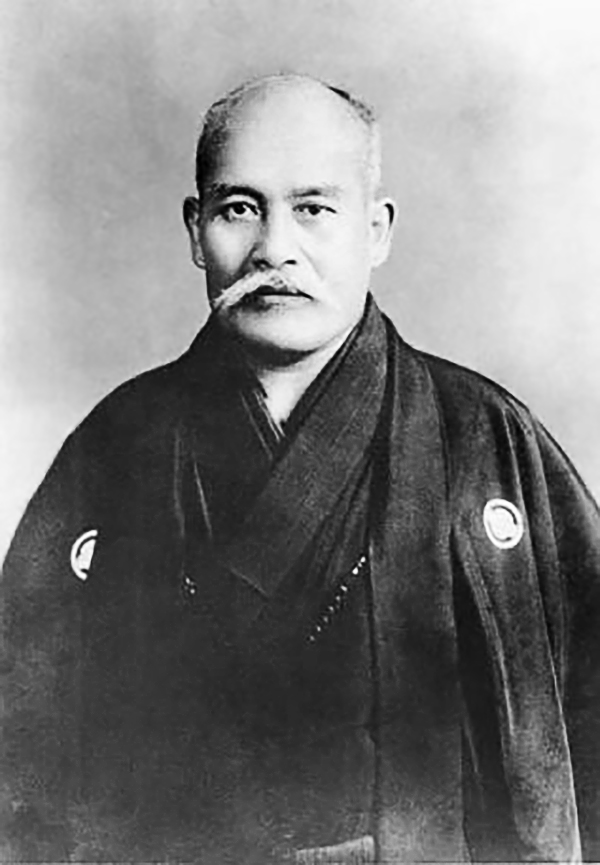
Aikido was created by Morihei Ueshiba (1883–1969), referred to by some aikido practitioners as ja (Great Teacher).{{cite encyclopedia |archive-url=https://web.archive.org/web/20140826175452/http://www.aikidojournal.com/encyclopedia?entryID=533 |archive-date=26 August 2014
Initial development
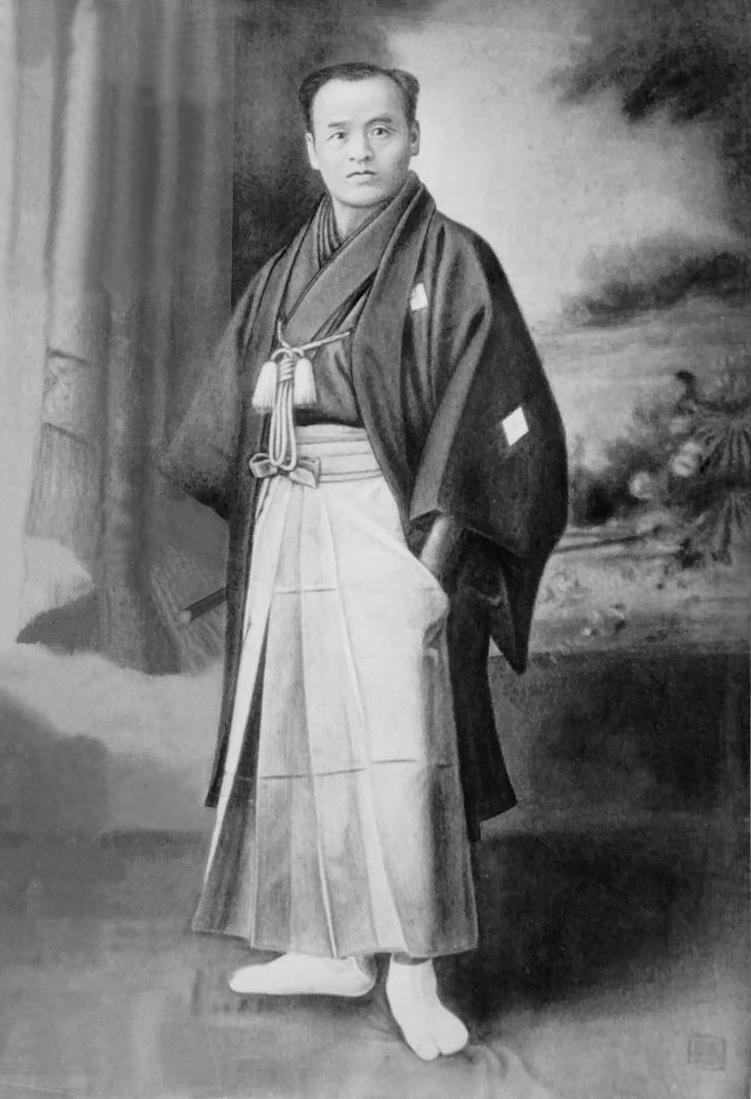
Ueshiba developed aikido primarily during the late 1920s through the 1930s through the synthesis of the older martial arts that he had studied.{{cite book | author-link = John Stevens (scholar) |archive-url=https://web.archive.org/web/20140330055654/http://www.aikidojournal.com/encyclopedia.php?entryID=723 |archive-date=30 March 2014
The art of ja is the primary technical influence on aikido. Along with empty-handed throwing and joint-locking techniques, Ueshiba incorporated training movements with weapons, such as those for the spear (ja), short staff (ja), and possibly the bayonet. Aikido also derives much of its technical structure from the art of swordsmanship (ja).{{cite book
Religious influences

After Ueshiba left Hokkaido in 1919, he met and was profoundly influenced by Onisaburo Deguchi, the spiritual leader of the Ōmoto-kyō religion (a neo-Shinto movement) in Ayabe.{{cite encyclopedia |archive-url=https://web.archive.org/web/20071017200533/http://www.aikidojournal.com/article.php?articleID=73 |archive-date=17 October 2007 | access-date = 14 August 2007 | archive-url= https://web.archive.org/web/20070813025607/http://www.oomoto.or.jp/English/enDokt/dokt-en.html | archive-date= 13 August 2007 | url-status= live}} In addition to the effect on his spiritual growth, the connection with Deguchi gave Ueshiba entry to elite political and military circles as a martial artist. As a result of the exposure, he was able to attract not only financial backing but also gifted students. Several of the students went on to begin their own styles of aikido.{{cite journal |archive-url=https://web.archive.org/web/20070926225638/http://www.aikidojournal.com/article.php?articleID=626 |archive-date=26 September 2007
International dissemination
Aikido was first introduced to the rest of the world in 1951 by Minoru Mochizuki with a visit to France, where he demonstrated aikido techniques to judo students.{{cite encyclopedia |archive-url=https://web.archive.org/web/20140826182832/http://www.aikidojournal.com/encyclopedia.php?entryID=474 |archive-date=26 August 2014
Proliferation of independent organizations
The largest aikido organization is the Aikikai Foundation, which remains under the control of the Ueshiba family. However, aikido has developed into many styles, most of which were formed by Morihei Ueshiba's major students. The earliest independent styles to emerge were Yoseikan Aikido, begun by Minoru Mochizuki in 1931, Yoshinkan Aikido, founded by Gozo Shioda in 1955,{{cite encyclopedia |archive-url=https://web.archive.org/web/20070926225749/http://www.aikidojournal.com/encyclopedia.php?entryID=785 |archive-date=26 September 2007 | author-link = Fumiaki Shishida |author-link2= Tetsuro Nariyama
After Ueshiba's death in 1969, two more major styles emerged. Significant controversy arose with the departure of the Aikikai Hombu Dojo's chief instructor Koichi Tohei, in 1974. Tohei left as a result of a disagreement with the son of the founder, Kisshomaru Ueshiba, who at that time headed the Aikikai Foundation. The disagreement was over the proper role of ja development in regular aikido training. After Tohei left, he formed his own style, called Shin Shin Toitsu Aikido, and the organization that governs it, the Ki Society (ja).{{cite encyclopedia |archive-url=https://web.archive.org/web/20070807104204/http://www.aikidojournal.com/encyclopedia.php?entryID=701 |archive-date=7 August 2007
Today, the major styles of aikido are each run by a separate governing organization, have their own headquarters in Japan, and are taught throughout the world.
{{transliteration|ja|Ki}}

The study of ja is an important component of aikido. The term does not specifically refer to either physical or mental training, as it encompasses both. The kanji for ja was written in its older form as 氣 up until the Japanese governmental writing reforms after World War II, and now is more prevalently seen in its modern form of 気. This form has the removal of the eight directions denoting the pre and post natal energies of (Chinese – zh) also known in the Art of Aikido as "Source energy".
The character for ja is used in everyday Japanese terms, such as "health", or "shyness". ja has many meanings, including "ambience", "mind", "mood", or "intention and action", although its literal meaning is 'air' or 'breath'. However, in traditional martial arts and medicine it is often referred to in its more general terminology as "life energy". Gozo Shioda's Yoshinkan Aikido, considered one of the "hard styles", largely follows Ueshiba's teachings from before World War II, and surmises that the secret to ja lies in timing and the application of the whole body's strength to a single point. In later years, Ueshiba's application of ja in aikido took on a softer, more gentle feel. The concept was known as Takemusu Aiki, and many of his later students teach about ja from this perspective. Koichi Tohei's Ki Society centers almost exclusively around the study of the empirical (albeit subjective) experience of ja, with students' proficiency in aikido techniques and ja development ranked separately.
Training

In aikido, as in virtually all Japanese martial arts, there are both physical and mental aspects of training. The physical training in aikido is diverse, covering both general physical fitness and conditioning, as well as specific techniques.{{cite book
In some dojo, Uchi-deshi programs permit students to live in the dojo and immerse themselves in practice several times each day.
Fitness
Physical training goals pursued in conjunction with aikido include controlled relaxation, correct movement of joints such as hips and shoulders, flexibility, and endurance, with less emphasis on strength training. In aikido, pushing or extending movements are much more common than pulling or contracting movements. This distinction can be applied to general fitness goals for the aikido practitioner. In aikido, specific muscles or muscle groups are not isolated and worked to improve tone, mass, or power. Aikido-related training emphasizes the use of coordinated whole-body movement and balance similar to yoga or pilates. For example, many dōjōs begin each class with warm-up exercises, which may include stretching and ja (break falls).
Roles of {{transliteration|ja|uke}} and {{transliteration|ja|tori}}
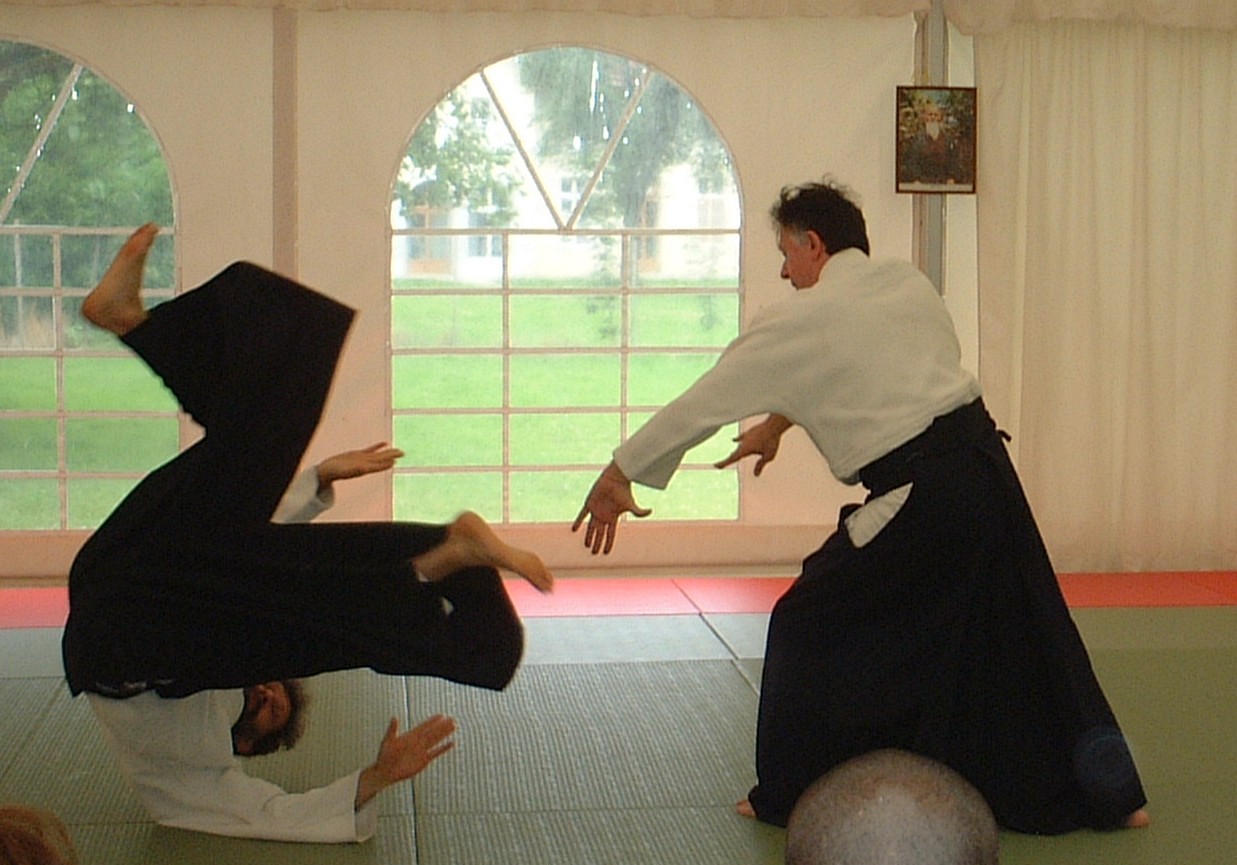
Aikido training is based primarily on two partners practicing pre-arranged forms (ja) rather than freestyle practice. The basic pattern is for the receiver of the technique (ja) to initiate an attack against the person who applies the technique—the , or (depending on aikido style), also referred to as (when applying a throwing technique), who neutralises this attack with an aikido technique.
Both halves of the technique, that of ja and that of ja, are considered essential to aikido training. Both are studying aikido principles of blending and adaptation. ja learns to blend with and control attacking energy, while ja learns to become calm and flexible in the disadvantageous, off-balance positions in which ja places them. This "receiving" of the technique is called ja.{{cite book
Initial attacks
Aikido techniques are usually a defense against an attack, so students must learn to deliver various types of attacks to be able to practice aikido with a partner. Although attacks are not studied as thoroughly as in striking-based arts, attacks with intent (such as a strong strike or an immobilizing grab) are needed to study correct and effective application of technique. Many of the strikes of aikido resemble cuts from a sword or other grasped object, which indicate its origins in techniques intended for armed combat. Other techniques which explicitly appear to be punches (ja), are practiced as thrusts with a knife or sword. Kicks are generally reserved for upper-level variations; reasons cited include that falls from kicks are especially dangerous, and that kicks (high kicks in particular) were uncommon during the types of combat prevalent in feudal Japan.
Some basic strikes include:
- Front-of-the-head strike is a vertical knifehand strike to the head. In training, this is usually directed at the forehead or the crown for safety, but more dangerous versions of this attack target the bridge of the nose and the maxillary sinus.
- Side-of-the-head strike is a diagonal knifehand strike to the side of the head or neck.
- Chest thrust is a punch to the torso. Specific targets include the chest, abdomen, and solar plexus, sometimes referred to as "middle-level thrust", or "direct thrust".
- Face thrust is a punch to the face, sometimes referred to as "upper-level thrust".
Beginners in particular often practice techniques from grabs, both because they are safer and because it is easier to feel the energy and the direction of the movement of force of a hold than it is for a strike. Some grabs are historically derived from being held while trying to draw a weapon, whereupon a technique could then be used to free oneself and immobilize or strike the attacker while they are grabbing the defender. Here are examples of some basic grabs:
- Single-hand grab, when one hand grabs one wrist.
- Both-hands grab, when both hands grab one wrist; sometimes referred to as "single hand double-handed grab"
- Both-hands grab, when both hands grab both wrists; sometimes referred to as "double single-handed grab".
- Shoulder grab when one shoulder is grabbed.
- Both-shoulders-grab, when both shoulders are grabbed. It is sometimes combined with an overhead strike as shoulder grab face strike.
- Chest grab, when the lapel is grabbed; sometimes referred to as "collar grab".
Basic techniques
Main article: Aikido techniques

Here is a sample of the basic or widely practiced throws and pins. Many of the techniques derive from Daitō-ryū Aiki-jūjutsu, but some others were invented by Morihei Ueshiba. The precise terminology for some may vary between organisations and styles; the terms presented are the terms used by the Aikikai Foundation. Although the names of the first five techniques listed are in succession, they are not universally taught in numeric order.{{cite book
- First technique, a control technique using one hand on the elbow and one hand near the wrist which leverages ja to the ground.{{cite encyclopedia |archive-url=https://web.archive.org/web/20140826181246/http://www.aikidojournal.com/encyclopedia?entryID=289 |archive-date=26 August 2014
- Second technique is a pronating wristlock that torques the arm and applies painful nerve pressure. (There is an adductive wristlock or Z-lock in the ja version.)
- Third technique is a rotational wristlock that directs upward-spiraling tension throughout the arm, elbow and shoulder.
- Fourth technique is a shoulder control technique similar to ja, but with both hands gripping the forearm. The knuckles (from the palm side) are applied to the recipient's radial nerve against the periosteum of the forearm bone.{{cite encyclopedia |archive-url=https://web.archive.org/web/20080122182812/http://www.aikidojournal.com/encyclopedia?entryID=780 |archive-date=22 January 2008
- Fifth technique is a technique that is visually similar to ja, but with an inverted grip of the wrist, medial rotation of the arm and shoulder, and downward pressure on the elbow. Common in knife and other weapon take-aways.
- Four-direction throw is a throw during which ja's hand is folded back past the shoulder, locking the shoulder joint.
- Forearm return is a supinating wristlock-throw that stretches the extensor digitorum.
- Breath throw is a loosely used umbrella term for various types of mechanically unrelated techniques; ja generally do not use joint locks like other techniques.{{cite encyclopedia |archive-url=https://web.archive.org/web/20080122182746/http://www.aikidojournal.com/encyclopedia?entryID=419 |archive-date=22 January 2008
- Entering throw, throws in which ja moves through the space occupied by ja. The classic form superficially resembles a "clothesline" technique.
- Heaven-and-earth throw, a throw in which, beginning with ja, moving forward, ja sweeps one hand low ("earth") and the other high ("heaven"), which unbalances ja so that they easily topple over.
- Hip throw, aikido's version of the hip throw; ja drops their hips lower than those of ja, then flips ja over the resultant fulcrum.
- Figure-ten throw, a throw that locks the arms against each other (the kanji for "10" is a cross-shape: 十).{{cite encyclopedia |archive-url=https://web.archive.org/web/20080122182726/http://www.aikidojournal.com/encyclopedia?entryID=337 |archive-date=22 January 2008
- Rotary throw is a throw in which ja sweeps ja's arm back until it locks the shoulder joint, then uses forward pressure to throw them.
Implementations

Aikido makes use of body movement (ja or 体捌き) to blend the movement of ja with the movement of ja. For example, an "entering" (ja) technique consists of movements inward towards ja, while a "turning" technique uses a pivoting motion.{{cite journal |archive-url=https://web.archive.org/web/20071017193616/http://www.aikidojournal.com/article.php?articleID=686 |archive-date=17 October 2007 Additionally, an "inside" technique takes place in front of ja, whereas an "outside" technique takes place to their side; a "front" technique is applied with motion to the front of ja, and a "rear" version is applied with motion towards the rear of ja, usually by incorporating a turning or pivoting motion. Finally, most techniques can be performed while in a seated posture (ja). Techniques where both uke and ja are standing are called ja, techniques where both start off in ja are called ja, and techniques performed with ja standing and ja sitting are called ja (半身半立). From these few basic techniques, there are numerous of possible implementations. For example, ja can be applied to an opponent moving forward with a strike (perhaps with an ja type of movement to redirect the incoming force), or to an opponent who has already struck and is now moving back to reestablish distance (perhaps an ja version). Specific aikido ja are typically referred to with the formula "attack-technique(-modifier)"; ja, for example, refers to any ja technique executed when ja is holding one wrist. This could be further specified as ja (referring to any forward-moving ja technique from that grab).
are strikes (or feints) employed during an aikido technique. Some view ja as attacks against "vital points" meant to cause damage in and of themselves. For instance, Gozo Shioda described using ja in a brawl to quickly down a gang's leader.{{cite book | author-link = Gozo Shioda | author-link = Gozo Shioda |access-date = 1 February 2007 |archive-url = https://web.archive.org/web/20061231203238/http://www.tsuki-kage.com/ueshiba.html |archive-date = 31 December 2006
Weapons

Weapons training in aikido traditionally includes the short staff (ja) (these techniques closely resemble the use of the bayonet, or Jūkendō), the wooden sword (ja), and the knife (ja).{{cite book| last = Dang
Multiple attackers and {{transliteration|ja|randori}}
One feature of aikido is training to defend against multiple attackers, often called ja, or ja. Freestyle practice with multiple attackers called is a key part of most curricula and is required for the higher-level ranks.{{cite book
In Shodokan Aikido, ja differs in that it is not performed with multiple persons with defined roles of defender and attacker, but between two people, where both participants attack, defend, and counter at will. In this respect it resembles judo ja.
Injuries
In applying a technique during training, it is the responsibility of ja to prevent injury to ja by employing a speed and force of application that is appropriate with their partner's proficiency in ja. When injuries (especially to the joints) occur, they are often the result of a ja misjudging the ability of ja to receive the throw or pin.{{cite encyclopedia |archive-url=https://web.archive.org/web/20080122182653/http://www.aikidojournal.com/article?articleID=7&highlight=injuries |archive-date=22 January 2008
Mental training
Aikido training is mental as well as physical, emphasizing the ability to relax the mind and body even under the stress of dangerous situations.{{cite book
Uniforms and ranking
| rank | belt | color | type | |
|---|---|---|---|---|
| ja | [[File:Judo white belt.svg | 65px]] | white | ja/ja |
| ja | [[File:Judo black belt.svg | 65px]] | black | ja |
Aikido practitioners (commonly called ja outside Japan) generally progress by promotion through a series of "grades" (ja), followed by a series of "degrees" (ja), pursuant to formal testing procedures. Some aikido organizations use belts to distinguish practitioners' grades, often simply white and black belts to distinguish ja and ja grades, although some use various belt colors. Testing requirements vary, so a particular rank in one organization is not comparable or interchangeable with the rank of another. Some dōjōs have an age requirement before students can take the ja rank exam.
The uniform worn for practicing aikido (ja) is similar to the training uniform (ja) used in most other modern martial arts; simple trousers and a wraparound jacket, usually white. Both thick ("judo-style"), and thin ("karate-style") cotton tops are used. Aikido-specific tops are available with shorter sleeves which reach to just below the elbow.
Most aikido systems add a pair of wide pleated black or indigo trousers known as ja (used also in Naginatajutsu, kendo, and iaido). In many schools, the wearing of ja is reserved for practitioners with ja ranks or for instructors, while others allow all practitioners to wear a ja regardless of rank.
Aikido styles
Aikido styles vary in their intention, due to its holistic nature. The most common differences noted in aikido, when observed externally, relate to the intensity and realism of training. Stanley Pranin has observed that some criticism may stem from weak attacks from ja, allowing for a conditioned response from ja, resulting in underdevelopment of the skills needed for the safe and effective practice of both partners.
To counteract that some styles allow students to become less compliant over time, however in keeping with the core philosophies, that is after having demonstrated proficiency in being able to protect themselves and their training partners. Shodokan Aikido addresses the issue by practicing in a competitive format. Such adaptations are debated between styles, with some maintaining that there is no need to adjust their methods because either the criticisms are unjustified, or that they are not training for self-defense or combat effectiveness, but spiritual, fitness or other reasons. Reasons for the difference and diversity of teachings, intention, and forms of aikido can be traced to the shift in training focus after the end of Ueshiba's seclusion in Iwama from 1942 to the mid-1950s, as he increasingly emphasized the spiritual and philosophical aspects of aikido. As a result, strikes to vital points by ja, entering (ja) and initiation of techniques by ja, the distinction between ja (front side) and ja (back side) techniques, and the use of weapons, were all de-emphasized or eliminated from practice.
Conversely, some styles of aikido place less importance on the spiritual practices which were emphasized by Ueshiba. According to Minoru Shibata of Aikido Journal:
O-Sensei's aikido was not a continuation and extension of the old and has a distinct discontinuity with past martial and philosophical concepts.
In other words, aikido practitioners who focus on aikido's roots in traditional ja or ja are said to be diverging from what Ueshiba taught, as some critics urge practitioners:
[Ueshiba's] transcendence to the spiritual and universal reality were the fundamentals of the paradigm that he demonstrated.
References
References
- "About Aikido".
- Sharif, Suliaman. (2009). "50 Martial Arts Myths". New Media Entertainment.
- Ueshiba, Kisshōmaru. (2004). "The Art of Aikido: Principles and Essential Techniques". Kodansha International.
- David Jones. (2015). "Martial Arts Training in Japan: A Guide for Westerners". Tuttle Publishing.
- Michael A. Gordon. (2019). "Aikido as Transformative and Embodied Pedagogy: Teacher as Healer". Springer.
- Ueshiba, Morihei. (2013). "Budo: Teachings Of The Founder Of Aikido". Kodansha America.
- Tamura, Nobuyoshi. (1991). "Aikido – Etiquette et transmission. Manuel a l'usage des professeurs.". Editions du Soleil Levant.
- Abe, Tadashi. (1958). "L'aiki-do – Methode unique creee par le maitre Morihei Ueshiba – L'arme et l'esprit du samourai japonais.". Editions Chiron.
- Draeger, Donn F.. (1974). "Modern Bujutsu & Budo – The Martial Arts and Ways of Japan". Weatherhill.
- Robert W. Smith. "Journal of Non-lethal Combat: Judo in the US Air Force, 1953". ejmas.com.
- (June 29, 2022). "The Truth About Steven Seagal's Aikido".
- (January 1995). "The Encyclopedia of Martial Arts Movies". [[Scarecrow Press]], 1995.
- Reed, William. (1997). "A Test Worth More than a Thousand Words".
- Pranin, Stanley. (2006). "Jumbi Taiso".
- Pranin, Stanley. (2008). "Kaitennage".
- (2010). "Aikido Randori: Tetsuro Nariyama". Shodokan.
- "Aikido and Injuries: Special Report".
- Heckler, Richard. (1985). "Aikido and the New Warrior". North Atlantic Books.
- Federação Portuguesa de Aikido. (1 April 2007). "Rules for Dan Ranks".
- (9 December 2016). "How to Choose your Aikidogi – Size & Model". Seido Shop.
- Pranin, Stanley. (Fall 1990). "Aikido Practice Today". Aiki News.
- Wagstaffe, Tony. (30 March 2007). "In response to the articles by Stanley Pranin – Martial arts in a state of decline? An end to the collusion?". Aikido Journal.
- (2017-05-06). "The Ueshiba Legacy – Part 2, by Mark Murray".
- Shibata, Minoru J.. (2007). "A Dilemma Deferred: An Identity Denied and Dismissed". Aikido Journal.
This article was imported from Wikipedia and is available under the Creative Commons Attribution-ShareAlike 4.0 License. Content has been adapted to SurfDoc format. Original contributors can be found on the article history page.
Ask Mako anything about Aikido — get instant answers, deeper analysis, and related topics.
Research with MakoFree with your Surf account
Create a free account to save articles, ask Mako questions, and organize your research.
Sign up freeThis content may have been generated or modified by AI. CloudSurf Software LLC is not responsible for the accuracy, completeness, or reliability of AI-generated content. Always verify important information from primary sources.
Report