From Surf Wiki (app.surf) — the open knowledge base
Agia Pelagia
Seaside resort in Crete
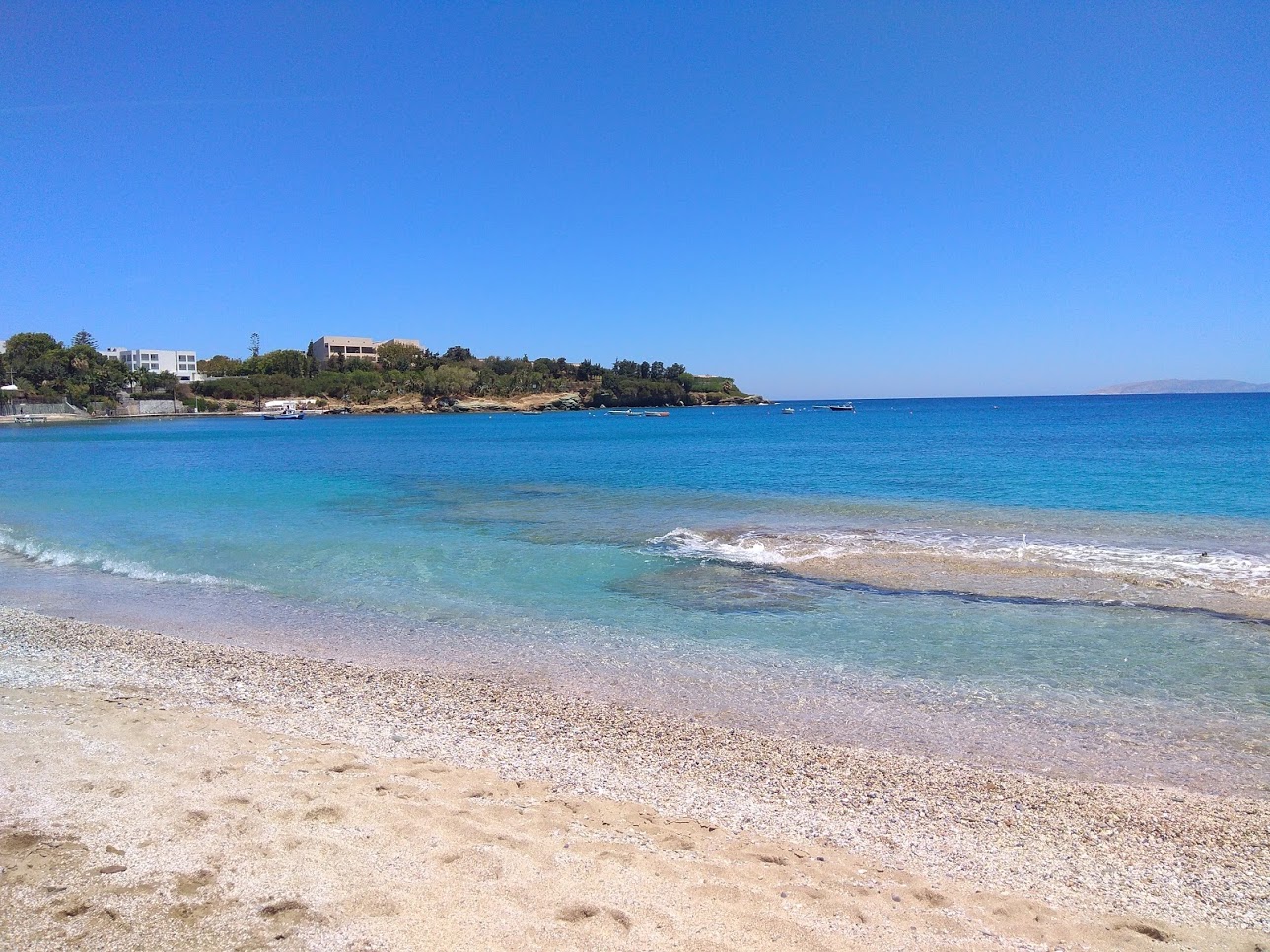
Seaside resort in Crete
The village takes its name from the homonymous church, in the Monastery of the Sebbathians, ruins of which are found at a distance of 1 km west of the village. The beaches of the village are popular with locals and tourists because they are sheltered by the rock outcroppings that almost encircle Agia Pelagia Bay.{{cite book|title=Greek islands|url=https://archive.org/details/greekislands00hell|url-access=registration|publisher=Lonely Planet|first=Paul |last=Hellander|edition=4|year=2006| ISBN=1-74059-914-4}}
Agia Pelagia was heavily damaged by the 2022 Greek floods.
Archaeology
The first major excavations at Agia Pelagia were carried out at Cape Souda, near Evresi Cave, by Sir Arthur Evans. It was archaeologist Stylianos Alexiou, along with Dr. Athanasia Kanta, who performed the majority of later research. Alexiou, and others put forward the hypothesis that Agia Pelagia was the site of ancient Panormos (Ancient Greek: Πάνορμος), also known as Aulopotamos (Αὐλοπόταμος). At the north end of Agia Pelagia Bay, remnants of excavations of the Hellenistic town of Apollonia (), also Apollonia (Ἀπολλωνία) can still be seen.
The legendary archaeologist John Pendlebury classified surface finds discovered at Agia Pelagia as "implied" proof of a Late Minoan settlement there. Post-Minoan graves and the University (Prtanion) of the 4th century BC were found in 1970 at the site "Kladistos" or "Kladotos". Also, there is a nearby cave, with the name "Evresi", where - according to legend - local people found the icon of Agia Pelagia.
The village also has outcrops of blue-greenschist rock which was quarried and used to pave streets and floors of Minoan palaces between 1650 and 1600 BC.
References
References
- "Crete: readers' tips, recommendations and travel advice". The Telegraph.
- (2022-10-16). "Second person found dead after flash flooding in Crete".
- "The Gold Epistomia of Crete". Center for Hellenic Studies-Harvard University.
- Pendlebury, J.D.S.. (1965). "The Archaeology of Crete". Penguin Random House.
- (2010). "Types of schist used in buildings of Minoan Crete". [[Hellenic Journal of Geosciences]].
This article was imported from Wikipedia and is available under the Creative Commons Attribution-ShareAlike 4.0 License. Content has been adapted to SurfDoc format. Original contributors can be found on the article history page.
Ask Mako anything about Agia Pelagia — get instant answers, deeper analysis, and related topics.
Research with MakoFree with your Surf account
Create a free account to save articles, ask Mako questions, and organize your research.
Sign up freeThis content may have been generated or modified by AI. CloudSurf Software LLC is not responsible for the accuracy, completeness, or reliability of AI-generated content. Always verify important information from primary sources.
Report