From Surf Wiki (app.surf) — the open knowledge base
African easterly jet
Jetstream over West Africa
Jetstream over West Africa
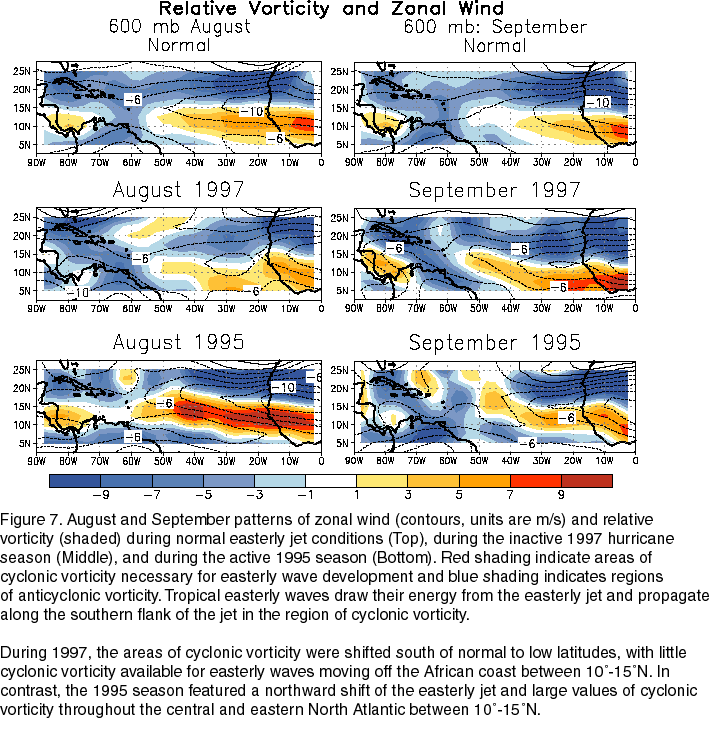
The African easterly jet is a region of the lower troposphere over West Africa where the seasonal mean wind speed is at a maximum and the wind is easterly. The temperature contrast between the Sahara Desert and the Gulf of Guinea causes the jet to form to the north of the monsoon trough. The jet's maximum wind speeds are at a height of 3 km. The jet moves northward from its south-most location in January, reaching its most northerly latitude in August. Its strongest winds are in September while it begins shifting back towards the equator. Within the easterly jet, tropical waves form. Convective complexes associated with these waves can form tropical cyclones. If the jet is south of its normal location during August and September, tropical cyclogenesis is suppressed. If desertification continues across Sub-Saharan Africa, the strength of the jet could increase, although tropical wave generation probably would decrease, which would decrease the number of tropical cyclones in the Atlantic basin.
Formation and characteristics
During January, the African easterly jet lies at 3000 m above sea level at five degrees north latitude. Winds within it increase in speed from 30 km/h in January to 40 km/h in March. Shifting northward in April to the seventh parallel, winds within the jet increase to 45 km/h. By June, it shifts northward into northwest Africa.
From June into October, the thermal low over northern Africa leads to a low-level westerly jet stream to the south of the Intertropical Convergence Zone. The mid-level African easterly jet develops because heating of the West African land mass during this time of year creates a surface temperature and moisture gradient between the Gulf of Guinea and the Sahara Desert. The atmosphere responds by generating vertical wind shear to maintain thermal wind balance. The jet reaches its zenith in August, lying between the 16th and 17th parallels. In September, winds maximize near 50 km/h between the 12th and 13th parallels. The easterly jet weakens and drops southward during October and November.
Impact
The mid-level African easterly jet is considered to play a crucial role in the West African monsoon, and helps form the tropical waves that move across the tropical Atlantic and eastern Pacific oceans during the warm season. The jet exhibits both barotropic and baroclinic instability, which produces synoptic scale, westward-propagating disturbances in the jet known as African easterly waves or tropical waves. These instabilities, particularly in the presence of moist-convection, cause intense lower-layer cyclonic vortices at the northern flank of the jet.
A small number of mesoscale storm systems embedded in these waves develop into tropical cyclones after they move from west Africa into the tropical Atlantic, mainly during August and September. When the jet is south of normal during the peak months of the Atlantic hurricane season, tropical cyclone formation is suppressed.
References
References
- Marcel Leroux. (2001). "The Meteorology and Climate of Tropical Africa". Springer.
- B. Pu and K. H. Cook (2008). [http://adsabs.harvard.edu/abs/2008AGUFM.A13A0229P Dynamics of the Low-Level Westerly Jet Over West Africa.] American Geophysical Union, Fall Meeting 2008, abstract #A13A-0229. Retrieved on 8 March 2009.
- Kerry H. Cook. [https://archive.today/20130101205758/http://ams.allenpress.com/perlserv/?request=get-abstract&doi=10.1175/1520-0442(1999)012%3C1165:GOTAEJ%3E2.0.CO;2 Generation of the African Easterly Jet and Its Role in Determining West African Precipitation.] Retrieved on 8 May 2008.
- [[Chris Landsea]]. AOML Frequently Asked Questions. [https://www.aoml.noaa.gov/hrd/tcfaq/A4.html Subject: A4) What is an easterly wave ?] Retrieved on 8 May 2008.
- Rostami, M., Zeitlin, V., 2021, [https://doi.org/10.1080/03091929.2021.1959574 Instabilities of low-latitude easterly jets in the presence of moist convection and topography and related cyclogenesis, in a simple atmospheric model.] Geophysical & Astrophysical Fluid Dynamics, DOI:10.1080/03091929.2021.1959574.
- Climate Prediction Center. (November 1997). "Figure 7". [[National Oceanic and Atmospheric Administration]].
This article was imported from Wikipedia and is available under the Creative Commons Attribution-ShareAlike 4.0 License. Content has been adapted to SurfDoc format. Original contributors can be found on the article history page.
Ask Mako anything about African easterly jet — get instant answers, deeper analysis, and related topics.
Research with MakoFree with your Surf account
Create a free account to save articles, ask Mako questions, and organize your research.
Sign up freeThis content may have been generated or modified by AI. CloudSurf Software LLC is not responsible for the accuracy, completeness, or reliability of AI-generated content. Always verify important information from primary sources.
Report