From Surf Wiki (app.surf) — the open knowledge base
Adam lay ybounden
15th-century English Christian text
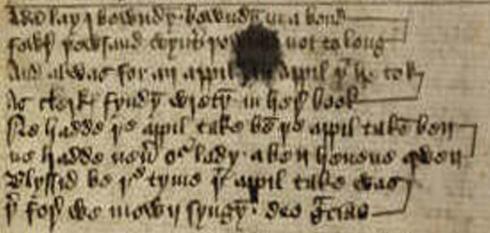
15th-century English Christian text
"Adam lay ybounden", originally titled "Adam lay i-bowndyn", is a 15th-century English Christian text of unknown authorship. It takes as its theme the Fall of Man, as described in the Book of Genesis.
Originally a song text, no contemporary musical settings survive, although there are many notable modern choral settings of the text, such as that by Benjamin Britten (A Ceremony of Carols) and Boris Ord.
Origins
The manuscript in which the poem is found (Sloane MS 2593, ff. 10v-11) is held by the British Library, which dates the work to c.1400 and speculates that the lyrics may have belonged to a wandering minstrel. Other poems included on the same page in the manuscript include "I have a gentil cok", the famous lyric poem "I syng of a mayden" and two riddle songs – "A minstrel's begging song" and "I have a yong suster".
Analysis of their dialect by K.R. Palti (2008) places them within the song tradition of East Anglia and more specifically Norfolk; two further carol manuscripts from the county contain songs from Sloane MS 2593. The texts of the songs were first printed by Victorian antiquarian Thomas Wright in 1836, who speculated that a number of the songs were intended for use in mystery plays.
Analysis

Adam lay ybounden relates the events of Genesis, Chapter 3. In medieval theology, Adam was supposed to have remained in bonds with the other patriarchs in the limbus patrum from the time of his death until the crucifixion of Christ (the "4000 winters"). The second verse narrates the Fall of Man following Adam's temptation by Eve and the serpent. John Speirs suggests that there is a tone of astonishment, almost incredulity in the phrase "and all was for an apple", noting "an apple, such as a boy might steal from an orchard, seems such a little thing to produce such overwhelming consequences. Yet so it must be because clerks say so. It is in their book (probably meaning the Vulgate itself)."
The third verse suggests the subsequent redemption of man by the birth of Jesus Christ by Mary, who was to become the Queen of Heaven as a result, and thus the song concludes on a positive note hinting at Thomas Aquinas' concept of the "felix culpa" (blessed fault). Speirs suggests that the lyric retells the story in a particularly human way: "The doctrine of the song is perfectly orthodox...but here is expressed very individually and humanly. The movement of the song reproduces very surely the movements of a human mind."
Text
| Middle English original spelling | Middle English converted (Edith Rickert) |
|---|
Settings
The text was originally meant to be a song text, although no music survives. However, there are many notable modern choral settings of the text, with diverse interpretations by composers such as Peter Warlock, John Ireland, Boris Ord, Howard Skempton and Benjamin Britten (titled Deo Gracias in his Ceremony of Carols). A new setting by Giles Swayne was commissioned for and first performed in 2009 by the Choir of St John's College, Cambridge and their annual broadcast of the Advent carol service on BBC Radio 3. The Connecticut composer Robert Edward Smith wrote a setting of the text that was premiered in December 2018 in Hartford at Trinity College's annual Lessons and Carols. The piece featured the College's Chapel Singers, directed by Christopher Houlihan.
Boris Ord
\relative { \key b \minor \time 3/4 b'4. b8\noBeam a b fis4 fis2 b4. d8\noBeam cis b fis2.
}
Boris Ord's 1957 setting is probably the best-known version as a result of its traditional performance following the First Lesson at the annual Festival of Nine Lessons and Carols at the chapel of King's College, Cambridge, where Ord was organist from 1929 to 1957.
References
References
- (1856). "Songs and Carols from a Manuscript in the British Museum of the Fifteenth Century". T. Richards.
- "Medieval lyrics".
- Palti, K.R.; (2008) ''[http://discovery.ucl.ac.uk/15578/ ‘Synge we now alle and sum’: three Fifteenth-Century collections of communal song: a study of British Library, Sloane MS 2593; Bodleian Library, MS Eng. poet. e.1; and St John’s College, Cambridge, MS S.54]''. Doctoral thesis, UCL (University College London), 104
- Thomas Wright, ''Songs and carols printed from a manuscript in the Sloane collection in the British museum'' (London: W. Pickering, 1836), vi
- Thomas Wright, ''[https://archive.org/details/songscarolsfromm00wrigrich Songs and carols from a manuscript in the British Museum of the fifteenth century]'', (London: T. Richards, 1856), p.109
- John Speirs, ''Medieval English Poetry: The Non-Chaucerian Tradition'' (London: Faber & Faber, 1957), pp.65–66
- Sarah Jane Boss, ''Empress and handmaid: on nature and gender in the cult of the Virgin Mary'' (Continuum International Publishing Group, 2000) {{ISBN. 978-0-304-70781-2 p.114
- Paul Morris suggests that the text's evocation of Genesis implies a "fall upwards".Paul Morris, ''A walk in the garden: biblical, iconographical and literary images of Eden'' (London: Continuum International Publishing Group, 1992) {{ISBN. 978-1-85075-338-4, p.33
- Thomas Wright, ''[https://archive.org/details/songscarolsfromm00wrigrich Songs and carols from a manuscript in the British Museum of the fifteenth century]'', (London: T. Richards, 1856), pp.32–33
- Edith Rickert, ''Ancient English Christmas Carols: 1400–1700'' (London: Chatto & Windus, 1914), p.163
- Peter Warlock, [http://www1.cpdl.org/wiki/index.php/Adam_lay_ybounden_(Peter_Warlock) Adam lay ybounden], [[Choral Public Domain Library]], Retrieved 22 November 2010
- John Ireland, [http://www1.cpdl.org/wiki/index.php/Adam_lay_ybounden_(John_Ireland) Adam lay ybounden] {{Webarchive. link. (2010-12-04 , [[Choral Public Domain Library]], Retrieved 22 November 2010)
- link. (2011-04-14 , Retrieved 22 November 2010)
- [http://ukcatalogue.oup.com/product/9780193432475.do OUP Skempton, "Adam lay y-bounden"]
- Corinne Saunders, ''A Companion to Medieval Poetry'', p. 272 (London : John Wiley and Sons, 2010) {{ISBN. 978-1-4051-5963-0
- [http://www.bbc.co.uk/pressoffice/proginfo/radio/2009/wk48/sun.shtml A Service For Advent With Carols, Live From The Chapel Of St John's College, Cambridge], Sunday 29 November
- [https://www.trincoll.edu/StudentLife/SpiritualReligiousLife/chapelmusic/Pages/Lessons.aspx] {{Webarchive. link. (2018-08-24 Lessons and Carols)
- [http://www.kings.cam.ac.uk/events/chapel-services/nine-lessons/order-service-2003.html A Festival of Nine Lessons and Carols 2003] {{Webarchive. link. (2013-12-21 , Retrieved 22 November 2010)
This article was imported from Wikipedia and is available under the Creative Commons Attribution-ShareAlike 4.0 License. Content has been adapted to SurfDoc format. Original contributors can be found on the article history page.
Ask Mako anything about Adam lay ybounden — get instant answers, deeper analysis, and related topics.
Research with MakoFree with your Surf account
Create a free account to save articles, ask Mako questions, and organize your research.
Sign up freeThis content may have been generated or modified by AI. CloudSurf Software LLC is not responsible for the accuracy, completeness, or reliability of AI-generated content. Always verify important information from primary sources.
Report