From Surf Wiki (app.surf) — the open knowledge base
Acylation
1=Chemical reaction which adds an acyl group (R–C=O) to a compound
1=Chemical reaction which adds an acyl group (R–C=O) to a compound
In chemistry, acylation is a broad class of chemical reactions in which an acyl group () is added to a substrate. The compound providing the acyl group is called the acylating agent. The substrate to be acylated and the product include the following:
- alcohols, esters
- amines, amides
- arenes or alkenes, ketones A particularly common type of acylation is acetylation, the addition of the acetyl group. Closely related to acylation is formylation, which employ sources of "HCO+ in place of "RCO+".
Examples
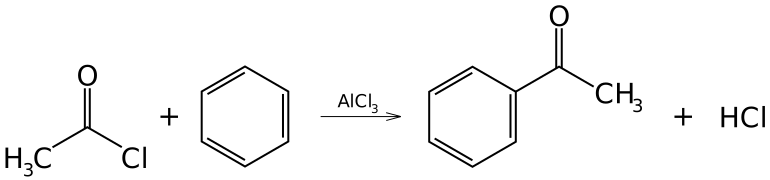
Because they form a strong electrophile when treated with Lewis acids, acyl halides are commonly used as acylating agents. For example, Friedel–Crafts acylation uses acetyl chloride () as the agent and aluminum chloride () as a catalyst to add an acetyl group to benzene:
This reaction is an example of electrophilic aromatic substitution.
Acyl halides and acid anhydrides of carboxylic acids are also common acylating agents. In some cases, active esters exhibit comparable reactivity. All react with amines to form amides and with alcohols to form esters by nucleophilic acyl substitution.
Acylation can be used to prevent rearrangement reactions that would normally occur in alkylation. To do this an acylation reaction is performed, then the carbonyl is removed by Clemmensen reduction or a similar process.
Acylation in biology
Protein acylation is the post-translational modification of proteins via the attachment of functional groups through acyl linkages. Protein acylation has been observed as a mechanism controlling biological signaling. One prominent type is fatty acylation, the addition of fatty acids to particular amino acids (e.g. myristoylation, palmitoylation or palmitoleoylation). Different types of fatty acids engage in global protein acylation. Palmitoleoylation is an acylation type where the monounsaturated fatty acid palmitoleic acid is covalently attached to serine or threonine residues of proteins. Palmitoleoylation appears to play a significant role in the trafficking, targeting, and function of Wnt proteins.
References
References
- 裴, 坚. (2016). "基础有机化学". 北京大学出版社.
- (2017). "Organic Chemistry". Cengage Learning.
- (2014). "Organic Chemistry: Structure and Function.". [[W.H. Freeman and Company]].
- (1988). "The Biology and Enzymology of Eukaryotic Protein Acylation". [[Annual Review of Biochemistry]].
- (1999). "Fatty acylation of proteins: New insights into membrane targeting of myristoylated and palmitoylated proteins". [[Biochimica et Biophysica Acta (BBA) - Molecular Cell Research]].
- (2019). "A method for the gross analysis of global protein acylation by gas–liquid chromatography". [[IUBMB Life]].
- Hannoush, Rami N.. (October 2015). "Synthetic protein lipidation". [[Current Opinion in Chemical Biology]].
- (2016-12-13). "Vertebrate development : maternal to zygotic control".
- (2018-10-20). "Wnt lipidation: Roles in trafficking, modulation, and function". [[Journal of Cellular Physiology]].
- (February 2016). "Fatty acylation of Wnt proteins". [[Nature Chemical Biology]].
This article was imported from Wikipedia and is available under the Creative Commons Attribution-ShareAlike 4.0 License. Content has been adapted to SurfDoc format. Original contributors can be found on the article history page.
Ask Mako anything about Acylation — get instant answers, deeper analysis, and related topics.
Research with MakoFree with your Surf account
Create a free account to save articles, ask Mako questions, and organize your research.
Sign up freeThis content may have been generated or modified by AI. CloudSurf Software LLC is not responsible for the accuracy, completeness, or reliability of AI-generated content. Always verify important information from primary sources.
Report