From Surf Wiki (app.surf) — the open knowledge base
Act of Congress
Bill of the United States Congress signed into law by the president
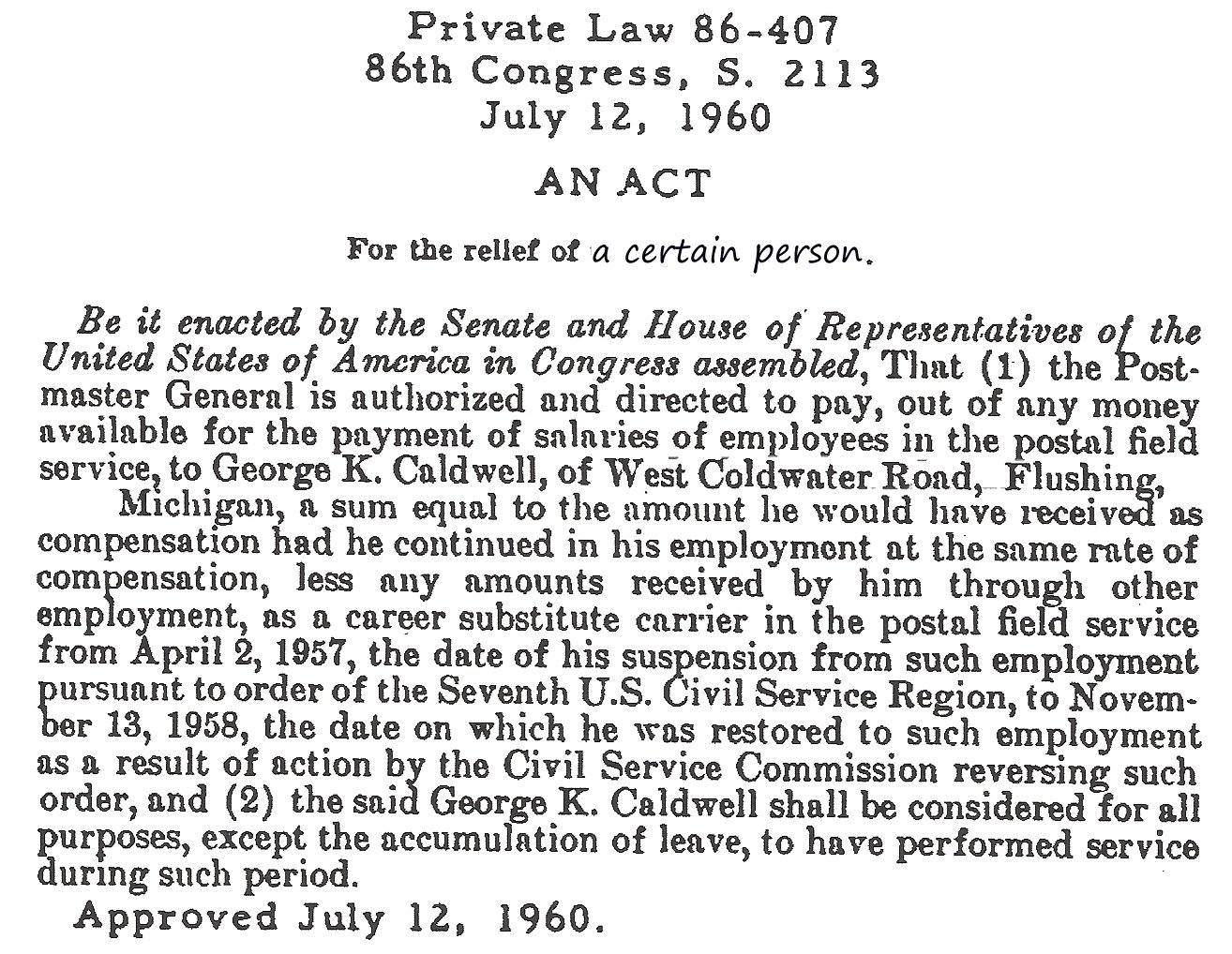
Bill of the United States Congress signed into law by the president
An act of Congress is a statute passed by both the Senate and House of Representatives of the United States Congress and signed into law by the president. Acts may apply only to individual entities (called private laws), or to the general public (public laws).
For a bill to become an act, the text must pass through both houses with a majority, then be either signed into law by the president of the United States, be left unsigned for ten days (excluding Sundays) while Congress remains in session, or, if vetoed by the president, receive a congressional override from of both houses.
Public law, private law, designation
In the United States, acts of Congress are designated as either public laws, relating to the general public, or private laws, relating to specific institutions or individuals. Since 1957, all acts of Congress have been designated as "Public Law X–Y" or "Private Law X–Y". X is the number of the Congress and Y refers to the sequential order of the bill (when it was enacted).{{cite web | access-date = 2008-09-04
When the legislation of those two kinds are proposed, it is called public bill and private bill respectively.
Usage
The word "act", as used in the term "act of Congress", is a common, not a proper noun. The capitalization of the word "act" (especially when used standing alone to refer to an act mentioned earlier by its full name) is deprecated by some dictionaries and usage authorities. However, the Bluebook requires "Act" to be capitalized when referring to a specific legislative act. The United States Code capitalizes "act".
The term "act of Congress" is sometimes used in informal speech to indicate something for which getting permission is burdensome. For example, "It takes an act of Congress to get a building permit in this town."
Promulgation (United States)
An act adopted by simple majorities in both houses of Congress is promulgated, or given the force of law, in one of the following ways:
- Signature by the president of the United States,
- Inaction by the president after ten days from reception, excluding Sundays, while the Congress is in session, or
- Reconsideration by the Congress after a presidential veto during its session. A bill must receive a majority vote in both houses to override a president's veto.
The president promulgates acts of Congress made by the first two methods. If an act is made by the third method, the presiding officer of the house that last reconsidered the act promulgates it.
Under the United States Constitution, if the president does not return a bill or resolution to Congress with objections before the time limit expires, then the bill automatically becomes an act. If the Congress is adjourned at the end of this period, then the bill dies and cannot be reconsidered (see pocket veto). If the president rejects a bill or resolution while the Congress is in session, a two-thirds vote of both houses of Congress is needed for reconsideration to be successful.
Promulgation in the sense of publishing and proclaiming the law is accomplished by the president, or the relevant presiding officer in the case of an overridden veto, delivering the act to the archivist of the United States. The archivist provides for its publication as a slip law and in the United States Statutes at Large after receiving the act. Thereafter, the changes are published in the United States Code.
Judicial review and constitutionality
Through the process of judicial review, an act of Congress that violates the Constitution may be declared unconstitutional by the courts. A judicial declaration that an act of Congress is unconstitutional does not remove the act from the Statutes at Large or the United States Code; rather, it prevents the act from being enforced. However, the act as published in annotated codes and legal databases is marked with annotations indicating that it is no longer good law.
Notes
References
References
- [http://www.bartleby.com/61/72/A0067200.html Bartleby.com] {{webarchive. link. (March 14, 2009)
- "act: Meaning and Definition of".
- "act". Cambridge University Press.
- "act". Longman Dictionary of Contemporary English.
- "Act Definition & Meaning".
- (2007). "Clayton Antitrust Act". The Columbia Encyclopedia, Sixth Edition.
- "House of Commons {{!}} British Parliament & Politics".
- ''The Bluebook: A Uniform System of Citation'', 20th ed., Rule R8(c)(ii) (Cambridge: The Harvard Law Review Association, 2015), 92.
- See {{usc. 1. 106a, "Promulgation of laws".
- {{usc. 1. 106a, "Promulgation of laws".
- {{usc. 1. 113, {{"'Little and Brown's' edition of laws and treaties; slip laws; Treaties and Other International Acts Series; admissibility in evidence".
- {{usc. 1. 112, "Statutes at Large; contents; admissibility in evidence".
This article was imported from Wikipedia and is available under the Creative Commons Attribution-ShareAlike 4.0 License. Content has been adapted to SurfDoc format. Original contributors can be found on the article history page.
Ask Mako anything about Act of Congress — get instant answers, deeper analysis, and related topics.
Research with MakoFree with your Surf account
Create a free account to save articles, ask Mako questions, and organize your research.
Sign up freeThis content may have been generated or modified by AI. CloudSurf Software LLC is not responsible for the accuracy, completeness, or reliability of AI-generated content. Always verify important information from primary sources.
Report