From Surf Wiki (app.surf) — the open knowledge base
Acheron
River in Greece
River in Greece
| Field | Value |
|---|---|
| name | Acheron |
| image | Acheron river 2.jpg |
| image_caption | Acheron river near the village of Glyki |
| source1_location | Ioannina regional unit, Epirus |
| mouth_location | Ionian Sea |
| mouth_coordinates | |
| subdivision_type1 | Country |
| subdivision_name1 | Greece |
| length_km | 52 |
| basin_size_km2 | 705 |
the river in Greece
The Acheron ( or ; Acheron or Ἀχερούσιος Acherousios; Acherontas) is a river in the Epirus region of northwest Greece.
In Greek mythology, Acheron is often depicted as the entrance to the Greek Underworld where souls must be ferried across by Charon (although some later sources, such as Roman poets, assign this role to the river Styx).
Description
It is 52 km long, and has a drainage area of 705 km2. The river's source is located near the village Zotiko, in the southwestern part of the Ioannina regional unit. The Acheron flows into the Ionian Sea in Ammoudia, near Parga.
Mythology
Ancient Greek mythology saw the Acheron, sometimes known as the "river of woe", as one of the five rivers of the Greek underworld. For example: |publication-date = 2008 |access-date = 15 March 2022 The name is of uncertain etymology.
Most classical accounts, including Pausanias (10.28) and later Dante's Inferno (3.78), portray the Acheron as the entrance to the Underworld and depict Charon ferrying the souls of the dead across it. Ancient Greek literary sources such as Pindar, Aeschylus, Euripides, Plato, and Callimachus also place Charon on the Acheron. Roman poets, including Propertius, Ovid, and Statius, name the river as the Styx, perhaps following the geography of Virgil's underworld in the Aeneid, where Charon is associated with both rivers.
The Homeric poems describe the Acheron as a river of Hades, into which Cocytus and Phlegethon both flowed.
The Roman poet Virgil called the Acheron the principal river of Tartarus, from which the Styx and the Cocytus both sprang. The newly dead would be ferried across the Acheron by Charon in order to enter the Underworld.
The Suda describes the river as "a place of healing, not a place of punishment, cleansing and purging the sins of humans".
According to later traditions, Acheron had been a son of Helios and either Gaia or Demeter, who was turned into the Underworld river bearing his name after he refreshed the Titans with drink during their contest with Zeus. By this myth, Acheron is also the father of Ascalaphus by either Orphne or Gorgyra.
The river called Acheron with the nearby ruins of the Necromanteion (oratory of the dead) is found near Parga on the mainland of Greece opposite Corfu. Another branch of Acheron was believed to surface at the Acherusian cape (now Karadeniz Ereğli in Turkey) and was seen by the Argonauts according to Apollonius of Rhodes. Greeks who settled in Italy identified the Acherusian lake into which Acheron flowed with Lake Avernus. Plato in his Phaedo identified Acheron as the second greatest river in the world, excelled only by Oceanus.

He claimed that Acheron flowed in the opposite direction from Oceanus beneath the earth under desert places. The word is also occasionally used as a synecdoche for Hades itself. Virgil mentions Acheron with the other infernal rivers in his description of the underworld in Book VI of the Aeneid. In Book VII, line 312 he gives to Juno the famous saying, flectere si nequeo superos, Acheronta movebo: 'If I cannot bend the will of Heaven, I shall move Hell.' The same words were used by Sigmund Freud as the dedicatory motto for his seminal book The Interpretation of Dreams, figuring Acheron as psychological underworld beneath the conscious mind.
The Acheron was sometimes referred to as a lake or swamp in Greek literature, as in Aristophanes' The Frogs and Euripides' Alcestis.
.jpg)
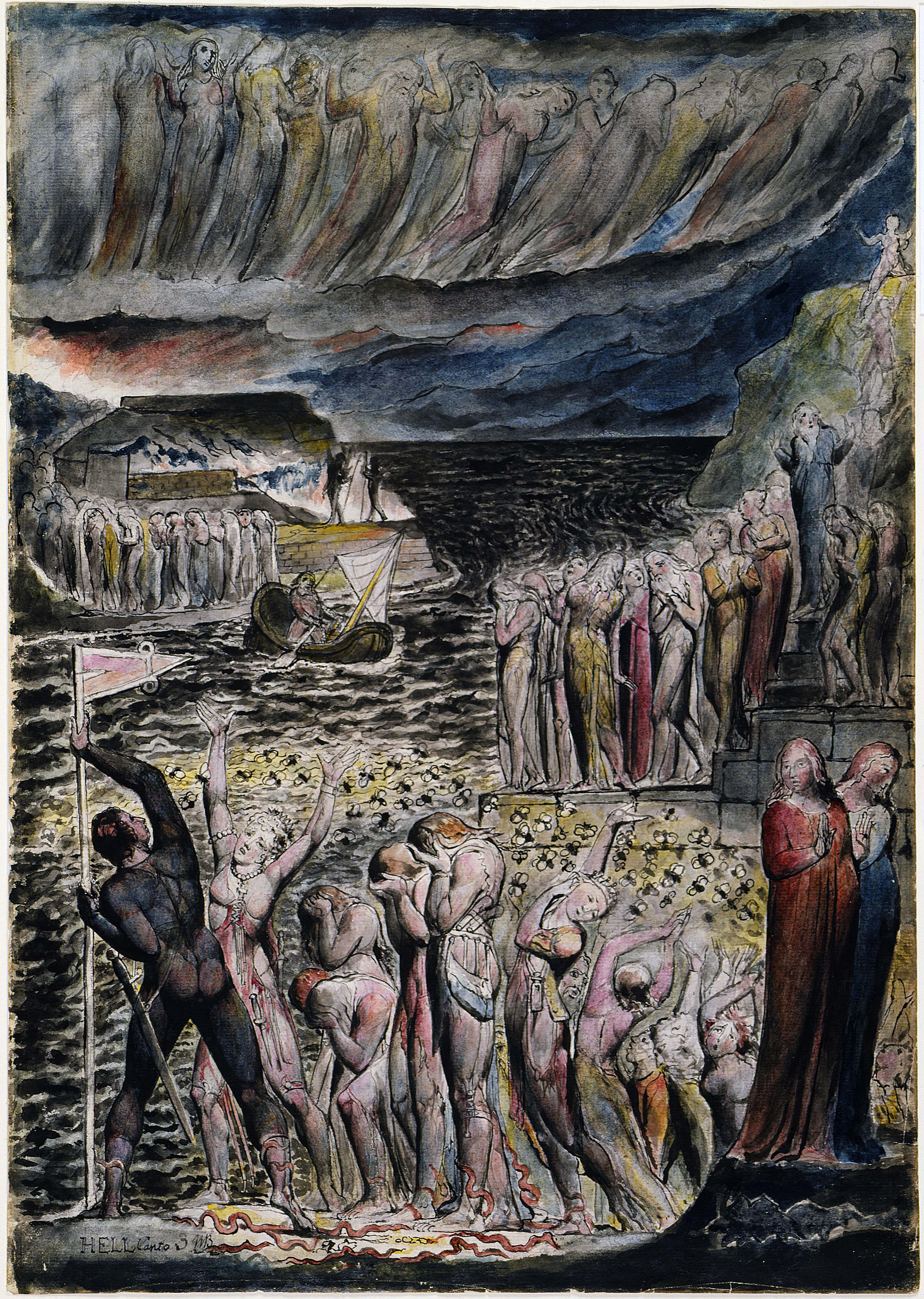
In Dante's Inferno, the Acheron river forms the border of Hell. Following Greek mythology, Charon ferries souls across this river to Hell. Those who were neutral in life sit on the banks.
In culture
- In Dante's Inferno, Charon ferries newly deceased sinners across Acheron.
- In Christopher Marlowe's play, The Tragical History of Doctor Faustus, Acheron is mentioned in Act I, scene iii, wherein Doctor Faustus conjures Mephistophiles: Sint mihi dei Acherontis propitii, or "May the gods of Hell (Acheron) be propitious unto me."
- In Shakespeare's play, Macbeth, Acheron is referenced as a euphemism for the gates of hell by Hecate in Act III, scene v: "Get you gone, and at the pit of Acheron meet me i' th' morning.
Namesake
Acheron Lake in Antarctica is named after the mythical river.
Several ships have been named HMS Acheron.
There is a stream named the Dry Acheron in Canterbury, New Zealand.
The Eocene turtle genus Acherontemys of the Roslyn Formation in North America was named in reference to the Acheron mythos.
Gallery
File:Acheron 2.jpg|Acheron river File:Acheron 3.jpg|Acheron river (another view) File:Baileybridge over the Acheron river in Gliki - Greece.jpg|Truss bridge over the Acheron river file:Acherontemys heckmani holotype USNM V4213 img3.jpg|Acherontemys heckmani fossil carapace File:66 River of The Dead.a.jpg|alt=River of the Dead - a painting by Mikhail Sol|River of the Dead - a painting by Mikhail Sol
References
References
- "Preliminary Flood Risk Assessment". Ministry of Environment, Energy and Climate Change.
- [[Robert S. P. Beekes. R. S. P. Beekes]], ''Etymological Dictionary of Greek'', Brill, 2009, p. 182.
- [[Homer]], ''[[The Odyssey]]'' x. 513
- [[Pausanias (geographer). Pausanias]], ''Description of Greece'' i. 17, § 5
- [[Virgil]], ''[[Aeneid]]'' vi. 297
- Virgil, ''Aeneid'' 6. 323
- "Illustrations to Dante's "Divine Comedy", object 5 (Butlin 812.5) "The Vestibule of Hell and the Souls Mustering to Cross the Acheron"". [[William Blake Archive]].
- [http://www.stoa.org/sol/ Suda On Line]
- [[Natalis Comes]]. ''Mythologiae, 3.1''
- [[Ovid]], ''Metamorphoses'' 5. 539
- Pseudo-Apollodorus, ''Bibliotheca'' 1. 33
- Line 312 in the conventional lineation, see J.W. Mackail (Editor and Translator), ''The AEneid'' (Clarendon press, Oxford: 1930), p. 271.
- "Macbeth".
- {{Cite Colledge2006
- "Dry Acheron Track".
- (1899). "Descriptions of two new species of tortoises from the Tertiary of the United States". Proceedings of the United States National Museum.
This article was imported from Wikipedia and is available under the Creative Commons Attribution-ShareAlike 4.0 License. Content has been adapted to SurfDoc format. Original contributors can be found on the article history page.
Ask Mako anything about Acheron — get instant answers, deeper analysis, and related topics.
Research with MakoFree with your Surf account
Create a free account to save articles, ask Mako questions, and organize your research.
Sign up freeThis content may have been generated or modified by AI. CloudSurf Software LLC is not responsible for the accuracy, completeness, or reliability of AI-generated content. Always verify important information from primary sources.
Report