From Surf Wiki (app.surf) — the open knowledge base
Ace of hearts
Playing card
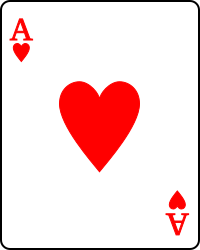
Playing card
The ace of hearts () is a card in a deck of playing cards: the ace in the suit of hearts (). There is one ace of hearts in a standard deck of 52 cards.
Gameplay
In the 17th century French game Le Jeu de la Guerre, the ace of hearts represented the cavalry.
In the game Bankafalet, the second best card in the deck is the ace of hearts.
In the Irish game Five Cards, the ace of hearts is the second highest card in the pack, below the five fingers (aka five of trumps).
Symbolism

Literature
American author Zane Grey used the cartomantic meaning of playing cards in his novels. For example, in his book The Border Legion, he describes the character Joan Randle as an Ace of Hearts, after she "outwit[s] and outtalk[s] her would-be-seducer, outlaw Kells". The very same card is pinned by Kells to a tree, where he shoots at with many bullets, "every one of which touch[ing] the red heart and one of them...obliterat[ing] it", and then signs his name below. This foreshadows the climax described above. These uses of the ace of hearts by Grey utilize the many symbolic meanings of the card including intimidation, eroticism, and death.
Referring to the Jesuits, the author of The true history of Pope Joan says: "a certain prince of ours did compare unto them a game of cardes, in which the gamesters like loadem play and bring them forth last that are of most price, to beat downe the adverse play: or like the ace of hearts at Mawe (the game which is with us called Rumstich)". This is said to provide the answer to the origin of the card game Mawe.
In Tess of the D'Urbervilles by Thomas Hardy, the murder of the main villain is given away by a spot on the ceiling that "speedily grew as large as the palm of [Mrs. Brooks'] hand" and "[Mrs. Brooks] could perceive that it was red". The narrative goes on to say: "the oblong white ceiling, with this scarlet blot in the midst, had the appearance of a gigantic ace of hearts".

Asexuality
The ace of hearts is a symbol for those who are asexual, but not aromantic. Those who are both asexual and aromantic use the ace of spades as a symbol.
Encoding
The ace of hearts is encoded into Unicode with the code point U+1F0B1, as part of the playing cards Unicode block. |1F0B1|name1=Playing Card Ace Of Hearts}}
References
References
- Singer, Samuel Weller. (1816). "Researches into the history of playing cards; with illustrations of the origin of printing and engraving on wood". T. Bensley and Son.
- "Zabawa weselna w rodzinie chłopskiej". cyfrowe.mnw.art.pl.
- Kimball, Arthur G.. (1993). "Ace of Hearts: The Westerns of Zane Grey". TCU Press.
- Hardy, Thomas. (2003). "Tess of the D'Urbervilles". Penguin Classics.
- (2015). "The Invisible Orientation: An Introduction to Asexuality". Simon and Schuster.
- "Playing Cards". [[Unicode Consortium]].
This article was imported from Wikipedia and is available under the Creative Commons Attribution-ShareAlike 4.0 License. Content has been adapted to SurfDoc format. Original contributors can be found on the article history page.
Ask Mako anything about Ace of hearts — get instant answers, deeper analysis, and related topics.
Research with MakoFree with your Surf account
Create a free account to save articles, ask Mako questions, and organize your research.
Sign up freeThis content may have been generated or modified by AI. CloudSurf Software LLC is not responsible for the accuracy, completeness, or reliability of AI-generated content. Always verify important information from primary sources.
Report