From Surf Wiki (app.surf) — the open knowledge base
Academy of the Hebrew Language
Israeli institution established in 1953
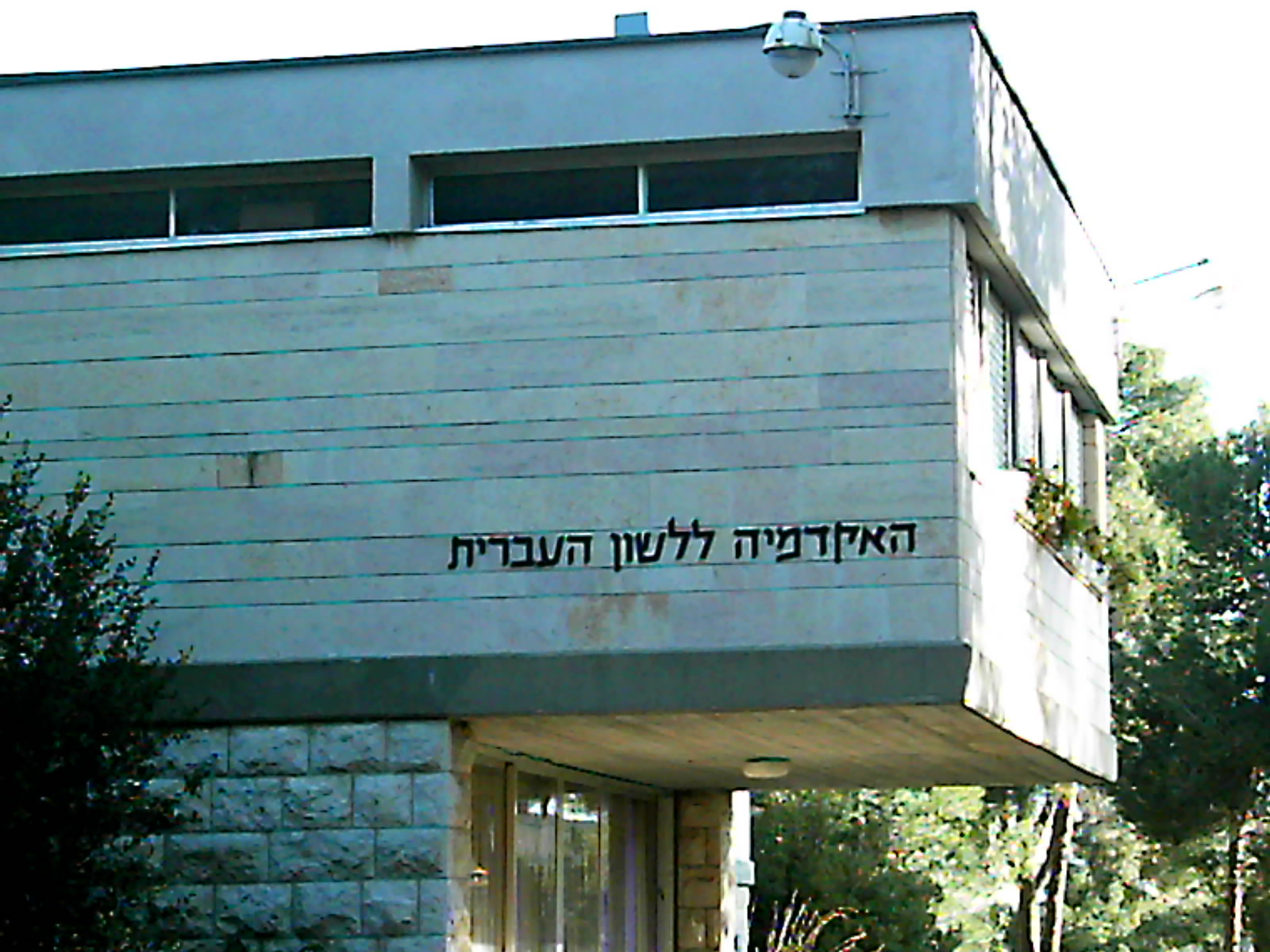
Israeli institution established in 1953
| Field | Value | |
|---|---|---|
| name | Academy of the Hebrew Language | |
| native_name | האקדמיה ללשון העברית | |
| native_name_lang | he | |
| former_name | Hebrew Language Committee | |
| image | File:Academy of the Hebrew Language.png | |
| size | 250px | |
| alt | ||
| formation | 1890 – Hebrew Language Committee | |
| 1953 – Academy of the Hebrew Language | ||
| type | Governmental organization | |
| status | Language regulator | |
| purpose | To regulate the Hebrew language | |
| professional_title | ||
| headquarters | {{Plainlist | |
| coords | ||
| region_served | Hebrew-speaking population | |
| language | Modern Hebrew | |
| leader_title | President | |
| leader_name | Aharon Maman | |
| main_organ | ||
| num_staff | 38 | |
| website |
1953 – Academy of the Hebrew Language
- Givat Ram, Jerusalem, Israel
The Academy of the Hebrew Language (, ha-akademyah la-lashon ha-ivrit) was established by the Israeli government in 1953 as the "supreme institution for scholarship on the Hebrew language in the Hebrew University of Jerusalem of Givat Ram campus."
Its stated aims are to assemble and research the Hebrew language in all its layers throughout the ages; to investigate the origin and development of the Hebrew tongue; and to direct the course of development of Hebrew, in all areas, including vocabulary, grammar, writing, spelling, and transliteration.
Since 2022, the Academy has been headed by Aharon Maman. It is composed of 42 members, in addition to having members who serve as academic advisors, as well as honorary members. Every person is entitled to query the Academy on language matters and to receive a formal reply.
History
The Academy replaced the Hebrew Language Committee (Vaʻad ha-lashon ha-ʻIvrit) established in 1890 by Eliezer Ben-Yehuda, who was its first president. As Hebrew became the spoken language in Palestine and was adopted by the educational system, the Hebrew Language Committee published bulletins and dictionaries. It coined thousands of words that are in everyday use today.
Its successor, the Academy of the Hebrew Language, has continued this mission of creating new Hebrew words to keep up modern usage.
Although the academy's business is creating new words from Hebrew roots and structures to replace loanwords derived from other languages, its own name is a loanword, "akademya." It addresses this irony on its English website. The birth of a word
The Academy's mission, as defined in its constitution, is "to direct the development of Hebrew in light of its nature" (). The Academy sets standards for modern Hebrew grammar, orthography, transliteration, and punctuation based on the historical development of the language. It also writes a Hebrew Historical Dictionary.
Organization
The plenum consists of 42 members. In addition, the Academy employs 8 academic advisors, among them respected scholars of language, linguistics, Judaic studies, and Bible. It also has 9 honorary members. The Academy's decisions are binding on all governmental agencies, including the Israeli Public Broadcasting Corporation.
References
References
- [http://www.lprc.org.il/LPRC/images/PDF/phd_yitzhaki.pdf Minority Languages and Language Policy: The Case of Arabic in Israel] {{webarchive. link. (April 26, 2012)
- [https://books.google.com/books?id=hZqpCrG3qw0C&pg=PA504 ''The New Jewish Encyclopedia'', ed. David Bridger]
- "Hebrew Academy".
- [[Ghil'ad Zuckermann]] argues that this is an "oxymoronic" mission impossible: "If the '''nature''' of a language is to evolve in a specific direction, why '''direct''' it by language policing?", see Zuckermann, Ghil'ad (2008), [http://www.zuckermann.org/pdf/Realistic_Prescriptivism_Academy.pdf Realistic Prescriptivism: The Academy of the Hebrew Language, its Campaign of "Good Grammar" and Lexpionage, and the Native Israeli Speakers]. ''Israel Studies in Language and Society'' 1, pp. 135–154.
- According to Zuckermann, "the Historical Dictionary Project is the Academy's most important contribution", see Zuckermann, Ghil'ad (2008), [http://www.zuckermann.org/pdf/Realistic_Prescriptivism_Academy.pdf Realistic Prescriptivism: The Academy of the Hebrew Language, its Campaign of "Good Grammar" and Lexpionage, and the Native Israeli Speakers]. ''Israel Studies in Language and Society'' 1, pp. 135–154.
- [https://hebrew-academy.org.il/topic/al_haakademya/haverim/ Hebrew Academy membership (official site)]
This article was imported from Wikipedia and is available under the Creative Commons Attribution-ShareAlike 4.0 License. Content has been adapted to SurfDoc format. Original contributors can be found on the article history page.
Ask Mako anything about Academy of the Hebrew Language — get instant answers, deeper analysis, and related topics.
Research with MakoFree with your Surf account
Create a free account to save articles, ask Mako questions, and organize your research.
Sign up freeThis content may have been generated or modified by AI. CloudSurf Software LLC is not responsible for the accuracy, completeness, or reliability of AI-generated content. Always verify important information from primary sources.
Report