From Surf Wiki (app.surf) — the open knowledge base
Abu Marwan Abd al-Malik I Saadi
Moroccan Saadi Dynasty ruler from 1576 to 1578

Moroccan Saadi Dynasty ruler from 1576 to 1578
| Field | Value |
|---|---|
| name | Abd al-Malik |
| أبو مروان عبد الملك الغازي | |
| succession | Sultan of Morocco |
| reign | 1576 – 1578 |
| full name | Abu Marwan Abd al-Malik bin Mohammed al-Shaykh al-Saadi |
| era dates | 16th Century |
| predecessor | Abu Abdallah Mohammed |
| successor | Ahmad al-Mansur |
| spouse | Zahara bint Agi Morato |
| issue | Moulay Ismail al-Sâadi |
| dynasty | Saadian dynasty |
| father | Mohammed al-Shaykh |
| mother | Sahaba al-Rehmania |
| birth_date | |
| birth_place | Marrakesh, Saadi Sultanate |
| death_date | 4 August 1578 |
| (aged 37) | |
| death_place | Ksar el-Kebir, Saadi Sultanate |
| burial_date | August 1578 |
| burial_place | Saadian Tombs, Marrakesh |
| religion | Sunni Islam |
| module | {{Infobox military person |
| embed | yes |
| serviceyears | |
| allegiance | Saadi Sultanate (1554–1557) |
| Ottoman Empire (1557–1576) | |
| Saadi Sultanate | |
| (1576–1578) | |
| battles | Battle of Tadla (1554) |
| Battle of Lepanto (1571) | |
| Conquest of Tunis (1574) | |
| Capture of Fez (1576) | |
| Battle of Alcácer Quibir (1578) |
أبو مروان عبد الملك الغازي | issue-type = (aged 37) Ottoman Empire (1557–1576) Saadi Sultanate (1576–1578) Battle of Lepanto (1571) Conquest of Tunis (1574) Capture of Fez (1576) Battle of Alcácer Quibir (1578) Abu Marwan Abd al-Malik I (), often simply Abd al-Malik or Mulay Abdelmalek, (b. 1541 – d. 4 August 1578) was the Saadian Sultan of Morocco from 1576 until his death right after the Battle of Alcácer Quibir against Portugal in 1578.
Biography
Saadian Prince (1541–1557)
Main article: Abdallah al-Ghalib
Abd al-Malik was one of the sons of the Saadian Sultan Mohammed al-Shaykh and Sahaba al-Rehmania, his father was assassinated by the Ottomans in 1557 by order of Hasan Pasha, son of Barbarossa, as he was preparing for an alliance with Spain against the Ottomans.
One of his brothers Abdallah al-Ghalib (1557–1574) then took power and ascended to the throne. He planned to eliminate his other brothers in the process. Abd al-Malik had to escape from Morocco and stay abroad with his mother Sahâba al-Rehmânia, his elder brother Abd al-Mu'min al-Saadi and his younger brother Ahmad until 1576.
Exile to the Ottoman Empire (1557–1576)
Main article: Battle of Lepanto, Conquest of Tunis (1574)
Abd al-Malik spent 17 years among the Ottomans with his brothers, most of the time in the Regency of Algiers, benefiting from Ottoman training and contacts with Ottoman culture. Abd al-Mu'min was named governor of the city of Tlemcen by the ruler of the Regency of Algiers, Hasan Pasha, but Abd al-Mu'min was assassinated there in 1571.
Abd al-Malik visited Istanbul on several occasions. He went to the Ottoman capital in July 1571, and then was involved with his brother al-Mansur in the Battle of Lepanto on the Ottoman side on 7 October 1571. He was captured during the battle and transported to Spain and then brought before the Spanish king Philip II. The Spanish king decided, upon the advice of Andrea Gasparo Corso, to hold him captive in the Spanish possession of Oran, in order to use him when the opportunity arose. However, Abd al-Malik managed to escape from Oran in 1573 and travelled back to the Ottoman Empire.
In January 1574, while in Constantinople, French physician Guillaume Bérard saved Abd al-Malik's life during an epidemic. As a result, they later became friends. When Abd al-Malik became Sultan, he asked Henry III of France that Guillaume Bérard be appointed Consul of France in Morocco.
In 1574, Abd al-Malik participated in the conquest of Tunis by the Ottomans. Following this success, he again visited Constantinople, and obtained from the new Ottoman ruler Murad III an agreement to help him militarily regain the Moroccan throne.
Abd al-Malik joined the Ottomans and was able to invade Morocco with the help of an Ottoman force of 10,000 soldiers dispatched from Algiers in 1576. The Ottoman force captured Fez during that year.
Reign (1576–1578)
Main article: Capture of Fez (1576)
Abd al-Malek recognized the Ottoman sultan Murad III as his Caliph, and reorganized his army on Ottoman lines and adopted Ottoman customs, but negotiated for the Ottoman troops to leave his country, in exchange for a large payment in gold.
Battle of Alcácer Quibir (1578)
Main article: Battle of Alcácer Quibir
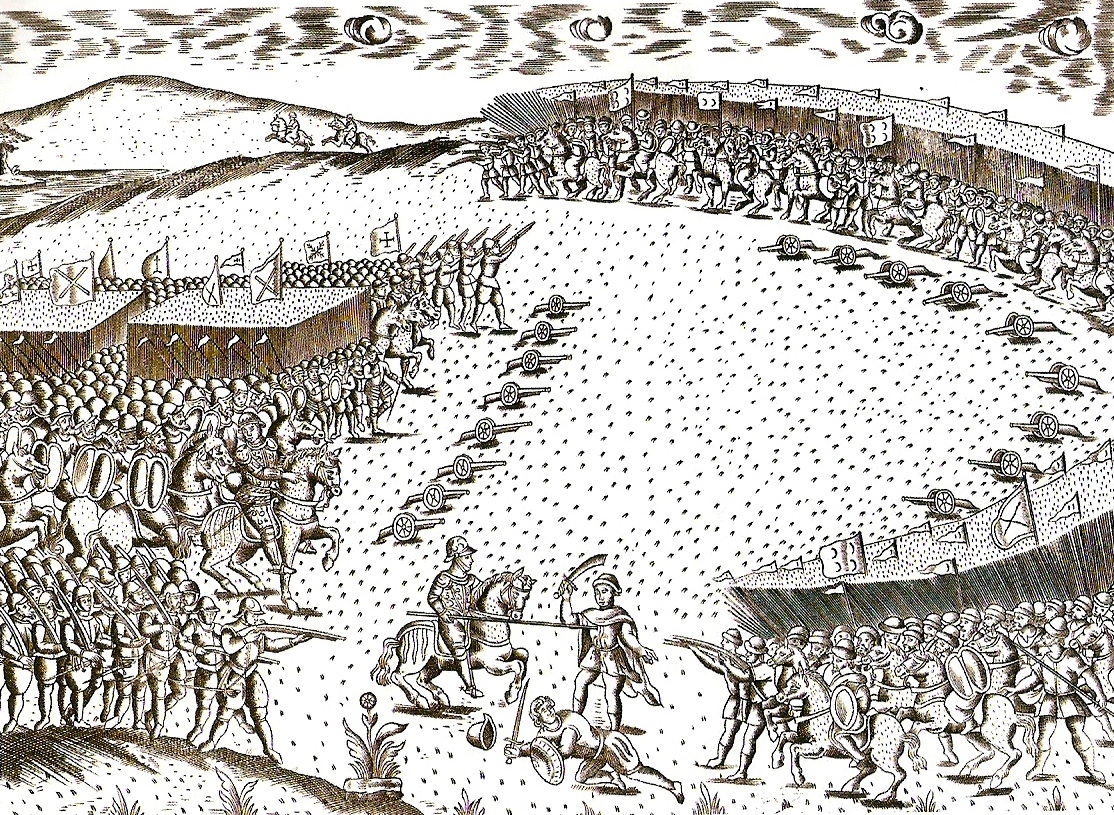
After losing the throne to Abu Marwan Abd al-Malik I in 1576, the ousted Sultan Abu Abdallah Mohammed II had been able to flee to Portugal and then convince King Sebastian to launch a military campaign against Morocco. The campaign turned out to be a complete failure after they were defeated at the Battle of Alcácer Quibir in 1578. The battle ended after nearly four hours of heavy fighting and resulted in the total defeat of the Portuguese and Abu Abdallah's army leaving 8,000 dead, including the slaughter of almost the whole country's nobility, with 15,000 taken as prisoners. Perhaps 100 survivors had managed to escape to the coast. The body of King Sebastian, who led a charge into the midst of the enemy and was then cut off, was never found. The disappearance of Sebastian and the deaths of Abu Abdallah and Abd al-Malik has earned the battle the name "Battle of the Three Kings".
Death (1578)
Main article: Ahmad al-Mansur
Abd al-Malik is known to have been seriously ill in the days leading up to the battle. During the battle itself, he died under unclear circumstances, possibly in combat or from natural causes from his illness. Other accounts, mainly by Moroccan historians, claim that he had been poisoned by some of his officers of Turkish background as part of an Ottoman conspiracy, similar to what had happened to Muhammad al-Shaykh in 1557. While plausible, this account may also have reflected anti-Ottoman attitudes that were present in the court of Ahmad al-Mansur, who succeeded his brother to the throne and ruled from 1578 to 1603.
References
Bibliography
- Stephan and Nandy Ronart: Lexikon der Arabischen Welt. Artemis Verlag, 1972
References
- Muḥammad al-Ṣaghīr ibn Muḥammad Ifrānī. (1888). "Nozhet-Elhâdi : Histoire de la dynastie saadienne au Maroc (1511-1670)".
- Muḥammad al-Ṣaghīr ibn Muḥammad Ifrānī. (1888). "Nozhet-Elhâdi : Histoire de la dynastie saadienne au Maroc (1511-1670)".
- [https://books.google.com/books?id=cPlP5Y4of7AC&pg=PA103 ''The last great Muslim empires: history of the Muslim world'' by Frank Ronald Charles Bagley, Hans Joachim Kissling p.103''ff'']
- [https://books.google.com/books?id=gWjpowTH4b4C&pg=PA75 ''Europe through Arab eyes, 1578-1727'' by Nabil I. Matar p.75]
- "Abd al-Malik fought on the Ottoman side in 1571 in the great sea battle of Lepanto." in ''Ahmad al-Mansur: the beginnings of modern Morocco'' Mercedes García-Arenal OneWorld, 2009 p.10
- [https://books.google.com/books?id=h97ivaPeOx8C&pg=PA277 ''Cervantes in Algiers: a captive's tale'' by María Antonia Garcés, p.277 note 39]
- [https://books.google.com/books?id=V7qpKqM2Ji8C&pg=PA408 ''The Cambridge History of Africa'' by J. D. Fage p.408-]
- [https://books.google.com/books?id=klxj_ecxIqcC&pg=PA293 ''Shakespeare: The critical complex'' by Stephen Orgel p. 293]
- (1985). "La bataille de l'oued el-Makhazen : dite bataille des Trois Rois (4 août 1578)". Éd. du C.N.R.S..
- Abun-Nasr, Jamil. (1987). "A history of the Maghrib in the Islamic period". Cambridge University Press.
- Véronne, Chantal de la. (2012). "Encyclopaedia of Islam, Second Edition". Brill.
- El Moudden, Abderrahmane. (1992). "Sharifs and Padishahs: Moroccan-Ottoman relations from the 16th through the 18th centuries. Contribution to the study of a diplomatic culture". Princeton University (PhD thesis).
This article was imported from Wikipedia and is available under the Creative Commons Attribution-ShareAlike 4.0 License. Content has been adapted to SurfDoc format. Original contributors can be found on the article history page.
Ask Mako anything about Abu Marwan Abd al-Malik I Saadi — get instant answers, deeper analysis, and related topics.
Research with MakoFree with your Surf account
Create a free account to save articles, ask Mako questions, and organize your research.
Sign up freeThis content may have been generated or modified by AI. CloudSurf Software LLC is not responsible for the accuracy, completeness, or reliability of AI-generated content. Always verify important information from primary sources.
Report