From Surf Wiki (app.surf) — the open knowledge base
Abolhassan Banisadr
President of Iran from 1980 to 1981

President of Iran from 1980 to 1981
| Field | Value | ||||||
|---|---|---|---|---|---|---|---|
| honorific_prefix | Seyyed | ||||||
| name | Abolhassan Banisadr | ||||||
| native_name | |||||||
| native_name_lang | fa | ||||||
| image | Abolhassan Banisadr portrait 1980 2.jpg | ||||||
| caption | Banisadr | ||||||
| order | 1st | ||||||
| office | President of Iran | ||||||
| term_start | 4 February 1980 | ||||||
| term_end | 22 June 1981 | ||||||
| 1blankname | Supreme Leader | ||||||
| 1namedata | Ruhollah Khomeini | ||||||
| 2blankname | Prime Minister | ||||||
| 2namedata | Mohammad-Ali Rajai | ||||||
| predecessor | Office established | ||||||
| successor | Mohammad-Ali Rajai | ||||||
| order2 | Head of Council of the Islamic Revolution | ||||||
| term_start2 | 7 February 1980 | ||||||
| term_end2 | 20 July 1980 | ||||||
| predecessor2 | Mohammad Beheshti | ||||||
| successor2 | Office abolished | ||||||
| office3 | Minister of Foreign Affairs | ||||||
| Acting | |||||||
| term_start3 | 12 November 1979 | ||||||
| term_end3 | 29 November 1979 | ||||||
| appointer3 | Council of the Revolution | ||||||
| predecessor3 | Ebrahim Yazdi | ||||||
| successor3 | Sadegh Ghotbzadeh | ||||||
| office4 | Minister of Economic Affairs and Finance | ||||||
| term_start4 | 17 November 1979 | ||||||
| term_end4 | 10 February 1980 | ||||||
| appointer4 | Council of the Revolution | ||||||
| predecessor4 | Ali Ardalan | ||||||
| successor4 | Hossein Namazi | ||||||
| order5 | Member of the Assembly of Experts for Constitution | ||||||
| term_start5 | 15 August 1979 | ||||||
| term_end5 | 15 November 1979 | ||||||
| majority5 | 1,752,816 (69.4%) | ||||||
| constituency5 | Tehran Province | ||||||
| birth_date | |||||||
| birth_place | Hamadan, Imperial State of Persia | ||||||
| death_date | |||||||
| death_place | Paris, France | ||||||
| party | Independent | ||||||
| otherparty | {{plainlist | ||||||
| *National Front <ref>{{cite book | author | Houchang E. Chehabi | title=Iranian Politics and Religious Modernism: The Liberation Movement of Iran Under the Shah and Khomeini | publisher=I.B.Tauris | pages=200 | date=1990 | isbn=978-1850431985}} |
| spouse | |||||||
| children | 3 | ||||||
| signature | Abulhassan Banisadr signature.svg | ||||||
| alma_mater | University of Tehran | ||||||
| Sorbonne University |
| honorific-suffix = Acting
- National Front (1960s)
- Office for the Cooperation of the People with the President (1980–1981)
- National Council of Resistance of Iran (1981–1983) Sorbonne University
Following his impeachment, Banisadr fled Iran and found political asylum in France, where he co-founded the National Council of Resistance of Iran. Banisadr later focused on political writings about his revolutionary activities and his critiques of the Iranian government. He became a critic of Supreme Leader Ali Khamenei and the country's handling of its 2009 elections.
Early life and education
Banisadr was born on 22 March 1933 in Baghcheh, a small village north of Hamedan. His father, Nasrollah, was a Shia cleric who had originally migrated to the area from Bijar, Kurdistan. Banisadr studied law, theology, and sociology at the University of Tehran. He participated in the anti-Shah student movement during the early 1960s, which led to his being imprisoned twice and wounded during the 1963 demonstrations. Due to his political activities, Banisadr soon fled from Iran to France, where he studied finance and economics at the Sorbonne. In France, he also wrote a book about Islamic finance, Eghtesad Tohidi, which roughly translates as "The Economics of Monotheism".
In 1972, Banisadr's father died. It was at the funeral in Iraq that Banisadr met Ruhollah Khomeini, and thereafter joined the latter's Islamic resistance group, becoming an advisor. Prior to the Iranian Revolution, Banisadr was affiliated with the pro-Mossadeq National Front (Iran). During his youth in Paris, he assumed leadership of the Islamic faction within the National Front, then recognized as the Islamic Association of Students. Banisadr later returned to Iran with Khomeini on 1 February 1979, as the Iranian Revolution neared completion.
Career
Upon the establishment of a post-revolutionary Interim Government, Banisadr was named Deputy Minister of Finance. At Khomeini's direction, he also became a member of the Council of the Islamic Revolution, taking the seat vacated by Mehdi Bazargan, who had left to become the prime minister. On 12 November 1979, following the dissolution of the Interim Government in response to the Iran hostage crisis. Banisadr replaced Ebrahim Yazdi as Minister of Foreign Affairs. That same month, on 17 November, Banisadr was promoted to Minister of Finance. He openly criticized the hostage crisis, arguing that the ordeal was isolating Iran from the Third World and forming "a state within a state."
In January 1980, Banisadr registered to become a candidate for Iran's newly formed presidency. Though he lacked religious credentials, he remained protected by Khomeini, who had insisted that members of the clergy not run for office. On 25 January 1980, the election was held and Banisadr received 75.6 percent of the vote, winning a four-year term as president. Inaugural ceremonies took place on 4 February at a hospital where Khomeini was recuperating from a heart ailment.
Between August and September 1980, Banisadr survived two helicopter crashes near the Iran–Iraq border. Prior to the beginning of the Iran–Iraq War, he was made commander-in-chief by Khomeini.
Impeachment
By early 1981, Iran was experiencing difficulty on the frontline, a sharp reduction in human rights, stricter media censorship, increased corruption, and heavy social upheaval. Banisadr, engaged in a power struggle with religious hardliners, called for a new referendum on democratic governance, pointing out that while he had won over 10 million votes in the presidential election, the theocratic-aligned Islamic Republican Party (IRP) received less than 4 million in the parliamentary elections. The message became a rallying point "for all doubters and dissidents" of the new regime, including the militant left-wing Mojahedin-e Khalq organization (MEK).
On 10 June 1981, amid a worsening political climate, Khomeini stripped Banisadr of his title as commander-in-chief. A week later, on 17 June, the Islamic Consultative Assembly debated Banisadr's ousting for his opposition to the theocratic establishment ruling Iran; only one legislator, Salaheddin Bayani, spoke in Banisadr's favor during the proceedings. Legislators filed articles of impeachment against Banisadr on 21 June, which Khomeini signed off on the next day, showing endorsement for the decision. Hussein-Ali Montazeri, second in line to the supreme leader, was among the most prominent of clerics who remained in support of Banisadr, but he later had his authority stripped.[[File:Banisadr namaz.jpg|left|thumb|Banisadr praying in military uniform, 1979]] In the days before his removal from office, Banisadr had gone into hiding in Tehran as the Islamic Revolutionary Guard Corps (IRGC) seized presidential buildings and imprisoned writers at a newspaper closely tied to him. Street violence soon escalated as both Hezbollah mobs and the IRGC attacked "counterrevolutionary" demonstrators at a large pro-Banisadr rally, killing 50, wounding 300, and arresting nearly a thousand. Over the summer of 1981, several of Banisadr's closest friends and advisors were executed, in addition to hundreds of revolutionaries deemed unsympathetic to the Islamic regime.
In an attempt to regain power, Banisadr sought to organize a collaboration of anti-Khomeini factions, including the MEK, the Kurdistan Democratic Party, and the communist Organization of People's Fedaian Guerrillas, while eschewing any contact with pro-monarchist exile groups. Banisadr met numerous times while in hiding with MEK leader Massoud Rajavi to plan a formal alliance. However, after the 27 July 1981 execution of prominent MEK member Mohammad Reza Saadati, both Banisadr and Rajavi concluded that it was unsafe to remain in Iran.
Flight and exile
On 29 July 1981, Banisadr and Rajavi were smuggled aboard an Iranian Air Force Boeing 707 piloted by sympathetic Army Colonel Behzad Moezi.
Banisadr and Rajavi found political asylum in France, conditional on abstaining from anti-Khomeini activities inside the country, a restriction effectively ignored by the two after the French embassy evacuated from Tehran. By 1984, however, Banisadr had withdrawn from the coalition after a disagreement with Rajavi.
''My Turn to Speak''
In 1991, Banisadr released an English translation of his 1989 text My Turn to Speak: Iran, the Revolution and Secret Deals with the U.S. In the book, Banisadr alleged covert dealings between the Ronald Reagan presidential campaign and leaders in Tehran to prolong the Iran hostage crisis before the 1980 United States presidential election. He also claimed that Henry Kissinger plotted to set up a Palestinian state in the Iranian province of Khuzestan and that Zbigniew Brzezinski conspired with Saddam Hussein to plot Iraq's 1980 invasion of Iran.
Lloyd Grove of The Washington Post described the book as atypical for a bestseller, noting that it was assembled from interviews by French journalist Jean-Charles Deniau and characterized it as often enigmatic and complex rather than straightforward. In a review for Foreign Affairs, William B. Quandt characterized the book as a rambling and self-serving collection of reminiscences, stating that it contains numerous sensational allegations but lacks supporting documentation. Kirkus Reviews called it "an interesting—though frequently incredible and consistently self-serving-memoir," adding that "frequent sensational accusations render [Banisadr's] tale an eccentric, implausible commentary on the tragic folly of the Iranian Revolution."
Later views
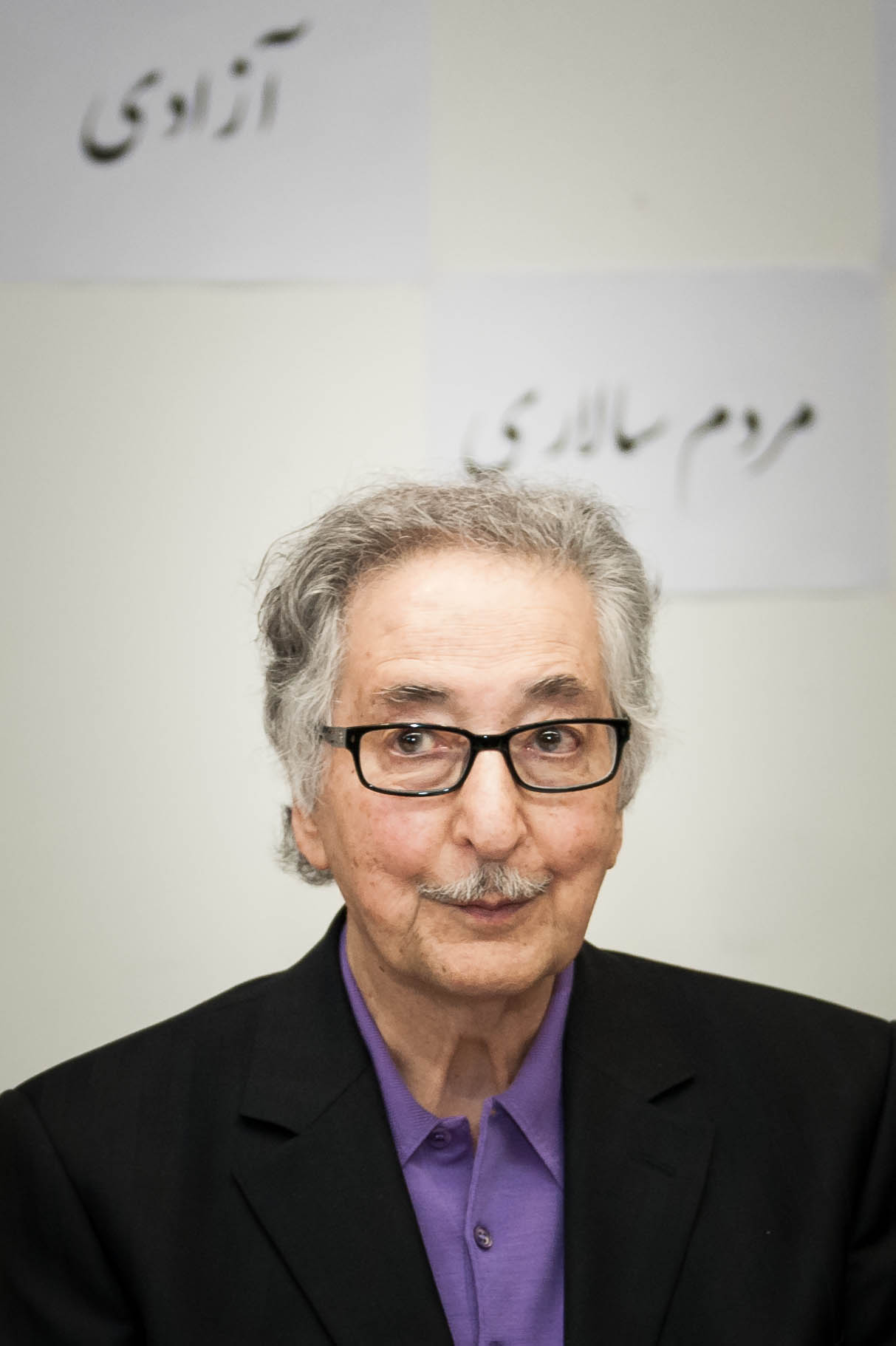
In published articles on the 2009 Iranian presidential election protests, Banisadr attributed the unusually open political climate before the election to the government's urgent need to prove its legitimacy, which he said had been lost. He further wrote that the spontaneous uprising had not only cost the government its political legitimacy, but that Khamenei's threats leading to the violent crackdown had also cost the government its religious legitimacy.
Personal life and death
In 1961, Banisadr married Ozra Hosseini. They shared two daughters and one son.
Beginning in 1981, Banisadr lived with his family in the commune of Auvers-sur-Oise, under close guard by French police, until later moving to Versailles. Banisadr's daughter, Firouzé, married Massoud Rajavi in 1982, but the couple divorced in 1984 following Banisadr's withdrawal from the NCRI.
After a long illness, Banisadr died at Pitié-Salpêtrière Hospital in Paris on 9 October 2021, at the age of 88. He is buried in Versailles, in the cemetery of Gonards.
Hossein Mousavian, Secretary of Iran's National Front (Iran), described Banisadr as "a man of principles." Iran analyst Morteza Kazemian stated on Iran International TV that Banisadr was "an independent nationalist figure, who believed in Iran's territorial integrity and strived to strengthen social movements in Iran and fight clerical despotism."
Books
- Touhid Economics, 1980
- My Turn to Speak: Iran, the Revolution and Secret Deals with the U.S. Washington, D.C.: Potomac Books, 1991. . Translation of Le complot des ayatollahs. Paris: La Découverte, 1989
- Le Coran et le pouvoir: principes fondamentaux du Coran, Imago, 1993
- Dignity in the 21st Century, Doris Schroeder and Abol-Hassan Banisadr, with translation by Mahmood Delkhasteh and Sarah Amsler
- Books after 1980
References
References
- (February 2008). "مجادلات دوره مصدق به شورای انقلاب کشیده شد". Institute for humanities and cultural studies.
- Houchang E. Chehabi. (1990). "Iranian Politics and Religious Modernism: The Liberation Movement of Iran Under the Shah and Khomeini". I.B.Tauris.
- Jessup, John E.. (1998). "An Encyclopedic Dictionary of Conflict and Conflict Resolution, 1945-1996". Greenwood Publishing Group.
- "پورتال رسمی شهرداری بیجار گروس".
- (10 October 2021). "Abolhassan Bani-Sadr, Former Iranian President, Dies at 88". The New York Times.
- (February 2023). "Banisadr, Iran's first president after 1979 revolution, dies". News Observer.
- Bekkin, Renat. "Iran: Experimenting with the Islamic Economy". CA&C Press AB.
- Rubin, Barry. (1980). "Paved with Good Intentions". Penguin Books.
- "Banisadr, President Ousted By Iran Clerics, Dies After 40 Years In Exile".
- Metz, Helen Chapin. "The Revolution". Phobos.
- "Abolhasan Bani-Sadr".
- Abrahamian, Ervand. (1989). "Radical Islam: The Iranian Mojahedin". [[I. B. Tauris]].
- (2001). "Iran: Outlaw, Outcast, Or Normal Country?". Nova Publishers.
- (9 October 2021). "Banisadr, Iran's First President After the 1979 Revolution, Dies". Bloomberg.
- "Iran: Abolhassan Bani-sadar Is Sworn In As First President Of Iran. 1980". British Pathe.
- "Banisadr, Iran's first president after 1979 revolution, dies". Spectrum Local News.
- Mozaffari, Mahdi. (1993). "Changes in the Iranian political system after Khomeini's death". Political Studies.
- (1981-01-05). "Islamic Clerics Denounce Bani-Sadr Over Conduct of The War With Iraq". [[The New York Times]].
- (1982-03-20). "Wavelength". University of Massachusetts Boston.
- Svensson, Isak. (2013). "Ending Holy Wars: Religion and Conflict Resolution in Civil Wars (Peace and Conflict Series)". University of Queensland Press.
- Abrahamian, Ervand. (1989). "Radical Islam: The Iranian Mojahedin". [[I. B. Tauris]].
- Moin, Baqer. (1999). "Khomeini: Life of the Ayatollah". [[I.B. Tauris]].
- Sahimi, Mohammad. (20 August 2013). "Iran's Bloody Decade of 1980s". Payvand.
- (1981-06-18). "Assembly Sets Debate To Impeach Bani-Sadr". The Washington Post.
- (13 May 2013). "Iranian presidential elections 2013: the essential guide". The Guardian.
- Schirazi, Asghar, ''The Constitution of Iran: politics and the state in the Islamic Republic'', London; New York: I.B. Tauris, 1997, p.293-4
- Sinkaya, Bayram. (2015). "The Revolutionary Guards in Iranian Politics: Elites and Shifting Relations (Iranian Studies)". Routledge.
- Sepehr Zabih. (1982). "Iran Since the Revolution". Taylor & Francis.
- "Bani-Sadr Flees to Paris For 2nd Exile". The Washington Post.
- "Bani-Sadr escapes to Paris".
- Sreberny-Mohammadi, Annabelle. (January 1987). "Post-Revolutionary Iranian Exiles: A Study in Impotence". Third World Quarterly.
- Quandt, Walter B.. (Winter 1991). "My Turn To Speak: Iran, the Revolution and Secret Deals with the U.S.". Council on Foreign Relations.
- Neil A Lewis. (7 May 1991). "Bani-Sadr, in U.S., Renews Charges of 1980 Deal". The New York Times.
- Grove, Lloyd. (6 May 1991). "Bani-Sadr Thickens the Plot". The Washington Post.
- "My Turn to Speak: Iran, the Revolution and Secret Deals with the US".
- (19 February 2008). "Persian TV weekly highlights". Voice of America.
- Abolhassan Banisadr. (3 July 2009). "The Regime Cares Nothing about Human Rights". Die Welt / Qantara.
- (31 July 2009). "Iran at the Crossroads". The New York Times.
- (2024-04-29). "تصویر کارت عروسی بنیصدر در سال ۵۳ +عکس منتشرنشده".
- (2025-11-27). "ماجرای دردسرساز بیحجابی همسر بنیصدر/ چه کسی فرمان آزادی عذرا حسینی را صادر کرد؟/".
- Falk, Richard. (1 January 1982). "Interviews with Abol-Hassan Banisadr and Massoud Rajavi". [[Alternatives: Global, Local, Political]].
- (7 July 2009). "Former Iran president says Khamenei behind election "fraud"". WashingtonTV.
- Abrahamian, Ervand. (1989). "Radical Islam: The Iranian Mojahedin". [[I.B. Tauris]].
- O'Hern, Steven. "Iran's Revolutionary Guard: The Threat That Grows While America Sleeps". Potomac Books, Inc..
- Smith, Craig S.. (24 September 2005). "Exiled Iranians Try to Foment Revolution From France". The New York Times.
- "ابوالحسن بنیصدر درگذشت". BBC News فارسی.
- (9 October 2021). "Former Iranian President Bani-Sadr dies in Paris". Reuters.
- (18 October 2021). "Yvelines | la communauté iranienne rend hommage à Abolhassan Bani Sadr à Versailles".
- "Banisadr, President Ousted By Iran Clerics, Dies After 40 Years In Exile".
- "IRAN: EXPERIMENTING WITH THE ISLAMIC ECONOMY". CAC.org.
- Quandt, Walter B.. (Winter 1991). "My Turn To Speak: Iran, the Revolution and Secret Deals with the U.S.". Council on Foreign Relations.
- "Le Coran et le pouvoir: Principes fondamentaux du Coran (Hors collection Imago) (French Edition)". AbeBooks.
- "banisadr.org - Abolhassan Banisadr: Dignity in the 21st Century".
- "banisadr.org - تالیفات بنی صدر از 1360 به بعد".
This article was imported from Wikipedia and is available under the Creative Commons Attribution-ShareAlike 4.0 License. Content has been adapted to SurfDoc format. Original contributors can be found on the article history page.
Ask Mako anything about Abolhassan Banisadr — get instant answers, deeper analysis, and related topics.
Research with MakoFree with your Surf account
Create a free account to save articles, ask Mako questions, and organize your research.
Sign up freeThis content may have been generated or modified by AI. CloudSurf Software LLC is not responsible for the accuracy, completeness, or reliability of AI-generated content. Always verify important information from primary sources.
Report