From Surf Wiki (app.surf) — the open knowledge base
Abdominal muscles
Muscles of the abdomen

Muscles of the abdomen
Abdominal muscles cover the anterior and lateral abdominal region and meet at the anterior midline. These muscles of the anterolateral abdominal wall can be divided into four groups: the external obliques, the internal obliques, the transversus abdominis, and the rectus abdominis.
Anterior abdominal wall
There are three flat skeletal muscles in the antero-lateral wall of the abdomen. The external oblique, closest to the surface, extend inferiorly and medially, in the direction of sliding one’s four fingers into pants pockets. Perpendicular to it is the intermediate internal oblique, extending superiorly and medially, the direction the thumbs usually go when the other fingers are in the pants pocket. The deep muscle, the transversus abdominis, is arranged transversely around the abdomen, similar to the front of a belt on a pair of pants. This arrangement of three bands of muscles in different orientations allows various movements and rotations of the trunk. The three layers of muscle also help to protect the internal abdominal organs in an area where there is no bone.
Linea alba
The linea alba is a white, fibrous band that is made of the bilateral rectus sheaths that join at the anterior midline of the body. These enclose the rectus abdominis muscles (a pair of long, linear muscles, commonly called the “sit-up” muscles) that originate at the pubic crest and pubic symphysis, and extend the length of the body’s trunk. Each muscle is segmented by three transverse bands of collagen fibers called the tendinous intersections. This results in the look of “six-pack abs,” as each segment hypertrophies on individuals at the gym who do many sit-ups.
Posterior abdominal wall
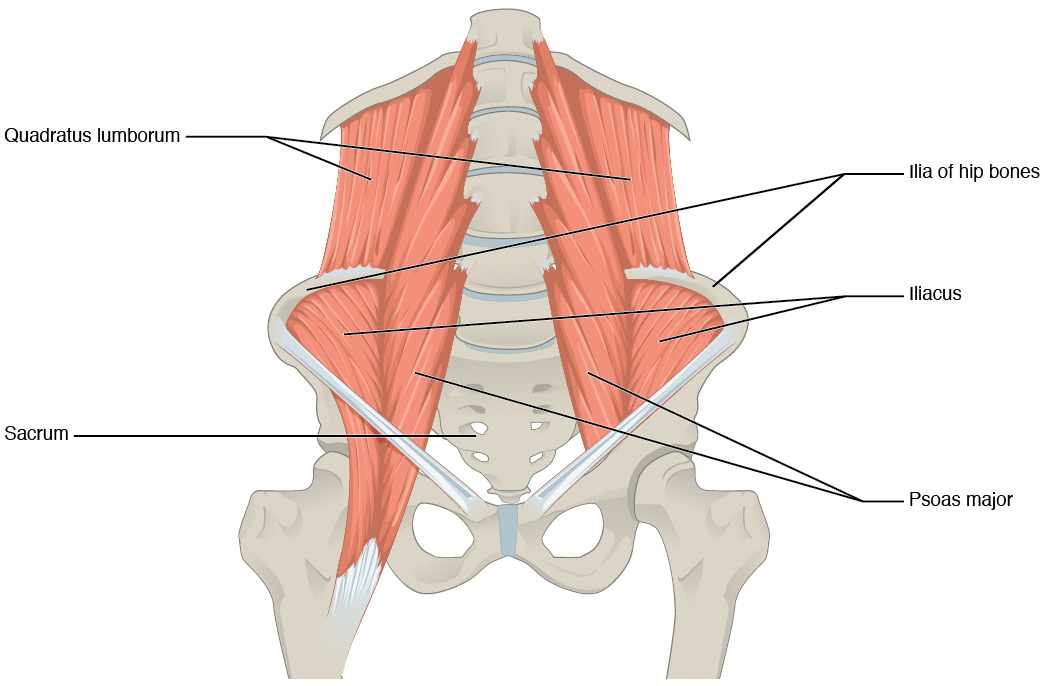
The posterior abdominal wall is formed by the lumbar vertebrae, parts of the ilia of the hip bones, psoas major and iliacus muscles, and quadratus lumborum muscle. This part of the core plays a key role in stabilizing the rest of the body and maintaining posture.
Functions
| Movement | Target | Target motion direction | Prime mover | Origin | Insertion | Twisting at waist; also bending to the side | Squeezing abdomen during forceful exhalations, defecation, urination, and childbirth | Sitting up | Bending to the side |
|---|---|---|---|---|---|---|---|---|---|
| Vertebral column | Supination; lateral flexion | External obliques; internal obliques | Ribs 5–12; ilium | Ribs 7–10; linea alba; ilium | |||||
| Abdominal cavity | Compression | Transversus abdominis | Ilium; ribs 5–10 | Sternum; linea alba; pubis | |||||
| Vertebral column | Flexion | Rectus abdominis | Pubis | Sternum; ribs 5 and 7 | |||||
| Vertebral column | Lateral flexion | Quadratus lumborum | Ilium; ribs 5–10 | Rib 12; vertebrae L1–L4 |
Source text
This article was imported from Wikipedia and is available under the Creative Commons Attribution-ShareAlike 4.0 License. Content has been adapted to SurfDoc format. Original contributors can be found on the article history page.
Ask Mako anything about Abdominal muscles — get instant answers, deeper analysis, and related topics.
Research with MakoFree with your Surf account
Create a free account to save articles, ask Mako questions, and organize your research.
Sign up freeThis content may have been generated or modified by AI. CloudSurf Software LLC is not responsible for the accuracy, completeness, or reliability of AI-generated content. Always verify important information from primary sources.
Report