From Surf Wiki (app.surf) — the open knowledge base
Aardvark
Burrowing mammal native to Africa

Burrowing mammal native to Africa
The aardvark ( ; Orycteropus afer) is a medium-sized, burrowing, nocturnal mammal native to Africa. The aardvark is the only living member of the genus Orycteropus, the family Orycteropodidae and the order Tubulidentata. It has a long proboscis, similar to a pig's snout, which is used to sniff out food.
The aardvark is an afrotherian, a clade that also includes elephants, manatees, and hyraxes.
It is found over much of the southern two-thirds of the African continent, avoiding areas that are mainly rocky. A nocturnal feeder, the aardvark subsists on ants and termites by using its sharp claws and powerful legs to dig the insects out of their hills. Aardvarks also dig to create burrows in which to live and rear their young.
Name and taxonomy
Name
The aardvark is sometimes colloquially called the "African ant bear", "anteater" (not to be confused with the South American anteaters), or the "Cape anteater" after the Cape of Good Hope.
The name aardvark is Afrikaans () and comes from earlier Afrikaans erdvark.
The name Orycteropus means 'burrowing foot', and the name afer refers to Africa.
Taxonomy

The aardvark is not closely related to the pig; rather, it is the sole extant representative of the obscure mammalian order Tubulidentata, in which it is usually considered to form one variable species of the genus Orycteropus, the sole surviving genus in the family Orycteropodidae. The aardvark is not closely related to the South American anteater, despite sharing some characteristics and a superficial resemblance. Along with sirenians, hyraxes, elephants, and their extinct relatives, these animals form the superorder Afrotheria. Studies of the brain have shown the similarities with Condylarthra.
Evolutionary history
Based on his study of fossils, Bryan Patterson has concluded that early relatives of the aardvark appeared in Africa around the end of the Paleocene. The ptolemaiidans, a clade of mammals with uncertain affinities, may actually be stem-aardvarks, either as a sister clade to Tubulidentata or as a grade leading to true tubulidentates.
The first unambiguous tubulidentate was probably Myorycteropus africanus from Kenyan Miocene deposits. The earliest example from the genus Orycteropus was Orycteropus mauritanicus, found in Algeria in deposits from the middle Miocene, with an equally old version found in Kenya. Fossils from the aardvark have been dated to 5 million years, and have been located throughout Europe and the Near East.
The Pleistocene Plesiorycteropus from Madagascar was originally thought to be a tubulidentate that was descended from ancestors that entered the island during the Eocene. However, a number of subtle anatomical differences coupled with recent molecular evidence now lead researchers to believe that Plesiorycteropus is a relative of golden moles and tenrecs that achieved an aardvark-like appearance and ecological niche through convergent evolution.
Subspecies
The aardvark has seventeen poorly defined subspecies listed:
- Orycteropus afer afer (Southern aardvark)
- O. a. adametzi Grote, 1921 (Western aardvark)
- O. a. aethiopicus Sundevall, 1843
- O. a. angolensis Zukowsky & Haltenorth, 1957
- O. a. erikssoni Lönnberg, 1906
- O. a. faradjius Hatt, 1932
- O. a. haussanus Matschie, 1900
- O. a. kordofanicus Rothschild, 1927
- O. a. lademanni Grote, 1911
- O. a. leptodon Hirst, 1906
- O. a. matschiei Grote, 1921
- O. a. observandus Grote, 1921
- O. a. ruvanensis Grote, 1921
- O. a. senegalensis Lesson, 1840
- O. a. somalicus Lydekker, 1908
- O. a. wardi Lydekker, 1908
- O. a. wertheri Matschie, 1898 (Eastern aardvark)
The 1911 Encyclopædia Britannica also mentions O. a. capensis or Cape ant-bear from South Africa.
Description

The aardvark is vaguely pig-like in appearance. Its body is stout with a prominently arched back and is sparsely covered with coarse hairs. The limbs are of moderate length, with the rear legs being longer than the forelegs. The front feet have lost the pollex (or 'thumb'), resulting in four toes, while the rear feet have all five toes. Each toe bears a large, robust nail which is somewhat flattened and shovel-like, and appears to be intermediate between a claw and a hoof. Whereas the aardvark is considered digitigrade, it appears at times to be plantigrade. This confusion happens because when it squats it stands on its soles. A contributing characteristic to the burrow digging capabilities of aardvarks is an endosteal tissue called compacted coarse cancellous bone (CCCB). The stress and strain resistance provided by CCCB allows aardvarks to create their burrows, ultimately leading to a favourable environment for plants and a variety of animals. Digging is also facilitated by its forearm's unusually stout ulna and radius.[[File:Aardvark skeleton mount.JPG|thumb|right|An aardvark skeleton and mounted individual]]An aardvark's weight is typically between 60 and(-). An aardvark's length is usually between 105 and(-), and can reach lengths of 2.2 m when its tail (which can be up to 70 cm) is taken into account. It is 60 cm tall at the shoulder, and has a girth of about 100 cm. It does not exhibit sexual dimorphism.
It is the largest member of the proposed clade Afroinsectiphilia. The aardvark is pale yellowish-grey in colour and often stained reddish-brown by soil. The aardvark's coat is thin, and the animal's primary protection is its tough skin. Its hair is short on its head and tail; however its legs tend to have longer hair. The hair on the majority of its body is grouped in clusters of three to four hairs. The hair surrounding its nostrils is dense to help filter particulate matter out as it digs. Its tail is very thick at the base and gradually tapers.
Head
The greatly elongated head is set on a short, thick neck, and the end of the snout bears a disc, which houses the nostrils. It contains a thin but complete zygomatic arch. The teeth consist of 14 upper and 12 lower jaw molars. The nasal area of the aardvark is another unique area, as it contains ten nasal conchae, more than any other placental mammal.
The sides of the nostrils are thick with hair. Its nose is made up of more turbinate bones than any other mammal, with between nine and 11, compared to dogs with four to five. The snout resembles an elongated pig snout. The mouth is small and tubular, typical of species that feed on ants and termites. The aardvark has a long, thin, snakelike, protruding tongue (as much as 30 cm long) The ears, which are very effective, are disproportionately long, about 20 - long. The eyes are small for its head, and consist only of rods.
Digestive system
The aardvark's stomach has a muscular pyloric area that acts as a gizzard to grind swallowed food up, thereby rendering chewing unnecessary. Its cecum is large. Both sexes emit a strong smelling secretion from an anal gland. Its salivary glands are highly developed and almost completely ring the neck; their output is what causes the tongue to maintain its tackiness. The female has two pairs of teats in the inguinal region.
Genetically speaking, the aardvark is a living fossil, as its chromosomes are highly conserved, reflecting much of the early eutherian arrangement before the divergence of the major modern taxa.
Habitat and range
Aardvarks are found in sub-Saharan Africa, where suitable habitat (savannas, grasslands, woodlands and bushland) and food (i.e., ants and termites) is available. They spend the daylight hours in dark burrows to avoid the heat of the day. The only major habitat that they are not present in is swamp forest, as the high water table precludes digging to a sufficient depth. They also avoid terrain rocky enough to cause problems with digging. They have been documented as high as 3200 m in Ethiopia. They can be found throughout sub-Saharan Africa from Ethiopia all the way to Cape of Good Hope in South Africa with few exceptions including the coastal areas of Namibia, Ivory Coast, and Ghana. They are not found in Madagascar.
Ecology and behaviour


Aardvarks live for up to 23 years in captivity. Its keen hearing warns it of predators: lions, leopards, cheetahs, African wild dogs, hyenas, and pythons. Some humans also hunt aardvarks for meat. Aardvarks can dig fast or run in zigzag fashion to elude enemies, but if all else fails, they will strike with their claws, tail and shoulders, sometimes flipping onto their backs lying motionless except to lash out with all four feet. They are capable of causing substantial damage to unprotected areas of an attacker. They will also dig to escape as they can. Sometimes, when pressed, aardvarks can dig extremely quickly.
Feeding
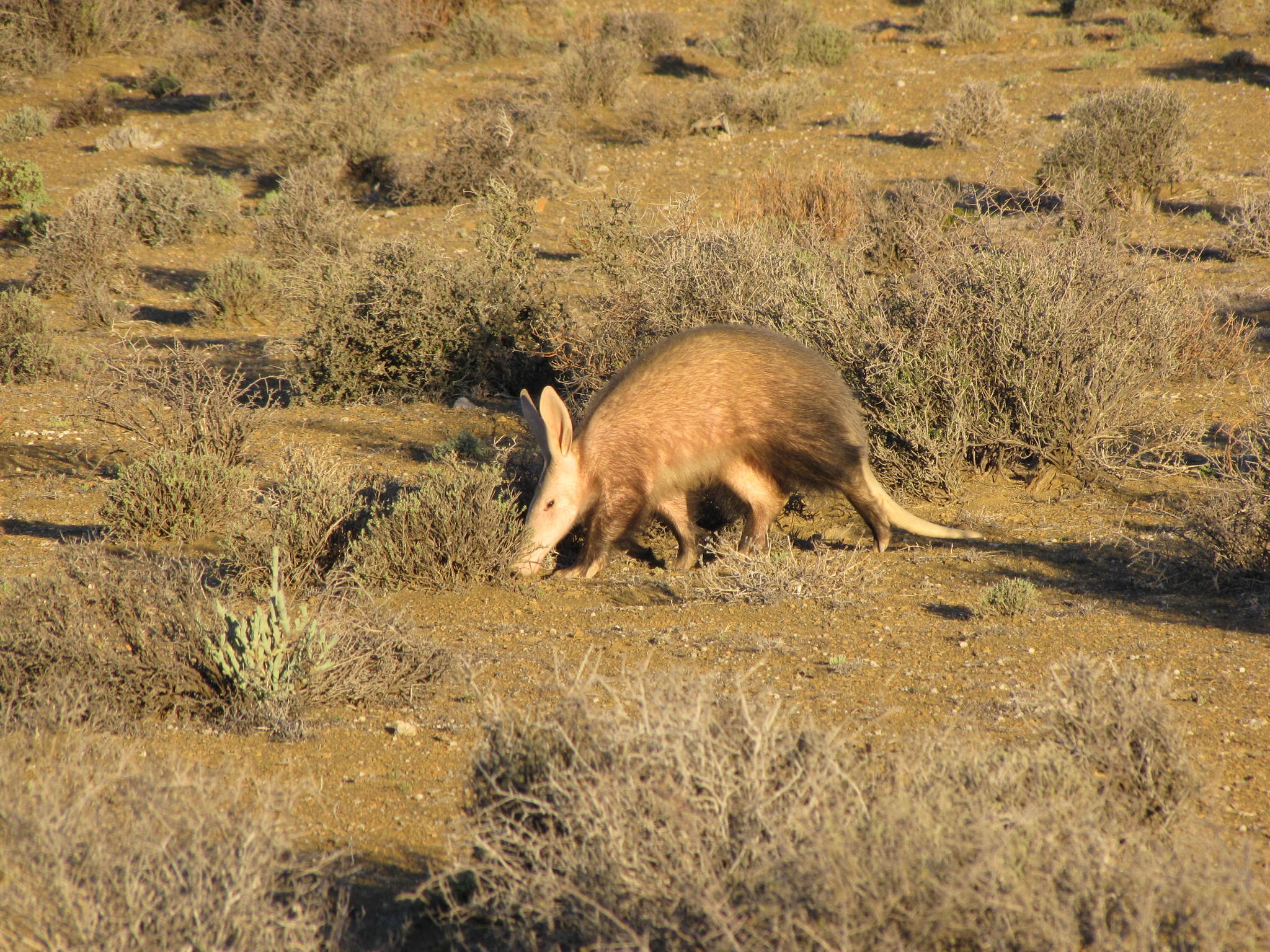
The aardvark is nocturnal and is a solitary creature that feeds almost exclusively on ants and termites (myrmecophagy); studies in the Nama Karoo revealed that ants, especially Anoplolepis custodiens, were the predominant prey year-round, followed by termites like Trinervitermes trinervoides. In winter, when ant numbers declined, aardvarks relied more on termites, often feeding on epigeal mounds coinciding with the presence of alates, possibly to meet their nutritional needs. They avoid eating the African driver ant and red ants. Due to their stringent diet requirements, they require a large range to survive.
The only fruit eaten by aardvarks is the aardvark cucumber. In fact, the cucumber and the aardvark have a symbiotic relationship as they eat the subterranean fruit, then defecate the seeds near their burrows, which then grow rapidly due to the loose soil and fertile nature of the area. The time spent in the intestine of the aardvark helps the fertility of the seed, and the fruit provides needed moisture for the aardvark.
An aardvark emerges from its burrow in the late afternoon or shortly after sunset, and forages over a considerable home range encompassing 10 to. While foraging for food, the aardvark will keep its nose to the ground and its ears pointed forward, which indicates that both smell and hearing are involved in the search for food. They zig-zag as they forage and will usually not repeat a route for five to eight days as they appear to allow time for the termite nests to recover before feeding on it again.
During a foraging period, they will stop to dig a V-shaped trench with their forefeet and then sniff it profusely as a means to explore their location. Termite mounds alone do not provide enough food for the aardvark, so they look for termites that are on the move. When these insects move, they can form columns 10 - long and these tend to provide easy pickings with little effort exerted by the aardvark. These columns are more common in areas of livestock or other hoofed animals. The trampled grass and dung attract termites from the Odontotermes, Microtermes, and Pseudacanthotermes genera.
On a nightly basis they tend to be more active during the first portion of night (roughly the four hours between 8:00p.m. and 12:00a.m.); however, they do not seem to prefer bright or dark nights over the other. During adverse weather or if disturbed they will retreat to their burrow systems. They cover between 2 and per night; however, some studies have shown that they may traverse as far as 30 km in a night.
Aardvarks shift their circadian rhythms to more diurnal activity patterns in response to a reduced food supply. This survival tactic may signify an increased risk of imminent mortality.
Vocalisation
The aardvark is a rather quiet animal. However, it does make soft grunting sounds as it forages and loud grunts as it makes for its tunnel entrance. When it is threatened it will make for one of its burrows. If one is not close it will dig a new one rapidly. This new one will be short and require the aardvark to back out when the coast is clear.
Movement
The aardvark is a good swimmer and can swim in strong currents. It can dig a yard of tunnel in about five minutes, but otherwise moves fairly slowly. When leaving the burrow at night, it pauses at the entrance for about ten minutes, sniffing and listening. After this period of watchfulness, it bounds out to a distance of some 10 m. It then pauses, pricks its ears, twisting its head to listen, before moving off to forage.
Aside from digging out ants and termites, the aardvark also excavates burrows in which to live, which generally fall into one of three categories: burrows made while foraging, refuge and resting location, and permanent homes.
Reproduction
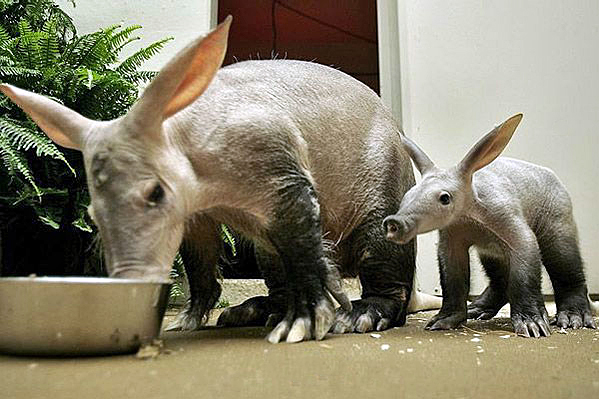
It is believed to exhibit polygamous breeding behavior. During mating, the male secures himself to the female's back using his claws, which can occasionally result in noticeable scratches. Males play no role on parental care.
Aardvarks pair only during the breeding season; after a gestation period of seven months, one cub weighing around 1.7 - is born during May–July. When born, the young has flaccid ears and many wrinkles. When nursing, it will nurse off each teat in succession. After two weeks, the folds of skin disappear and after three, the ears can be held upright. After 5–6 weeks, body hair starts growing. It is able to leave the burrow to accompany its mother after only two weeks and eats termites at nine weeks, and is weaned between three months and 16 weeks. At six months of age, it is able to dig its own burrows, but it will often remain with the mother until the next mating season, and is sexually mature from approximately two years of age.
Conservation
Aardvarks were thought to have declining numbers, however, this is possibly because they are not readily seen. There are no definitive counts because of their nocturnal and secretive habits; however, their numbers seem to be stable overall. They are not considered common anywhere in Africa, but due to their large range, they maintain sufficient numbers. There may be a slight decrease in numbers in eastern, northern, and western Africa. Southern African numbers are not decreasing. It has received an official designation from the IUCN as least concern. However, the species is in a precarious situation, as they are so dependent on such specific food; therefore if a problem arises with the abundance of termites, the species as a whole would be affected drastically.
Recent research suggests that aardvarks may be particularly vulnerable to alterations in temperature caused by climate change. Droughts negatively impact the availability of termites and ants, which comprise the bulk of an aardvark's diet. Nocturnal species faced with resource scarcity may increase their diurnal activity to spare the energy costs of staying warm at night, but this comes at the cost of withstanding high temperatures during the day. A study on aardvarks in the Kalahari Desert saw that five out of six aardvarks being studied perished following a drought.
Aardvarks adapt well to captivity. The first recorded instance was at London Zoo in 1869, which housed an individual from South Africa.
Mythology and popular culture
In African folklore, the aardvark is admired because of its diligent quest for food and its fearless response to soldier ants. Hausa magicians make a charm from the heart, skin, forehead, and nails of the aardvark, which they then proceed to pound together with the root of a certain tree. Wrapped in a piece of skin and worn on the chest, the charm is said to give the owner the ability to pass through walls or roofs at night. The charm is said to be used by burglars and those seeking to visit young girls without their parents' permission. Aome tribes, such as the Margbetu, Ayanda, and Logo, The ancient Egyptian god Set is usually depicted with the head of an unidentified animal, whose similarity to an aardvark has been noted in scholarship.
The titular character and his families from Arthur, an animated television series for children based on a book series and produced by WGBH, shown in more than 180 countries, is an aardvark. In the first book of the series, Arthur's Nose (1976), he has a long, aardvark-like nose, but in later books, his face becomes more rounded.
Footnotes
References
References
- Taylor, A.. (2015). "''Orycteropus afer''".
- {{harvnb. Hoiberg. 2010
- [https://www.dsae.co.za/entry/aardvark/e00015 "Aardvark, n."] ''Dictionary of South African English''. Dictionary Unit for South African English, 2018. 26 February 2019.
- {{harvnb. Schlitter. 2005
- {{harvnb. Goodwin. 1997
- It means 'earth [[pig]]' or 'ground pig' ({{lang. af. aarde: {{gloss. earth, {{lang. af. vark: {{gloss. pig, young pig), because of its burrowing habits.{{harvnb. Merriam-Webster Online Dictionary. 2010
- {{Cite OED. (March 2018)
- (2018). "aardvark". Dictionary Unit for South African English.
- Shoshani. 2002
- {{harvnb. Shoshani. 2002
- Asher. Bennett. Lehmann. 2009
- {{harvnb. Rodriguez. 2013
- {{harvnb. Rahm. 1990
- Shoshani. 2002
- (March 2007). "Additional material of the enigmatic Early Miocene mammal ''Kelba'' and its relationship to the order Ptolemaiida". Proc Natl Acad Sci USA.
- Seiffert, Erik R. (2007). "A new estimate of afrotherian phylogeny based on simultaneous analysis of genomic, morphological, and fossil evidence". BMC Evolutionary Biology.
- (2013). "A Molecular Phylogeny of Plesiorycteropus Reassigns the Extinct Mammalian Order 'Bibymalagasia'". PLOS ONE.
- {{cite EB1911
- {{harvnb. Rahm. 1990
- (11 July 2018). "Digging the compromise: investigating the link between limb bone histology and fossoriality in the aardvark (Orycteropus afer)". PeerJ.
- (1 August 2018). "Ecosystem engineering through aardvark (Orycteropus afer) burrowing: Mechanisms and effects". Ecological Engineering.
- (2018-07-11). "Digging the compromise: investigating the link between limb bone histology and fossoriality in the aardvark ( Orycteropus afer )". PeerJ.
- "Aardvark Forelimb and Scapula - Wits University".
- (2011). "Handbook of the mammals of the world". Lynx Edicions.
- The head of the aardvark contains many unique and different features. One of the most distinctive characteristics of the Tubulidentata is their [[Tooth. teeth]]. Instead of having a [[pulp (tooth). canines]] at the front of the jaw, which fall out and are not replaced. Adult aardvarks have only cheek teeth at the back of the [[jaw]], and have a [[dentition. dental formula]] of: {{DentalFormula. Martin. 1983
- Rahm. 1990
- {{harvnb. Anon. 2003
- {{harvnb. African Wildlife Foundation. 2013
- {{harvnb. Anon. 2013
- {{harvnb. Rahm. 1990
- {{harvnb. van Aarde. 1984
- (2002-01-01). "The feeding ecology of the aardvark Orycteropus afer". Journal of Arid Environments.
-
- cm. Rahm. 1990
- (2020). "Increased Diurnal Activity Is Indicative of Energy Deficit in a Nocturnal Mammal, the Aardvark". Frontiers in Physiology.
- Rahm. 1990
- Melton, Derek A.. (June 1976). "The biology of aardvark (Tubulidentata-Orycteropodidae)". Mammal Review.
- (2017-07-31). "Drought-induced starvation of aardvarks in the Kalahari: an indirect effect of climate change". Biology Letters.
- {{harvnb. Rebecca. 2007
- {{harvnb. te Velde. 1997
- {{harvnb. WGBH. 2013
- [https://www.thriftbooks.com/w/arthurs-nose-an-arthur-adventure_marc-brown/317005/item/2746044/ Arthur's Nose], Thriftbooks; accessed 2020.09.29.
- [https://www.thriftbooks.com/w/arthurs-eyes-an-arthur-adventure_marc-brown/464241/item/15015689/ Arthur's Eyes], Thriftbooks; accesses 2020.09.29.
This article was imported from Wikipedia and is available under the Creative Commons Attribution-ShareAlike 4.0 License. Content has been adapted to SurfDoc format. Original contributors can be found on the article history page.
Ask Mako anything about Aardvark — get instant answers, deeper analysis, and related topics.
Research with MakoFree with your Surf account
Create a free account to save articles, ask Mako questions, and organize your research.
Sign up freeThis content may have been generated or modified by AI. CloudSurf Software LLC is not responsible for the accuracy, completeness, or reliability of AI-generated content. Always verify important information from primary sources.
Report