From Surf Wiki (app.surf) — the open knowledge base
A30 road
Major road in England

Major road in England
| Field | Value | ||||
|---|---|---|---|---|---|
| country | GBR | ||||
| type | A | ||||
| route | 30 | ||||
| map | [[File:A30 road map.png | 200px]] | |||
| map_custom | yes | ||||
| length_mi | 284 | ||||
| direction_a | East | ||||
| direction_b | West | ||||
| terminus_a | Hounslow, London () | ||||
| destinations | Heathrow Airport | ||||
| Staines-upon-Thames | |||||
| Basingstoke | |||||
| Salisbury | |||||
| Shaftesbury | |||||
| Yeovil | |||||
| Honiton | |||||
| Exeter | |||||
| Okehampton | |||||
| Launceston | |||||
| Bodmin | |||||
| Newquay | |||||
| Truro | |||||
| Redruth | |||||
| Penzance | |||||
| terminus_b | Land's End () | ||||
| {{jct | country | GBR | A | 4}} | |
| {{jct | country | GBR | A | 312 | name1= }} |
| {{jct | country | GBR | M | 25 | dab1=Great Britain}} Junction 13 |
| {{jct | country | GBR | A | 303 | name1= }} |
| {{jct | country | GBR | A | 34}} | |
| {{jct | country | GBR | A | 338 | name1= }} |
| {{jct | country | GBR | A | 36}} | |
| {{jct | country | GBR | A | 350 | name1= }} |
| {{jct | country | GBR | A | 303 | name1= }} |
| {{jct | country | GBR | A | 35}} | |
| {{jct | country | GBR | M | 5 | dab1=Great Britain}} Junctions 29 and 31 |
| {{jct | country | GBR | A | 38}} | |
| {{jct | country | GBR | A | 39}} | |
| previous_type | A | ||||
| previous_route | 29 | ||||
| next_type | A | ||||
| next_route | 31 |
Staines-upon-Thames Basingstoke Salisbury Shaftesbury Yeovil Honiton Exeter Okehampton Launceston Bodmin Newquay Truro Redruth Penzance Junction 13
Junctions 29 and 31
The A30 is a major road in England, running 284 miles WSW from London to Land's End.
The road has been a principal axis in Britain from the 17th century to early 19th century, as a major coaching route and post road. It used to provide the fastest route from London to the South West by land until a century before roads were numbered; nowadays much of this function is performed by the M3 (including A316) and A303 roads. The road has kept its principal status in the west from Honiton, Devon to Land's End where it is mainly dual carriageway and retains trunk road status.
Route
London to Honiton
The A30 begins at Henlys Roundabout, where the route stems from the A4 near Hounslow. It crosses the A312 before running south of the Southern Perimeter Road, Heathrow Airport and north of Ashford and Staines-upon-Thames, before reaching the M25 motorway orbital motorway. This first section is entirely dual carriageway. Taken with the A4, its natural continuation which nearby becomes non-dualled towards the M25, the section constitutes one of five routes into the southern half of London which reach Inner London with at least a dual-carriageway, the others being the A3, the M3, the M20 and A2, however approximately one mile before reaching Inner London it is combined with the London variants of the M3 and M4 approaches.
After running astride the M25 to cross the Thames on a bridge designed by Lutyens, the Runnymede Bridge, the A30 runs parallel to but distant from the M3 until southwest of Basingstoke, bypassing Egham and passing through heathland and Sunningdale, Bagshot bypass, and Camberley where the route almost mirrors the Devil's Highway, a stone (stane) street to Calleva Atrebatum (Silchester Roman town), believed to be older still, then passes close to Hook town centre and in the surrounding country the soil is arable.
After the 1930s Basingstoke bypass, the M3 changes direction (between North Waltham and Popham, at the Popham Interchange) the A303 takes over for 2 mi the A30 losing continuity. From Sutton Scotney village the A30 runs parallel to the latter road as-the-crow-flies 85 mi to north-east of Honiton, Devon passing through towns Stockbridge (where it meets its first substantive river since the Thames, the Test) and its trout fishing centres, Shaftesbury, Sherborne, Yeovil, Crewkerne and Chard. Between Stockbridge and Shaftesbury it enters the cathedral city of Salisbury.
Between the M25 and Honiton, the A30 is mostly single carriageway, carrying local traffic with short stretches of dual carriageway from Camberley to Basingstoke, which has a dualled inner ring road, two between Stockbridge and Salisbury (an alike ring road shared with the A36), and between Sherborne and Yeovil.
Exeter to Penzance
This section is a trunk road as far as Penzance. The route is dual carriageway from Exeter to Camborne in West Cornwall. West of Camborne is mainly single carriageway.
To pass Exeter, through traffic can join the M5 motorway for 3 mi. West of Exeter, the A30 is dual carriageway through Devon and into Cornwall, bypassing Whiddon Down, Okehampton and Launceston.
At Whiddon Down the road previously had a roundabout, known as the Merrymeet junction, but was replaced in December 2006 by a split-level junction allowing the A30 dual carriageway to run unimpeded by traffic from the A382, in what had been a major cause of traffic.
The dual carriageway continues through Cornwall. A Preferred Route Announcement to dual the section from Carland Cross to Chiverton Cross was made in July 2017, a Development Consent Order was made in February 2020 by Secretary of State for Transport, and construction started in March 2020. The new section opened in 2024.
From Chiverton Cross, the dual carriageway bypasses Redruth and Camborne. The A30 returns to single carriageway west of Camborne, and a mid-1980s bypass takes the road around Hayle. Between Hayle and Penzance, the A30 returns to the original route and it passes through several villages. Approaching Penzance, the A30 briefly becomes a dual carriageway once again. Once west of Penzance, the A30 becomes a more rural road running through or past several villages, before terminating at Land's End.
Junction list
|road
History
Post road
A customary route was long established, even prior to the appointment of Brian Tuke as Master of the King's Posts in 1512, and in William Harrison's Description of England in Holinshed's Chronicles in 1577 this is described as a route from London, through Chard, Honiton, Exeter, Crockernwell, Okehampton, Launceston, Bodmin, and on through Truro.
In 1574, Elizabeth I's Master of Posts Thomas Randolph was given an Order of Council to establish permanent posts on the route between the royal court and Exeter "for the speedy conveyance of all such packets as shall be sent from the Earl of Bedford out of the West Country", with then Earl of Bedford being Francis Russell, later Lord Lieutenant of Devon, based at Tavistock. Whilst court postmaster Robert Gascoigne was tasked the following week, the permanent posts were not in operation until 28 July 1579, when twelve Royal postmasters were in place, at the rate of 20 pence per day, formalising the route as a Royal post road.
This route followed:
- the City of London post room
- Hartfordbridge
- Basingstoke
- Andover
- Salisbury
- Shaftesbury
- Sherborne
- Crewkerne
- Honiton
- Exeter
- Crediton
All of these intermediate towns from the 1579 post road are on (or bypassed by) the modern A30, with the exception of Andover, which the modern road passes to the South of through Stockbridge, Sutton Scotney, and North Waltham.
There may have been a period of abeyance for some of these posts, but by the late 1580s, the threat of Spanish Invasion reinforced the need for effective communication along the line to Plymouth, for which the post road was the natural route. By 1595, the route was fully re-established to Exeter (and thence on a branch to Plymouth) and the royal route continued to Launceston. The route into Cornwall was used for passing of messages in relation to the Nine Years' War in Southern Ireland.
17th–18th centuries
.jpg)
The road appeared on John Ogilby's 1675 map of Britain, as "The Road from London to The Land's End in Cornwall", where which he described that "The Post-Office making this one of their Principal Roads", and opined that the section through Surrey and Hampshire was "in general a very good Road with suitable Entertainment".
The route described by Ogilby started at Hyde Park Corner, and closely mirrored the modern route as far as Exeter, except for three sections from Knightsbridge to Bedfont, Basingstoke to Salisbury via Andover and Exeter to Penzance via Ashburton, Plymouth, and following the Cornish south coast via St Austell.
The road was known to attract significant postal and coach traffic along its length by 1686.
The route is described as the "Great Road to Land's End" in the Magna Britannia, published in the early 19th century. As the coaching road to Land's End was a major route, it was a popular place for highwaymen. William Davies, also known as the Golden Farmer, robbed several coaches travelling across Bagshot Heath. He was hanged in 1689 at a gallows at the local gibbet hill between Bagshot and Camberley. The Jolly Farmer pub was built near the site of the gallows (gibbet), a junction.
19th century
At the turn of the 19th century, William Hanning created the "New Direct Road", a fast coaching route between London and Exeter. The road deviated from Ogilby's route running via Amesbury and Ilminster, rejoining the older road at Honiton. It became popular with postal services such as The Subscription. In 1831, a race was held between London and Exeter via the New Direct Road, which resulted in a dead heat. 170 miles were covered in 13 hours, compared to a typical early 18th century time of four days. In response to the competition of routes, a new turnpike road was built west of Chard, avoiding the historic route to Honiton via Stockland, with several steep hills. This road met the New Direct Road near Upottery.
This 'New Direct Road' is the basis of what is now the A303.
Historically, the route between London and Land's End was also called the "Great South-West Road". In the 21st century, the name only refers to a small section of the road near Heathrow.
Redruth to Penzance
In 1825 an Act of Parliament established the Hayle Bridge Causeway and Turnpike Trust which was required to construct a bridge, causeway and turnpike over the Hayle River from Griggs Quay () in the west to Phillack in the east. The turnpike was needed to ease the transport of copper ore to the port at Hayle for export. A second Act was passed in 1837 to establish the Griggs Quay to Penzance Turnpike and in 1839 an Act formed a third trust, the Hayle and Redruth Turnpike to complete the turnpike to Redruth. The running of the Causeway turnpike was overseen by the winner of a public auction and for the year 1880, the winning bid was £591 10s. In 1885 the management of the causeway by the turnpike came to an end, and the White house (tollhouse) on the eastern end of the Hayle causeway, along with the garden and three granite posts was put up for auction on 30 October 1885. A second tollhouse at Long Rock was also for auction as well as a number of posts and gates.
20th century
The A30 was one of the first roads to be classified by the Ministry of Transport for funding in 1921. It followed Ogilby's route up to Exeter, then the basic route of the modern A30 through Okehampton, Launceston and Bodmin to the Greenmarket in Penzance, where it ended. It was extended to Land's End in 1925.
The Great South West Road section of the A30 around Heathrow had been planned as the western end of the Great West Road project, one of the first bypasses built for motor traffic. Construction began in 1914 but was quickly halted because of World War I. It resumed construction in 1919. The full route from Chiswick to Ashford was opened by King George V on 30 May 1925.
Following the construction of a bypass around Basingstoke, the route of the A30 was changed on 1 April 1933 to run by Sutton Scotney and Stockbridge, rejoining the original route at Lopcombe Corner east of Salisbury. An alternative route, the A303 was created out of existing roads at the same time between Micheldever Station and the Blackdown Hills, that followed the basic course of Hanning's New Direct Road.
By the mid-20th century, large sections of the A30 were struggling to cope with the increasing demands of road traffic. In the mid-1960s, numerous councils complained that the Secretary of State for Transport, Barbara Castle, decided that improvements to the A38 from Exeter to Plymouth were of higher priority for funding than any work on the A30. Cornwall County Council complained that the A30 through the county was narrow and twisted, and known as the "stage coach trail".
Following World War II, the Ministry of Transport planned a large-scale upgrade of the A30 across south-west England, with the eventual intention that most of the route would be at least dual-carriageway. The M3 motorway was planned as a replacement for the A30 between London and Popham. Following a public enquiry in 1966, the line was fixed the following year. The work was completed as far as Bagshot in 1971, then to Sunbury-on-Thames in 1974. In 1971, the Secretary of State for the Environment, Peter Walker announced many upgrades of the A30 across Devon and Cornwall, identifying the section from Okehampton to Bodmin as a key area of improvement.
The 2.2 miles Honiton dual-carriageway bypass opened in early December 1966 at a cost of £984,000. The Hayle bypass was first proposed in the late 1970s. It was controversial, and Dora Russell protested against its construction. It was completed in 1985.
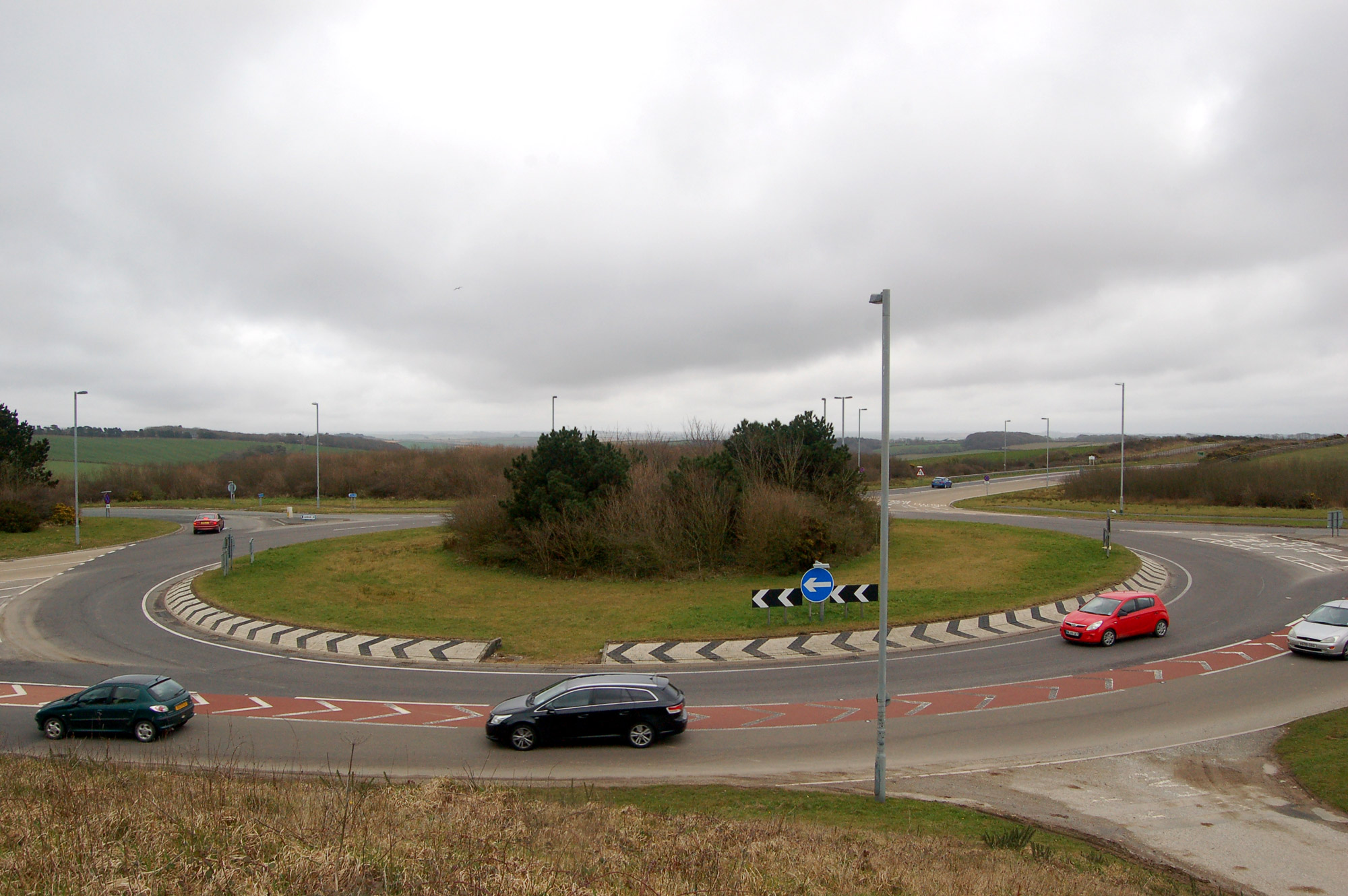
Okehampton Bypass (Confirmation of Orders) Act 1985 The Okehampton bypass, which opened on 19 July 1988, goes to the south of the town, cutting through the northern edge of Dartmoor National Park in Devon. In the 1980s, the route of the bypass was the subject of a prolonged campaign from conservationists, including Sylvia Sayer, who preferred a route to the north of the town through agricultural land.
The section between Honiton and Exeter in East Devon was upgraded in 1999 to dual carriageway, giving quicker access to Exeter International Airport. This road was built under the Design Build Finance Operate (DBFO) Private Finance Initiative scheme by the private consortium Connect A30, who receive a shadow toll from the Government for each vehicle travelling along the road. Archaeological investigations during the work found a Roman cavalry garrison and later settlement at Pomeroy Wood. There were several protests by environmentalists during construction and the particular nature of the DBFO scheme, with a long-lasting occupation of sites on the planned route, focused around Fairmile. Swampy received press attention for his part in this protest. In 2016, President of The Automobile Association, Edmund King, claimed that the action had led to a slowdown in road construction throughout Britain.
21st century
During 2006 one of the main bottlenecks on the road was removed when the Merrymeet roundabout between Okehampton and Exeter near Whiddon Down was replaced with a grade-separated junction and dual carriageway.
Since the Bodmin to Indian Queens project was completed in late 2007, the new dual carriageway runs to the north of Goss Moor. The previous road has been converted to a cycle lane. In December 2012 it was announced that 2.8 miles from Temple to Higher Carblake would be upgraded to a dual carriageway. Building started in early 2015, and was completed in summer 2017. This work made the A30 continuous dual carriageway between the M5 at Exeter and Carland Cross in Cornwall.
On 17 January 2008, British Airways Flight 38 crash-landed near the Great South West Road southeast of Heathrow Airport. Shortly before the crash landing, the captain of the Boeing 777 involved was able to clear the A30 by raising the flaps, saving the lives of motorists on the ground.
In December 2014, the stretch of the A30 in Devon and Cornwall was identified as a key route for improvement in the government's Road Investment Strategy. This includes further dual carriageway improvements east of Honiton towards the Blackdown Hills, and between Chiverton Cross and Carland Cross.
In 2022, the casket of Queen Elizabeth II was driven partially on this road en route to Windsor Castle, her final resting place.
Carland Cross to Chiverton Cross
Dualling of the stretch between Carland Cross and Chiverton Cross established a continuous dual carriageway from Exeter right through to Camborne. Although this was shelved in 2006 as it was not considered a regional priority, it was included within the government's Road Investment Strategy in 2014. The preferred route was announced in July 2017, and on 6 February 2020, the Secretary of State for Transport approved Highways England's application for a Development Consent Order for the scheme to be constructed. Work began in March 2020 with an estimated cost of £330 million, a total of £20 million being provided by the European Regional Development Fund. The scheme is included as a case study in the Department for Transport's document Road Investment Strategy 2: 2020–2025. The route of the road passes near a World Heritage Site, a Registered Park and Gardens and a number of Sites of Special Scientific Interest. The scheme included a 20-metre-wide 'green bridge' over the new road to promote connectivity and biodiversity. The road opened in 2024, 49 years after the nearby Camborne-Redruth bypass section, which had opened in 1975.
Cultural references
John Betjeman referred to the A30 in his poem "Meditation on the A30". Arthur Boyt, focus of BBC documentary The Man Who Eats Badgers, described the A30 near Bodmin Moor as a good road for finding roadkill.
In Monty Python's Flying Circus, episode 34: The Cycling Tour, Mr Pither laments "As I lay down to the sound of the Russian gentlemen practising their shooting, I realised I was in a bit of a pickle. My heart sank as I realised I should never see the Okehampton by-pass again...", just before his impending execution in Russia.
Rick Beato, interviewing Brian May of the band Queen in 2021, asked him (about the band), "How often would you tune?" to which May replied, "Not often enough, some people would say. We used to say we tuned to the A30."
References
Notes
Citations
Sources
References
- "Bodmin Turnpike Roads".
- "Transport in Cornwall".
- "Area 1 (map)". Highways Agency.
- (9 March 2005). "A30 junction scheme unveiled". Tavistock Times Gazette.
- (25 June 2003). "Minister unveils Merrymeet layout". Tavistock Times Gazette.
- (21 December 2006). "Road opens with months to spare". BBC News.
- Brayshay, Mark. (December 1991). "Royal Post-Horse Routes in South West England in the Reigns of Elizabeth I and James I". Reports of Transactions of the Devon Association for the Advancement of Science.
- (1959). "A History of the County of Wiltshire". Victoria County History.
- (2003). "Old Hampshire Mapped : Ogilby Routes". Geography Department, Portsmouth University.
- Ogilby, John. (1699). "The Traveller's Guide: Or, A Most Exact Description of the Roads of England".
- (May 2017). "Identifying the Trunk Roads of Early Modern England and Wales". The Cambridge Group for the History of Population and Social Structure.
- (1814). "Cornwall".
- Simpson, Jacqueline. (2011). "Green Men & White Swans: The Folklore of British Pub Names". Random House.
- Fort, Tom. (2012). "The A303: Highway to the Sun". Simon and Schuster.
- "CHARD TURNPIKE TRUST Records". Somerset Heritage Centre.
- (1933–1942). "CLASSIFICATION: Re-numbering of classified routes". The National Archives.
- (23 September 1880). "Hayle Bridge Causeway and Turnpike Road". The Cornishman.
- (22 October 1885). "Hayle Bridge Causeway and Turnpike Trust". The Cornishman.
- "Half Inch Ministry of Transport Road Map". Ordnance Survey.
- (1921–1949). "CLASSIFICATION: Road numbering". The National Archives.
- (24 February 1919). "The Great West Road". The Times.
- (12 May 1925). "London to the West". The Times.
- (5 November 1958). "A.30 and A.303". [[Hansard.
- (20 June 1966). "Road to the West : Ministry's Choice Dismays Cornwall". The Times.
- (12 November 1958). "A.30 and A.303". [[Hansard.
- "M3 London to Southampton". The Motorway Archive.
- (16 August 2016). "M3. London to Southampton Statistics and options". The Motorway Archive.
- (24 June 1971). "1,000 more miles of motorway will bring growth to less prosperous areas". The Times.
- (16 December 1966). "Honiton Bypass". [[Autocar (magazine).
- (28 April 1977). "Over 80, she still battles on". The Times.
- (2 May 1985). "Road Works (Compensation)". [[Hansard.
- Kelly, Matthew. (2015). "Quartz and Feldspar – Dartmoor: A British Landscape in Modern Times". Jonathan Cape.
- "Highways Agency - A30 Exeter to Bere Regis".
- (1999). "A30 Honiton to Exeter – Horse Power – Roman Style". [[Highways Agency]].
- Hunt, Barry. (14 June 2016). "Revealed: Road-building records of Prime Ministers, including David Cameron". The Comet.
- Smith, Colleen. (1 February 2020). "Remembering when Swampy emerged from his long tunnel protest under Devon's A30". Devon Live.
- "Highways Agency - A30 Merrymeet Junction".
- (29 November 2004). "Moor dualling plans get go-ahead". BBC News.
- "AUTUMN STATEMENT 2012".
- "A30 Temple to Higher Carblake Improvement – Cornwall Council". Highways England.
- "Report on the accident to Boeing 777-236ER, G-YMMM, at London Heathrow Airport on 17 January 2008". AAIB.
- (2008-05-20). "BA crash inquiry reveals heroics".
- (December 2014). "Road Investment Strategy: Overview". Department for Transport.
- "A30/A303/A358 Improvement Project". Somerset County Council.
- (19 September 2022). "Map shows where you can watch the Queen on her final journey to Windsor Castle".
- (6 July 2006). "Winners and losers in roads plan". BBC News.
- "Road Investment Strategy : for the 2015/16 – 2019/20 Road Period".
- "A30 Chiverton to Carland Cross Improvement Scheme : Preferred route announcement".
- (7 February 2020). "Main Cornwall route gets 'vital' £290m upgrade". BBC News.
- (18 May 2020). "A30 Chiverton to Carland Cross". [[Highways England]].
- (11 March 2020). "Road Investment Strategy 2: 2020–2025".
- "Meditation on the A30 – A poem by John Betjeman". Poetry Connection.
- "Arthur Boyt".
- "Monty Python's Flying Circus: Just the Words – Episode 34". ibras.dk.
- (21 September 2021). "Brian May Interview - Queen's Songs, Stories and Guitar Style". [[YouTube]].
This article was imported from Wikipedia and is available under the Creative Commons Attribution-ShareAlike 4.0 License. Content has been adapted to SurfDoc format. Original contributors can be found on the article history page.
Ask Mako anything about A30 road — get instant answers, deeper analysis, and related topics.
Research with MakoFree with your Surf account
Create a free account to save articles, ask Mako questions, and organize your research.
Sign up freeThis content may have been generated or modified by AI. CloudSurf Software LLC is not responsible for the accuracy, completeness, or reliability of AI-generated content. Always verify important information from primary sources.
Report