From Surf Wiki (app.surf) — the open knowledge base
A0620-00
Binary star in the constellation Monoceros
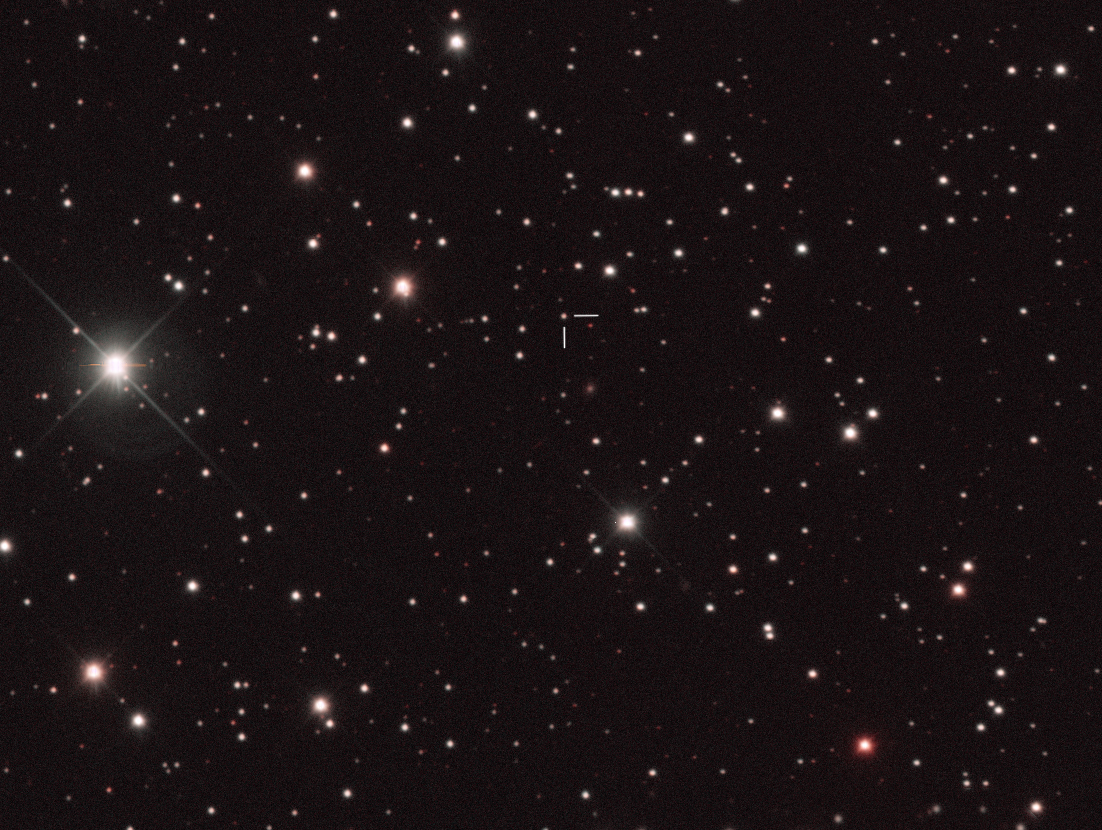
Binary star in the constellation Monoceros
A0620-00 (abbreviated from 1A 0620-00) is a binary star system in the constellation of Monoceros, with an apparent magnitude of 11.2.
A0620-00 consists of two objects. The first object is a K-type main-sequence star. it is too massive to be a neutron star and must therefore be a stellar-mass black hole. The two objects orbit each other every 7.75 hours.
A0620-00 has undergone two X-ray outbreaks. The first one was in 1917. The second burst, in 1975, was detected by the Ariel 5 satellite. During that time, A0620-00 was the brightest X-ray point source. It is now classified as an X-ray nova. Its black hole nature was determined in 1986.
The black hole in A0620-00 pulls matter from the K-type star into an accretion disk.
Stephen Hawking memorial broadcast
On 15 June 2018, a signal was transmitted from the European Space Agency big radio antenna at Cebreros Station (77 kilometers west of Madrid, Spain), in memory of Stephen Hawking, who died on 14 March 2018, and his work on the physics of black holes. The broadcast will travel the 3,457-light-year distance at the speed of light and will arrive in the year 5475; this will be the first-ever human interaction with a currently known black hole. 1A 0620-00 was chosen for this broadcast as it was the closest known black hole to Earth at the time. The message was one of peace and hope according to his family.
References
References
- {{cite constellation. V616 Mon
- (2022). "The Disk Veiling Effect of the Black Hole Low-mass X-Ray Binary A0620-00". The Astrophysical Journal.
- {{cite Gaia DR3. 3118721026600835328
- (2017). "The mass of the black hole in 1A 0620-00, revisiting the ellipsoidal light curve modelling". Monthly Notices of the Royal Astronomical Society.
- (2019-10-01). "The Revised TESS Input Catalog and Candidate Target List". The Astronomical Journal.
- "1A 0620-00".
- (2010). "The Inclination of the Soft X-Ray Transient A0620-00 and the Mass of its Black Hole". The Astrophysical Journal.
- (1986). "The black hole binary A0620-00". Astrophysical Journal.
- Foellmi, Cédric. (2009). "What is the closest black hole to the Sun?". New Astronomy.
- (1976). "Optical observations of the recurrent nova associated with A0620-00 - 1917-1975". Astrophysical Journal.
- (1975). "Discovery of powerful transient X-ray source A0620-00 with Ariel V Sky Survey Experiment". Nature.
- Ghosh, Pallab. (15 June 2018). "Prof Hawking: A fitting way to go". [[BBC]].
- (15 June 2018). "Stephen Hawking laid to rest between graves of Sir Isaac Newton and Charles Darwin". The Telegraph.
- (December 2017). "The mass of the black hole in 1A 0620–00, revisiting the ellipsoidal light curve modelling". Monthly Notices of the Royal Astronomical Society.
This article was imported from Wikipedia and is available under the Creative Commons Attribution-ShareAlike 4.0 License. Content has been adapted to SurfDoc format. Original contributors can be found on the article history page.
Ask Mako anything about A0620-00 — get instant answers, deeper analysis, and related topics.
Research with MakoFree with your Surf account
Create a free account to save articles, ask Mako questions, and organize your research.
Sign up freeThis content may have been generated or modified by AI. CloudSurf Software LLC is not responsible for the accuracy, completeness, or reliability of AI-generated content. Always verify important information from primary sources.
Report