From Surf Wiki (app.surf) — the open knowledge base
A. P. J. Abdul Kalam
President of India from 2002 to 2007<!-- Do NOT add counts or ordinals, as per [[WP:CONSENSUS]] -->

President of India from 2002 to 2007<!-- Do NOT add counts or ordinals, as per [[WP:CONSENSUS]] -->
| Field | Value | |
|---|---|---|
| name | A. P. J. Abdul Kalam | |
| image | A. P. J. Abdul Kalam.jpg | |
| caption | Official portrait | |
| office | President of India | |
| term_start | 25 July 2002 | |
| term_end | 25 July 2007 | |
| predecessor | K. R. Narayanan | |
| primeminister | Atal Bihari Vajpayee | |
| Manmohan Singh | ||
| successor | Pratibha Patil | |
| vicepresident | Krishan Kant | |
| Bhairon Singh Shekhawat | ||
| office1 | Principal Scientific Adviser to the Government of India | |
| term_start1 | November 1999 | |
| term_end1 | November 2001 | |
| president1 | K. R. Narayanan | |
| primeminister1 | Atal Bihari Vajpayee | |
| predecessor1 | Office established | |
| successor1 | Rajagopala Chidambaram | |
| office2 | Director General of Defence Research and Development Organisation | |
| term2 | 1992–1999 | |
| predecessor2 | Raja Ramanna | |
| successor2 | Vasudev Kalkunte Aatre | |
| birth_date | ||
| birth_place | Rameswaram, Madras Presidency, British India (present day Tamil Nadu, India) | |
| death_date | ||
| death_place | Shillong, Meghalaya, India | |
| resting_place | Dr. A. P. J. Abdul Kalam Memorial, Rameswaram, Tamil Nadu, India | |
| alma_mater | {{Plainlist | |
| profession | ||
| awards | List of awards and honours | |
| blank1 | Notable work(s) | |
| data1 | {{Plainlist | |
| module | {{Infobox scientist | |
| embed | yes | |
| fields | Aerospace engineering | |
| workplaces | {{Plainlist | |
| signature | A. P. J. Abdul Kalam signature.svg | |
| honours | Padma Bhushan (1981) | |
| Padma Vibhushan (1990) | ||
| Bharat Ratna (1997) | ||
| website | ||
| party | Independent | |
| order | ||
| order2 | ||
| order1 |
Manmohan Singh Bhairon Singh Shekhawat
- St. Joseph's College (BEng)
- Madras Institute of Technology (MEng)
- Wings of Fire
- India 2020
- Ignited Minds
- Indomitable Spirit
- Transcendence: My Spiritual Experiences with Pramukh Swamiji}}
- Defence Research and Development Organisation
- Indian Space Research Organisation}} Padma Vibhushan (1990) Bharat Ratna (1997)
Avul Pakir Jainulabdeen Abdul Kalam ( ; 15 October 193127 July 2015) was an Indian aerospace scientist and statesman who served as the president of India from 2002 to 2007.
Born and raised in a Muslim family in Rameswaram, Tamil Nadu, Kalam studied physics and aerospace engineering. He spent the next four decades as a scientist and science administrator, mainly at the Defence Research and Development Organisation (DRDO) and Indian Space Research Organisation (ISRO) and was intimately involved in India's civilian space programme and military missile development efforts. He was known as the "Missile Man of India" for his work on the development of ballistic missile and launch vehicle technology. He also played a pivotal organisational, technical, and political role in Pokhran-II nuclear tests in 1998, India's second such test after the first test in 1974.
Kalam was elected as the president of India in 2002 with the support of both the ruling Bharatiya Janata Party and the then-opposition Indian National Congress. He was widely referred to as the "People's President". He engaged in teaching, writing and public service after his presidency. He was a recipient of several awards, including the Bharat Ratna, India's highest civilian honour.
While delivering a lecture at IIM Shillong, Kalam collapsed and died from an apparent cardiac arrest on 27 July 2015, aged 83. Thousands attended the funeral ceremony held in his hometown of Rameswaram, where he was buried with full state honours. A memorial was inaugurated near his home town in 2017.
Early life and education
Avul Pakir Jainulabdeen Abdul Kalam was born on 15 October 1931 to a Tamil Muslim family in the pilgrimage center of Rameswaram on Pamban Island, Madras Presidency (now in the Indian state of Tamil Nadu). His father, Jainulabdeen Marakayar, was a boat owner and imam of a local mosque, and his mother, Ashiamma, was a housewife. His father owned a boat that ferried Hindu pilgrims between Rameswaram and Dhanushkodi.
Kalam was the youngest of four brothers and a sister in the family. His ancestors had been wealthy Marakayar traders and landowners, with numerous properties and large tracts of land. Marakayar are a Muslim ethnic group found in coastal Tamil Nadu and Sri Lanka who claim descent from Arab traders and local women. The family business had involved trading goods and transporting passengers between the Indian mainland and the Pamban Island and to and from Sri Lanka. With the opening of the Pamban Bridge connecting Pamban Island to mainland India in 1914, the businesses failed. As a result, apart from the ancestral home, the other family fortune and properties were lost by the 1920s, and the family was poverty-stricken by the time Kalam was born. As a young boy, he delivered newspapers to support the family's meager income.
In his school years, Kalam got average grades but was described by his teachers as a bright and hardworking student with a strong desire to learn. He spent hours learning Mathematics. He did his schooling at Schwartz Higher Secondary School in Ramanathapuram. He then graduated in Physics from St. Joseph's College, Tiruchirappalli, in 1954.
Kalam moved to Madras in 1955 to study aerospace engineering at the Madras Institute of Technology. While he was working on a class project, the Dean of the institution was dissatisfied with his lack of progress and threatened to revoke his scholarship unless the project was finished within the next three days. Kalam met the deadline, impressing the Dean, who later said to him, "I was putting you under stress and asking you to meet a difficult deadline." Later, he narrowly missed out on his dream of becoming a fighter pilot, as he placed ninth in qualifiers, and only eight positions were available in the Indian Air Force.
Career as a scientist
After graduating from the Madras Institute of Technology in 1960, Kalam became a member of the Defence Research & Development Service and joined the Aeronautical Development Establishment of the Defence Research and Development Organisation (DRDO) as a scientist. During his early career, he was involved in the design of small hovercraft, and remained unconvinced by his choice of a job at DRDO. Later, he joined the Indian National Committee for Space Research, working under renowned space scientist Vikram Sarabhai. He was interviewed and recruited into Indian Space Research Organisation (ISRO) by H. G. S. Murthy, the first director of the Thumba Equatorial Rocket Launching Station.
In 1969, Kalam transferred to ISRO where he became the project director of India's first satellite launch vehicle (SLV) which successfully deployed the Rohini satellite in near-earth orbit in July 1980. He had earlier started work on an expandable rocket project independently at DRDO in 1965. In 1969, Kalam received the approval from the Government of India to expand the programme to include more engineers. In 1963–64, he visited NASA's Langley Research Center in Hampton, Goddard Space Flight Center in Greenbelt, and Wallops Flight Facility. Since the late 1970s, Kalam was part of the effort to develop the SLV-3 and Polar Satellite Launch Vehicle (PSLV), both of which were successful.
In May 1974, Kalam was invited by Raja Ramanna to witness the country's first nuclear test Smiling Buddha as the representative of Terminal Ballistics Research Laboratory, even though he was officially not part of the project. In the 1970s, Kalam directed two projects, Project Devil and Project Valiant, which sought to develop ballistic missiles using the technology from the successful SLV programme. Despite the disapproval of the union cabinet, then Prime Minister Indira Gandhi allotted funds for these aerospace projects under Kalam's directorship through her discretionary powers. Kalam also played a major role in convincing the cabinet to conceal the true nature of these classified projects. His research and leadership brought him recognition in the 1980s, which prompted the government to initiate an advanced missile programme under his directorship.
Kalam worked with metallurgist V. S. R. Arunachalam, who was then scientific adviser to the Defence Minister, on the suggestion by the then Defence Minister R. Venkataraman on the simultaneous development of a quiver of missiles instead of taking planned missiles one after another. Venkatraman was instrumental in getting the cabinet approval for allocating for the project titled Integrated Guided Missile Development Programme (IGMDP) and appointed Kalam as its chief executive. Kalam played a major role in the development of missiles including Agni, an intermediate range ballistic missile and Prithvi, the tactical surface-to-surface missile, despite inflated costs and time overruns. He was known as the "Missile Man of India" for his work on the development of ballistic missile and launch vehicle technology.
Kalam served as the chief scientific adviser to the prime minister and secretary of the DRDO from July 1992 to December 1999. He played a key organisational, political and technical role in the Pokhran-II nuclear tests conducted in May 1998. Along with Rajagopala Chidambaram, he served as the chief project coordinator for the tests. Media coverage of Kalam during this period made him the country's best known nuclear scientist. However, the director of the site test, K. Santhanam, said that the thermonuclear bomb had been a "fizzle" and criticised Kalam for issuing an incorrect report. The claim was refuted and rejected by Kalam and Chidambaram.
In 1998, Kalam worked with cardiologist Bhupathiraju Somaraju and developed a low cost coronary stent, named the "Kalam-Raju stent". In 2012, the duo designed a tablet computer named the "Kalam-Raju tablet" for usage by healthcare workers in rural areas.
Presidency

On 10 June 2002, the National Democratic Alliance (NDA) which was in power at the time, expressed its intention to nominate Kalam for the post of the President of India. His candidature was backed by the opposition parties including the Samajwadi Party and the Nationalist Congress Party. After the support for Kalam, incumbent president K. R. Narayanan chose not to seek a re-election. Kalam said of the announcement of his candidature:
On 18 June, Kalam filed his nomination papers in the Indian Parliament. Three sets of nomination papers were filed, one accompanied by the NDA leaders including prime minister Atal Bihari Vajpayee and senior cabinet members, the second accompanied by Congress including Sonia Gandhi, and the third with leaders from other supporting political parties. He faced off against Lakshmi Sahgal, and the polling for the presidential election was held on 15 July 2002, in the Indian parliament and the state assemblies, with the media predicting a win for Kalam. The counting was held on 18 July, and Kalam won the elections after securing 922,884 electoral votes as against the 107,366 votes won by Sahgal. He was sworn in as the 11th president of India on 25 July 2002. He was the first scientist and the first bachelor to occupy the top chair at Rashtrapati Bhawan.

During his term as president, he was affectionately known as the "People's President". He later stated that signing the Office of profit bill was the toughest decision he had taken during his tenure. In September 2003, during an interactive session at PGIMER in Chandigarh, Kalam asserted the need of Uniform Civil Code in India, keeping in view the population of the country. He also took a decision to impose President's rule in Bihar in 2005. However, during his tenure as president, he made no decision on 20 out of the 21 mercy petitions submitted to him to commute death penalties, including that of terrorist Afzal Guru, who was convicted of conspiracy in the December 2001 attack on the Indian Parliament and was sentenced to death by the Supreme Court of India in 2004. He acted only on a single plea, rejecting that of Dhananjoy Chatterjee, who was later hanged.
Towards the end of his term, on 20 June 2007, Kalam expressed his willingness to consider a second term in office provided there was certainty about his victory in the upcoming presidential election. His name was proposed by the United National Progressive Alliance, but he did receive the support of the ruling United Progressive Alliance. However, two days later, he decided not to contest the election again stating that he wanted to avoid involving the Rashtrapati Bhavan in the political processes.

In April 2012, towards the expiry of the term of the 12th president Pratibha Patil, media reports claimed that Kalam was likely to be nominated for his second term. After the reports, social networking sites witnessed a surge in posts supporting his candidature. While the ruling Indian National Congress opposed the nomination of Kalam, other parties such as the Bharatiya Janata Party and the Trinamool Congress were reported by the media to be keen on his candidature. On 18 June 2012, Kalam declined to contest stating that:
Post-presidency

After leaving office, Kalam returned to teaching, and became a visiting professor at various institutions. He became a visiting professor at IIM Shillong, an honorary professor at his alma mater Anna University in Chennai, and an honorary fellow of the Indian Institute of Science at Bengaluru. In September 2007, he became the first chancellor of the newly established Indian Institute of Space Science and Technology at Thiruvananthapuram. He also conducted lectures for management students in India, and visited China twice at the invitation of the Chinese government to conduct sessions at the Peking University.
In 2011, Kalam voiced his support towards the establishment of the nuclear power plant at Koodankulam in Tamil Nadu, giving assurances for the safety of the facility. However, some of the locals were unconvinced by his statements on the safety of the plant, and were hostile to his visit. In May 2012, Kalam launched a programme called What Can I Give Movement aimed at the youth of India with a central theme of defeating corruption.
Death
Main article: Death and state funeral of A. P. J. Abdul Kalam
On 27 July 2015, Kalam travelled to Shillong to deliver a lecture on "Creating a Livable Planet Earth" at IIM Shillong. While climbing a flight of stairs, he experienced some discomfort, but was able to enter the auditorium after a brief rest. At around 6:35 p.m. IST, after five minutes into his lecture, he collapsed. He was rushed to the nearby Bethany Hospital in a critical condition, and upon arrival, he lacked a pulse or any other signs of life. Despite being placed in the intensive care unit, he was confirmed dead of a sudden cardiac arrest at 7:45p.m. His purported last words to his aide Srijan Pal Singh were: "Funny guy! Are you doing well?"
Aftermath

Following his death, the people of India paid tributes on social media. The Government of India declared a seven-day state mourning period as a mark of respect. Various leaders from India and abroad condoled the death of Kalam. Kalam's body was flown to New Delhi on the morning of 28 July, where dignitaries including then president, vice president, and prime minister paid their last respects. His body was placed in his Delhi residence for public viewing. On 29 July, his body was flown to the town of Mandapam via Madurai, and was carried towards his home town of Rameswaram by road. His body was displayed in an open area to allow the public to pay their final respects until 8p.m. that evening. On 30 July 2015, following an Islamic burial prayer performed by the local imam, he was laid to rest at Rameswaram's Pei Karumbu ground with full state honours with over 350,000 people in attendance.
Dr. A. P. J. Abdul Kalam Memorial was built in memory of Kalam by the DRDO in Pei Karumbu in Rameswaram. It was inaugurated by the prime minister Narendra Modi in July 2017. The memorial displays replicas of rockets and missiles which Kalam had worked with, and various acrylic paintings about his life. There is a large statue of Kalam in the entrance showing him playing the veena, and two other smaller statues in sitting and standing posture respectively.
Personal life and interests

Kalam was the youngest of five siblings, the eldest of whom was a sister, Asim Zohra (), followed by three elder brothers: Mohammed Lebbai (5 November 1916–7 March 2021), Mustafa Kalam () and Kasim Mohammed (). He was close to his elder siblings and their extended families throughout his life, and would regularly send small sums of money to his older siblings, though he himself remaining a lifelong bachelor.
Kalam was noted for his integrity and his simple lifestyle. He was a teetotaler, and a vegetarian. Kalam enjoyed writing Tamil poetry, playing the veena (an Indian string instrument), and listening to Carnatic devotional music every day. He never owned a television, and was in the habit of rising at 6:30 or 7a.m. and sleeping by 2a.m. His personal possessions included a few books, a veena, clothing, a compact disc player and a laptop. He left no will, and his possessions went to his eldest brother after his death.
Kalam set a target of interacting with 100,000 students during the two years after his resignation from the post of scientific adviser in 1999. He explained, "I feel comfortable in the company of young people, particularly high school students. Henceforth, I intend to share with them experiences, helping them to ignite their imagination and preparing them to work for a developed India for which the road map is already available." His dream is to let every student to light up the sky with victory using their latent fire in the heart. He had an active interest in other developments in the field of science and technology such as developing biomedical implants. He also supported open source technology over proprietary software, predicting that the use of free software on a large scale would bring the benefits of information technology to more people.
Religious and spiritual views
Religion and spirituality were very important to Kalam throughout his life. He was a practising Sunni Muslim, and daily namaz and fasting during Ramadan were integral to his life. His father was an imam of a mosque, and had strictly instilled these Islamic customs in his children. His father had also impressed upon the young Kalam the value of interfaith respect and dialogue. As Kalam recalled: "Every evening, my father A. P. Jainulabdeen, an imam, Pakshi Lakshmana Sastry, the head priest of the Ramanathaswamy Hindu temple, and a church priest used to sit with hot tea and discuss the issues concerning the island." Such early exposure convinced Kalam that the answers to India's multitudinous issues lay in "dialogue and cooperation" among the country's religious, social, and political leaders. Moreover, since Kalam believed that "respect for other faiths" was one of the key cornerstones of Islam, and he remarked: "For great men, religion is a way of making friends; small people make religion a fighting tool."
One component of Kalam's widespread popularity among diverse groups in India, and an enduring aspect of his legacy, is the syncretism he embodied in appreciating various elements of the many spiritual and cultural traditions of India. In addition to his faith in the Quran and Islamic practice, Kalam was well-versed in Hindu traditions, learnt Sanskrit. and read the Bhagavad Gita. In 2002, in one of his early speeches to Parliament after becoming the president, he reiterated his desire for a more united India, stating that "During the last one year I met a number of spiritual leaders of all religions ... and I would like to endeavour to work for bringing about unity of minds among the divergent traditions of our country". Describing Kalam as a unifier of diverse traditions, Shashi Tharoor remarked, "Kalam was a complete Indian, an embodiment of the eclecticism of India's heritage of diversity". Former deputy prime minister L. K. Advani concurred that Kalam was "the best exemplar of the Idea of India, one who embodied the best of all the cultural and spiritual traditions that signify India's unity in immense diversity.
Kalam's desire to meet spiritual leaders led him to meet Pramukh Swami Maharaj, the Hindu guru of the Bochasanwasi Shri Akshar Purushottam Swaminarayan Sanstha (BAPS), who Kalam would come to consider his ultimate spiritual teacher and guru. Kalam and Pramukh Swami met eight times over a fourteen-year period and on his first meeting on 30 June 2001, Kalam described being immediately drawn to Pramukh Swami's simplicity and spiritual purity. Kalam stated that he was inspired by Pramukh Swami throughout their numerous interactions, and recalled being moved by Swami's equanimity and compassion, citing this incident as one of his motivations for writing his experiences as a book later. Summarising the effect that Pramukh Swami had on him, Kalam stated that "[Pramukh Swami] has indeed transformed me. He is the ultimate stage of the spiritual ascent in my life ... Pramukh Swamiji has put me in a God-synchronous orbit. No manoeuvres are required any more, as I am placed in my final position in eternity."
Writings
Main article: A. P. J. Abdul Kalam bibliography

Kalam has authored various books during his career, and his books have garnered interest in various countries.
In his book India 2020, he strongly advocated an action plan to develop India into a "knowledge superpower" and a developed nation by 2020. He regarded his work on India's nuclear weapons programme as a way to assert India's place as a future superpower.
Kalam described a "transformative moment" in his life in his book Transcendence: My Spiritual Experiences with Pramukh Swamiji. When he asked Pramukh Swami on how India might realise his vision of development, Swami answered to add a sixth area of developing faith in God and spirituality to overcome the current climate of crime and corruption.
;Bibliography The following are the books authored by Kalam:
Awards and honours
Main article: List of honors and awards received by A. P. J. Abdul Kalam
Kalam received honorary doctorates from various universities. The Government of India honoured him with the Padma Bhushan in 1981 and the Padma Vibhushan in 1990. In 1997, he was awarded India's highest civilian honour, the Bharat Ratna, for his contribution to the scientific research and modernisation of defence technology in India. He received the Indira Gandhi Award for National Integration in 1997, Savarkar Award in 1998, and Ramanujan Award in 2000. In 2008, he was the recipient of Hoover Medal. In 2013, he was awarded the Von Braun Award by the National Space Society "to recognize excellence in the management and leadership of a space-related project".
Legacy
Main article: List of things named after A. P. J. Abdul Kalam
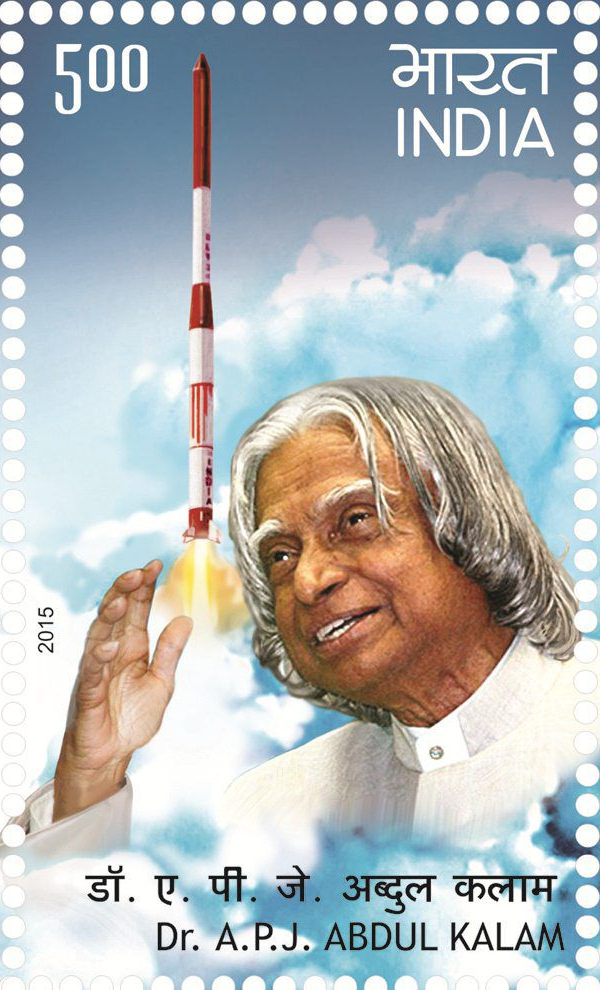
Kalam's birthday is celebrated as World Students' Day in India. In 2012, Kalam was ranked second in the Greatest Indian poll conducted by Outlook. In September 2014, India and the United States launched the Fulbright-Kalam climate fellowship which enabled six Indian doctoral students and researchers to work with institutions in the US for a period of 6–12 months. In 2015, the Government of Tamil Nadu announced that Kalam's birthday, 15 October, would be observed as "Youth Renaissance Day". It also instituted the "Dr. A. P. J. Abdul Kalam Award" constituting a gold medal, a certificate and , to be awarded annually on the Indian Independence Day, to residents of the state with achievements in promoting scientific growth, the humanities or the welfare of students. On the anniversary of Kalam's birth in 2015, the Central Board of Secondary Education (CBSE) released topics on his name as a part of the CBSE expression series. On the same day, India Post released postage stamps commemorating the 84th anniversary of Kalam's birth.
In 2017, researchers at the NASA's Jet Propulsion Laboratory discovered a new bacterium on the filters of the International Space Station and named it Solibacillus kalamii to honour Kalam. In February 2018, scientists from the Botanical Survey of India named a newly found plant species as Drypetes kalamii, in his honour. In 2022, a newly discovered species of footballfish was named as Himantolophus kalami in Kalam's honour. In 2023, a newly discovered tardigrade was named Batillipes kalami after him.
Several places and locations have been named after Kalam. In August 2015, Aurangzeb Road in New Delhi was named after Kalam as Dr APJ Abdul Kalam Road. In September 2015, the national missile test site in Odisha in Wheeler Island was renamed as Abdul Kalam Island. In October 2015, a 6180 m peak near the Bara Shigri Glacier in the Himalayas was named as Mount Kalam. Dr APJ Abdul Kalam Missile Complex, a missile research facility in Hyderabad is named after him. Dr. A. P. J. Abdul Kalam Science City in Patna, and Dr. Abdul Kalam Science Centre and Planetarium in Puducherry are named in honour of Kalam. Several universities, and other educational institutions and other locations were renamed or named in honour of Kalam.
In popular culture
;Biographies
- Eternal Quest: Life and Times of Dr Kalam by S Chandra; Pentagon Publishers, 2002.
- President A P J Abdul Kalam by R K Pruthi; Anmol Publications, 2002.
- A P J Abdul Kalam: The Visionary of India by K Bhushan, G Katyal; A P H Pub Corp, 2002.
- The Kalam Effect: My Years with the President by P M Nair; HarperCollins, 2008.
- My Days With Mahatma Abdul Kalam by Fr A K George; Novel Corporation, 2009.
- A.P.J. Abdul Kalam: A Life by Arun Tiwari; Harper Collins, 2015.
- The People's President: Dr A P J Abdul Kalam by S M Khan; Bloomsbury Publishing, 2016.
;Film and media In 2008, a documentary film A Little Dream directed by P. Dhanapal was released in India. In the 2011 Hindi film I Am Kalam, Kalam is portrayed as a positive influence on a poor but bright Rajasthani boy named Chhotu, who renames himself Kalam in honour of his idol. People's President is a 2016 Indian documentary feature film directed by Pankaj Vyas and produced by the Government of India's Films Division. My Hero Kalam is a 2018 Kannada biographical film by Shivu Hiremath which portrays Kalam's life from childhood to the Pokhran tests. The third episode of Mega Icons (2018–2020), a documentary television series about prominent personalities of India aired on National Geographic was based on Kalam's life. In the 2020 Tamil film Soorarai Pottru, Sheik Maideen portrayed Kalam. In Rocket Boys, a Hindi biographical streaming television series on SonyLIV, the character of Kalam was played by Arjun Radhakrishnan. In the 2022 Tamil film Rocketry: The Nambi Effect, Kalam is portrayed by Amaan.
References
References
- (1999). "Wings of Fire: An Autobiography". Universities Press.
- (1 March 2012). "Bio-data: Avul Pakir Jainulabdeen Abdul Kalam". Press Information Bureau, [[Government of India]].
- Akbar, M J. (9 July 2012). "APJ Abdul Kalam speaks to Editorial Director M.J. Akbar about presidential elections 2012".
- (23 January 2012). "Dr Abdul Kalam, People's President in Sri Lanka". [[Daily News (Sri Lanka).
- Jai, Janak Raj. (2003). "Presidents of India, 1950–2003". Regency Publications.
- "APJ Abdul Kalam, the unconventional President who learnt the art of the political". [[ABP News]].
- "The greatest student India ever had". Dailyo.
- "Brother awaits Kalam last trip". [[Telegraph (India).
- (28 July 2015). "How two orthodox Brahmins played a crucial role in APJ Abdul Kalam's childhood". Qz.
- "Day before death, Kalam enquired about elder brother's health". [[CNN-News18.
- (31 July 2015). "Not aware of any will left by Kalam: nephew". [[The Times of India]].
- (2004). "Pride of the Nation: Dr. A.P.J Abdul Kalam". Diamond Pocket Books (P) Ltd..
- (2002). "A.P.J. Abdul Kalam: The Visionary of India". A.P.H. Publishing Corporation.
- (18 March 2024). "Kalam's alma mater in Ramnad set for renovation". [[The Times of India]].
- K. Raju. (24 September 2006). "Kalam meets the teacher who moulded him". [[The Hindu]].
- Dixit, Sumita Vaid. (18 March 2010). "The boy from Rameswaram who became a President". [[Rediff.com]].
- (18 August 2013). "Failed in my dream of becoming a pilot : Abdul Kalam in new book". [[The Hindu]].
- "Avul Pakir Jainulabdeen Abdul Kalam". [[National Informatics Centre]].
- Gopalakrishnan, Karthika. (23 June 2009). "Kalam tells students to follow their heart". [[The Times of India]].
- Pawar, Ashwini. (29 July 2015). "I'm proud that I recommended him for ISRO: EV Chitnis". [[Daily News and Analysis]].
- Ramchandani. (2000). "A to C (Abd Allah ibn al-Abbas to Cypress).". Encyclopædia Britannica (India).
- (November 1989). "Bulletin of the Atomic Scientists". Educational Foundation for Nuclear Science.
- (23 August 2024). "When Dr APJ Abdul Kalam learnt from failure and Isro bounced back to life". [[India Today]].
- "APJ Abdul Kalam, profile". [[Rashtrapathi Bhavan]].
- (28 July 2015). "Lesser Known Facts About Dr APJ Abdul Kalam". [[The New Indian Express]].
- (July 2003). "Missile Chronology, 1971–1979". James Martin Center for Nonproliferation Studies at Monterey Institute of International Studies, Nuclear Threat Initiative.
- (5 July 2002). "The prime motivator". [[Frontline (magazine).
- Pandit, Rajat. (9 January 2008). "Missile plan: Some hits, misses". [[The Times of India]].
- Pruthi, R. K.. (2005). "President A.P.J. Abdul Kalam". Anmol Publications.
- (30 July 2015). "India's 'Mr. Missile': A man of the people". [[Toronto Sun]].
- (30 July 2015). "Kalam's unrealised 'Nag' missile dream to become reality next year". [[The Times of India]].
- Sen, Amartya. (2003). "Prisoners of the Nuclear Dream". Sangam Books.
- Conley, Jerome M.. (2001). "Indo-Russian military and nuclear cooperation: lessons and options for U.S. policy in South Asia". Lexington Books.
- (8 November 2011). "Koodankulam nuclear plant: A. P. J. Abdul Kalam's safety review has failed to satisfy nuke plant protestors, expert laments". [[The Economic Times]].
- (25 September 2009). "Pokhran row". [[Frontline (magazine).
- (August 2009). "Pokhran II controversy needless: PM". Hard News.
- (15 August 2001). "Story of indigenous stents". [[Business Line]].
- (19 December 1998). "The stent man". [[Rediff.com]].
- Gopal, M. Sai. (22 March 2012). "Now, 'Kalam-Raju tablet' for healthcare workers". [[The Hindu]].
- Times News Network. (11 June 2002). "NDA's smart missile: President Kalam". [[The Economic Times]].
- "With him at the helm, there is hope that things might change". [[Rediff.com]].
- (11 June 2002). "SP to support Kalam for President's post". [[Rediff.com]].
- (11 June 2002). "NCP supports Kalam's candidature for presidentship". [[Rediff.com]].
- (11 June 2002). "Narayanan opts out, field clear for Kalam". [[Rediff.com]].
- (13 June 2002). "Overwhelmed by response: Kalam". [[Rediff.com]].
- (18 June 2002). "Presidential nominee Abdul Kalam files nomination papers". [[Rediff.com]].
- (15 July 2002). "Polling for presidential election begins". [[Rediff.com]].
- Ved, Mahendra. (26 July 2002). "Kalam is 11th President in 12th term". [[The Times of India]].
- "Former Presidents, Rashtrapati Bhavan".
- (18 July 2002). "Abdul Kalam elected President". [[The Hindu]].
- (25 July 2002). "A P J Kalam is sworn in as India's eleventh President". [[Rediff.com]].
- (23 May 2011). "Basic Technical Communication". [[Prentice Hall]].
- (28 July 2015). "Why Abdul Kalam was the 'People's President'". DailyO.
- (19 June 2012). "APJ Abdul Kalam is people's president: Mamata Banerjee". [[CNN-IBN]].
- Perappadan, Bindu Shajan. (14 April 2007). "The people's President does it again". [[The Hindu]].
- "My toughest decision as president was returning the Office of Profit Bill to Parliament". [[The Indian Express]].
- (14 August 2016). "How a 110 years old became friend of APJ Kalam". Better India.
- (18 July 2010). "Signing office of profit bill was toughest decision: A P J Kalam". [[The Economic Times]].
- (29 September 2003). "Uniform Civil Code essential: Kalam". [[Rediff.com]].
- (30 September 2003). "Kalam calls for uniform civil code". [[The Economic Times]].
- "APJ Abdul Kalam: The People's President". [[NDTV]].
- V., Venkatesan. (April 2009). "Mercy Guidelines". Frontline.
- (21 May 2010). "The journey of a mercy plea". [[The New Indian Express]].
- (22 June 2007). "Kalam not to contest presidential poll". [[Rediff.com]].
- (22 June 2007). "Kalam not to contest Presidential polls". [[The Times of India]].
- (10 May 2007). "Talks under way on Presidential election". [[The Hindu]].
- (22 June 2007). "Kalam not to contest Presidential polls". [[The Times of India]].
- Raj, Rohit. (23 April 2012). "Virtual world seeks second term for Abdul Kalam". [[Deccan Chronicle]].
- Marapakwar, Prafulla. (23 April 2012). "Next President should be apolitical: Pawar". [[The Times of India]].
- (23 April 2012). "Race for Rashtrapati Bhawan: APJ Abdul Kalam a good choice, says SP; backs Pawar". [[NDTV]].
- (26 April 2012). "Netizens campaign for second term to Kalam". [[Deccan Herald]].
- Azeez, Parwin. (8 May 2012). "Kalam for President clicks on social networks". [[The Times of India]].
- Benedict, Kay. (14 June 2012). "Congress opposes APJ Abdul Kalam's name for President".
- (30 April 2012). "President poll: BJP rejects Pranab Mukherjee, Hamid Ansari, may back Kalam". [[CNN-IBN]].
- (30 April 2012). "Presidential polls: We will not support Pranab Mukherjee, BJP says". [[The Times of India]].
- (13 June 2012). "Prez poll: Mulayam, Mamata suggest APJ Kalam, Manmohan Singh, Somnath Chatterjee". [[DNA India]].
- (16 June 2012). "Mamata turns to Facebook, seeks support for Kalam". [[The Times of India]].
- S, Karthick. (18 June 2012). "Abdul Kalam not to contest presidential poll 2012". [[The Times of India]].
- (7 March 2013). "Kalam to join as visiting faculty at IIM Shillong". [[Dinamalar]].
- (15 July 2007). "Kalam may become honorary professor". [[The Hindustan Times]].
- (27 May 2008). "Honorary Fellowship of IISc". [[Indian Institute of Science]].
- (22 June 2012). "Turning Points: A Journey Through Challenges". [[Harper Collins]].
- (9 September 2008). "Kalam appointed IIST Chancellor". [[The Hindu]].
- (22 December 2007). "Kalam to teach management students". [[The Economic Times]].
- (29 July 2015). "China professor: Abdul Kalam not just India's scientist but of the world". [[The Indian Express]].
- (7 November 2011). "Dr Kalam's 'assurance' on nuclear power plants draws flak". Financial Magazine.
- (7 November 2011). "Kalam bats for Kudankulam but protesters unimpressed". [[The Times of India]].
- "About us". What Can I Give.
- Mallady, Shastry. (26 June 2011). "Take part in movement against corruption: Kalam". [[The Hindu]].
- Scott, D.J. Walter. (3 August 2015). "Kalam had no property". [[The Hindu]].
- (28 July 2015). "End of an era: 'Missile man' APJ Abdul Kalam passes away after cardiac arrest". Firstpost.
- (27 July 2015). "Abdul Kalam, former president of India, passes away at 84". [[The Indian Express]].
- (28 July 2015). "Abdul Kalam showed no signs of life when brought to hospital: Doctor". [[CNN-IBN]].
- Sanyal, Anindita. (27 July 2015). "Former President APJ Abdul Kalam Dies at 83". NDTV.com.
- (31 July 2015). "11 Last Words of Famous People That Reflect Exactly What Life Was To Them". India Times.
- (28 July 2015). "People's president: India mourns Abdul Kalam". [[BBC News]].
- (28 July 2015). "Seven-day state mourning but no holiday". [[The Times of India]].
- "Former President APJ Abdul Kalam has died aged 83". [[The Guardian]].
- (29 July 2015). "Abdul Kalam's Death Tremendous Loss to India: ISRO Chief A S Kiran Kumar". [[NDTV]].
- (28 July 2015). "World leaders pay glowing tributes to inspirational Kalam". [[Business Standard]].
- (28 July 2015). "Farewell Kalam! Pranab, Modi lead nation in paying homage". [[The Hindustan Times]].
- (28 July 2015). "Live: Kalam's body at Delhi house for people to pay tribute". [[India Today]].
- Arunachalam, Pon Vasanth. (29 July 2015). "Dignitaries Pay Respect to Kalam in Madurai Airport". [[The New Indian Express]].
- (29 July 2015). "Kalam's mortal remains reach Rameswaram". The Hindu.
- (28 July 2015). "India Pays Tribute to 'People's President' A.P.J. Abdul Kalam". [[Time Inc.]].
- (30 July 2015). "Thousands bid adieu to former President A P J Abdul Kalam". [[The Hindu]].
- "People's president' Kalam laid to rest with full state honours". [[Business Standard]].
- "Nation bids adieu to Abdul Kalam". [[The Hindu]].
- "Dr APJ Abdul Kalam National Memorial Foundation Stone Laying Ceremony". [[Press Information Bureau]].
- "Images of the Inauguration function". [[Defence Research and Development Organisation]].
- "The Prime Minister of India, Shri Narendra Modi's web page with news and photos".
- (31 July 2017). "What is the Abdul Kalam memorial row?". [[The Indian Express]].
- (7 March 2021). "Kalam's elder brother dies at 104". [[The Hindu]].
- (5 November 2016). "Abdul Kalam's elder brother turns 100 and APJ had bought a gift for him". [[India Today]].
- (29 July 2015). "We thought he would be with us for another decade: Kalam's nephew". Mid-Day.
- (31 July 2015). "Man of integrity, Kalam insulated family from trappings of power". [[The Times of India]].
- (4 November 2016). "Kalam's brother turns 100, says takes life as it comes". [[The Hindu]].
- Michael, Saneesh. (n.d.). "A.P.J. Abdul Kalam - The President of the masses". OneIndia.
- "Of Rasam and Rice: The Humble Lifestyle of Former President Dr. APJ Abdul Kalam". [[NDTV]].
- (30 November 1998). "India's A.P.J. Abdul Kalam".
- Tharoor, Shashi. (28 June 2015). "Abdul Kalam: People's president, extraordinary Indian". [[BBC]].
- (28 July 2015). "Kalam Tribute: Sir Never Had a TV at Home, Recalls Secretary of 24 Years". [[NDTV]].
- (3 August 2015). "Kalam had no property". [[The Hindu]].
- (3 August 2015). "Guru Kalam's assets, royalties to go to elder brother". One India.
- Becker, David. (29 May 2003). "India leader advocates open source". [[CNET]].
- Lama, The Office of His Holiness the 14th Dalai. "The Office of His Holiness The Dalai Lama".
- "Dr Kalam, India's Most Non-Traditional President". [[NDTV]].
- Kalam, A.P.J. Abdul. (2015). "Transcendence: My Spiritual Experiences with Pramukh Swamiji". HarperCollins India.
- (30 July 2015). "Ramzan & Rameswaram: His ties with the island". [[The Times of India]].
- (27 July 2015). "APJ Abdul Kalam: Not Hindu, Not Muslim – Death of an 'Indian'".
- (28 July 2015). "Remembering Kalam: Greatly beloved, but he maybe missed being truly great". Firstpost.
- "Abdul Kalam or Abul Kalam- the message is same". [[The Times of India]].
- "Kalam on why Sanskrit is important". [[Rediff.com]].
- "Muslims react to A P J Abdul Kalam's candidature for President". [[Rediff.com]].
- (28 July 2015). "Three books that influenced APJ Abdul Kalam deeply". Firstpost.
- (28 July 2015). "Kalam served India till last breath: Advani". [[Zee News]].
- "Transcending boundaries with Swamiji". Ahmedabad Mirror.
- (30 July 2015). "Did Kalam sense his end was near? Arun Tiwari suspects". [[The Hindu]].
- (9 February 2006). "Kalam, the author catching on in South Korea". [[Outlook (Indian magazine).
- Kalam, A.P.J. Abdul. (1 October 2011). "IDG Session Address". NUJS Law Review.
- (14 October 2022). "List of 25 Inspiring books written by Dr. APJ Abdul Kalam". [[Jagran Prakashan]].
- "Developments in Fluid Mechanics and Space Technology". [[National Informatics Centre]].
- "Dr. Abdul Kalam's new Book A Manifesto for Change to release on July 14". Bihar Prabha.
- "Dr.Kalam's Page". Abdulkalam.com.
- Dayekh, Ribal. (16 April 2011). "Dr Abdul Kalam former President of India arrives to Dubai". [[Zawya]].
- (11 June 2009). "Kalam receives honorary doctorate from Queen's University Belfast". [[Oneindia.in]].
- (26 November 1997). "Bharat Ratna conferred on Dr Abdul Kalam". [[Rediff.com]].
- "Dr. APJ Abdul Kalam, 2008 Hoover Medal Recipient". [[American Society of Mechanical Engineers]].
- "NSS Von Braun Award". [[National Space Society]].
- (15 October 2021). "Why APJ Kalam's birth anniversary is celebrated as World Students' Day". [[The Hindustan Times]].
- Sengupta, Uttam. (20 August 2012). "A Measure of the Man". [[Outlook (Indian magazine).
- (12 March 2016). "India, US Launch Fulbright-Kalam Climate Fellowship". [[NDTV]].
- (31 July 2015). "Award in Kalam's name, birthday to be observed as 'Youth Renaissance Day'". [[The Economic Times]].
- (16 October 2015). "APJ Abdul Kalam.pdf". [[Central Board of Secondary Education]].
- (15 October 2015). "PM's remarks at birth anniversary celebrations of Dr. A.P.J Abdul Kalam". [[Prime Minister's Office (India).
- (21 May 2017). "NASA pays tribute to APJ Abdul Kalam by naming new species after him". International Business Times.
- (24 February 2018). "New plant species from West Bengal named after former President Abdul Kalam". [[The Hindu]].
- Scharpf, Christopher. (3 June 2024). "Order LOPHIIFORMES (part 2): Families Caulophrynidae, Neoceratiidae, Melanocetidae, Himantolophidae, Diceratiidae, Oneirodidae, Thaumatichthyidae, Centrophrynidae, Ceratiidae, Gigantactinidae And Linophrynidaee". Christopher Scharpf.
- Rajwi, Tiki. (19 September 2023). "New marine tardigrade species named after former President A.P.J. Abdul Kalam". [[The Hindu]].
- (29 August 2015). "Delhi exits 'cruel' Aurangzeb Road for 'kind' Abdul Kalam". [[The Indian Express]].
- (4 September 2015). "Aurangzeb Road is now Abdul Kalam Road". [[The Hindu]].
- "Aurangzeb Road Renamed After APJ Abdul Kalam, Arvind Kejriwal Tweets 'Congrats'". [[NDTV]].
- (4 September 2015). "Odisha's Wheeler Island to be renamed after APJ Abdul Kalam". [[The Hindustan Times]].
- (23 October 2015). "These 2 Indians Scaled an Unexplored Mountain Peak. And Named It Mt. Kalam". Better India.
- (15 October 2015). "Missile Complex in Hyderabad renamed after Kalam". [[India Today]].
- (24 February 2019). "Work on APJ Abdul Kalam Science City to begin this month". [[The Times of India]].
- (16 August 2015). "Science centre-cum-planetarium named after Abdul Kalam". [[The Hindu]].
- (1 August 2015). "UPTU is now APJ Abdul Kalam Tech University". [[The Times of India]].
- (30 July 2015). "Bihar govt names college, science city after 'People's President' APJ Abdul Kalam". [[The Hindu]].
- (31 July 2015). "Institute to be named after Kalam". [[The Hindu]].
- (4 August 2015). "Complex to be named after Abdul Kalam". [[The Hindu]].
- (8 February 2019). "New arts and science college named after Dr APJ Abdul Kalam coming up in Tamil Nadu". [[India Today]].
- Rohde, David. (19 July 2002). "Nuclear Scientist, 70, a Folk Hero, Is Elected India's President". [[The New York Times]].
- Pruthi, Raj. (2003). "President Apj Abdul Kalam". Anmol Publications.
- (2002). "A.P.J. Abdul Kalam: The Visionary of India". APH Publishing.
- Nair, P. M.. (2008). "The Kalam Effect: My Years with the President". HarperCollins Publishers, a joint venture with the India Today Group.
- Fr A K George. (2009). "My Days with Mahatma Abdul Kalam". Novel Corp.
- Tiwari, Arun. (2015). "A.P.J. Abdul Kalam: A Life". HarperCollins.
- Khan, S M. (2016). "The People's President: Dr A P J Abdul Kalam". Bloomsbury.
- (12 January 2008). "Documentary on Kalam released". [[The Hindu]].
- (4 August 2011). "I Am Kalam: Movie Review". [[The Times of India]].
- (15 January 2021). "Biopic to be streamed as tribute to Dr APJ Abdul Kalam". [[Films Division of India]].
- "My Hero Kalam (2018)". Indiancine.
- "Mega Icons Season 1 Episode 1". [[Disney+ Hotstar]].
- (27 July 2016). "Meet the man who's Kalam but not Kalam". India Today.
- "'Rocket Boys' Begins Well, Then Turns Into Hagiography With a Blatantly Communal Touch".
- Chellappan, Kumar. (8 December 2013). "True lies". [[The Pioneer (India).
This article was imported from Wikipedia and is available under the Creative Commons Attribution-ShareAlike 4.0 License. Content has been adapted to SurfDoc format. Original contributors can be found on the article history page.
Ask Mako anything about A. P. J. Abdul Kalam — get instant answers, deeper analysis, and related topics.
Research with MakoFree with your Surf account
Create a free account to save articles, ask Mako questions, and organize your research.
Sign up freeThis content may have been generated or modified by AI. CloudSurf Software LLC is not responsible for the accuracy, completeness, or reliability of AI-generated content. Always verify important information from primary sources.
Report