From Surf Wiki (app.surf) — the open knowledge base
A Million Random Digits with 100,000 Normal Deviates
Random number book first published in 1955
Random number book first published in 1955
| Field | Value |
|---|---|
| italic title | |
| name | A Million Random Digits with 100,000 Normal Deviates |
| image | File:A_Million_Random_Digits_with_100,000_Normal_Deviates.jpg |
| author | RAND Corporation |
| orig_lang_code | en |
| country | United States |
| language | English |
| publisher | The Free Press |
| published | 1955 |
A Million Random Digits with 100,000 Normal Deviates is a random number book by the RAND Corporation, originally published in 1955. The book, consisting primarily of a random number table, was an important 20th century work in the field of statistics and random numbers.
Production and background
It was produced starting in 1947 by an electronic simulation of a roulette wheel attached to a computer, the results of which were then carefully filtered and tested before being used to generate the table. The RAND table was an important breakthrough in delivering random numbers, because such a large and carefully prepared table had never before been available. In addition to being available in book form, one could also order the digits on a series of punched cards.
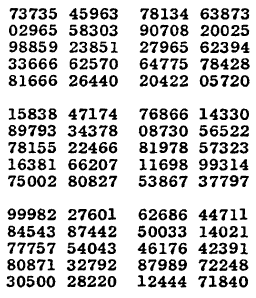
The table is formatted as 400 pages, each containing 50 lines of 50 digits. Columns and lines are grouped in fives, and the lines are numbered 00000 through 19999. The standard normal deviates are another 200 pages (10 per line, lines 0000 through 9999), with each deviate given to three decimal places. There are 28 additional pages of front matter.
Utility
The main use of the tables was in statistics and the experimental design of scientific experiments, especially those that used the Monte Carlo method; in cryptography, they have also been used as nothing up my sleeve numbers, for example in the design of the Khafre cipher. The book was one of the last of a series of random number tables produced from the mid-1920s to the 1950s, after which the development of high-speed computers allowed faster operation through the generation of pseudorandom numbers rather than reading them from tables.
2001 edition
The book was reissued in 2001 () with a new foreword by RAND Executive Vice President Michael D. Rich. It has generated many humorous user reviews on Amazon.com.
Sample
The digits begin:
References
Additional sources
- George W. Brown, "History of RAND's random digits—Summary," in A.S. Householder, G.E. Forsythe, and H.H. Germond, eds., Monte Carlo Method, National Bureau of Standards Applied Mathematics Series, 12 (Washington, D.C.: U.S. Government Printing Office, 1951): 31–32. (Available here for download from the RAND Corporation.)
References
- (1955). "Reviewed work: A Million Random Digits with 100,000 Normal Deviates, the Rand Corporation". Journal of the Operations Research Society of America.
- (1955). "Reviewed work: A Million Random Digits with 100,000 Normal Deviates., the Rand Corporation". Biometrika.
- (2007). "A Million Random Digits". New England Review (1990-).
- Heffernan, Virginia. (January 15, 2010). "The Reviewing Stand".
This article was imported from Wikipedia and is available under the Creative Commons Attribution-ShareAlike 4.0 License. Content has been adapted to SurfDoc format. Original contributors can be found on the article history page.
Ask Mako anything about A Million Random Digits with 100,000 Normal Deviates — get instant answers, deeper analysis, and related topics.
Research with MakoFree with your Surf account
Create a free account to save articles, ask Mako questions, and organize your research.
Sign up freeThis content may have been generated or modified by AI. CloudSurf Software LLC is not responsible for the accuracy, completeness, or reliability of AI-generated content. Always verify important information from primary sources.
Report