From Surf Wiki (app.surf) — the open knowledge base
97.5th percentile point
Number useful in statistics for analyzing a normal curve

Number useful in statistics for analyzing a normal curve
In probability and statistics, the 97.5th percentile point of the standard normal distribution is a number commonly used for statistical calculations. The approximate value of this number is 1.96, meaning that 95% of the area under a normal curve lies within approximately 1.96 standard deviations of the mean. Because of the central limit theorem, this number is used in the construction of approximate 95% confidence intervals. Its ubiquity is due to the arbitrary but common convention of using confidence intervals with 95% probability in science and frequentist statistics, though other probabilities (90%, 99%, etc.) are sometimes used. |access-date = 2008-02-04 |archive-url = https://web.archive.org/web/20080205120031/http://www.itl.nist.gov/div898/handbook/eda/section3/eda352.htm |archive-date = 5 February 2008 |url-status = dead | access-date = 2008-02-01 | archive-url = https://web.archive.org/web/20080128190903/http://www.childrens-mercy.org/stats/ask/why95.asp | archive-date = 28 January 2008 | url-status = dead | access-date= 4 February 2008 | doi-access=free | access-date=2008-02-04 | archive-url=http://arquivo.pt/wayback/20090718220240/http://resources.bmj.com/bmj/authors/types-of-article/research | archive-date=18 July 2009 | url-status=live
There is no single accepted name for this number; it is also commonly referred to as the "standard normal deviate", "normal score" or "Z score" for the 97.5 percentile point, the .975 point, or just its approximate value, 1.96.
If X has a standard normal distribution, i.e. X ~ N(0,1),
: \mathrm{P}(X 1.96) \approx 0.025, ,
: \mathrm{P}(X
and as the normal distribution is symmetric,
: \mathrm{P}(-1.96
One notation for this number is z.975.
: \frac{1}{\sqrt{2\pi}}\int_{-z_{.975}}^{z_{.975}} e^{-x^2/2} , \mathrm{d}x = 0.95.
Its square, about 3.84146, is the 95th percentile point of a chi-squared distribution with 1 degree of freedom, often used for testing 2×2 contingency tables.
History

The use of this number in applied statistics can be traced to the influence of Ronald Fisher's classic textbook, Statistical Methods for Research Workers, first published in 1925: "The value for which P = .05, or 1 in 20, is 1.96 or nearly 2; it is convenient to take this point as a limit in judging whether a deviation is to be considered significant or not." In Table 1 of the same work, he gave the more precise value 1.959964. , Table 1 In 1970, the value truncated to 20 decimal places was calculated to be :1.95996 39845 40054 23552...
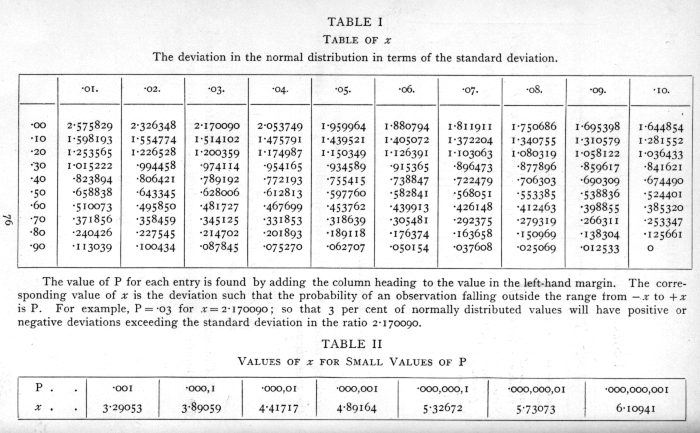
The commonly used approximate value of 1.96 is therefore accurate to better than one part in 50,000, which is more than adequate for applied work.
Some people even use the value of 2 in the place of 1.96, reporting a 95.4% confidence interval as a 95% confidence interval. This is not recommended but is occasionally seen.
Software functions ==
The inverse of the standard normal cumulative distribution function (CDF) can be used to compute the value. The following is a table of function calls that return 1.96 in some commonly used applications:
| Application | Function call |
|---|---|
| Excel | NORM.S.INV(0.975)` |
| MATLAB | norminv(0.975)` |
| R | qnorm(0.975)` |
| Python (SciPy) | scipy.stats.norm.ppf(0.975)` |
| SAS | probit(0.025);` |
| SPSS | x = COMPUTE IDF.NORMAL(0.975,0,1).` |
| Stata | invnormal(0.975)` |
| Wolfram Language (Mathematica) |
References
References
- {{Cite OEIS. A220510
- "Estimating the Population Mean Using Intervals". Statistical Computation Lab.
- [http://reference.wolfram.com/mathematica/ref/InverseCDF.html InverseCDF], Wolfram Language Documentation Center.
- [http://reference.wolfram.com/mathematica/ref/NormalDistribution.html?q=NormalDistribution&lang=en NormalDistribution], Wolfram Language Documentation Center.
This article was imported from Wikipedia and is available under the Creative Commons Attribution-ShareAlike 4.0 License. Content has been adapted to SurfDoc format. Original contributors can be found on the article history page.
Ask Mako anything about 97.5th percentile point — get instant answers, deeper analysis, and related topics.
Research with MakoFree with your Surf account
Create a free account to save articles, ask Mako questions, and organize your research.
Sign up freeThis content may have been generated or modified by AI. CloudSurf Software LLC is not responsible for the accuracy, completeness, or reliability of AI-generated content. Always verify important information from primary sources.
Report