From Surf Wiki (app.surf) — the open knowledge base
779 Nina
Main-belt asteroid
Main-belt asteroid
| Field | Value | |||
|---|---|---|---|---|
| minorplanet | yes | |||
| name | 779 Nina | |||
| background | #D6D6D6 | |||
| discovery_ref | ||||
| discoverer | G. Neujmin | |||
| discovery_site | Simeiz Obs. | |||
| discovered | 25 January 1914 | |||
| mpc_name | (779) Nina | |||
| alt_names | A914 BHA908 YB | |||
| A912 TE1914 UB | ||||
| named_after | Nina Neujmina | |||
| (Discoverer's sister) | ||||
| mp_category | {{plainlist | |||
| * {{nowrap | main-belt<ref name | "MPC-object" /(middle)}} | ||
| * background<ref name | "AstDys-object" / | |||
| orbit_ref | ||||
| epoch | 31 May 2020 (JD 2459000.5) | |||
| uncertainty | 0 | |||
| observation_arc | 103.51 yr (37,806 d) | |||
| aphelion | 3.2707 AU | |||
| perihelion | 2.0571 AU | |||
| semimajor | 2.6639 AU | |||
| eccentricity | 0.2278 | |||
| period | 4.35 yr (1,588 d) | |||
| mean_anomaly | 301.50° | |||
| mean_motion | / day | |||
| inclination | 14.582° | |||
| asc_node | 283.74° | |||
| arg_peri | 49.126° | |||
| dimensions | ||||
| mean_diameter | {{plainlist | |||
| * {{val | 76.62 | 4.0 | ul | km}} |
| * {{val | 80.572 | 2.220 | u | km}} |
| * {{val | 81.27 | 1.00 | u | km}} |
| rotation | ||||
| albedo | {{plainlist | |||
| * <ref name | "AKARI" / | |||
| * <ref name | "SIMPS" / | |||
| * <ref name | "Mainzer-2016" / | |||
| spectral_type | {{plainlist | |||
| * SMASS {{ | }} X | |||
| * X <ref name | "Lazzaro-2004" / | |||
| * M <ref name | "Belskaya-2017" / | |||
| abs_magnitude | {{plainlist | |||
| * 7.9<ref name | "MPC-object" / | |||
| * 8.10<ref name | "Mainzer-2016" / | |||
| * 8.30<ref name | "SIMPS" /}} |
A912 TE1914 UB (Discoverer's sister)
- main-belt(middle)
- background
- SMASS X
- X (S3OS2)
- M (Belskaya)
- 7.9
- 8.10
- 8.30}}
779 Nina (prov. designation: or ) is a large background asteroid, approximately 80 km in diameter, located in the central region of the asteroid belt. It was discovered on 25 January 1914, by Russian astronomer Grigory Neujmin (1886–1946) at the Simeiz Observatory on the Crimean peninsula. The metallic X-type asteroid with an intermediate albedo has a rotation period of 11.2 hours. It was named after the discoverer's sister, Nina Neujmina (Tsentilovich) (1889–1971).
Orbit and classification
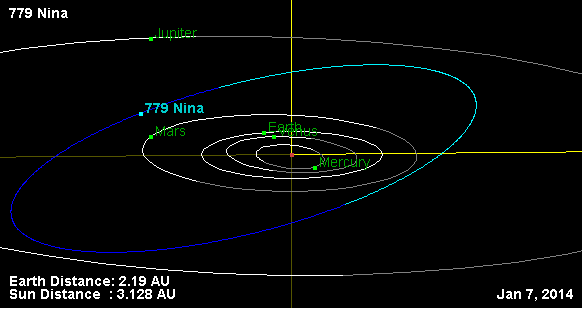
Nina is a non-family asteroid of the main belt's background population when applying the hierarchical clustering method to its proper orbital elements. It orbits the Sun in the central main-belt at a distance of 2.1–3.3 AU once every 4 years and 4 months (1,588 days; semi-major axis of 2.66 AU). Its orbit has an eccentricity of 0.23 and an inclination of 15° with respect to the ecliptic. The body's was first observed as and at Heidelberg Observatory on 16 December 1908 and 14 October 1912, respectively. The observation arc begins at Vienna Observatory on 31 July 1916, more than two years after to its official discovery observation at Simeiz Observatory on Crimea.
Naming
This minor planet was after Nina Nikolaevna Neujmina (Tsentilovich) (1889–1971), mathematician and sister of Russian discoverer Grigory Neujmin (1886–1946).
Physical characteristics
In the Bus–Binzel SMASS classification, Nina is an X-type asteroid. It is also an X-type in both the Tholen- and SMASS-like taxonomy of the Small Solar System Objects Spectroscopic Survey (S3OS2). Belskaya classifies Nina as a metallic M-type asteroid, which is the equivalent spectral type in the Tholen taxonomy for X-types with an intermediate albedo (see below).
Rotation period
In June 1981, a rotational lightcurve of Nina was obtained from photometric observations by Alan Harris at the Table Mountain and Lowell observatories. Lightcurve analysis gave a rotation period of hours with a brightness variation of magnitude (). It was confirmed by Brian Warner at his Palmer Divide Observatory in Colorado in January 2009, who determined a period of hours with an amplitude of magnitude (). In September 2012, French amateur astronomer Gérald Rousseau obtained a period of hours with an amplitude of magnitude ().
Diameter and albedo
According to the surveys carried out by the Infrared Astronomical Satellite IRAS, the NEOWISE mission of NASA's Wide-field Infrared Survey Explorer (WISE), and the Japanese Akari satellite, Nina measures (), () and () kilometers in diameter and its surface has an albedo of (), () and (), respectively. The Collaborative Asteroid Lightcurve Link adopts Petr Pravec's revised WISE-albedo of 0.1694 and takes a diameter of 77.46 kilometers based on an absolute magnitude of 8.1. The WISE team also published an alternative mean-diameter of () with an albedo of (). On 10 November 2005, an asteroid occultation of Nina gave a best-fit ellipse dimension of (), with a quality rating of 2. These timed observations are taken when the asteroid passes in front of a distant star.
Notes
References
This article was imported from Wikipedia and is available under the Creative Commons Attribution-ShareAlike 4.0 License. Content has been adapted to SurfDoc format. Original contributors can be found on the article history page.
Ask Mako anything about 779 Nina — get instant answers, deeper analysis, and related topics.
Research with MakoFree with your Surf account
Create a free account to save articles, ask Mako questions, and organize your research.
Sign up freeThis content may have been generated or modified by AI. CloudSurf Software LLC is not responsible for the accuracy, completeness, or reliability of AI-generated content. Always verify important information from primary sources.
Report