From Surf Wiki (app.surf) — the open knowledge base
733 series
Japanese train type
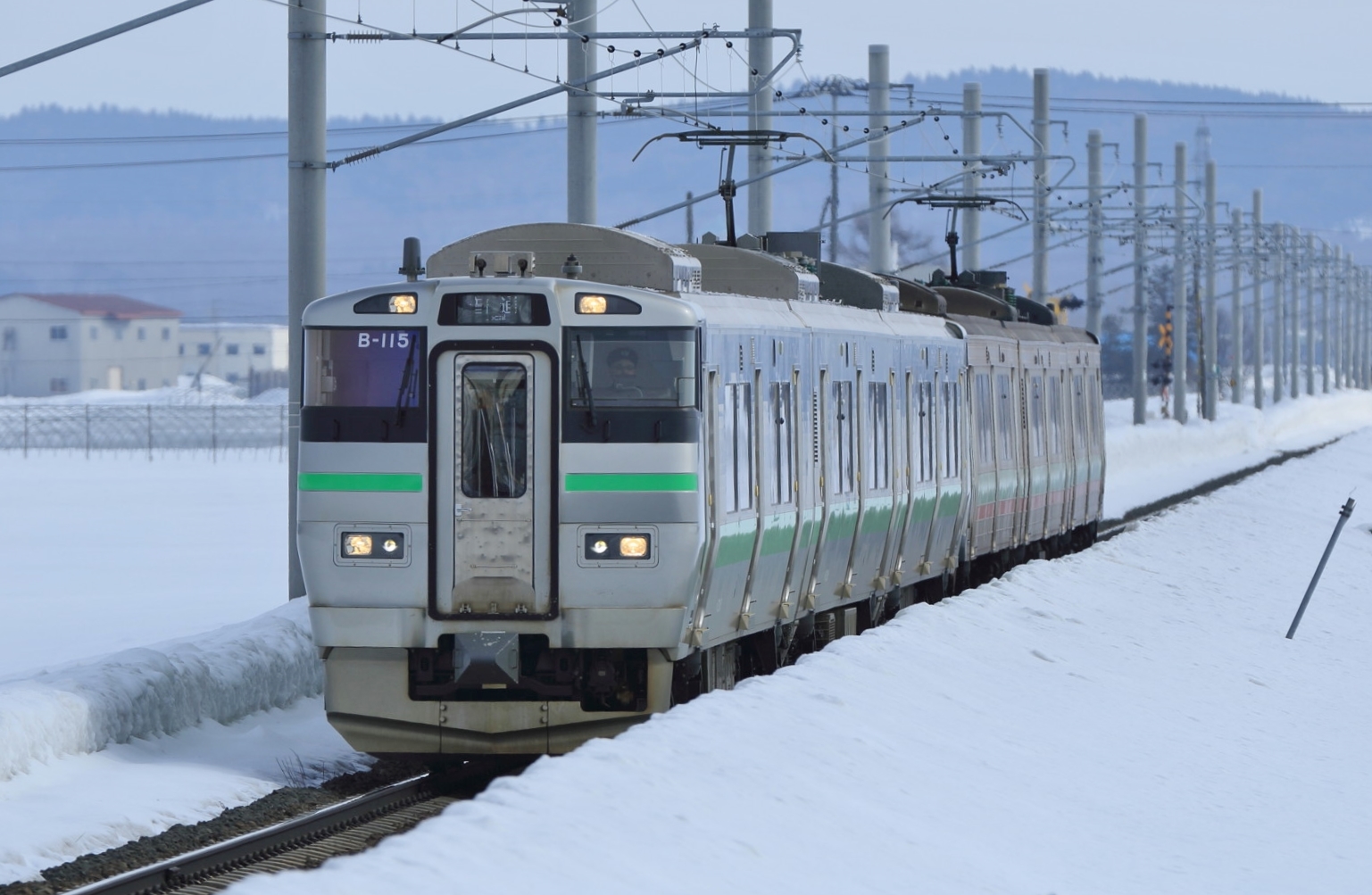
Japanese train type
| Field | Value | ||||
|---|---|---|---|---|---|
| name | 733 series | ||||
| image | JRH Series733 B107.jpg | ||||
| caption | Set B-107 on a Hakodate Main Line local service, August 2024 | ||||
| service | 1 June 2012 – present | ||||
| manufacturer | Kawasaki Heavy Industries | ||||
| factory | Kobe | ||||
| replaced | 721 series | ||||
| yearconstruction | 2012–2018, 2024– | ||||
| numberbuilt | 183 vehicles (43 sets) | ||||
| numberservice | 105 vehicles (28 sets) | ||||
| formation | 3/6 cars per trainset | ||||
| fleetnumbers | {{plainlist | ||||
| operator | |||||
| depots | Sapporo | ||||
| lines | Hakodate Main Line, Sasshō Line | ||||
| carbody | Stainless steel | ||||
| carlength | {{plainlist | ||||
| * {{Convert | 21200 | mm | ftin | abbr | on}} (end cars) |
| * {{Convert | 20800 | mm | ftin | abbr | on}} (intermediate cars) |
| width | 2892 mm | ||||
| floorheight | 1050 mm | ||||
| doors | 3 per side | ||||
| maxspeed | {{plainlist | ||||
| * {{Convert | 130 | km/h | mph | abbr | on}} (design) |
| * {{Convert | 120 | km/h | mph | abbr | on}} (service) |
| acceleration | 2.2 km/h/s | ||||
| traction | N-MT731A | ||||
| poweroutput | 230 kW per motor | ||||
| electricsystem | 20 kV AC (overhead catenary) | ||||
| collectionmethod | N-PS785 single-arm pantograph | ||||
| bogies | N-DT733 (motored), N-TR733 (trailer) | ||||
| safety | ATS-DN | ||||
| multipleworking | 721 series, 731 series, 735 series | ||||
| gauge |
- B-101 – B-121
- B-1001 – B-1004
- B-3101/3201 – B-3111/3211
- B-4101/4201 –
- 21200 mm (end cars)
- 20800 mm (intermediate cars)
- 130 km/h (design)
- 120 km/h (service)
The 733 series is an electric multiple unit (EMU) train type operated by Hokkaido Railway Company (JR Hokkaido) on suburban services in the Sapporo area of Hokkaido, Japan, since 1 June 2012.
Variants
- 733-0 series: 3-car sets operated since June 2012
- 733-1000 series: 3-car sets to be operated on Hakodate Liner shinkansen access services from March 2016
- 733-3000 series: 6-car sets operated on Airport rapid services since July 2014
- 733-4000 series: 6-car sets operated on Airport rapid services since October 2024
Design
Similar in appearance to the aluminum-bodied 735 series EMUs built in 2010, the 733 series EMUs have stainless steel bodies with steel driving cab ends. At 2892 mm, the 733 series cars are also wider than the 731 series and 735 series cars, which are 2800 mm wide. Sets B-113 onward, delivered from September 2013, feature full-color LED destination indicators, instead of the three-color indicators used on earlier sets.
Five new six-car sets, classified "733-3000 series", were delivered in 2014 and phased in on Airport rapid services between and from July, operating alongside the existing 721 series EMUs, and allowing the withdrawal of the remaining 711 series EMUs still in service. These sets include a "u Seat" car with unidirectional reclining seating for reserved seat passengers. The new sets feature LED lighting in the passenger areas.
File:733 LED destination indicator Sapporo 20120810.JPG|3-color LED destination indicator showing bilingual display, August 2012 File:733 series B-116 LED destination indicator Sapporo 20131115.JPG|Full-color LED destination indicator on set B-116, November 2013
Operations
The 733 series sets entered service from 1 June 2012 on suburban services in the Sapporo area of Hokkaido, including the newly electrified Sasshō Line. They are capable of running in multiple with 721 series, 731 series, and 735 series EMUs. However, unlike the 731 series, they cannot operate in multiple with the KiHa 201 series DMUs also used on the Sasshō Line.
Formations
, the fleet consists of 21 three-car sets, numbered B-101 to B-121, and seven six-car 733-3000 series sets, numbered B-3101 to B-3107, formed as shown below, with one motored ("M") intermediate car and two non-powered trailer ("T") cars. Car 1 is at the Takikawa/Tomakomai end.
3-car sets (B-101 – B-121)
| Car No. | 1 | 2 | 3 | Designation | Numbering | Weight (t) | Capacity |
|---|---|---|---|---|---|---|---|
| (total/seated) | |||||||
| Tc1 | M | Tc2 | |||||
| KuHa 733-100 | MoHa 733-100 | KuHa 733-200 | |||||
| 33.9 | 43.1 | 35.5 | |||||
| 139/46 | 154/52 | 146/50 |
- Car 1 has a universal access toilet.
- Car 2 is fitted with an N-PS785 single-arm pantograph.
3-car 733-1000 series sets (B-1001 – B-1004)

The fleet of four three-car 733-1000 series sets are formed as shown below, with car 1 at the Hakodate end.
| Car No. | 1 | 2 | 3 | Designation | Numbering | Weight (t) | Capacity |
|---|---|---|---|---|---|---|---|
| (total/seated) | |||||||
| Tc1 | M | Tc2 | |||||
| KuHa 733-1000 | MoHa 733-1000 | KuHa 733-2000 | |||||
| 34.2 | 41.9 | 35.5 | |||||
| 138/46 | 156/52 | 145/50 |
- Car 1 has a universal access toilet.
- Car 2 is fitted with a single-arm pantograph.
File:Kuha 733-1002.jpg|KuHa 733-1002 of set B1002 File:Moha 733-1002.jpg|MoHa 733-1002 of set B1002 File:Kuha 733-2002.jpg|KuHa 733-2002 of set B1002
6-car 733-3000 series sets (B-3101/3201 – B-3107/3207)

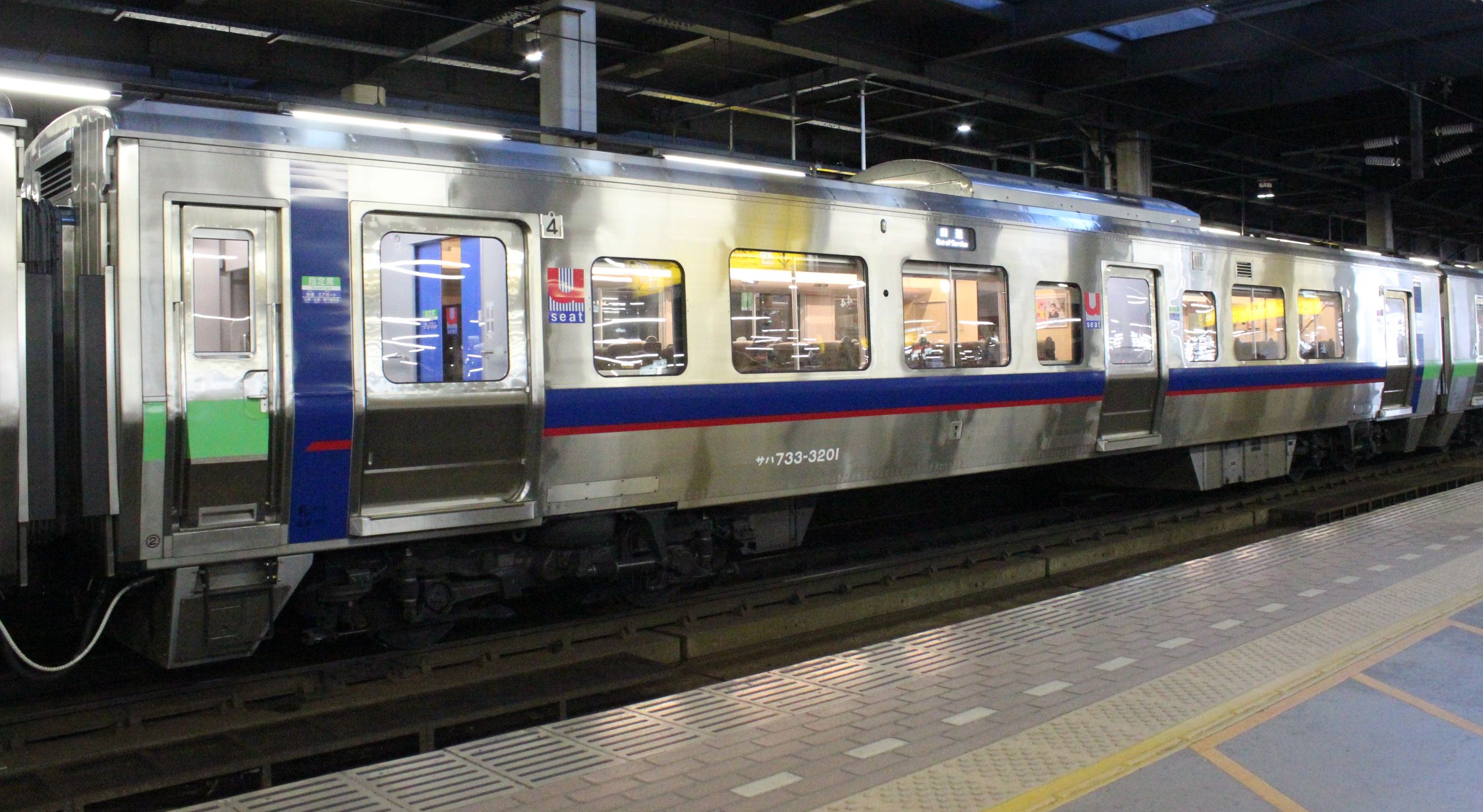
Seven six-car 733-3000 series sets are formed as shown below with two motored ("M") cars and four non-powered trailer ("T") cars. The sets each consist of two 3-car half sets, numbered "B-310x" and "B-320x", with car 1 at the New Chitose Airport end.
| Car No. | 1 | 2 | 3 | 4 | 5 | 6 | Designation | Numbering | Weight (t) | Capacity |
|---|---|---|---|---|---|---|---|---|---|---|
| (total/seated) | ||||||||||
| Tc1 | M | T | Tu | M | Tc2 | |||||
| KuHa 733-3100 | MoHa 733-3100 | SaHa 733-3100 | SaHa 733-3200 | MoHa 733-3200 | KuHa 733-3200 | |||||
| 33.7 | 41.8 | 34.0 | 31.8 | 41.8 | 35.3 | |||||
| 142/46 | 156/52 | 149/48 | 72/43 | 156/52 | 146/47 |
- Car 4 has "u Seat" unidirectional reclining seating.
- Car 1 has a toilet, and car 3 has a universal access toilet.
- Cars 2 and car 5 are each fitted with an N-PS785 single-arm pantograph.
Interior
The 3-car sets have longitudinal bench seating throughout, with a total capacity of 439 (148 seated).
File:JRH-733 inside 20120901.jpg|Interior view, showing priority seats highlighted in orange, September 2012
Bogies
File:N-DT733 bogie 733 Hyogo 20120208.JPG|N-DT733 motor bogie File:N-TR733 bogie 733 Hyogo 20120208.JPG|N-TR733 trailer bogie
History

The first two 3-car sets, B-101 and B-102, were delivered from the Kawasaki Heavy Industries factory in Kobe in February 2012, with two more sets, B-103 and B-104, delivered later the same month. Twelve more sets (36 vehicles) are scheduled to be delivered during fiscal 2014.
The first 733-3000 series six-car sets entered service on 19 July 2014.
The first two 733-1000 series three-car sets, B-1001 and B-1002, were delivered from the Kawasaki Heavy Industries factory in Kobe in October 2015.
The first two 733-4000 series six-car sets, B-4101/4201 and B-4102/4102, were delivered from the Kawasaki Heavy Industries factory in May 2024. These sets entered service from 25 October 2024, replacing ageing 721 series EMUs and allowing for additional capacity and frequency on Airport services.
Build details

The official delivery dates for the fleet are as shown below.
| Set No. | Manufacturer | Date delivered |
|---|---|---|
| B-101 | Kawasaki Heavy Industries | 10 March 2012 |
| B-102 | 13 March 2012 | |
| B-103 | 15 March 2012 | |
| B-104 | 17 March 2012 | |
| B-105 | 10 May 2012 | |
| B-106 | 11 May 2012 | |
| B-107 | 12 May 2012 | |
| B-108 | 13 May 2012 | |
| B-109 | 22 August 2012 | |
| B-110 | 13 August 2012 | |
| B-111 | 20 August 2012 | |
| B-112 | 21 August 2012 | |
| B-113 | 18 September 2013 | |
| B-114 | 19 September 2013 | |
| B-115 | 16 October 2013 | |
| B-116 | 17 October 2013 | |
| B-117 | 18 October 2013 | |
| B-118 | 9 November 2013 | |
| B-119 | 10 November 2013 | |
| B-120 | 11 November 2014 | |
| B-121 | 12 November 2014 | |
| B-1001 | 2015 | |
| B-1002 | ||
| B-1003 | ||
| B-1004 | ||
| B-3101/3201 | 24 June 2014 | |
| B-3102/3202 | 4 July 2014 | |
| B-3103/3203 | 6 August 2014 | |
| B-3104/3204 | 7 August 2014 | |
| B-3105/3205 | 18 October 2014 | |
| B-3106/3206 | 17 June 2015 | |
| B-3107/3207 | 2 July 2015 | |
| B-3108/3208 | 8 May 2018 | |
| B-3109/3209 | 10 May 2018 | |
| B-3110/3210 | 5 June 2018 | |
| B-3111/3211 | 7 June 2018 | |
| B-4101/4201 | May 2024 | |
| B-4102/4202 | ||
| B-4103/4203 | October 2024 | |
| B-4104/4204 | ||
| B-4105/4205 | June 2025 | |
| B-4106/4206 | ||
| B-4107/4207 | August 2025 |
References
References
- {{cite magazine. Koyusha Co., Ltd.. (June 2012)
- Tetsudō Daiya Jōhō Magazine. (February 2012)
- link. (2 June 2012). Japan Railfan Magazine Online. Koyusha Co., Ltd.
- link. (14 March 2012). Tetsudo Hobidas. Neko Publishing
- link. (14 May 2014). News release. Hokkaido Railway Company
- Tetsudō Daiya Jōhō Magazine. (May 2012)
- Kotsu Shimbunsha. (18 November 2015)
- {{cite magazine. Koyusha Co., Ltd.. (March 2016)
- [[Japan Railfan Magazine]]. (October 2014)
- link. (9 February 2012). Japan Railfan Magazine Online. Koyusha Co., Ltd.
- Tetsudō Daiya Jōhō Magazine. (March 2012)
- link. (28 February 2012). Japan Railfan Magazine Online. Koyusha Co., Ltd.
- Masahiro. Saka. Tetsudō Daiya Jōhō Magazine. (May 2014)
- link. (20 July 2014). Japan Railfan Magazine Online. Koyusha Co., Ltd.
- link. (6 October 2015). RM News. Neko Publishing Co., Ltd.
- (2024-05-16). "". link. Koyusha Co., Ltd.
- (2024-10-27). "". link. Koyusha Co., Ltd.
- (2024-04-04). "". link
- {{cite magazine. Koyusha Co., Ltd.. (July 2019)
- {{cite magazine. Koyusha Co., Ltd.. (July 2016)
- (6 November 2024). "快速「エアポート」に733系4000番代が登場". Neko Publishing.
- (24 October 2024). "JR北海道733系4000番代B4103+B4203編成、甲種輸送を実施". Neko Publishing.
- (12 June 2025). "【JR北海道】733系4000番代の甲種輸送を実施". Neko Publishing.
- (29 August 2025). "733系4000番代が甲種輸送される". Koyusha Co., Ltd..
This article was imported from Wikipedia and is available under the Creative Commons Attribution-ShareAlike 4.0 License. Content has been adapted to SurfDoc format. Original contributors can be found on the article history page.
Ask Mako anything about 733 series — get instant answers, deeper analysis, and related topics.
Research with MakoFree with your Surf account
Create a free account to save articles, ask Mako questions, and organize your research.
Sign up freeThis content may have been generated or modified by AI. CloudSurf Software LLC is not responsible for the accuracy, completeness, or reliability of AI-generated content. Always verify important information from primary sources.
Report