From Surf Wiki (app.surf) — the open knowledge base
69th Street Transit Center
Rapid transit station in Philadelphia
Rapid transit station in Philadelphia
| Field | Value | ||
|---|---|---|---|
| name | |||
| style | SEPTA Metro | ||
| image | 20140526 16 Market Frankford El @ 69th St. (16772888036).jpg | ||
| image_caption | Market–Frankford (L) e.b. platform, March 2014 | ||
| address | 6901 Market Street | ||
| borough | Upper Darby Township, Pennsylvania | ||
| coordinates | |||
| owned | SEPTA | ||
| platform | 4 island platforms, 3 side platforms | ||
| tracks | 7 | ||
| connections | {{Unbulleted list | ||
| structure | At-grade | ||
| parking | 182 spaces | ||
| accessible | yes | ||
| opened | March 4, 1907 | ||
| former | 69th Street Terminal (1907–2011) | ||
| 69th Street Transportation Center (2011–2025) | |||
| services | {{Adjacent stations | system=SEPTA Metro | |
| line1 | L1 adj | right=Millbourne | |
| line2 | M1 adj | left2=Parkview | |
| line3 | D1 adj | left3=Fairfield Avenue | |
| line4 | D2 adj | left4=Fairfield Avenue}} | |
| other_services_collapsible | yes | ||
| other_services_header | Former services | ||
| other_services | {{Adjacent stations | ||
| system1 | Philadelphia Transportation Company | line1=Market Elevated | right1=66th Street |
| system2 | Lehigh Valley Transit Company | line2=Liberty Bell | left2=Parkview |
| system3 | Philadelphia and Western Railroad | line3=Strafford Branch | left3=Parkview |
| mapframe | yes | ||
| mapframe-zoom | 15 | ||
| mapframe-marker-color | #000 | ||
| mapframe-marker | rail-metro | ||
| map_state | collapsed | ||
| route_map |
| SEPTA City Bus: | SEPTA Suburban Bus: , 69th Street Transportation Center (2011–2025) | mapframe-zoom = 15 | mapframe-marker-color = #000 | mapframe-marker = rail-metro
69th Street Transit Center formerly known as (69th Street Transportation Center) is a SEPTA terminal in the Terminal Square area of Upper Darby Township, Pennsylvania. It serves the SEPTA Metro L, M, D, and multiple SEPTA bus routes. It is located at the end of 69th Street, a major retail corridor in Upper Darby Township across Market Street (Route 3) from the Tower Theater.
69th Street is the second-busiest SEPTA transfer point, after its 15th Street/City Hall station, serving 35,000 passengers daily during the week.
History
20th century
Great Hall 69th Street is one of the original Market Street Elevated stations built by the Philadelphia Rapid Transit Company; the line opened for service on March 4, 1907, running between the 69th Street and stations. The same year, on May 22, the Philadelphia and Western Railroad opened the first segment of what is now the Norristown High-Speed Line, running from 69th Street to a farm on Sugartown Road in Strafford. By 1931, the P&W was operating Bullet electric multiple units between 69th Street and Norristown Transportation Center.
The Great Hall station house, which opened in 1907 with the Market Street Elevated, was a catalyst for nearby development in Upper Darby, considered to be one of the earliest examples of transit-oriented development.
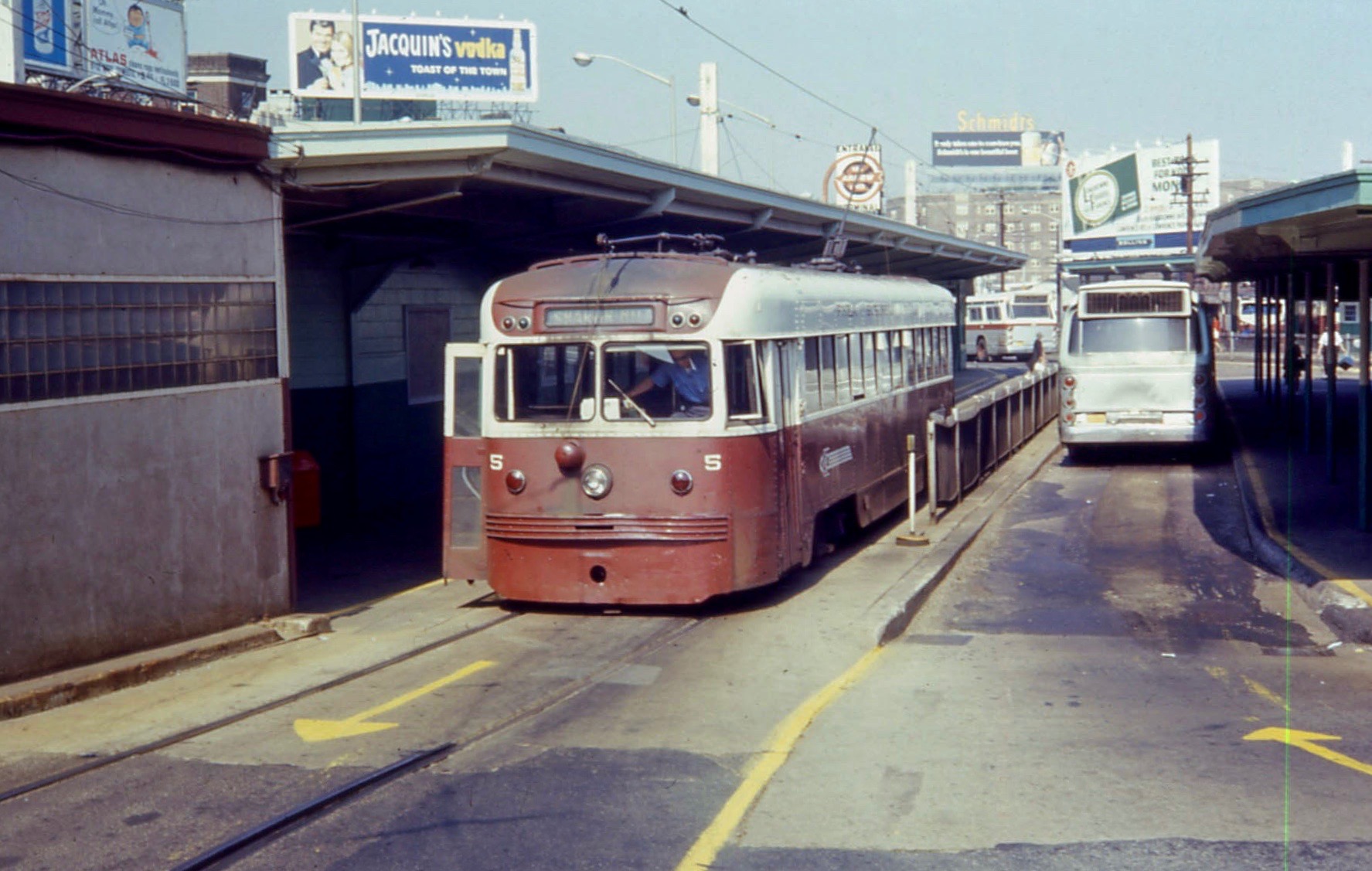
The Media–Sharon Hill Line (routes 101 and 102) opened slightly earlier, having begun service to Sharon Hill in March 1906 and to Media in March 1913. The lines were operated by the Philadelphia and West Chester Traction Company.
In 1954, the Media, Sharon Hill, and Norristown lines were purchased by the Philadelphia Suburban Transportation Company (PSTC), also known as Red Arrow Lines. PSTC merged into SEPTA in 1970, unifying all services in the station under a single operator for the first time on January 29.
21st century
On February 2, 2016, SEPTA opened a new West Terminal at the station, serving multiple bus routes and the 101 and 102 trolley lines. The $19.6 million project brought new tracks and pavement, new platforms and ramps to the terminal building, as well as a green roof and eco-friendly LED lighting.
A train crash occurred here on August 23, 1986, injuring 44 and killing 1. On August 22, 2017, an inbound Norristown Line train crashed into an unoccupied train at the terminal, injuring 33.
Plans for a new parking garage, which would bring 318 additional parking spaces to the station, were announced in October 2018. The garage would be located above the South Terminal bus berths, is expected to cost $37 million, and will break ground in summer 2020. A 2019 report suggested removing the bridge across Market Street in favor of a traffic-calmed intersection with crosswalks.
Market–Frankford Line platforms
Main article: Market-Frankford Line
69th Street is the Market–Frankford Line's western terminus. East of here, the route travels thorough West and Center City Philadelphia along Market Street, and then continues northeast to Frankford Transit Center. The station is one of two ground-level stations of the Market––Frankford Line, and one of two SEPTA rapid transit stations outside the Philadelphia city limits.
The station's three tracks and two platforms are located below ground at the center of the terminal, sandwiched between the station building and the Norristown High Speed Line terminal. The westbound platform (a single side platform on the right side of arriving trains) handles all alighting passengers who must exit here and leave the platform area, while the eastbound platform (an island platform between the 2 departure tracks) handles passengers arriving from the terminal upstairs. West of the station, a two-track balloon loop allows terminating trains to turn around and depart the station. There is also a large storage yard and a maintenance facility shared with the Media–Sharon Hill Line. Two MFL trains collided after one derailed on the balloon track seriously injuring the operator.
Norristown High Speed Line platforms
Main article: Norristown High Speed Line

SEPTA's Norristown High Speed Line (formerly Route 100) originates at 69th Street, continuing west and north to serve the communities of Haverford and Radnor before terminating at Norristown Transportation Center in Norristown. Unlike the Market–Frankford terminal, the Norristown Line tracks terminate at bumper blocks adjacent to the station, meaning that all platforms and tracks can handle both the boarding and alighting of passengers.
Bus and trolley routes

Surface transit lines at 69th Street are split into three distinct areas of the terminal. The largest of these areas is known as the West Terminal. It is located on a slightly elevated embankment west of the station house and adjacent to the intersection of Market Street and Victory Avenue. This area contains bus berths for routes , as well as two berths for the Media–Sharon Hill Line. The two trolley routes run southwest out of the station into the median of Terminal Square, and then via a separate right-of-way until diverging at . All bus routes at this terminal are operated by SEPTA's Suburban Division and operate west out of the station on West Chester Pike, State Road, or Garrett Road.
The station's South Terminal is adjacent to Market Street just east of 69th Street, also south of the terminal building. This area is located adjacent to the station's taxi stand and has berths for routes . Routes 21 and 68 are part of SEPTA's City Transit Division, while the remaining three are Suburban Division and former Red Arrow routes. These routes operate east into West Philadelphia on Market Street or south on 69th Street towards East Lansdowne.
The station's North Terminal handles the remaining six routes: . It is located north of the station building and heavy rail platforms, adjacent to the Market–Frankford/Media–Sharon Hill maintenance facility building and SEPTA Victory District garage. These buses depart the station via a private access road to Cardington Road and proceed north through Cobbs Creek Park before turning east towards West Philadelphia or west to Lower Merion Township. Route 123 is the only exception as it splits from the rest of the lines and heads south on Victory Avenue and then west on West Chester Pike on its way to King of Prussia Mall.
Station layout
The station building also houses SEPTA sales offices, stores, and eateries. There is also a 182-space park and ride lot east of the station building on Market Street. Market–Frankford platforms are accessed via a mezzanine over the tracks that leads from the station house, the Norristown line platforms accessible directly from doors that lead into a small hallway that attaches to the Main Hall, while the Route 101/102 trolleys board on a loop at the western bus terminal. There are two tracks on the north side of the loop, but trolleys only use the outer track; the inner track, which is also paved with asphalt, is used for bus berths.


References
References
- {{Cox-Upper Darby
- Hepp, John. (2013). "Subways and Elevated Lines". The Encyclopedia of Greater Philadelphia.
- (January 31, 2019). "SEPTA 69th Street Transportation Center: A Community Anchor + Gateway". Urban Land Institute.
- (May 21, 1907). "Railroad Sold for $1,000,000". New York Times.
- ISEPTAPHILLY Blog. "Route of the Week - Norristown High Speed Line". [[SEPTA]].
- ISEPTAPHILLY Blog. "Route of the Week - 101". [[SEPTA]].
- ISEPTAPHILLY Blog. "Route of the Week - 102". [[SEPTA]].
- Fallon Samuels Aidoo. (2017). "Red Arrow Lines". Encyclopedia of Greater Philadelphia.
- ISEPTAPHILLY Blog. (June 2, 2016). "SEPTA Celebrates New West Terminal at 69th Street Transportation Center". [[SEPTA]].
- "Notable SEPTA train accidents". [[The Philadelphia Inquirer]].
- "SEPTA: 33 Injured After Train Crashes At 69th Street Terminal". [[KYW-TV]].
- Darryl C. Murphy. (October 18, 2019). "SEPTA is building a parking garage for 69th Street Station's 35,000 daily riders". [[WHYY-FM]].
- "69th Street Transportation Center Map". [[SEPTA]].
This article was imported from Wikipedia and is available under the Creative Commons Attribution-ShareAlike 4.0 License. Content has been adapted to SurfDoc format. Original contributors can be found on the article history page.
Ask Mako anything about 69th Street Transit Center — get instant answers, deeper analysis, and related topics.
Research with MakoFree with your Surf account
Create a free account to save articles, ask Mako questions, and organize your research.
Sign up freeThis content may have been generated or modified by AI. CloudSurf Software LLC is not responsible for the accuracy, completeness, or reliability of AI-generated content. Always verify important information from primary sources.
Report