From Surf Wiki (app.surf) — the open knowledge base
500 (number)
| Field | Value | ||||||||
|---|---|---|---|---|---|---|---|---|---|
| number | 500 | ||||||||
| roman | D | lang1=Armenian | lang1 symbol=Շ | lang2=Hebrew | lang2 symbol=ת"ק / ך | lang3=Babylonian cuneiform | lang3 symbol=𒐜⟪ | lang4=Egyptian hieroglyph | lang4 symbol=𓍦 |
500 (five hundred) is the natural number following 499 (number) and preceding 501.
Mathematical properties
500 = 22 × 53. It is an Achilles number and a Harshad number, meaning it is divisible by the sum of its digits. It is the number of planar partitions of 10.
Other fields
Five hundred is also
- the number that many NASCAR races often use at the end of their race names (e.g., Daytona 500), to denote the length of the race (in miles, kilometers or laps).
- the longest advertised distance (in miles) of the IndyCar Series and its premier race, the Indianapolis 500.
Slang names
- Monkey (UK slang for £500; US slang for $500)
Integers from 501 to 599
500s
501
Main article: 501 (number)
501 = 3 × 167. It is:
- the sum of the first 18 primes (a term of the sequence ).
- palindromic in bases 9 (6169) and 20 (15120).
502
- 502 = 2 × 251
- vertically symmetric number
503
503 is:
- a prime number.
- a safe prime.
- the sum of three consecutive primes (163 + 167 + 173).
- the sum of the cubes of the first four primes.
- a Chen prime
- an Eisenstein prime with no imaginary part.
- an index of a prime Lucas number.
- an isolated prime
504
504 = 23 × 32 × 7. It is:
- the sum between the smallest pair of amicable numbers (220, 284).
- a tribonacci number.
- a semi-meandric number.
- a refactorable number.
- a Harshad number. :\sum_{n=0}^{10}{504}^{n} is prime
- the group order of the fourth smallest non-cyclic simple group A1(8) = 2G2(3)′.
- the number of symmetries of the simple group PSL(2,8) that is the automorphism group of the Macbeath surface.
- a largely composite number
505
- 505 = 5 × 101
- model number of Levi's jeans, model number of
- This number is the magic constant of n×n normal magic square and n-queens problem for n = 10.
506
506 = 2 × 11 × 23. It is:
- a sphenic number.
- a square pyramidal number.
- a pronic number.
- a Harshad number. 10^{506}-10^{253}-1 is a prime number. Its decimal expansion is 252 nines, an eight, and 253 more nines.
507
- 507 = 3 × 132 = 232 - 23 + 1, which makes it a central polygonal number
- The age Ming had before dying.
508
- 508 = 22 × 127, sum of four consecutive primes (113 + 127 + 131 + 137), number of graphical forest partitions of 30, since 508 = 222 + 22 + 2 it is the maximum number of regions into which 23 intersecting circles divide the plane.
509
509 is:
- a prime number.
- a Sophie Germain prime, smallest Sophie Germain prime to start a 4-term Cunningham chain of the first kind {509, 1019, 2039, 4079}.
- a Chen prime.
- an Eisenstein prime with no imaginary part.
- a highly cototient number
- a prime index prime.
510s
510
510 = 2 × 3 × 5 × 17. It is:
- the sum of eight consecutive primes (47 + 53 + 59 + 61 + 67 + 71 + 73 + 79).
- the sum of ten consecutive primes (31 + 37 + 41 + 43 + 47 + 53 + 59 + 61 + 67 + 71).
- the sum of twelve consecutive primes (19 + 23 + 29 + 31 + 37 + 41 + 43 + 47 + 53 + 59 + 61 + 67).
- a nontotient.
- a sparsely totient number.
- a Harshad number.
- the number of nonempty proper subsets of an 9-element set.
511
Main article: 511 (number)
511 = 7 × 73. It is:
- a Harshad number.
- a palindromic number and a repdigit in bases 2 (1111111112) and 8 (7778)
- 5-1-1, a roadway status and transit information hotline in many metropolitan areas of the United States.
512
Main article: 512 (number)
512 = 83 = 29. It is:
- a power of two
- a cube of 8
- a Leyland number using 4 & 4 (44 + 44)
- a Dudeney number.
- a Harshad number
- palindromic in bases 7 (13317) and 15 (24215)
- a vertically symmetric number
513
513 = 33 × 19. It is:
- Leyland number of the second kind using 3 & 6 (36 - 63)
- palindromic in bases 2 (10000000012) and 8 (10018)
- a Harshad number
- Area code of Cincinnati, Ohio
514
514 = 2 × 257, it is:
- a centered triangular number.
- a nontotient
- a palindrome in bases 4 (200024), 16 (20216), and 19 (18119)
- an Area Code for Montreal, Canada
515
515 = 5 × 10³, it is:
- the sum of nine consecutive primes (41 + 43 + 47 + 53 + 59 + 61 + 67 + 71 + 73).
- the number of complete compositions of 11.
516
516 = 22 × 3 × 43, it is:
- nontotient.
- untouchable number.
- refactorable number.
- a Harshad number.
517
517 = 11 × 47, it is:
- the sum of five consecutive primes (97 + 101 + 103 + 107 + 109).
- a Smith number.
518
518 = 2 × 7 × 37, it is:
- = 51 + 12 + 83 (a property shared with 175 and 598).
- a sphenic number.
- a nontotient.
- an untouchable number.
- palindromic and a repdigit in bases 6 (22226) and 36 (EE36).
- a Harshad number.
519
519 = 3 × 173, it is:
- the sum of three consecutive primes (167 + 173 + 179)
- palindromic in bases 9 (6369) and 12 (37312)
- a D-number.
520s
520
520 = 23 × 5 × 13. It is:
- an untouchable number.
- an idoneal number
- a palindromic number in base 14 (29214).
521
521 is:
- a Lucas prime.
- A Mersenne exponent, i.e. 2521−1 is prime.
- The largest known such exponent that is the lesser of twin primes
- a Chen prime.
- an Eisenstein prime with no imaginary part.
- palindromic in bases 11 (43411) and 20 (16120). 4521 - 3521 is prime
522
522 = 2 × 32 × 29. It is:
- the sum of six consecutive primes (73 + 79 + 83 + 89 + 97 + 101).
- a repdigit in bases 28 (II28) and 57 (9957).
- a Harshad number.
- number of series-parallel networks with 8 unlabeled edges.
523
523 is:
- a prime number.
- the sum of seven consecutive primes (61 + 67 + 71 + 73 + 79 + 83 + 89).
- palindromic in bases 13 (31313) and 18 (1B118).
- a prime with a prime number of prime digits
- the smallest prime number that starts a prime gap of length greater than 14
524
524 = 22 × 131
- number of partitions of 44 into powers of 2
525
525 = 3 × 52 × 7. It is palindromic in base ten, as well as the fifty-fifth self number greater than 1 in decimal. It is also:
- the sum of all prime numbers that divide the orders of the twenty-six sporadic groups (2, 3, 5, ..., 71; aside from 53 and 61).
- the sum of the dimensions of all five exceptional Lie algebras (14, 52, 78, 133, 248). 525 is the number of scan lines in the NTSC television standard.
526
526 = 2 × 263, centered pentagonal number, nontotient, Smith number
527
527 = 17 × 31. It is:
- palindromic in base 15 (25215)
- number of diagonals in a 34-gon
- also, the section of the US Tax Code regulating soft money political campaigning (see 527 groups)
528
528 = 24 × 3 × 11. It is:
- the 32nd triangular number.
- palindromic in bases 9 (6469) and 17 (1E117).
- the 167th Totient number.
529
529 = 232. It is:
- a centered octagonal number.
- a lazy caterer number .
- also Section 529 of the IRS tax code organizes 529 plans to encourage saving for higher education.
530s
530
530 = 2 × 5 × 53. It is:
- a sphenic number.
- a nontotient.
- the sum of totient function for first 41 integers.
- an untouchable number.
- the sum of the first three perfect numbers.
- palindromic in bases 4 (201024), 16 (21216), and 23 (10123).
- a US telephone area code that covers much of Northern California.
531
531 = 32 × 59. It is:
- palindromic in base 12 (38312).
- a Harshad number.
- number of symmetric matrices with nonnegative integer entries and without zero rows or columns such that sum of all entries is equal to 6
532
532 = 22 × 7 × 19. It is:
- a pentagonal number.
- a nontotient.
- palindromic and a repdigit in bases 11 (44411), 27 (JJ27), and 37 (EE37).
- admirable number.
533
533 = 13 × 41. It is:
- the sum of three consecutive primes (173 + 179 + 181).
- the sum of five consecutive primes (101 + 103 + 107 + 109 + 113).
- palindromic in base 19 (19119).
- generalized octagonal number.
534
534 = 2 × 3 × 89. It is:
- a sphenic number.
- the sum of four consecutive primes (127 + 131 + 137 + 139).
- a nontotient.
- palindromic in bases 5 (41145) and 14 (2A214).
- an admirable number.
:\sum_{n=0}^{10}{534}^{n} is prime
535
535 = 5 × 10⁷. It is:
- a Smith number.
34 n^3 + 51 n^2 + 27 n+ 5 for n = 2; this polynomial plays an essential role in Apéry's proof that \zeta(3) is irrational.
535 is used as an abbreviation for May 35, which is used in China instead of June 4 to evade censorship by the Chinese government of references on the Internet to the Tiananmen Square protests of 1989.
536
536 = 23 × 67. It is:
- the number of ways to arrange the pieces of the ostomachion into a square, not counting rotation or reflection.
- the number of 1's in all partitions of 23 into odd parts
- a refactorable number.
- the lowest happy number beginning with the digit 5.
- the 168th Totient number.
537
537 = 3 × 179, Mertens function (537) = 0, Blum integer, D-number
538
538 = 2 × 269. It is:
- an open meandric number.
- a nontotient.
- the total number of votes in the United States Electoral College.
- the website FiveThirtyEight.
- Radio 538, a Dutch commercial radio station.
539
539 = 72 × 11
\sum_{n=0}^{10}{539}^{n} is prime
540s
540
540 = 22 × 33 × 5. It is:
- an untouchable number.
- a heptagonal number.
- a decagonal number.
- a repdigit in bases 26 (KK26), 29 (II29), 35 (FF35), 44 (CC44), 53 (AA53), and 59 (9959).
- a Harshad number.
- the number of doors to Valhalla according to the Prose Edda.
- the number of floors in Thor's hall, known as Bilskirnir, according to the Prose Edda.
- the sum of a twin prime (269 + 271)
- a largely composite number
541
541 is:
- the 100th prime.
- a lucky prime.
- a Chen prime.
- the 10th star number.
- palindromic in bases 18 (1C118) and 20 (17120).
- the fifth ordered Bell number that represents the number of ordered partitions of [5].
- 4541 - 3541 is prime.
For the Mertens function, M(541) = 0.
542
542 = 2 × 271. It is:
- a nontotient.
- the sum of totient function for the first 42 integers.
543
543 = 3 × 181; palindromic in bases 11 (45411) and 12 (39312), D-number.
\sum_{n=0}^{10}{543}^{n} is prime
544
544 = 25 × 17. Take a grid of 2 times 5 points. There are 14 points on the perimeter. Join every pair of the perimeter points by a line segment. The lines do not extend outside the grid. 544 is the number of regions formed by these lines.
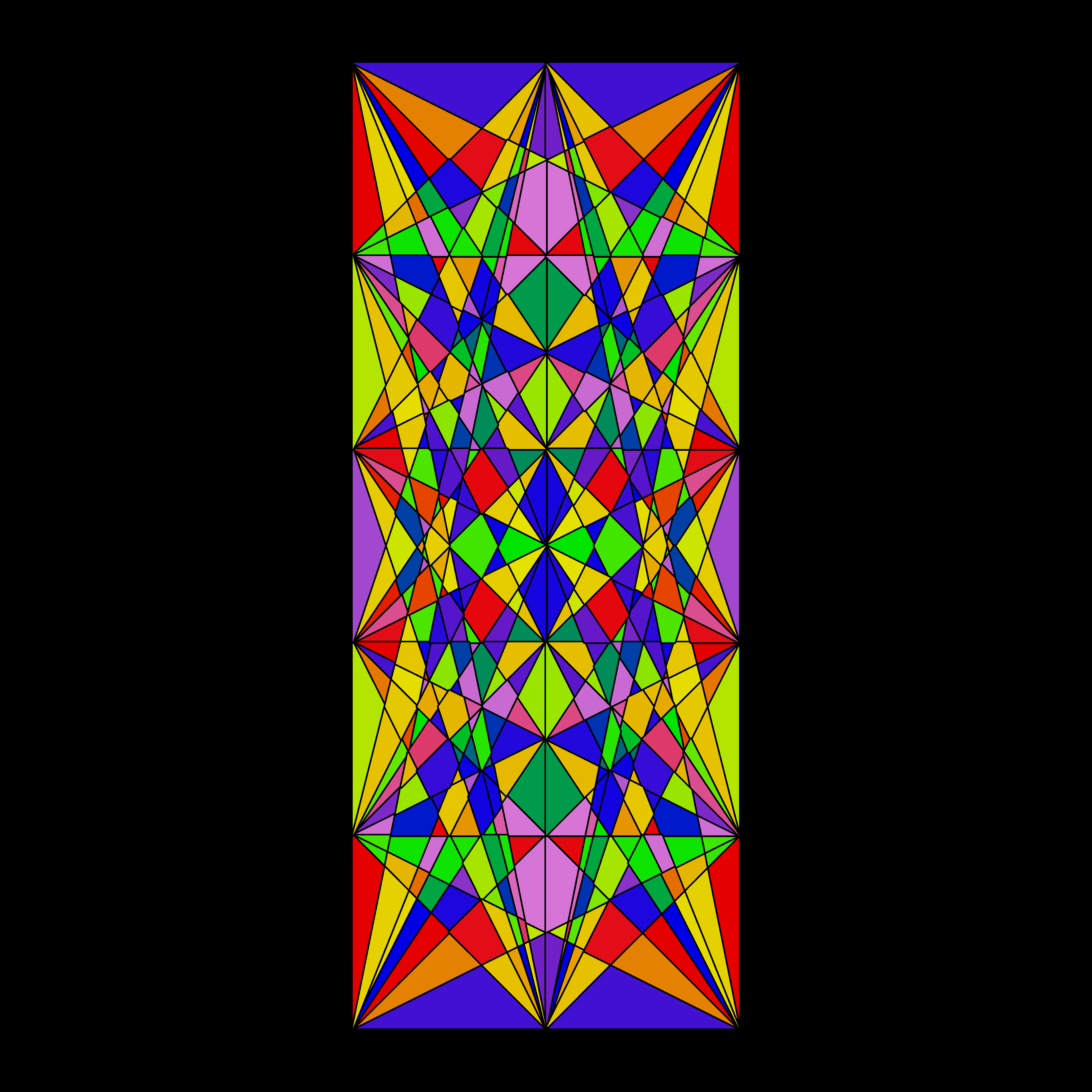
544 is also the number of pieces that could be seen in a 5×5×5×5 Rubik's Tesseract. As a standard 5×5×5 has 98 visible pieces (53 − 33), a 5×5×5×5 has 544 visible pieces (54 − 34).
545
545 = 5 × 10⁹. It is:
- a centered square number.
- palindromic in bases 10 (54510) and 17 (1F117).
546
546 = 2 × 3 × 7 × 13. It is:
- the sum of eight consecutive primes (53 + 59 + 61 + 67 + 71 + 73 + 79 + 83).
- palindromic in bases 4 (202024), 9 (6669), and 16 (22216).
- a repdigit in bases 9 and 16.
- 546! − 1 is prime.
547
547 is:
- a prime number.
- a cuban prime.
- a centered hexagonal number.
- a centered heptagonal number.
- a prime index prime.
548
548 = 22 × 137. It is:
- a nontotient.
- the default port for the Apple Filing Protocol. Also, every positive integer is the sum of at most 548 ninth powers;
549
549 = 32 × 61, it is:
- a repdigit in bases 13 (33313) and 60 (9960).
- φ(549) = φ(σ(549)).
550s
550
550 = 2 × 52 × 11. It is:
- a pentagonal pyramidal number.
- a primitive abundant number.
- a nontotient.
- a repdigit in bases 24 (MM24), 49 (BB49), and 54 (AA54).
- a Harshad number.
- the SMTP status code meaning the requested action was not taken because the mailbox is unavailable
551
551 = 19 × 29. It is:
- It is the number of mathematical trees on 12 unlabeled nodes.
- the sum of three consecutive primes (179 + 181 + 191).
- palindromic in base 22 (13122).
- the SMTP status code meaning user is not local
552
552 = 23 × 3 × 23. It is:
- the number of prime knots with 11 crossings.
- the sum of six consecutive primes (79 + 83 + 89 + 97 + 101 + 103).
- the sum of ten consecutive primes (37 + 41 + 43 + 47 + 53 + 59 + 61 + 67 + 71 + 73).
- a pronic number.
- an untouchable number.
- palindromic in base 19 (1A119).
- a Harshad number.
- the model number of .
- the SMTP status code meaning requested action aborted because the mailbox is full.
553
553 = 7 × 79. It is:
- the sum of nine consecutive primes (43 + 47 + 53 + 59 + 61 + 67 + 71 + 73 + 79).
- a central polygonal number.
- the model number of .
- the SMTP status code meaning requested action aborted because of faulty mailbox name.
554
554 = 2 × 277. It is:
- a nontotient.
- a 2-Knödel number
- the SMTP status code meaning transaction failed. Mertens function(554) = 6, a record high that stands until 586.
555
Main article: 555 (number)
555 = 3 × 5 × 37 is:
- a sphenic number.
- palindromic in bases 9 (6769), 10 (55510), and 12 (3A312).
- a repdigit in bases 10 and 36.
- a Harshad number.
- φ(555) = φ(σ(555)).
556
556 = 22 × 139. It is:
- the sum of four consecutive primes (131 + 137 + 139 + 149).
- an untouchable number, because it is never the sum of the proper divisors of any integer.
- a happy number.
- the model number of ; 5.56×45mm NATO cartridge.
557
557 is:
- a prime number.
- a Chen prime.
- an Eisenstein prime with no imaginary part.
- the number of parallelogram polyominoes with 9 cells.
558
558 = 2 × 32 × 31. It is:
- a nontotient.
- a repdigit in bases 30 (II30) and 61 (9961).
- a Harshad number.
- The sum of the largest prime factors of the first 558 is itself divisible by 558 (the previous such number is 62, the next is 993).
- in the title of the Star Trek: Deep Space Nine episode "The Siege of AR-558"
559
559 = 13 × 43. It is:
- the sum of five consecutive primes (103 + 107 + 109 + 113 + 127).
- the sum of seven consecutive primes (67 + 71 + 73 + 79 + 83 + 89 + 97).
- a nonagonal number.
- a centered cube number.
- palindromic in base 18 (1D118).
- the model number of .
560s
560
560 = 24 × 5 × 7. It is:
- a tetrahedral number.
- a refactorable number.
- palindromic in bases 3 (2022023) and 6 (23326).
- the number of diagonals in a 35-gon
561
561 = 3 × 11 × 17. It is:
- a sphenic number.
- the 33rd triangular number.
- a hexagonal number.
- palindromic in bases 2 (10001100012) and 20 (18120).
- the first Carmichael number
562
562 = 2 × 281. It is:
- a Smith number.
- an untouchable number.
- the sum of twelve consecutive primes (23 + 29 + 31 + 37 + 41 + 43 + 47 + 53 + 59 + 61 + 67 + 71).
- palindromic in bases 4 (203024), 13 (34313), 14 (2C214), 16 (23216), and 17 (1G117).
- a lazy caterer number .
- the number of Native American (including Alaskan) Nations, or "Tribes," recognized by the USA government. 56264 + 1 is prime
563
563 is:
- a prime number.
- a safe prime.
- the largest known Wilson prime.
- a Chen prime.
- an Eisenstein prime with no imaginary part.
- a balanced prime.
- a strictly non-palindromic number.
- a sexy prime.
- a happy prime.
- a prime index prime.
- 5563 - 4563 is prime.
564
564 = 22 × 3 × 47. It is:
- the sum of a twin prime (281 + 283).
- a refactorable number.
- palindromic in bases 5 (42245) and 9 (6869).
- number of primes 12.
565
565 = 5 × 113. It is:
- the sum of three consecutive primes (181 + 191 + 193).
- a member of the Mian–Chowla sequence.
- a happy number.
- palindromic in bases 10 (56510) and 11 (47411).
566
566 = 2 × 283. It is:
- nontotient.
- a happy number.
- a 2-Knödel number.
567
567 = 34 × 7. It is:
- palindromic in base 12 (3B312). :\sum_{n=0}^{10}{567}^{n} is prime
568
568 = 23 × 71. It is:
- the sum of the first nineteen primes (a term of the sequence ).
- a refactorable number.
- palindromic in bases 7 (14417) and 21 (16121).
- the smallest number whose seventh power is the sum of 7 seventh powers.
- the room number booked by Benjamin Braddock in the 1967 film The Graduate.
- the number of millilitres in an imperial pint.
- the name of the Student Union bar at Imperial College London
569
569 is:
- a prime number.
- a Chen prime.
- an Eisenstein prime with no imaginary part.
- a strictly non-palindromic number.
570s
570
570 = 2 × 3 × 5 × 19. It is:
- a triangular matchstick number
- a balanced number
571
571 is:
- a prime number.
- a Chen prime.
- a centered triangular number.
- the model number of which appeared in the 2000 movie U-571.
- the number of domino tilings of a 3x10 rectangle.
572
572 = 22 × 11 × 13. It is:
- a primitive abundant number.
- a nontotient.
- palindromic in bases 3 (2100123) and 15 (28215).
573
573 = 3 × 191. It is:
- a Blum integer
- known as the Konami number, since "ko-na-mi" is associated with 573 in the Japanese wordplay Goroawase
- the model number of
574
574 = 2 × 7 × 41. It is:
- a sphenic number.
- a nontotient.
- palindromic in base 9 (7079).
- number of partitions of 27 that do not contain 1 as a part.
- number of amino acid residues in a hemoglobin molecule.
575
575 = 52 × 23. It is:
- palindromic in bases 10 (57510) and 13 (35313).
- a centered octahedral number. And the sum of the squares of the first 575 primes is divisible by 575.
576
576 = 26 × 32 = 242. It is:
- the sum of four consecutive primes (137 + 139 + 149 + 151).
- a highly totient number.
- a Smith number.
- an untouchable number.
- palindromic in bases 11 (48411), 14 (2D214), and 23 (12123).
- a Harshad number.
- four-dozen sets of a dozen, which makes it 4 gross.
- a cake number.
- the number of parts in all compositions of 8.
577
577 is:
- a prime number.
- a Proth prime.
- a Chen prime.
- palindromic in bases 18 (1E118) and 24 (10124).
- the number of seats in National Assembly (France).
578
578 = 2 × 172. It is:
- a nontotient.
- palindromic in base 16 (24216).
- area of a square with diagonal 34
579
579 = 3 × 193; it is a ménage number, and a semiprime.
580s
580
580 = 22 × 5 × 29. It is:
- the sum of six consecutive primes (83 + 89 + 97 + 101 + 103 + 107).
- palindromic in bases 12 (40412) and 17 (20217).
581
581 = 7 × 83. It is:
- the sum of three consecutive primes (191 + 193 + 197).
- a Blum integer
582
582 = 2 × 3 × 97. It is:
- a sphenic number.
- the sum of eight consecutive primes (59 + 61 + 67 + 71 + 73 + 79 + 83 + 89).
- a nontotient.
- a vertically symmetric number .
- an admirable number.
583
583 = 11 × 53. It is:
- palindromic in base 9 (7179).
- number of compositions of 11 whose run-lengths are either weakly increasing or weakly decreasing
584
584 = 23 × 73. It is:
- an untouchable number.
- the sum of totient function for first 43 integers.
- a refactorable number.
585
585 = 32 × 5 × 13. It is:
- palindromic in bases 2 (10010010012), 8 (11118), and 10 (58510).
- a repdigit in bases 8, 38, 44, and 64.
- the sum of powers of 8 from 0 to 3.
When counting in binary with fingers, expressing 585 as 1001001001, results in the isolation of the index and little fingers of each hand, "throwing up the horns".
586
586 = 2 × 293.
- Mertens function(586) = 7 a record high that stands until 1357.
- 2-Knödel number.
- it is the number of several popular personal computer processors (such as the Intel Pentium).
587
587 is:
- a prime number.
- safe prime.
- a Chen prime.
- an Eisenstein prime with no imaginary part.
- the sum of five consecutive primes (107 + 109 + 113 + 127 + 131).
- palindromic in bases 11 (49411) and 15 (29215).
- the outgoing port for email message submission.
- a prime index prime.
588
588 = 22 × 3 × 72. It is:
- a Smith number.
- palindromic in base 13 (36313).
- a Harshad number.
589
589 = 19 × 31. It is:
- the sum of three consecutive primes (193 + 197 + 199).
- palindromic in base 21 (17121).
- a centered tetrahedral number.
590s
590
590 = 2 × 5 × 59. It is:
- a sphenic number.
- a pentagonal number.
- a nontotient.
- palindromic in base 19 (1C119).
591
591 = 3 × 197, D-number
592
592 = 24 × 37. It is:
- palindromic in bases 9 (7279) and 12 (41412).
- a Harshad number.
59264 + 1 is prime
593
593 is:
- a prime number.
- a Sophie Germain prime.
- the sum of seven consecutive primes (71 + 73 + 79 + 83 + 89 + 97 + 101).
- the sum of nine consecutive primes (47 + 53 + 59 + 61 + 67 + 71 + 73 + 79 + 83).
- an Eisenstein prime with no imaginary part.
- a balanced prime.
- a Leyland prime using 2 & 9 (29 + 92)
- a member of the Mian–Chowla sequence.
- a strictly non-palindromic number.
594
594 = 2 × 33 × 11. It is:
- the sum of ten consecutive primes (41 + 43 + 47 + 53 + 59 + 61 + 67 + 71 + 73 + 79).
- a nontotient.
- palindromic in bases 5 (43345) and 16 (25216).
- a Harshad number.
- the number of diagonals in a 36-gon.
- a balanced number.
595
595 = 5 × 7 × 17. It is:
- a sphenic number.
- the 34th triangular number.
- centered nonagonal number.
- palindromic in bases 10 (59510) and 18 (1F118).
596
596 = 22 × 149. It is:
- the sum of four consecutive primes (139 + 149 + 151 + 157).
- a nontotient.
- a lazy caterer number .
597
597 = 3 × 199. It is:
- a Blum integer
598
598 = 2 × 13 × 23 = 51 + 92 + 83. It is:
- a sphenic number.
- palindromic in bases 4 (211124) and 11 (4A411).
- number of non-alternating permutations of {1...6}.
599
599 is:
- a prime number.
- a Chen prime.
- an Eisenstein prime with no imaginary part.
- a prime index prime.
4599 - 3599 is prime.
References
References
- {{cite OEIS. A000219. Number of planar partitions (or plane partitions) of n
- Evans, I.H., ''Brewer's Dictionary of Phrase and Fable'', 14th ed., Cassell, 1990, {{ISBN. 0-304-34004-9
- {{Cite OEIS
- that is, a term of the sequence {{OEIS2C. A034961
- that is, the first term of the sequence {{OEIS2C. A133525
- since 503+2 is a product of two primes, 5 and 101
- since it is a prime which is congruent to 2 modulo 3.
- {{cite OEIS. A001606. Indices of prime Lucas numbers
- {{Cite OEIS. A259180. Amicable pairs.
- {{Cite OEIS
- {{Cite OEIS
- {{cite OEIS. A162862. Numbers n such that n^10 + n^9 + n^8 + n^7 + n^6 + n^5 + n^4 + n^3 + n^2 + n + 1 is prime
- Wohlfahrt, K.. (1985). "Macbeath's curve and the modular group". Glasgow Math. J..
- {{Cite OEIS. A067128. Ramanujan's largely composite numbers
- {{Cite OEIS
- {{Cite OEIS
- {{cite OEIS. A002061
- {{cite OEIS. A000070
- {{cite OEIS. A014206
- {{Cite OEIS
- {{Cite OEIS
- {{cite OEIS. A000918
- {{Cite OEIS. A076980. Leyland numbers
- {{Cite OEIS
- {{Cite OEIS. A045575. Leyland numbers of the second kind
- {{Cite OEIS
- {{cite OEIS. A107429. Number of complete compositions of n
- {{Cite OEIS
- {{Cite OEIS
- {{cite OEIS. A033553. 3-Knödel numbers or D-numbers: numbers n > 3 such that n
- {{Cite OEIS
- Dr. Kirkby. (May 19, 2021). "Many more twin primes below Mersenne exponents than above Mersenne exponents". Mersenne Forum.
- {{cite OEIS. A000084. Number of series-parallel networks with n unlabeled edges. Also called yoke-chains by Cayley and MacMahon.
- {{cite OEIS. A348699. Primes with a prime number of prime digits
- {{cite OEIS. A000123. Number of binary partitions: number of partitions of 2n into powers of 2
- {{Cite OEIS. A003052. Self numbers or Colombian numbers (numbers that are not of the form m + sum of digits of m for any m).
- {{Cite OEIS. A329191. The prime divisors of the orders of the sporadic finite simple groups.
- {{Cite OEIS. A113907. Dimensions of the five sporadic Lie groups.
- {{Cite OEIS
- {{cite OEIS. A000096
- "A000217 - OEIS".
- "A002202 - OEIS".
- {{Cite OEIS
- {{cite OEIS. A138178. Number of symmetric matrices with nonnegative integer entries and without zero rows or columns such that sum of all entries is equal to n
- {{Cite OEIS
- {{cite OEIS. A001082. Generalized octagonal numbers
- Larmer, Brook. (October 26, 2011). "Where an Internet Joke Is Not Just a Joke". New York Times.
- {{cite OEIS. A036469. Partial sums of A000009 (partitions into distinct parts)
- "A002202 - OEIS".
- {{Cite OEIS
- Snorri Sturluson. (1880). "Prose Edda".
- Snorri Sturluson. (1880). "Prose Edda".
- {{Cite OEIS
- {{Cite OEIS
- {{Cite OEIS. A000670. Fubini numbers: number of preferential arrangements of n labeled elements; or number of weak orders on n labeled elements; or number of ordered partitions of [n].
- {{Cite OEIS. A059801. Numbers k such that 4^k - 3^k is prime.
- {{cite OEIS. A002088
- {{Cite OEIS
- {{Cite OEIS
- {{Cite OEIS
- {{Cite OEIS
- {{cite OEIS. A006872
- {{Cite OEIS
- {{Cite OEIS
- "Sloane's A000055: Number of trees with n unlabeled nodes". OEIS Foundation.
- {{cite OEIS. A002863. Number of prime knots with n crossings
- {{cite OEIS. A006958. Number of parallelogram polyominoes with n cells (also called staircase polyominoes, although that term is overused)
- {{Cite OEIS
- {{Cite OEIS
- {{Cite OEIS
- "A000217 - OEIS".
- {{Cite OEIS
- Higgins, Peter. (2008). "Number Story: From Counting to Cryptography". Copernicus.
- {{Cite OEIS
- {{Cite OEIS
- {{Cite OEIS
- {{cite OEIS. A059802. Numbers k such that 5^k - 4^k is prime
- {{cite OEIS. A007053
- {{Cite OEIS
- {{cite OEIS. A045943
- {{cite OEIS. A020492. Balanced numbers: numbers k such that phi(k) (A000010) divides sigma(k) (A000203)
- {{cite OEIS. A002865. Number of partitions of n that do not contain 1 as a part
- {{cite OEIS. A001845. Centered octahedral numbers (crystal ball sequence for cubic lattice)
- {{cite OEIS. A111441. Numbers k such that the sum of the squares of the first k primes is divisible by k
- {{Cite OEIS
- {{cite OEIS. A001792
- {{Cite OEIS
- {{cite OEIS. A001105
- {{Cite OEIS
- {{cite OEIS. A332835. Number of compositions of n whose run-lengths are either weakly increasing or weakly decreasing
- {{Cite OEIS. A094133. Leyland prime numbers
- "A000217 - OEIS".
- {{Cite OEIS
This article was imported from Wikipedia and is available under the Creative Commons Attribution-ShareAlike 4.0 License. Content has been adapted to SurfDoc format. Original contributors can be found on the article history page.
Ask Mako anything about 500 (number) — get instant answers, deeper analysis, and related topics.
Research with MakoFree with your Surf account
Create a free account to save articles, ask Mako questions, and organize your research.
Sign up freeThis content may have been generated or modified by AI. CloudSurf Software LLC is not responsible for the accuracy, completeness, or reliability of AI-generated content. Always verify important information from primary sources.
Report