From Surf Wiki (app.surf) — the open knowledge base
3137 Horky
Background asteroid in asteroid belt
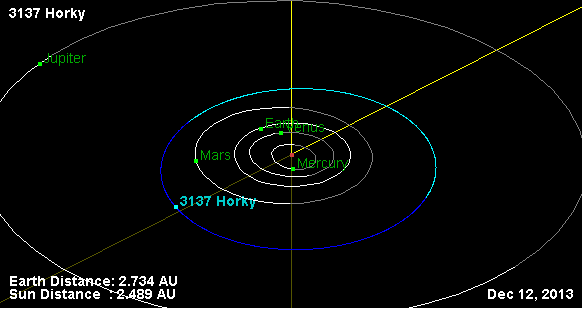
Background asteroid in asteroid belt
| Field | Value |
|---|---|
| minorplanet | yes |
| name | 3137 Horky |
| background | #D6D6D6 |
| discovery_ref | |
| discoverer | A. Mrkos |
| discovery_site | Kleť Obs. |
| discovered | 16 September 1982 |
| mpc_name | (3137) Horky |
| alt_names | |
| 1976 AC | |
| named_after | Horky |
| (Czech hill and village) | |
| mp_category | main-belt(inner) |
| background | |
| orbit_ref | |
| epoch | 23 March 2018 (JD 2458200.5) |
| uncertainty | 0 |
| observation_arc | 68.17 yr (24,900 d) |
| aphelion | 2.8571 AU |
| perihelion | 1.9482 AU |
| semimajor | 2.4026 AU |
| eccentricity | 0.1892 |
| period | 3.72 yr (1,360 d) |
| mean_anomaly | 143.98° |
| mean_motion | / day |
| inclination | 2.4738° |
| asc_node | 286.63° |
| arg_peri | 135.50° |
| mean_diameter | |
| albedo | |
| spectral_type | SMASS C |
| abs_magnitude | 13.3 |
1976 AC (Czech hill and village) background
3137 Horky, provisional designation , is a background asteroid from the inner regions of the asteroid belt, approximately 7 km in diameter. It was discovered on 16 September 1982, by Czech astronomer Antonín Mrkos at the Kleť Observatory in the Czech Republic. The likely stony asteroid was named for a hill near the Czech village of Horky.
Orbit and classification
Horky is a non-family asteroid from the main belt's background population. It orbits the Sun in the inner asteroid belt at a distance of 1.9–2.9 AU once every 3 years and 9 months (1,360 days; semi-major axis of 2.4 AU). Its orbit has an eccentricity of 0.19 and an inclination of 2° with respect to the ecliptic.
The body's observation arc begins with a precovery taken at Palomar Observatory in November 1949, almost 33 years prior to its official discovery observation at Klet.
Close approaches
On 1 May 2019, Horky will pass 15 Eunomia at a distance of 0.0096 AU. It is also projected to make close approaches to 29 Amphitrite, 7 Iris and 10 Hygiea.
Physical characteristics
In the SMASS classification, Horky is a carbonaceous C-type asteroid. However, based on the obtained albedo by the Wide-field Infrared Survey Explorer (WISE), it is rather a stony S-type (see below). As of 2018, no rotational lightcurve of this asteroid has been obtained from photometric observations. The body's rotation period, pole and shape remain unknown.
Diameter and albedo
According to the survey carried out by the NEOWISE mission of NASA's WISE telescope, Horky measures 6.685 kilometers in diameter and its surface has an albedo of 0.207, which indicates that is likely of a stony rather than carbonaceous composition. It has an absolute magnitude of 13.3.
Naming
This minor planet was named after a hill and its nearby village Horky in the Czech Republic, where the discoverer installed his first telescope in 1939. The official naming citation was published by the Minor Planet Center on 29 November 1993 (M.P.C. 22828).
References
This article was imported from Wikipedia and is available under the Creative Commons Attribution-ShareAlike 4.0 License. Content has been adapted to SurfDoc format. Original contributors can be found on the article history page.
Ask Mako anything about 3137 Horky — get instant answers, deeper analysis, and related topics.
Research with MakoFree with your Surf account
Create a free account to save articles, ask Mako questions, and organize your research.
Sign up freeThis content may have been generated or modified by AI. CloudSurf Software LLC is not responsible for the accuracy, completeness, or reliability of AI-generated content. Always verify important information from primary sources.
Report