From Surf Wiki (app.surf) — the open knowledge base
3-Deoxyanthocyanidin
Class of chemical compounds
Class of chemical compounds

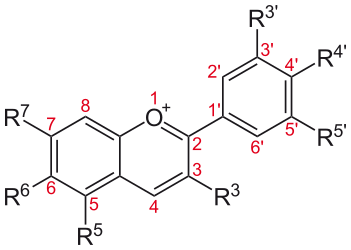
The 3-Deoxyanthocyanidins and their glycosides (3-deoxyanthocyanins or 3-DA) are molecules with an anthocyanidins backbone lacking an hydroxyl group at position 3 on the C-ring. This nomenclature is the inverse of that which is commonly used in flavonoids, where the hydroxy-group is assumed absent if it is not specified, e. g. flavan-3-ol, flavan-4-ol, flavan-3,4-ol and flavonol.
3-Deoxyanthocyanidins are yellow anthocyanidins that can be found primarily in ferns and mosses (Timberlake and Bridle, 1975, 1980), in Sorghum bicolor and in purple corn (Nakatani et al., 1979) (maíz morado).
3-Deoxyanthocyanidins are reported to be stable to color loss due to change in pH. Synthetic 3-deoxyanthocyanidins with a carboxylate group at carbon 4 show unusually stable colorant properties at pH 7.
In Sorghum, the SbF3'H2 gene, encoding a flavonoid 3'-hydroxylase, seems to be expressed in pathogen-specific 3-deoxyanthocyanidin phytoalexins synthesis, for example in Sorghum-Colletotrichum interactions.
This category include:
- Apigeninidin
- Columnidin
- Diosmetinidin
- Luteolinidin
- Tricetinidin
References
References
- (May 1, 1983). "Effect of substitution on the stability of 3-deoxyanthocyanidins in aqueous solutions". Journal of Agricultural and Food Chemistry.
- "Inclusions of flavonoid 3-deoxyanthocyanidins in Sorghum bicolor self-organize into spherical structures". Physiological and Molecular Plant Pathology.
- Awika, Joseph M.. (January 1, 2008). "Behavior of 3-deoxyanthocyanidins in the presence of phenolic copigments". Food Research International.
- (October 1, 2006). "Differential Expression of Two Flavonoid 3′-Hydroxylase cDNAs Involved in Biosynthesis of Anthocyanin Pigments and 3-Deoxyanthocyanidin Phytoalexins in Sorghum". Plant and Cell Physiology.
- "Biosynthesis and regulation of 3-deoxyanthocyanidin phytoalexins induced during Sorghum-Colletotrichum interaction: Heterologous expression in maize. Chopra, Surinder Gaffoor, Iffa Ibraheem, Farag". aspb.org.
This article was imported from Wikipedia and is available under the Creative Commons Attribution-ShareAlike 4.0 License. Content has been adapted to SurfDoc format. Original contributors can be found on the article history page.
Ask Mako anything about 3-Deoxyanthocyanidin — get instant answers, deeper analysis, and related topics.
Research with MakoFree with your Surf account
Create a free account to save articles, ask Mako questions, and organize your research.
Sign up freeThis content may have been generated or modified by AI. CloudSurf Software LLC is not responsible for the accuracy, completeness, or reliability of AI-generated content. Always verify important information from primary sources.
Report