From Surf Wiki (app.surf) — the open knowledge base
2nd (Sialkot) Cavalry Brigade
| Field | Value |
|---|---|
| unit_name | Sialkot Cavalry Brigade |
| 2nd (Sialkot) Cavalry Brigade | |
| 2nd Indian Cavalry Brigade | |
| Sialkot Brigade Area | |
| dates | 12 April 1904 – March 1918 |
| June 1920 – January 1940 | |
| country | British India |
| allegiance | British Crown |
| branch | |
| type | Cavalry |
| size | Brigade |
| command_structure | 2nd (Rawalpindi) Division |
| 1st Indian Cavalry Division | |
| garrison | Sialkot |
| garrison_label | Peacetime HQ |
| battles | First World War |
| notable_commanders | Br.-Gen. B.T. Mahon |
2nd (Sialkot) Cavalry Brigade 2nd Indian Cavalry Brigade Sialkot Brigade Area June 1920 – January 1940 1st Indian Cavalry Division :Western Front
The Sialkot Cavalry Brigade was a cavalry brigade of the British Indian Army formed in 1904 as a result of the Kitchener Reforms. It was mobilized as 2nd (Sialkot) Cavalry Brigade at the outbreak of the First World War as part of the 1st Indian Cavalry Division and departed for France. It served on the Western Front with the division until it was broken up in March 1918.
The brigade was reformed in June 1920 and broken up in January 1940.
History
The Kitchener Reforms, carried out during Lord Kitchener's tenure as Commander-in-Chief, India (1902–09), completed the unification of the three former Presidency armies, the Punjab Frontier Force, the Hyderabad Contingent and other local forces into one Indian Army. Kitchener identified the Indian Army's main task as the defence of the North-West Frontier against foreign aggression (particularly Russian expansion into Afghanistan) with internal security relegated to a secondary role. The Army was organized into divisions and brigades that would act as field formations but also included internal security troops.
The Sialkot Brigade (also referred to as Sialkote Brigade) was formed in April 1904 as a result of the Kitchener Reforms. The brigade formed part of the 2nd (Rawalpindi) Division.
;2nd (Sialkot) Cavalry Brigade
In September 1914, the brigade was mobilized as the 2nd (Sialkot) Cavalry Brigade and assigned to the 1st Indian Cavalry Division. With the division, it departed Bombay on 16 October 1914 and landed at Marseille on 7 November. However, the brigade did not reach the Front until 8–10 December due to horse sickness. While in France, the brigade was known by its geographical rather than numerical designation so as to avoid confusion with the British 2nd Cavalry Brigade also serving on the Western Front at the same time.
Other than the Battle of Cambrai when it helped to hold the German counter-attack, it was not involved in battle. Instead, it was held in reserve in case of a breakthrough, although it did send parties to the trenches on a number of occasions. They would hold the line, or act as Pioneers; such parties were designated as the Sialkot Battalion.
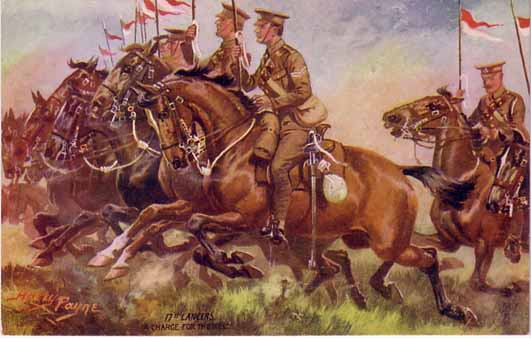
;Dissolved In March 1918, the brigade was broken up in France. The British units (17th (Duke of Cambridge's Own) Lancers and Q Battery, Royal Horse Artillery) remained in France and the Indian elements were sent to Egypt. On 22 July 1918 the 22nd Mounted Brigade was redesignated as 12th Cavalry Brigade and the division as 4th Cavalry Division.
;Reformed The Sialkot Cavalry Brigade was reformed in June 1920. In September 1920 it was designated as the 2nd Indian Cavalry Brigade and renamed as 2nd (Sialkot) Cavalry Brigade in 1927. By the outbreak of the Second World War it was resdesignated as Sialkot Brigade Area and it was broken up again in January 1940.
Orders of battle
| In India in August 1914 | ||
|---|---|---|
| Perry | 1993 | p=42}} |
| Western Front | ||
|---|---|---|
| Perry | 1993 | p=14}} |
| Sialkot Brigade Area on 3 September 1939 |
|---|
| At the outbreak of the Second World War, the brigade area had the following units under command: |
Commanders
The Sialkot Cavalry Brigade / 2nd (Sialkot) Cavalry Brigade had the following commanders:
| From | Rank | Name | Notes |
|---|---|---|---|
| 12 April 1904 | Brigadier-General | B.T. Mahon | |
| April 1908 | Major-General | A. Phayre | |
| 1 June 1911 | Brigadier-General | H.P. Leader | |
| 6 January 1916 | Brigadier-General | L.L. Maxwell | Broken up in March 1918 |
| June 1920 | Brigadier-General | C.H. Rankin | Brigade re-formed |
| June 1924 | Brigadier-General | C.R. Harbord | |
| June 1928 | Brigadier | C.R. Terrot | |
| June 1932 | Brigadier | T.A.A. Wilson | |
| August 1934 | Brigadier | F. Gwatkin | |
| August 1938 | Brigadier | T.W. Corbett | Broken up in January 1940 |
Notes
References
Bibliography
- {{cite book
- {{cite book
- {{cite book
- {{cite book
- {{cite web |access-date=1 July 2015 |url-status=dead |archive-url=https://web.archive.org/web/20150705211343/http://www.gulabin.com/armynavy/pdf/Army%20Commands%201900-2011.pdf |archive-date=5 July 2015
- {{cite web | access-date = 9 July 2015
- {{cite book
- {{cite book
References
- {{harvnb. Haythornthwaite. 1996
- The late Lieutenant General H.G. Hart. "Hart's Annual Army List for 1906". John Murray.
- "The Indian Army 1914 by Dr. Graham Watson on orbat.com".
- {{harvnb. Perry. 1993
- {{harvnb. Perry. 1993
- Becke. 1936
- {{harvnb. Perry. 1993
- {{harvnb. Mackie. 2015
- {{harvnb. Nafziger. n.d.
- {{London Gazette. (9 June 1938)
- Perry. 1993
- {{harvnb. Perry. 1993
- "Battle of Ypres". Commonwealth War Graves Commission.
- Baker, Chris. "Cavalry units of the Machine Gun Corps". The Long Long Trail.
- {{harvnb. Gaylor. 1996
- {{harvnb. Gaylor. 1996
- {{harvnb. Gaylor. 1996
- {{harvnb. Gaylor. 1996
- Perry. 1993
This article was imported from Wikipedia and is available under the Creative Commons Attribution-ShareAlike 4.0 License. Content has been adapted to SurfDoc format. Original contributors can be found on the article history page.
Ask Mako anything about 2nd (Sialkot) Cavalry Brigade — get instant answers, deeper analysis, and related topics.
Research with MakoFree with your Surf account
Create a free account to save articles, ask Mako questions, and organize your research.
Sign up freeThis content may have been generated or modified by AI. CloudSurf Software LLC is not responsible for the accuracy, completeness, or reliability of AI-generated content. Always verify important information from primary sources.
Report